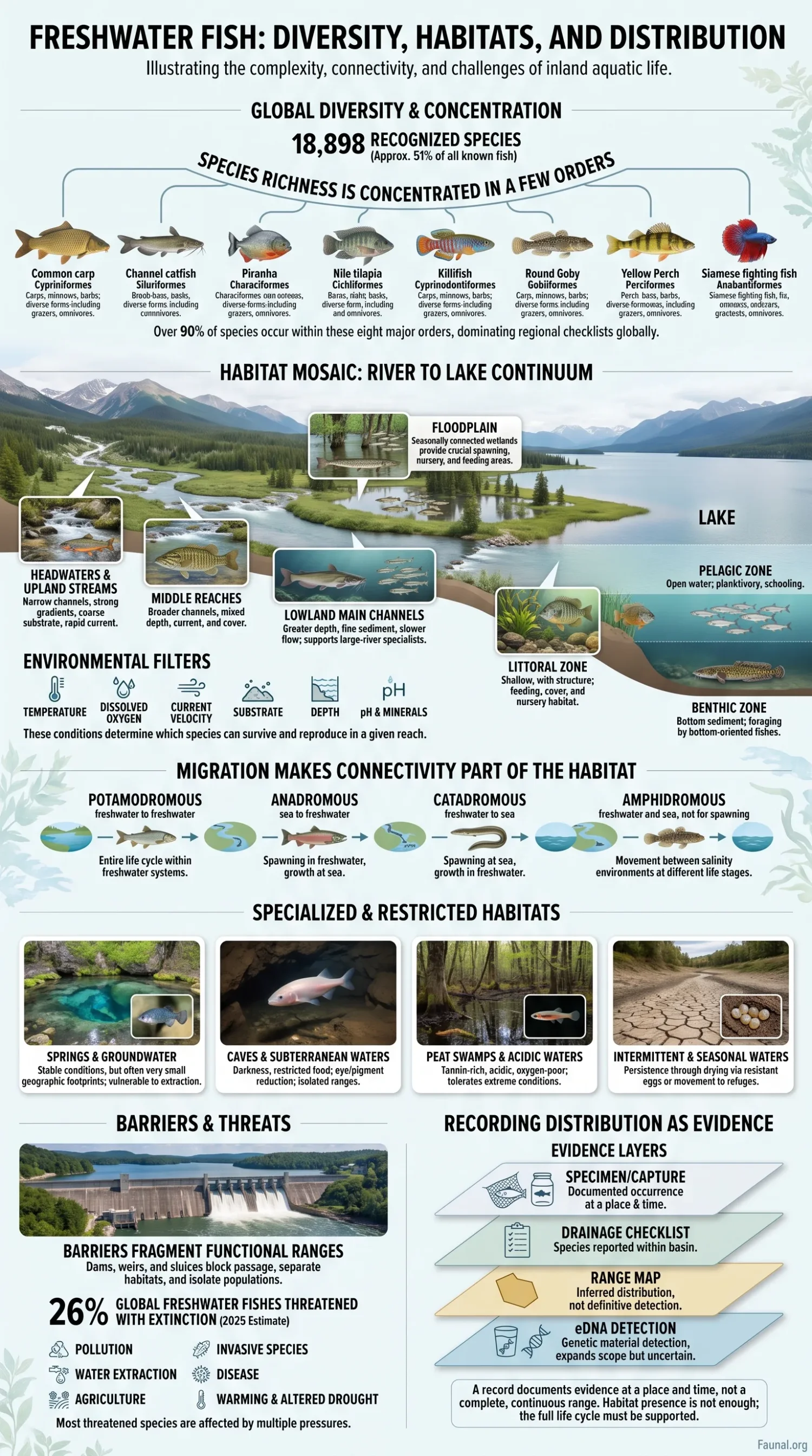
Freshwater fishes include species that spend all or a biologically necessary part of their life cycle in inland fresh or brackish waters. The IUCN/SSC Freshwater Fish Specialist Group currently reports 18,898 recognized freshwater fishes, about 51% of known fish species. Their diversity is distributed unevenly among river networks, lakes, floodplains, springs, caves and other inland waters, with drainage connections, isolation, water chemistry, flow and geological history helping determine which species occur together. IUCN/SSC Freshwater Fish Specialist Group
Recognized freshwater fishes
18,898
Current figure reported by the IUCN/SSC Freshwater Fish Specialist Group.
Freshwater ecoregions
426
Units in Freshwater Ecoregions of the World, delineated largely from freshwater biota and processes.
Estimated threatened share
26%
Best estimate for freshwater fishes in the global IUCN-led assessment published in 2025.
Freshwater Fish Is a Life-Cycle Category, Not One Branch of the Fish Tree
Freshwater fishes do not form a single evolutionary lineage. Carps, catfishes, cichlids, characins, gobies, killifishes, lampreys, sturgeons and many other groups entered or diversified in inland waters through different evolutionary histories. The ecological category is therefore defined mainly by use of freshwater during the life cycle, not by descent from one freshwater ancestor.
The boundary also extends beyond fishes that remain in a river or lake throughout life. The IUCN/SSC Freshwater Fish Specialist Group includes salt-intolerant freshwater residents, salt-tolerant species that depend on inland waters, some estuarine fishes, fishes of soda and salt lakes, and species that require freshwater during a necessary life stage. Occasional marine visitors entering a river do not automatically become freshwater fishes under this definition. IUCN/SSC freshwater-fish definition
Migration Changes Which Waters Belong to a Fish’s Functional Habitat
| Migration pattern | Movement | Biological meaning | Distribution consequence |
|---|---|---|---|
| Potamodromous | Migration remains within freshwater | Fish move between different parts of a river, lake or connected inland-water system | Longitudinal and lateral river connectivity can be part of the usable range |
| Anadromous | Sea to freshwater for reproduction | Much of growth occurs at sea, followed by a freshwater spawning migration | Marine habitat, estuary, migration corridor and spawning river are linked parts of one life cycle |
| Catadromous | Freshwater to sea for reproduction | Much of life is spent in inland waters before migration to the sea to breed | Loss of passage between river and ocean can break the life cycle even where inland habitat remains |
| Amphidromous | Movement between fresh and marine waters, but not as a direct spawning migration | Different developmental stages use different salinity environments | Short coastal rivers and estuarine connections may be necessary even for fishes strongly associated with freshwater |
These terms describe movement patterns rather than taxonomic groups. FAO fisheries terminology distinguishes diadromous fishes that move between sea and freshwater from potamodromous fishes whose migrations remain entirely within fresh water. FAO fish migration terminology
Why Global Freshwater Fish Totals Do Not Always Match
A freshwater-fish total is meaningful only with its classification rule and date. The IUCN/SSC specialist group currently gives 18,898 recognized freshwater fishes. FishBase uses a different reporting structure: its June 2026 summary contains 36,761 fish species and places 17,817 in its Freshwater category, 18,155 in Marine and 788 in Diadromous. FishBase states that its Freshwater category includes freshwater-only and freshwater–brackish fishes, while diadromous species are separated. FishBase June 2026 summary
Species Counts Depend on Life-Cycle Scope
A lower or higher freshwater-fish total is not automatically a taxonomic disagreement. One database may separate diadromous fishes while another includes fishes that require freshwater for a critical life stage within its freshwater definition. Publication date, newly described species, synonymy and taxonomic revision can also change totals.
FishBase Habitat-Use Categories, June 2026
FishBase partitions its 36,761 listed fish species into Freshwater, Marine and Diadromous categories in this summary.
FishBase, June 2026 habitat-use summary. Freshwater contains freshwater-only and freshwater–brackish fishes; diadromous fishes are tracked separately.
Most Freshwater Fish Species Belong to a Small Set of Species-Rich Orders
Freshwater fishes span many branches of fish evolution, yet species richness is highly concentrated. The IUCN/SSC Freshwater Fish Specialist Group reports that almost 90% of freshwater fish species occur within eight orders. This concentration helps explain why minnows, catfishes, characins, cichlids, killifishes and gobies repeatedly dominate regional freshwater checklists even though the exact mix changes greatly between drainage systems. IUCN/SSC freshwater-fish diversity
| Order | Representative freshwater forms | Ecological breadth |
|---|---|---|
| Cypriniformes | Carps, minnows, barbs and loaches | Includes schooling water-column fishes, benthic forms, grazers, omnivores and species specialized for flowing streams |
| Siluriformes | Catfishes | Ranges from small benthic species to large river predators, with many lineages adapted to turbid or structurally complex habitats |
| Characiformes | Characins and tetras | Contains small schooling fishes, insectivores, herbivores and predators, especially prominent in tropical African and South American waters |
| Cichliformes | Cichlids | Includes algae grazers, mollusc feeders, piscivores and many forms with parental care; lake radiations can produce many closely related species |
| Cyprinodontiformes | Toothcarps and killifishes | Includes species of permanent waters as well as lineages adapted to small, isolated or strongly seasonal habitats |
| Gobiiformes | Gobies and relatives | Includes benthic fishes of streams, estuaries and island waters, with several lineages using both freshwater and marine stages |
| Perciformes | Perch-like fishes | Contains freshwater predators and generalists alongside many marine lineages |
| Anabantiformes | Bettas, gouramis and relatives | Includes fishes adapted to tropical standing and slow-flowing waters, including low-oxygen environments in some lineages |
Higher fish classification continues to change as phylogenetic evidence and taxonomic treatments are revised. These orders are therefore most useful here as an orientation to the concentration of freshwater species, not as a permanent substitute for a current taxonomic register.
A River Contains a Sequence of Fish Habitats Rather Than One Uniform Environment
A species recorded from a river basin may occupy only a narrow part of that river network. Elevation, current velocity, channel width, substrate, temperature, depth, oxygen, vegetation and floodplain access change from headwaters to lowlands. The resulting habitat mosaic allows different fish assemblages to occupy reaches that are geographically connected but ecologically unlike one another.
| River setting | Common physical conditions | Fish-habitat implications |
|---|---|---|
| Headwaters and upland streams | Narrow channels, strong gradients, coarse substrate, riffles, locally cool water and rapid current | Favors fishes able to hold position in flow, use interstitial spaces, feed on benthic resources or reproduce on coarse substrate |
| Middle river reaches | Broader channels, alternating pools and riffles, tributary junctions and mixed substrate | Creates more combinations of depth, current and cover, allowing flowing-water specialists and generalists to coexist |
| Lowland main channels | Greater depth and width, fine sediments, side channels, backwaters and slower marginal habitats | Supports large-river specialists, pelagic fishes, benthic fishes and species that move between the channel and floodplain |
| Floodplain waters | Seasonally connected wetlands, oxbows, shallow channels and inundated vegetation | Can provide spawning, nursery, feeding and refuge habitat that is absent from the permanent main channel |
Floodplain habitat is especially dependent on timing. A flood that reconnects a river with side channels and inundated land can temporarily expand available feeding and nursery space. When water recedes, fishes may return to permanent channels, remain in floodplain lakes or become isolated until the next hydrological connection. Research on restored alluvial floodplains has documented complementary use of main channels and floodplain channels, including nursery and refuge functions. Science of the Total Environment floodplain study
Lakes Divide Fish Communities by Shoreline, Open Water and Depth
A lake is also a set of habitats. Shallow littoral zones can contain rooted plants, rock, woody material and warm nursery areas. Open pelagic water favors fishes able to forage or school away from structure. Benthic habitats concentrate organisms associated with sediment and the lake floor, while deep waters can impose low light, thermal stratification and seasonal oxygen constraints.
| Lake zone | Physical setting | Fish use |
|---|---|---|
| Littoral | Shallow shoreline with plants, rock, wood or other structure | Feeding, cover, nesting and juvenile habitat for many species |
| Pelagic | Open water away from shore and bottom | Planktivory, schooling, open-water predation and vertical movement |
| Benthic | Bottom sediment, rock and associated invertebrate habitat | Foraging by bottom-oriented fishes, shelter and specialized feeding |
| Deep water | Low light and, in stratified lakes, separation from warmer surface layers | Can support cold-water or deep-water specialists where oxygen remains adequate |
Long-lived lakes can also become evolutionary islands. When populations remain isolated while using different depths, shore types, foods or breeding areas, ecological divergence can accumulate within one lake system. African Great Lakes provide well-known examples of cichlid diversification, where closely related species differ in feeding structures, habitat use, behavior and reproductive traits.
Small Springs, Caves and Seasonal Waters Can Hold Disproportionately Restricted Faunas
Large rivers contain many species, but geographic range size and conservation exposure are not determined by waterbody size alone. A spring, isolated desert pool, karst stream or cave system may support only a small number of fish species while containing lineages found nowhere outside that drainage or groundwater system.
Springs and Groundwater Outlets
Spring-fed habitats can maintain relatively stable temperature and chemistry but may have very small geographic footprints. Where a species is confined to one spring complex, groundwater extraction, spring modification or contamination can affect a large share of its known habitat without altering a large area on a map.
Caves and Subterranean Waters
Subterranean fishes live under persistent darkness, restricted food input and unusual hydrological conditions. Eye and pigment reduction occur in several unrelated cave-fish lineages, while nonvisual sensory systems can become more important. The isolation of separate aquifers and cave passages can produce very small ranges that are poorly represented by ordinary surface-water maps.
Peat Swamps, Blackwater and Acidic Waters
Some tropical freshwater fishes tolerate highly acidic, tannin-rich and oxygen-poor waters that exclude many other species. The IUCN/SSC Freshwater Fish Specialist Group cites the minute Paedocypris progenetica from Indonesian peat swamps as an example of the biological extremes contained within freshwater fish diversity. IUCN/SSC freshwater-fish examples
Intermittent and Seasonal Waters
Temporary streams and seasonal pools impose a different filter: persistence through drying. Some fishes move to permanent refuge reaches as water contracts, while annual killifish lineages can persist through dry periods via resistant eggs in the substrate. Hydrological timing therefore determines whether apparently suitable habitat is actually available through the full reproductive cycle.
Temperature, Oxygen, Flow and Substrate Filter Fish Within the Same Basin
A connected river does not offer equal habitat to every fish along its length. Physical and chemical conditions determine whether a species can feed, grow, reproduce and survive at a particular reach. Temperature also interacts with oxygen: cold water can hold more dissolved oxygen than warm water, while respiration, decomposition, photosynthesis and water movement alter oxygen concentrations through time. U.S. Geological Survey dissolved-oxygen reference
| Environmental filter | What changes for fish | Distribution effect |
|---|---|---|
| Water temperature | Metabolic rate, growth, development, spawning timing and oxygen demand | Separates cold-water, warm-water and temperature-tolerant assemblages across latitude, elevation and season |
| Dissolved oxygen | Aerobic respiration and the amount of habitat usable without physiological stress | Can exclude oxygen-sensitive fishes from warm, stagnant, eutrophic or poorly mixed waters |
| Current velocity | Swimming cost, station holding and delivery of food | Separates fast-water specialists from fishes favoring pools, margins, backwaters or standing water |
| Substrate | Spawning surfaces, benthic prey, shelter and egg survival | Rock, gravel, sand, silt and vegetation support different reproductive and feeding strategies |
| Depth and channel form | Light, cover, current, predator exposure and thermal conditions | Creates distinct shallow-margin, pool, open-water and deep-channel assemblages |
| pH and dissolved minerals | Ion regulation and physiological tolerance | Strongly acidic, alkaline or mineral-rich waters can support specialized communities |
| Seasonal water level | Access to spawning, nursery, refuge and feeding habitat | Changes the usable range without changing the permanent outline of the drainage basin |
| Hydrological connectivity | Dispersal, migration, recolonization and gene flow | Determines whether suitable habitat patches function as one network or as isolated fragments |
Habitat presence is not enough: a waterbody may support adult survival but still be unsuitable for spawning, egg development, juvenile growth or seasonal refuge. Distribution depends on the life cycle, not only on where adult fish can be captured.
Native Freshwater Fish Distribution Follows Drainage History More Closely Than Political Borders
For strictly freshwater fishes, a watershed divide can be a stronger biogeographic boundary than a national border. Two tributaries on opposite sides of a ridge may be only a short distance apart on land but drain toward different rivers and contain fish assemblages with separate evolutionary histories. A large river basin, meanwhile, can cross several countries while remaining part of one connected aquatic network.
Freshwater Ecoregions of the World formalizes this difference at global scale. FEOW contains 426 freshwater ecoregions. Their boundaries generally, though not always, correspond to watersheds, and the delineation was driven by freshwater species—primarily fishes—and freshwater ecological and evolutionary processes rather than by terrestrial vegetation or political geography. Freshwater Ecoregions of the World
A Basin Boundary Can Separate Nearby Fish Faunas
A freshwater ecoregion or drainage basin describes biological and hydrological organization at a scale that a country label cannot. Species can still turn over within one ecoregion as elevation, stream order, barriers and local habitat change.
Watershed Divides Limit Ordinary Dispersal
Most strictly freshwater fishes cannot move across dry land or survive a marine route between unrelated river mouths. Once populations occupy different drainages, the land between those drainages can maintain separation over long periods. Isolation can allow genetic divergence and, eventually, speciation.
Waterfalls and Rapids Create Unequal Barriers
A waterfall need not block every fish equally. Swimming ability, body size, climbing behavior and flow conditions determine whether a barrier separates populations. The same cascade can therefore divide one species while remaining passable to another.
River Capture Can Move Faunas Between Drainages
Drainage networks are not permanently fixed. Erosion and tectonic change can divert the headwaters of one river into another basin, a process known as river capture. Fishes transferred with the captured drainage may then colonize a basin that was previously isolated, leaving a biological pattern that cannot be explained from the present map alone.
Former Basin Connections Leave Modern Distribution Patterns
Sea-level change, glaciation, lake expansion and past drainage connections can temporarily unite waters that are isolated today. Global work on freshwater-fish range size has found strong roles for present drainage position and historical connectivity, including connections created during lower Quaternary sea levels. This helps explain why present-day range boundaries cannot always be inferred from modern river geometry alone. Global freshwater-fish range-size study
Species Richness and Endemism Describe Different Distribution Patterns
A drainage with many fish species is not necessarily the drainage with the greatest proportion of species found nowhere else. Species richness counts how many species occur within a defined unit. Endemism measures restriction: an endemic species has a natural range confined to the stated geographic unit.
Global freshwater analyses repeatedly place major centers of fish richness and restricted-range diversity in tropical and subtropical drainages, especially parts of South America, Africa and Southeast Asia. The exact ranking depends on spatial unit, taxonomic treatment and whether introduced species are excluded. Journal of Animal Ecology global freshwater diversity analysis
| Distribution pattern | What produces it | Typical freshwater expression |
|---|---|---|
| Very high species richness | Large habitat area, warm climate, long evolutionary history, habitat heterogeneity and connected tributary networks | Species-rich tropical river systems with many ecological niches |
| High endemism in a large basin | Long isolation combined with internal diversification | Many species confined to one drainage or regional network despite a large total basin area |
| High endemism in a small system | Spring, cave, lake or closed basin isolation | Few total species but one or more extremely restricted lineages |
| Low native distinctiveness after introductions | Human movement of fishes between naturally isolated basins | Previously different faunas become more similar in taxonomic composition |
Human introductions can weaken natural biogeographic separation. A global analysis of freshwater-fish regions found that introductions and extirpations have altered endemism patterns within drainage basins, with introduced fishes contributing to greater similarity among faunas that evolved separately. Global analysis of human-altered freshwater-fish biogeography
Migration Makes Connectivity Part of the Habitat
For a resident fish with a very small home range, one stream reach may contain most resources needed during its life. A migratory fish can require spawning habitat, juvenile habitat, feeding areas, refuge reaches and the corridors connecting them. The effective habitat is therefore a network rather than a single patch of water.
Potamodromous fishes demonstrate why freshwater connectivity cannot be reduced to access between river and sea. Their entire migration occurs inland. A dam or sluice located between feeding and spawning areas can divide the life cycle even though both sides of the barrier remain freshwater habitat.
Diadromous fishes add another spatial layer. Anadromous species must pass from the sea through estuaries and rivers to spawning grounds. Catadromous species require the opposite connection for reproduction. Amphidromous life cycles can involve marine dispersal of early stages followed by freshwater recruitment. A map showing only adult captures in one habitat can therefore omit part of the habitat network needed to maintain the population.
River Barriers Can Shrink Functional Range Before a Species Vanishes From a Basin
A fish species does not need to disappear from an entire drainage for fragmentation to alter its distribution. Barriers can reduce the length of connected habitat, separate spawning and feeding reaches, isolate subpopulations and prevent recolonization after a local loss.
Mekong Fish Connectivity Under Anthropogenic Barriers
A 2025 analysis modeled barrier effects for 952 Mekong Basin fish species. Of those species, 881, or 92.5%, showed reduced population connectivity relative to a modeled barrier-free condition. Potamodromous fishes had the highest reported median fragmentation index among the migration categories compared in the study, linking freshwater-only migration with strong exposure to barriers within the river network.
The same study found that small dams and sluice gates collectively contributed strongly to modeled fragmentation, showing why barrier effects cannot be assessed only by counting the largest dams. Barrier density, position and passability determine which connections are lost. Communications Earth & Environment Mekong fragmentation study
Freshwater Fish Extinction Risk Is High, but Global and Regional Percentages Have Different Scopes
The IUCN-led global freshwater assessment published in 2025 covered fishes together with freshwater decapod crustaceans and odonates. For fishes alone, its best estimate placed 26% of freshwater species at high risk of extinction. Eighteen percent of the assessed freshwater fishes were Data Deficient, so uncertainty remains substantial even after the large assessment effort. Nature global freshwater fauna assessment
The study identified pollution, dams and water extraction, agriculture, invasive species and disease among the major pressures across the assessed freshwater groups. Most threatened freshwater species in the multi-taxon analysis were affected by more than one pressure, so degradation cannot always be assigned to a single cause.
Europe’s 2026 Assessment Shows a Higher Regional Threat Level
The updated European Red List released in April 2026 assessed all 558 native European freshwater fish species. It classified 42% as threatened with extinction and another 18% as Near Threatened. These figures describe the European assessment and should not be substituted for the global 26% estimate. IUCN European Red List of Freshwater Fishes
The European assessment also reported that about 39% of migratory freshwater fishes were declining, compared with about 14% of non-migratory species. Karst systems showed especially severe exposure: more than 90% of resident fish species in that habitat were reported as threatened. Springs and intermittent rivers were also prominent among habitats supporting threatened species.
The 26% and 42% Figures Measure Different Geographic Scopes
The 26% figure is the best global estimate from the 2025 assessment of freshwater fishes. The 42% figure comes from the 2026 assessment of native European freshwater fishes. Regional species composition, endemism, threat exposure, assessment coverage and Red List history differ, so the two values should retain their stated scopes.
Habitat Protection Must Preserve Hydrology as Well as Water Area
Protecting the outline of a river, wetland or lake does not necessarily protect the processes that make it usable for fish. Flow timing controls access to floodplains and spawning reaches. Groundwater levels maintain springs. Sediment movement renews channel and spawning substrates. Longitudinal connection permits migration, while lateral connection joins main channels to wetlands and backwaters.
| Pressure | Change to fish habitat | Distribution response that may follow |
|---|---|---|
| Dams, weirs and sluices | Block or reduce passage and alter flow, sediment and channel conditions | Range fragmentation, blocked migration and isolation of subpopulations |
| Water abstraction | Reduces discharge, wetted area, spring flow or seasonal connection | Contraction into remaining refuges and loss of intermittent connections |
| Pollution and eutrophication | Changes toxicity, nutrients, algal growth and oxygen conditions | Loss of sensitive species from otherwise connected waterbodies |
| Channel modification | Simplifies depth, substrate, bank structure and floodplain connection | Reduction of spawning, nursery and refuge habitats within the occupied basin |
| Introduced fishes | Add predation, competition, hybridization or disease pathways | Native assemblages can contract while faunas of separate basins become more alike |
| Warming and altered drought | Changes thermal habitat, oxygen availability and hydroperiod | Cold-water and seasonal-water ranges can shift, contract or become disconnected |
Conservation planning for freshwater fishes therefore operates at several spatial scales at once: the microhabitat needed for feeding or spawning, the reach containing suitable physical conditions, the network connecting life stages, and the basin or ecoregion containing the native species pool.
A Fish Record Documents Evidence at a Place and Time, Not a Complete Range
Freshwater fish distribution data are often organized by drainage basin because rivers and watersheds provide biologically meaningful spatial units. A widely used global database published in Scientific Data assembled records for 14,953 fish species across 3,119 drainage basins covering more than 80% of Earth’s surface. Its records incorporated native and non-native status and taxonomic validation, but the authors also reported geographic gaps, including parts of Southeast Asia, Indonesian islands, coastal Peru and northeastern Brazil. Global drainage-basin freshwater-fish database
The database also retained an occurrence-status field that could mark records as valid or questionable after review. This is an important distinction for freshwater biogeography: a point, specimen, literature record or database entry can support reported presence, but it does not establish that the species occupies every connected reach within the basin.
| Evidence type | What it can support | What it cannot establish by itself |
|---|---|---|
| Verified specimen or capture | Documented occurrence at a sampled place and time | Continuous occupation of the surrounding basin or present abundance elsewhere |
| Drainage-basin checklist | Species reported within the stated basin and source scope | Presence in every tributary, habitat or elevation zone |
| Range map | Mapped interpretation of known or inferred distribution under the map’s stated method | Detection at every point contained inside the polygon |
| eDNA detection | Detection of genetic material associated with a taxon in sampled water | Exact population size or proof that living fish were present at the precise sampling point |
| Telemetry | Movement of tagged individuals through monitored waters | The complete range of untagged populations or species-wide occupancy |
| Survey non-detection | Failure to detect the species with the stated method and effort | Definitive absence from the entire waterbody or basin |
Environmental DNA Expands Detection but Does Not Remove Spatial Uncertainty
Environmental DNA can detect fish genetic material without capturing the animals themselves and is especially useful in turbid, deep or structurally complex waters. A 2025 river comparison reported 211 species detected by eDNA across the Liao River survey, while capture-based methods still detected nine species not recovered by eDNA. The authors also noted that upstream transport, aquaculture inputs, feces, carcasses, contamination and reference-database gaps can produce mismatches between DNA detection and living local populations. Scientific Reports eDNA comparison
Freshwater fish distribution is best represented as layered evidence: taxonomy identifies the organism, habitat describes where it can persist, hydrology determines what it can reach, and records document where it has actually been detected or reported. None of those layers is interchangeable with the others.
Sources and Verification
- IUCN/SSC Freshwater Fish Specialist Group — About Freshwater Fishes — Used for the current recognized freshwater-fish total, the life-cycle definition and the concentration of species within major fish orders.
- FishBase — Number of Fishes, June 2026 — Used for the June 2026 Freshwater, Marine and Diadromous category totals and the scope of the Freshwater category.
- Freshwater Ecoregions of the World — Background — Used for the 426 freshwater ecoregions, watershed relationship and fish-centered basis of freshwater regionalization.
- FAO — Manual of Fisheries Science, Fish Migration Terminology — Used for anadromous, catadromous, amphidromous and potamodromous migration definitions.
- U.S. Geological Survey — Dissolved Oxygen and Water — Used for the relationship among water temperature, dissolved oxygen and aquatic habitat conditions.
- Journal of Animal Ecology — Global Diversity Patterns and Cross-Taxa Convergence in Freshwater Systems — Used for broad global patterns of freshwater species richness and restricted-range diversity.
- Drainage Network Position and Historical Connectivity Explain Global Patterns in Freshwater Fishes’ Range Size — Used for the role of present and historical drainage connectivity in shaping freshwater-fish geographic ranges.
- Major Shifts in Biogeographic Regions of Freshwater Fishes as Evidence of the Anthropocene Epoch — Used for the effects of introductions and extirpations on basin endemism and native biogeographic separation.
- Science of the Total Environment — Spatio-Temporal Dynamics of Habitat Use by Fish in a Restored Alluvial Floodplain — Used for nursery, refuge and complementary main-channel/floodplain habitat functions.
- Nature — One-Quarter of Freshwater Fauna Threatened with Extinction — Used for the 2025 global freshwater assessment, including the 26% best estimate for threatened freshwater fishes and fish Data Deficient coverage.
- IUCN — 2026 European Red List of Freshwater Fishes — Used for the 558-species European assessment, threatened and Near Threatened proportions, migratory-fish trends and karst-habitat findings.
- Communications Earth & Environment — River Fragmentation and Fishes in the Mekong River Basin — Used for the 952-species barrier analysis, reduced-connectivity findings and migration-category fragmentation results.
- Scientific Data — A Global Database on Freshwater Fish Species Occurrence in Drainage Basins — Used for drainage-basin occurrence coverage, taxonomic validation, occurrence-status fields and documented regional data gaps.
- Scientific Reports — Comparison Between eDNA and Traditional Morphological Methods for Fish Diversity Monitoring in Rivers — Used for eDNA detection performance and the limits created by transport, contamination, reference-database gaps and method-specific non-detection.
Dams and Freshwater Fish in Turkey: Habitat Fragmentation Explained
Habitat fragmentation frames the treatment of dams and freshwater fish in Turkey, relating the species account to the...
Endemic Freshwater Fish of Turkey: Basin-Restricted Species
Turkey’s endemic freshwater fish are described through basin-restricted species, keeping the species focus tied to a restricted geographic...
Invasive Freshwater Fish in Turkey: Impacts on Native Species
Invasive freshwater fish in Turkey are organized around impacts on native species, distinguishing introduced status from documented ecological...
3 articles in Freshwater Fish