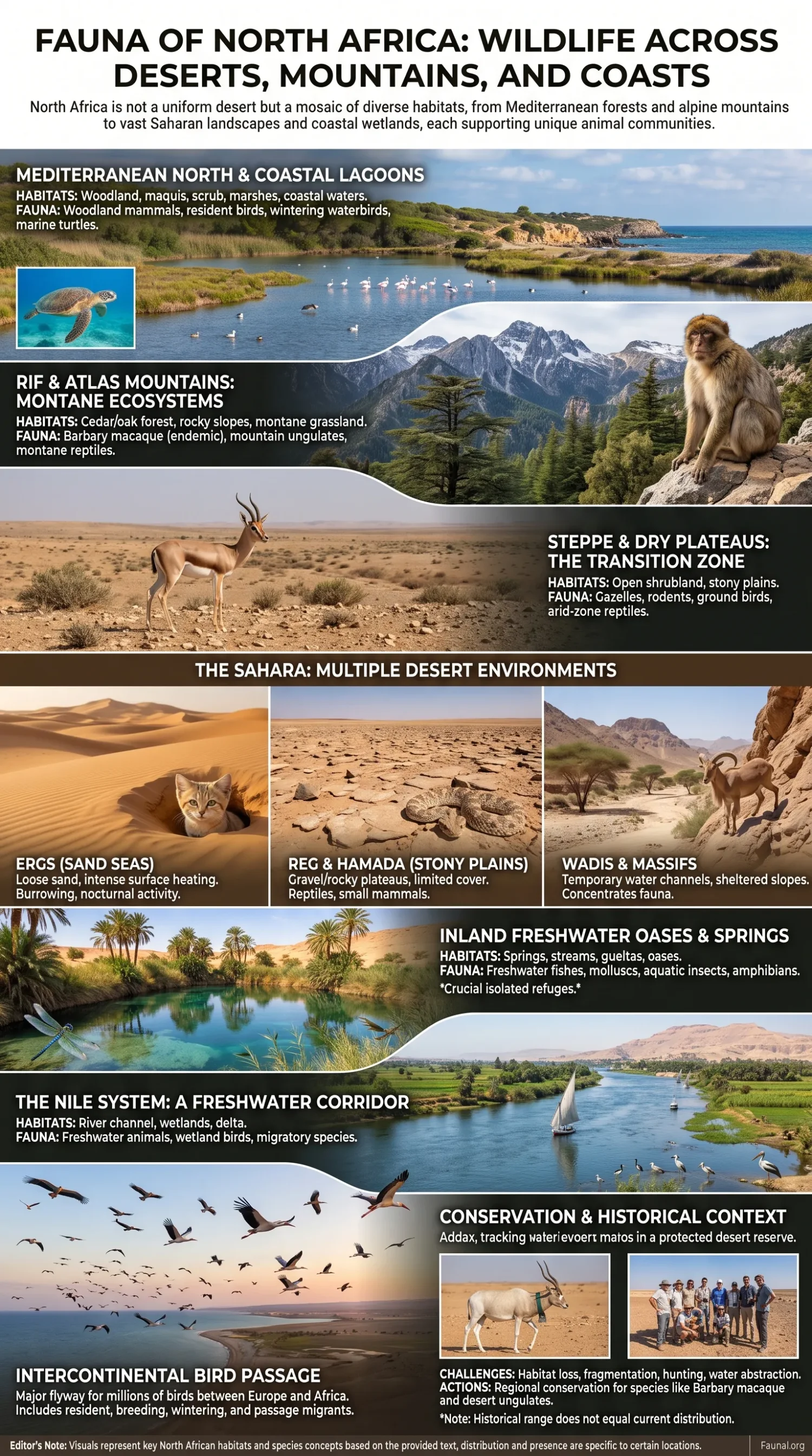
North Africa contains several sharply different faunal systems within a relatively narrow latitudinal belt. Mediterranean forests and scrub in the north, the Rif and Atlas Mountains, semi-arid steppe, the Sahara, isolated springs and wetlands, the Nile system, and Atlantic and Mediterranean coasts support animal communities with very different requirements. A Barbary macaque living in montane forest, a gazelle using dry mountain-steppe, a sand cat occupying arid desert and a migratory waterbird feeding in a coastal lagoon are all part of North African fauna, but they cannot be understood as members of one uniform “desert wildlife” community.
Geographic scope used on this page
North Africa here refers primarily to Morocco, Western Sahara, Algeria, Tunisia, Libya and Egypt. Mauritania, Sudan and adjoining Saharan or Sahelian areas are mentioned only where animal ranges, river systems, migration routes or conservation programmes cross that working boundary. This is an ecological editorial scope rather than a claim that every institution defines North Africa in exactly the same way.
The main faunal divide runs from the Mediterranean to the Sahara
Latitude matters, but it does not explain the region by itself. Elevation, rainfall, permanent water, substrate and isolation can change the fauna over much shorter distances. Northern Morocco and Algeria contain humid forest habitats that have little ecological resemblance to the central Sahara. A mountain stream in the Middle Atlas can support freshwater organisms that cannot cross the dry basins around it, while a saline coastal lagoon may receive birds travelling between Eurasia and Africa.
| Faunal zone | Typical environments | Animal communities strongly associated with the zone | Main distribution control |
|---|---|---|---|
| Mediterranean north | Woodland, maquis, scrub, farmland mosaics, marshes | Woodland mammals, amphibians, reptiles, resident birds and wintering waterbirds | Rainfall, vegetation cover and seasonal wetlands |
| Rif and Atlas systems | Cedar and oak forest, rocky slopes, valleys, montane grassland | Barbary macaque, mountain ungulates, montane reptiles and localized freshwater fauna | Elevation, forest continuity, slope and isolated drainage basins |
| Steppe and dry plateaus | Open shrubland, grassland, stony plains | Gazelles, rodents, ground birds, raptors and arid-zone reptiles | Vegetation density, grazing pressure and access to water |
| Sahara | Dunes, gravel plains, rocky plateaus, wadis and desert massifs | Desert ungulates, small mammals, carnivores, reptiles and arthropods | Substrate, temperature, water scarcity and shelter |
| Inland freshwater refuges | Springs, streams, gueltas, lakes, temporary pools and oases | Freshwater fishes, molluscs, aquatic insects and amphibians | Hydrological isolation and persistence of water |
| Nile system | River channel, lakes, wetlands, delta and irrigation networks | Freshwater animals, wetland birds and migratory species | Permanent water and north-south connectivity |
| Atlantic and Mediterranean coasts | Estuaries, lagoons, mudflats, dunes, cliffs and coastal waters | Shorebirds, marine turtles, seabirds, fishes and marine mammals | Tides, salinity, nesting habitat, fisheries and migration routes |
Mediterranean woodland reaches North Africa before true desert begins
The northern edge of the region includes cork oak, holm oak, cedar, fir, scrub, agricultural mosaics and seasonal wetlands. These habitats occur most extensively in Morocco, northern Algeria and northern Tunisia, with more localized Mediterranean environments farther east. They support animals that require more cover or moisture than the central Sahara can provide.
Wild boar, mongooses, wildcats, small mammals, woodland reptiles and amphibians form part of this northern assemblage, while temporary wetlands and coastal marshes add waterbirds and aquatic invertebrates. The boundary is gradual. Mediterranean scrub becomes drier, forest becomes more fragmented and open steppe becomes more prominent before the landscape passes into the Saharan system.
The Rif and Atlas Mountains preserve a distinctive montane fauna
The Rif, Middle Atlas, High Atlas, Anti-Atlas and Algerian mountain systems interrupt the broad arid pattern of North Africa. Temperature falls with elevation, precipitation can rise, north-facing slopes retain more moisture and forest can persist where nearby lowlands are much drier. Fauna therefore changes vertically as well as from north to south.
Barbary macaques are tied to the Morocco–Algeria mountain system
Macaca sylvanus, the Barbary macaque, is native to North Africa and its present natural range is centred on Morocco and Algeria. IUCN’s conservation planning for the species describes habitat loss, habitat degradation and fragmentation among the pressures affecting Algerian populations.[a]
The species is associated with several mountain habitat types rather than a single forest community. Cedar, holm oak, cork oak, mixed woodland, scrub and rocky mountain settings can all be used in different parts of its range. Long-term work in Morocco’s Middle Atlas also shows why a regional distribution label is not enough: population condition has to be considered together with forest condition and habitat change.
Cuvier’s gazelle occupies the mountain–steppe transition
Gazella cuvieri is restricted to North Africa, with IUCN’s regional conservation plan placing its natural distribution in Morocco, Algeria and Tunisia.[b] Its ecology helps show why the Atlas should not be treated simply as forest. Dry slopes, open woodland, shrubland, plateaus and semi-arid terrain form a broad transition between wetter mountains and desert systems.
Elevation does not produce one “mountain fauna.” Forest cover, slope, substrate, snow exposure, water availability and connection with adjacent steppe determine which animals can use each part of a mountain system.
The Sahara is several habitats, not a single sea of sand
Sand dunes are visually dominant in popular descriptions of the Sahara, but large parts of the desert consist of gravel plains, stony plateaus, rocky mountains, depressions and drainage channels. Each surface creates different opportunities for burrowing, hunting, concealment and movement.
Ergs favour animals able to move through loose sand
Ergs are dune fields and sand seas. Small rodents, foxes, reptiles and arthropods using these environments face unstable substrate, intense surface heating and limited shelter. Burrowing, nocturnal activity and pale coloration occur repeatedly among dune-associated animals, but no single adaptation defines the entire dune fauna.
Reg and hamada support different desert assemblages
Reg consists largely of gravel or stony plains, while hamada describes hard rocky plateau surfaces. Animals moving across compact open ground face different constraints from species that can bury themselves in dunes. Rocky cracks, escarpments and boulder fields also create shelter for reptiles, small mammals and invertebrates that would have little cover on a bare sand sheet.
Wadis and desert massifs interrupt the driest terrain
Wadis can remain dry for long periods and then carry water after rainfall. Even without permanent surface flow, their deeper soils and vegetation can create feeding and movement corridors. Desert mountain systems add shaded slopes, rock cavities and locally cooler conditions. Barbary sheep, reptiles, birds and small mammals can therefore be concentrated in rugged terrain while nearby open desert supports far fewer animals.
Saharan megafauna requires a regional rather than a country-only view
The Convention on Migratory Species treats many desert ungulates through its Sahelo-Saharan Megafauna Initiative. The current initiative includes taxa such as addax (Addax nasomaculatus), Cuvier’s gazelle (Gazella cuvieri), Dorcas gazelle (Gazella dorcas), slender-horned gazelle (Gazella leptoceros) and dama gazelle (Nanger dama), while Barbary sheep (Ammotragus lervia) is also part of the wider Sahelo-Saharan conservation work.[c]
That regional treatment is biologically useful because desert ranges cross national boundaries, but it should not be converted into a claim that every listed species currently occurs in every North African country. Several large Saharan mammals have lost much of their historical range, and modern presence requires current country-level evidence.
Survival in the desert depends as much on behaviour as anatomy
Avoiding the hottest hours is one of the most effective ways to reduce thermal and water stress. Many desert rodents, carnivores and reptiles shift much of their activity to dusk, night or cooler morning periods. Burrows provide another temperature regime below the surface and can retain more moisture than exposed ground.
Water balance also differs among species. Some obtain much of their water from prey or plant material; others travel to scarce water points. Concentrated urine, dry faeces, reduced daytime activity and behavioural thermoregulation can reduce water loss. Large ears, long limbs or pale coats may contribute to heat exchange or camouflage in particular species, but these traits should not be treated as a universal desert formula.
Mobility itself creates a trade-off. Travelling farther may provide food or water, but it raises energy expenditure and exposure to heat, predators, roads and people. For large desert herbivores, the ability to move between scattered habitat patches is therefore part of the ecology of the landscape rather than merely a feature of the animal.
Reptiles occupy substrates that mammals cannot use in the same way
Reptiles are especially visible in discussions of Saharan fauna because body temperature can be regulated through timing, posture, shade use and movement between sun and shelter. Their distributions still vary strongly by substrate and region.
The desert horned viper crosses much of Saharan North Africa
The Reptile Database records the desert horned viper, Cerastes cerastes, from Morocco, Western Sahara, Algeria, Tunisia, Libya and Egypt, as well as countries farther south and east.[d] Both horned and hornless individuals occur. Its broad desert distribution does not mean it occupies every Saharan surface continuously; local substrate and shelter still matter.
The Egyptian tortoise has a much narrower North African range
Testudo kleinmanni provides the opposite pattern. The Reptile Database places its North African range in Libya and northern Egypt, including western Egyptian desert and Mediterranean coastal areas.[e] A regional article that labels it simply a “Sahara reptile” would conceal the much narrower geographic evidence behind its occurrence.
Small waters can hold more localized fauna than vast desert areas
Freshwater is unevenly distributed across North Africa. IUCN notes that, apart from the Nile, permanent rivers are concentrated mainly in northern Morocco, Algeria and Tunisia. Demand for freshwater places direct pressure on the ecosystems and species that depend on those limited systems.[f]
Isolation is one reason these waters matter so much biologically. A fish, mollusc or aquatic insect restricted to one drainage network cannot move across hundreds of kilometres of dry terrain as a bird can. Mountain catchments, springs, small lakes, gueltas and separated river basins can therefore preserve localized lineages and produce sharply bounded distributions.
Oases are not the only freshwater refuges
- Mountain streams can maintain aquatic fauna in wetter Rif and Atlas catchments.
- Springs may support very small populations isolated from other waters.
- Gueltas retain water in rocky depressions and can function as refuges inside arid landscapes.
- Temporary pools may exist for only part of the year but still provide breeding habitat for aquatic invertebrates and amphibians.
- Oases combine groundwater or surface water with vegetation and can support insects, bats, birds and other animals far from larger wetlands.
Middle Atlas freshwater loss is already measurable
A 2026 study in the Journal of Arid Environments examined high-altitude freshwater systems in Morocco’s Middle Atlas and reported complete desiccation of six studied lakes together with local species loss. The study also measured surface-area losses of 52% at Aguelmame Azegza and 34% at Sidi Ali, linking the observed hydrological decline to combined climatic and human pressures.[g]
In an arid region, the biological importance of a habitat is not proportional to its area. A small spring or mountain lake can hold fauna with a much smaller range than animals moving across thousands of square kilometres of desert.
The Nile creates a long freshwater corridor through eastern North Africa
Egypt differs from the Maghreb because one permanent river system dominates much of its inland aquatic geography. The Nile channel, Lake Nasser, irrigation networks, wetlands and the Delta create connected or semi-connected aquatic habitats inside an otherwise arid landscape.
Fish, aquatic invertebrates, amphibians, reptiles and wetland birds use different parts of this system. The lower river and Delta also intersect agricultural land and artificial waterways, so occurrence in “the Nile” does not describe one uniform habitat. River channel, lake, marsh, canal and coastal lagoon records should remain separate when more detailed distribution evidence is available.
North Africa also functions as an intercontinental bird passage
Bird records require a different interpretation from most terrestrial mammal records because a species can occur in the region during only one part of its annual cycle. BirdLife reports that more than 1.5 million migratory birds pass over Egypt each year and identifies the country as part of the Rift Valley/Red Sea Flyway. Its account records 37 species of soaring birds regularly using that route, including raptors, storks, pelicans and some ibis.[h]
| Bird status | What the record means in North Africa |
|---|---|
| Resident | The population can remain within the region through the year. |
| Breeding visitor | The species occurs during the breeding season but may spend the rest of the year elsewhere. |
| Winter visitor | The species arrives from breeding areas farther north and uses North African habitats outside the breeding season. |
| Passage migrant | The species is recorded during migration while travelling between breeding and non-breeding areas. |
Western North Africa forms another major contact zone. Morocco’s Atlantic and Mediterranean wetlands, estuaries and coastal plains lie between Europe and Africa, so the fauna of a wetland can change substantially between breeding, migration and winter periods. A national bird list therefore does not by itself show which species breed, which overwinter and which are only passing through.
Coasts add marine and intertidal fauna to the regional picture
North Africa borders both the Atlantic Ocean and the Mediterranean Sea. Sandy beaches, rocky shores, sea cliffs, estuaries, salt marshes, tidal flats, lagoons and offshore waters create habitat for animals absent from the inland desert.
Mudflats and lagoons provide feeding areas for waders and other waterbirds. Shallow coastal water can function as feeding habitat for fishes and marine turtles, while sandy beaches may serve as nesting habitat where local conditions and species ranges allow it. Rocky coasts and caves are relevant to a very different set of coastal animals.
Three marine turtle species are covered by the Mediterranean regional action plan
The Mediterranean regional action plan coordinated by SPA/RAC covers the loggerhead turtle (Caretta caretta), green turtle (Chelonia mydas) and leatherback turtle (Dermochelys coriacea). The plan addresses nesting, feeding and wintering habitat as well as migration passages, and its latest revision was adopted by the Barcelona Convention parties in 2025.[i]
Coastal occurrence is not the same as nesting
A marine turtle recorded in North African waters should not automatically be described as nesting on the adjacent coast. Feeding occurrence, migration, stranding records and confirmed nesting beaches are separate evidence types.
Representative wildlife changes with habitat
The following species illustrate major ecological patterns within the region. It is a source-based set of representative examples, not a complete North African checklist.
| Species | Scientific name | North African association | Geographic context |
|---|---|---|---|
| Barbary macaque | Macaca sylvanus | Montane woodland, oak and cedar systems | Native range centred on Morocco and Algeria |
| Cuvier’s gazelle | Gazella cuvieri | Dry mountains, shrubland and mountain-steppe mosaics | Morocco, Algeria and Tunisia |
| Barbary sheep | Ammotragus lervia | Rocky mountains, escarpments and arid uplands | Native North African mountain and desert systems |
| Dorcas gazelle | Gazella dorcas | Desert and semi-desert open country | Part of the wider Saharan and Sahelo-Saharan fauna |
| Slender-horned gazelle | Gazella leptoceros | Arid Saharan landscapes | Sahara; modern distribution is much narrower than historical range |
| Sand cat | Felis margarita | Sand and stony desert | Documented in parts of western and central North Africa; records are patchy |
| Desert horned viper | Cerastes cerastes | Arid sandy and stony desert environments | Recorded across much of Saharan North Africa |
| Desert monitor | Varanus griseus | Open desert and semi-desert | Part of the wider Saharan and arid-zone reptile fauna |
| Egyptian tortoise | Testudo kleinmanni | Dry coastal and desert habitats | Libya and northern Egypt within this page’s scope |
| Loggerhead turtle | Caretta caretta | Mediterranean marine and coastal habitats | Occurrence, feeding and nesting evidence must be separated by locality |
| Green turtle | Chelonia mydas | Mediterranean marine habitats | Regional occurrence does not imply nesting throughout the North African coast |
The sand cat illustrates another evidence problem. A taxonomic review in Mammalian Species reports records from western Morocco and Western Sahara eastward into Algeria, while some other Saharan areas have sightings or less certain evidence. The authors explicitly caution that apparently suitable areas can lack records because survey coverage is incomplete.[j] Absence of records and confirmed absence are therefore not interchangeable.
Fauna changes again from west to east
Morocco and Western Sahara
Morocco combines Atlantic shores, Mediterranean habitats, the Rif, several Atlas ranges, steppe, Saharan margins and numerous separate drainage systems. This creates especially strong turnover between northern woodland fauna, mountain fauna and desert animals. Western Sahara extends the arid system toward the Atlantic and adds long stretches of desert coast.
Algeria
Northern Algeria contains Mediterranean mountains, forest and wetlands, while the country’s interior extends across enormous Saharan landscapes. Species associated with Kabylian forest, Atlas terrain, high plateaus and central desert should therefore not be flattened into one national habitat description.
Tunisia
Tunisia compresses a strong moisture gradient into a shorter north-south distance. Mediterranean woodland and wetlands in the north give way to steppe, salt depressions and Saharan environments toward the south. Coastal wetlands also place the country within Mediterranean bird and marine-animal systems.
Libya
Most of Libya is arid, but the Mediterranean coast and Jebel Akhdar create environmental conditions absent from much of the interior. The transition matters for reptiles, birds, coastal animals and localized vegetation-dependent fauna. In 2026, IUCN and its Libyan partners identified the Egyptian tortoise and Libyan rangelands among subjects for initial national species and ecosystem action planning.[k]
Egypt
Egypt combines Western Desert, Eastern Desert, Sinai, Red Sea coast, Mediterranean coast and the Nile. The Nile creates the strongest inland freshwater contrast, while the Red Sea and Mediterranean connect the country to marine systems and long-distance migration routes. An animal recorded in the Nile Delta, Sinai desert or Red Sea coast therefore represents very different ecological evidence despite sharing the same national boundary.
Historical range and present-day fauna need separate labels
Historical wildlife literature for the Sahara contains species whose modern distributions are far smaller than their former ranges. Old range maps, museum specimens and historical hunting records remain valuable evidence, but they cannot establish present-day occurrence by themselves.
This distinction is particularly relevant to large desert mammals. The CMS Sahelo-Saharan programme includes species that have undergone severe range contraction, extirpation from former areas or conservation reintroductions elsewhere in the Sahara-Sahel system. A historical record in Morocco, Algeria, Libya or Egypt should therefore be labelled historical unless modern evidence establishes continued wild presence.
Historical range is not current distribution
A museum specimen, old range map or former country record establishes past occurrence. It does not by itself demonstrate that a wild population survives there today. Captive animals and reintroduced populations also require separate treatment from naturally surviving populations.
Conservation pressures follow the habitat rather than one regional pattern
North African wildlife does not face one uniform threat profile. Forest fragmentation matters greatly for animals such as the Barbary macaque. Hunting, disturbance, habitat connectivity and access to remote areas affect desert ungulates. Water abstraction, drought, dams, pollution and introduced species can alter isolated freshwater systems. Coastal development, fisheries interactions, marine litter and disturbance affect marine and shoreline fauna.
Freshwater animals can be especially exposed because suitable habitat is spatially restricted. Once a spring dries, a mountain lake contracts or a connected stream becomes fragmented, an aquatic population may have no adjacent habitat into which it can move. Terrestrial desert animals face a different problem: suitable sites may remain, but roads, hunting pressure or land use can make movement between them more difficult.
North African conservation now operates across borders and habitat systems
Several active conservation systems reflect the fact that regional fauna crosses political boundaries. CMS coordinates work on Sahelo-Saharan megafauna. IUCN has species plans for taxa such as Cuvier’s gazelle and Barbary macaque and continued regional species-conservation work in North Africa during 2026. SPA/RAC coordinates Mediterranean action for marine turtles and other marine fauna. Bird conservation operates along migration routes that extend far beyond North Africa.
The biological pattern behind these programmes is consistent: water, elevation, substrate, isolation and seasonal movement divide North Africa into overlapping faunal systems. Country boundaries remain useful for checklists and conservation administration, but habitat and verified occurrence evidence are needed to explain where animals actually belong within the region.
Sources and Verification
- [a] IUCN — Conservation strategy and action plan for the Barbary macaque in Algeria 2018–2027 — Used for the native North African range, conservation context and habitat-fragmentation pressures affecting Macaca sylvanus.
- [b] IUCN — Conservation strategy and action plan for Cuvier’s gazelle in North Africa 2017–2026 — Used for the confirmed North African scope of Gazella cuvieri in Morocco, Algeria and Tunisia.
- [c] Convention on Migratory Species — Sahelo-Saharan Megafauna Initiative — Used for current regional conservation treatment and accepted names of major Sahelo-Saharan ungulates.
- [d] The Reptile Database — Cerastes cerastes — Used for the accepted scientific name and documented country distribution of the desert horned viper.
- [e] The Reptile Database — Testudo kleinmanni — Used for the accepted scientific name and North African distribution of the Egyptian tortoise.
- [f] IUCN — Red List of North Africa Freshwater Biodiversity — Used for the regional distribution of permanent rivers and the pressure placed on freshwater ecosystems by water demand.
- [g] Journal of Arid Environments — Middle Atlas freshwater ecosystems and fish communities — Used for the 2026 findings on lake desiccation, surface-area loss and local species loss in Morocco’s Middle Atlas.
- [h] BirdLife International — Migratory birds and wetlands in Egypt — Used for the Rift Valley/Red Sea Flyway, annual migration estimate and regularly occurring soaring-bird groups in Egypt.
- [i] SPA/RAC — Action Plan for the conservation of marine turtles in the Mediterranean — Used for the marine turtle species covered by the regional plan, protected habitat functions and the 2025 plan update.
- [j] Mammalian Species — Felis margarita — Used for North African sand-cat records and the caution that gaps in survey coverage can create apparent gaps in distribution.
- [k] IUCN — Libya sets out a five-year roadmap for nature conservation — Used for the 2026 Libyan conservation priorities that identify the Egyptian tortoise and rangelands for national action planning.