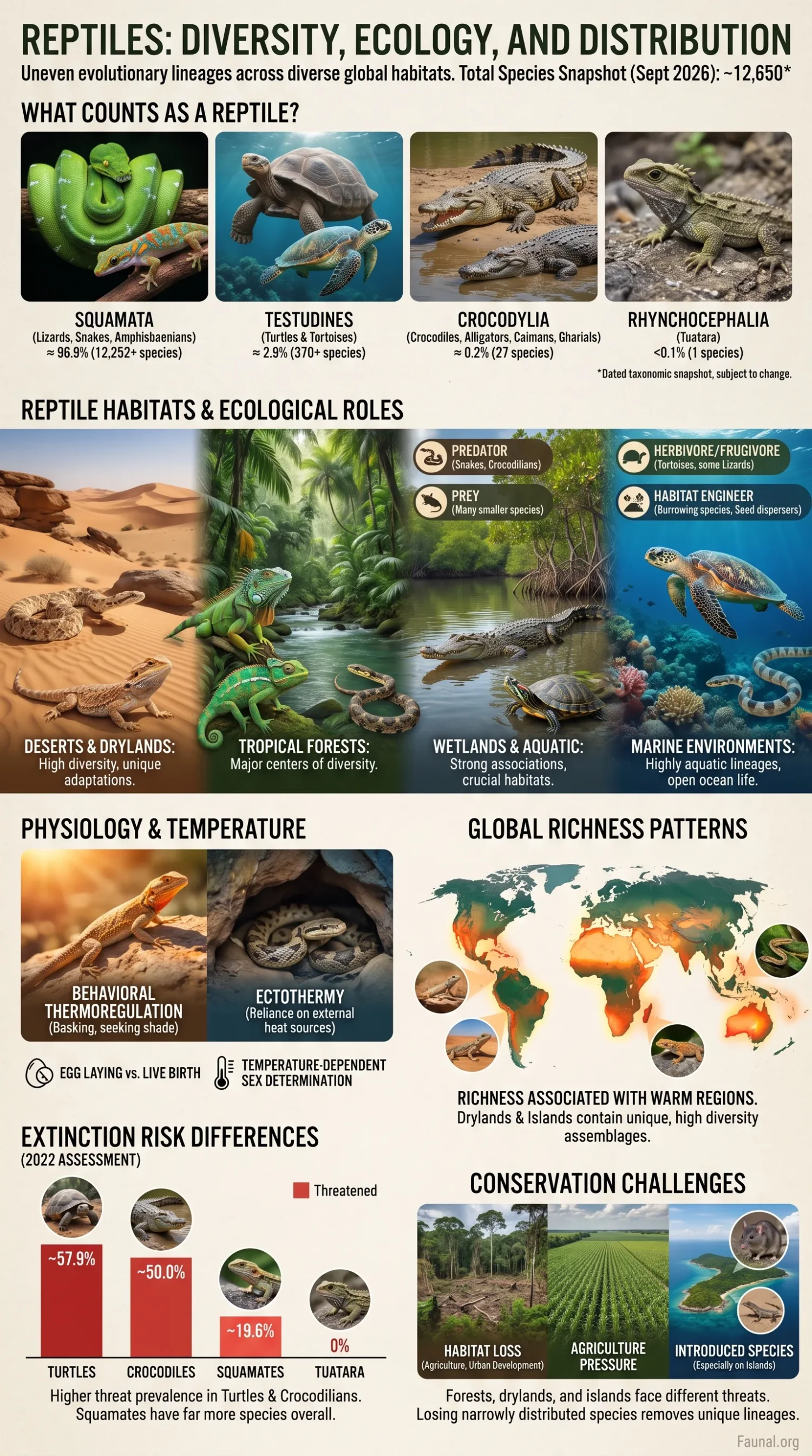
Reptiles occupy deserts, tropical forests, temperate landscapes, rivers, wetlands, islands and marine environments, but their diversity is distributed very unevenly among evolutionary lineages. The Reptile Database, which covers living reptiles, returned 12,650 species in its all-species search accessed in September 2026. Nearly all of that diversity belongs to Squamata, while turtles, crocodilians and the tuatara account for a much smaller share. [a]
What Counts as a Reptile?
Wildlife databases normally use reptiles to mean the living non-avian reptiles: lizards, snakes, amphisbaenians, turtles and tortoises, crocodilians and tuatara. These animals do not form an isolated evolutionary branch if birds are excluded. Modern phylogenetic work places birds within Archosauria, the lineage that also contains crocodilians, so birds are reptiles in the cladistic sense.
Why Birds Are Outside This Page
This page follows the non-avian reptile scope used by major reptile taxonomy and conservation datasets. In evolutionary classification, birds belong within the reptile lineage rather than forming a completely separate branch from it. [f]
The living non-avian reptiles are divided among four major lineages used here: Squamata, Testudines, Crocodylia and Rhynchocephalia. Their present-day species richness differs by several orders of magnitude.
Almost 97% of Living Reptile Species Are Squamates
| Living lineage | Included animals | Species in current database search | Share of 12,650 species |
|---|---|---|---|
| Squamata | Lizards, snakes and amphisbaenians | 12,252 [b] | 96.9% |
| Testudines | Turtles and tortoises | 370 [c] | 2.9% |
| Crocodylia | Crocodiles, alligators, caimans and gharials | 27 [d] | 0.2% |
| Rhynchocephalia | Tuatara | 1 accepted living species, Sphenodon punctatus [e] | <0.1% |
12,650 is a dated taxonomic snapshot, not a permanent biological constant. New species descriptions, species splits, revalidation of names and synonymization can all change the total. Reptile diversity figures should therefore be tied to a database version or access date.
Squamata contains the evolutionary radiation responsible for most modern reptile diversity. It includes familiar external forms such as geckos, skinks, monitors, chameleons, vipers, boas and cobras, but also burrowing lineages whose limbs are reduced or absent. The numerical dominance of Squamata means that broad statements about “reptiles” can easily become statements about squamates unless turtles, crocodilians and tuatara are considered separately.
Why Different Global Reptile Datasets Give Different Species Totals
Taxonomy, range mapping, ecological trait compilation and extinction-risk assessment are separate scientific tasks. They are updated on different schedules. A current taxonomic catalogue can therefore contain more species than a global range dataset or a published conservation assessment without any of the datasets being internally inconsistent.
| Dataset or study | Date or version | Reptile coverage | What the number represents |
|---|---|---|---|
| Reptile Database | Accessed September 2026 | 12,650 species | Current living-species taxonomy returned by the all-species search |
| GARD 1.7 | Published 2022 | 10,914 terrestrial reptile species [g] | Versioned geographic range dataset |
| Global reptile extinction-risk assessment | Published 2022; taxonomy based largely on the assessment period before publication | 10,196 assessed species | Species included in the global IUCN-based analysis |
| ReptTraits | Published 2024 | 12,060 species [i] | Species represented in a 40-trait ecological dataset |
These differences matter when combining datasets. A species recognized after a range product was assembled cannot automatically be assumed to have its own validated polygon in that older product. The reverse problem also occurs after taxonomic merging: an older dataset may contain names that a newer taxonomy treats as synonyms or subspecies.
Temperature Links Reptile Physiology to Place and Time
Most reptiles are ectothermic: external heat sources make a large contribution to the body temperatures they can maintain. This does not mean that their body temperature simply matches the surrounding air. Many species regulate temperature behaviorally by changing location, posture, activity time, exposure to sunlight or contact with warm and cool surfaces.
Ectothermy is tied to many aspects of reptile life history. Lower energetic costs of maintaining body temperature, seasonal thermal conditions and access to suitable microclimates influence activity, feeding, growth and reproduction. Reptile lineages also show repeated transitions between egg laying and live birth, while incubation temperature can affect development in species with temperature-sensitive developmental systems. [j]
These relationships help explain why reptile ecology often changes sharply over short distances. A sun-exposed rock face, shaded forest floor, underground retreat and wetland edge can create different thermal environments even within the same landscape. Elevation, canopy cover, soil structure, season and daily weather can therefore influence where a reptile is active without defining the full geographic range of its species.
Reptile Habitats Extend Far Beyond Hot, Dry Ground
Deserts support many reptile species, especially squamates, but reptiles also occupy humid forests, temperate woodland, grasslands, shrublands, caves, mountain slopes, river systems, lakes, marshes, mangroves, coastal zones and open ocean. Marine turtles spend much of their lives at sea. Sea snakes include highly aquatic lineages. Crocodilians are strongly associated with aquatic and wetland habitats, while many tortoises are terrestrial.
Habitat use can be highly specialized. Some geckos and anoles spend much of their active period on trunks or branches. Sand-adapted lizards may move through loose substrates. Blindsnakes and amphisbaenians can spend much of their lives below ground. Other reptiles switch between aquatic and terrestrial environments for feeding, basking, nesting or seasonal movement.
A global species count therefore says little about ecological similarity. A dataset built from 12,060 reptile species and 40 traits was needed precisely because body size, activity, habitat use, reproduction, diet and other ecological attributes vary so widely among reptile lineages. The term “reptile ecology” describes many different life strategies rather than one shared ecological model.
Reptiles Function as Predators, Prey, Herbivores and Plant Partners
Carnivory is widespread among reptiles. Snakes consume vertebrates and invertebrates across a wide size range. Many lizards feed heavily on arthropods. Crocodilians can occupy high trophic positions in aquatic food webs. Reptiles are also prey for birds, mammals, fishes, other reptiles and invertebrates, moving energy between trophic levels.
Herbivory and frugivory add another set of interactions. Tortoises, turtles and several lizard lineages consume fruits or plant material, and some transport viable seeds. Lizards can also transfer pollen in certain ecological settings. Reptiles may move nutrients between aquatic and terrestrial environments, alter vegetation through feeding and create physical structures that other organisms use. Research on tropical reptiles has grouped these functions into seed and pollen transport, nutrient movement, trophic interactions and habitat engineering. [k]
These roles are species-dependent. It would be incorrect to describe reptiles collectively as either top predators, insect controllers or seed dispersers. Each function depends on diet, body size, habitat, abundance and behavior.
Global Richness Patterns Are Not the Same for Lizards, Snakes and Turtles
Reptile richness is strongly associated with warm regions, but its geography does not follow a single tropical pattern. Reptiles are unusually diverse in many dry regions, and some islands contain dense concentrations of endemic lineages. Tropical forests remain major centers of diversity, while subtropical deserts, savannas, shrublands and seasonally dry landscapes can contain reptile assemblages that are poorly represented when conservation priorities are inferred mainly from birds or mammals.
A global analysis of 10,064 terrestrial reptile species found that distribution patterns of other tetrapods represented total reptile richness and snake richness better than they represented lizard and turtle richness. Areas rich in endemic lizards showed particularly weak overlap with hotspots defined from other tetrapod groups. [h]
This difference has practical consequences. A reserve network selected primarily around bird and mammal distributions may still omit reptile-rich landscapes. Arid regions, grasslands and savannas can gain conservation value when reptile distributions are considered directly rather than estimated from better-studied vertebrate groups.
A Range Map, an Occurrence Record and a Species List Are Different Evidence
Reptile distribution can be represented in several ways. Expert-reviewed range polygons describe an interpreted geographic range. Museum specimens and observations document recorded occurrences at particular places and dates. Regional checklists summarize taxa accepted for a defined area under a particular taxonomy.
These records should not be treated as interchangeable. A point occurrence does not show that a species occupies every location around the point. An absence of records may reflect low survey effort rather than biological absence. A broad range polygon can include unsuitable habitat inside its boundary. Historical museum specimens may document former presence rather than current occupancy.
Distribution Data Have Their Own Update Cycle
GARD 1.7 provides ranges for 10,914 terrestrial reptile species, while the current Reptile Database contains more living species. Newly described or recently revised taxa therefore require separate range verification instead of automatic assignment to an older polygon.
Extinction Risk Differs Sharply Among Reptile Lineages
The 2022 global reptile assessment evaluated 10,196 species and estimated that 1,829 species, or 21.1%, were threatened with extinction under IUCN categories. Another 1,507 species, 14.8% of those assessed, were Data Deficient. The assessment found much higher threat prevalence among turtles and crocodilians than among squamates. [l]
| Group in the 2022 assessment | Threatened | Interpretation |
|---|---|---|
| Turtles | 57.9% | More than half of assessed species fell within threatened categories. |
| Crocodiles | 50.0% | Half of the species included in that assessment were threatened. |
| Squamates | 19.6% | Lower proportional risk than turtles and crocodilians, but far more species in absolute terms. |
| Tuatara | 0% | The single living lineage representative was not categorized as threatened in that analysis. |
These percentages belong to the taxonomy and assessments used for the 2022 study. They should not be multiplied directly by the 12,650-species total from the September 2026 Reptile Database search to estimate a current number of threatened species.
Forests, Islands and Drylands Present Different Conservation Problems
More than half of the reptiles represented in the global assessment used forest habitats. Among species restricted to the compared habitat categories, 26.6% of forest-restricted reptiles were threatened, compared with 13.7% of species restricted to arid habitats. Agriculture, urban development and logging affected many threatened forest reptiles.
Drylands should not therefore be treated as unimportant. They can contain unusually high reptile richness and evolutionary diversity even where the proportion of threatened species is lower. Losing a narrowly distributed dryland reptile can remove a lineage that is poorly represented in forest-centered conservation planning.
Islands create another pattern. Restricted ranges, isolated evolutionary histories and introduced predators can place island reptiles under pressures that differ from those affecting continental populations. The 2022 assessment identified introduced mammals as threats to hundreds of reptile species on islands. Threatened reptiles were especially concentrated in parts of Southeast Asia, West Africa, northern Madagascar, the northern Andes and the Caribbean.
Reptile diversity cannot be represented by a single species total, biome or hotspot map. Taxonomic richness is dominated by squamates, ecological roles differ among lineages and habitats, and geographic datasets must be matched to the taxonomy and date for which they were assembled.
Sources and Verification
- [a] The Reptile Database — all-species search — Used for the September 2026 total of 12,650 living reptile species returned by the database.
- [b] The Reptile Database — Squamata search — Used for the current Squamata count of 12,252 species.
- [c] The Reptile Database — Testudines search — Used for the current Testudines count of 370 species.
- [d] The Reptile Database — Crocodylia search — Used for the current Crocodylia count of 27 species.
- [e] The Reptile Database — Sphenodon punctatus — Used to verify the accepted living tuatara species and its placement in Rhynchocephalia.
- [f] Getting to the root of it: perspectives on the phylogenetic origins of modern reptiles — Used for the evolutionary placement of turtles, lepidosaurs, crocodilians and birds within modern reptile phylogeny.
- [g] GARD 1.7 — updated global distributions for terrestrial reptiles — Used for the published range-dataset coverage of 10,914 terrestrial reptile species.
- [h] The global distribution of tetrapods reveals a need for targeted reptile conservation — Used for global reptile richness patterns, lizard endemism and differences between reptile and other tetrapod conservation geography.
- [i] ReptTraits ecological trait dataset — Used for the 12,060-species, 40-trait coverage illustrating ecological variation across living reptiles.
- [j] Life-History Evolution in Reptiles — Used for ectothermy, behavioral thermoregulation and variation in reproductive and developmental strategies.
- [k] The Plight of Reptiles as Ecological Actors in the Tropics — Used for reptile roles in trophic interactions, plant reproduction, nutrient movement and habitat engineering.
- [l] A global reptile assessment highlights shared conservation needs of tetrapods — Used for assessed-species totals, extinction-risk prevalence, habitat comparisons, Data Deficient coverage and geographic threat patterns.
Alpine and Mountain Reptiles of Europe: Cold-Adapted Species
For Europe’s alpine and mountain reptiles, the focus is cold-adapted species, organizing the account around adaptation to the...
Endemic Reptiles of Europe: Islands, Peninsulas, and Restricted Ranges
Europe’s endemic reptiles are organized by islands, peninsulas, and restricted ranges, keeping geographic restriction central.
Lizards of Europe: Common Groups, Habitats, and Distribution
Common groups, habitats, and distribution frame the treatment of Europe’s lizards, keeping occurrence and habitat context within the...
Lizards of Turkey: Common Families and Habitats
Common families and habitats frame the treatment of Turkey’s lizards, grouping the named animals within the regional fauna.
Reptiles of Europe: Snakes, Lizards, Turtles, and Tortoises
Europe’s reptiles are described through snakes, lizards, turtles, and tortoises, keeping the list anchored to the area named.
Reptiles of Turkey: Lizards, Snakes, Turtles, and Tortoises
Turkey’s reptiles are described through lizards, snakes, turtles, and tortoises, relating the listed taxa to their regional wildlife...
Snakes of Europe: Venomous and Non-Venomous Species
Europe’s snakes are organized around venomous and non-venomous species, keeping the taxonomic groups tied to their regional setting.
Snakes of Turkey: Venomous and Non-Venomous Species
Turkey’s snakes are organized around venomous and non-venomous species, relating the listed taxa to their regional wildlife context.
Threats to European Reptiles: Habitat Loss, Roads, and Climate Change
European reptiles are assessed through habitat loss, roads, and climate change, connecting each pressure with the reptiles and...
Turtles and Tortoises of Europe: Freshwater, Marine, and Land Species
Europe’s turtles and tortoises link freshwater, marine, and land species, framing the listed species groups within the regional...
Turtles and Tortoises of Turkey: Freshwater, Marine, and Land Species
Turkey’s turtles and tortoises link freshwater, marine, and land species, relating the listed taxa to their regional wildlife...
11 articles in Reptiles