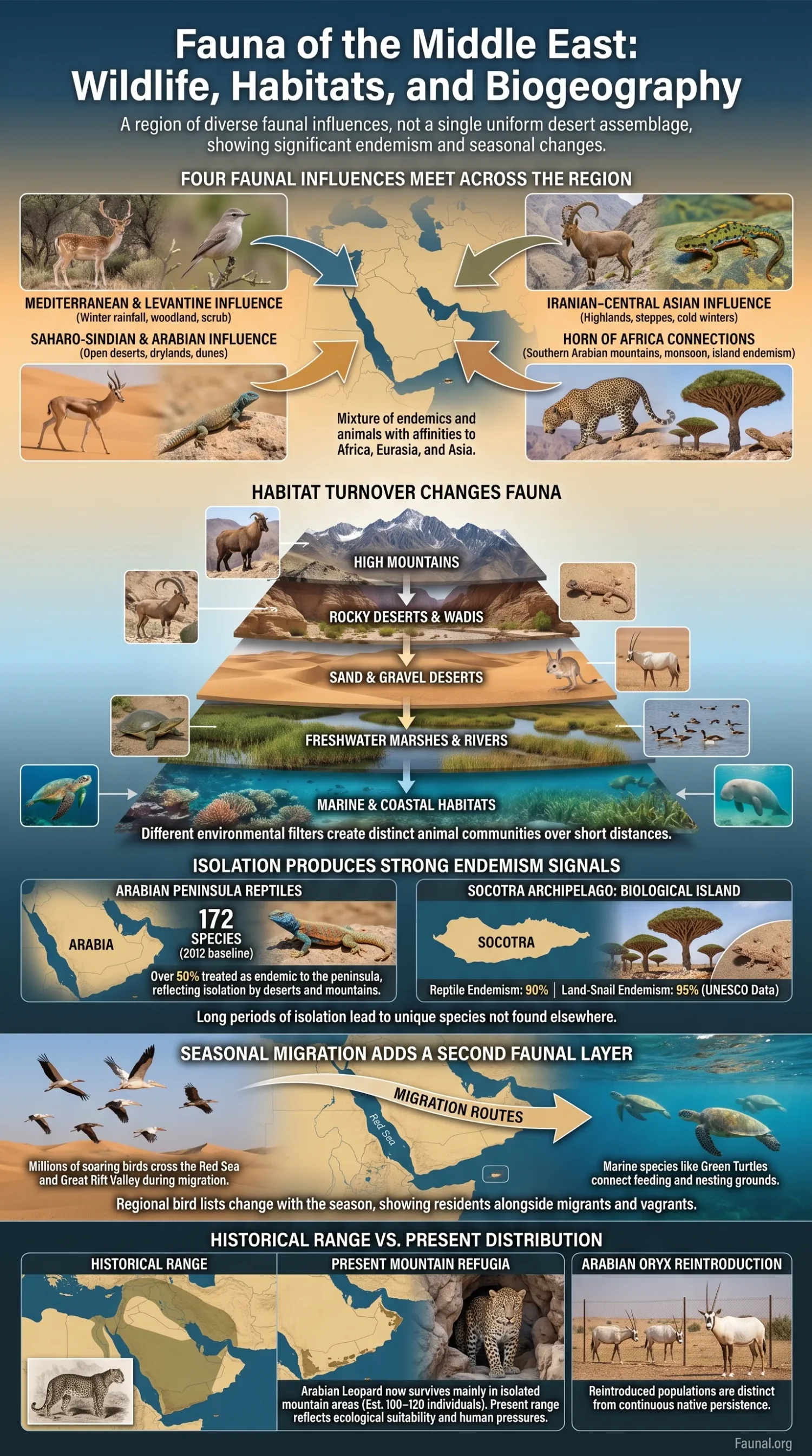
The fauna of the Middle East is not one uniform desert assemblage. Mediterranean coasts and scrub, the Iranian and Anatolian uplands, Arabian sand and gravel deserts, monsoon-influenced mountains in southern Arabia, the Tigris–Euphrates wetlands, isolated islands and several contrasting seas support animal communities with different origins and habitat requirements. The region also lies between major centers of fauna in Africa, Eurasia and southern Asia, so resident animals occur alongside migrants, range-edge populations and taxa confined to mountains, freshwater basins or islands.
The Middle East Is a Geographic Label, Not a Single Faunal Unit
There is no universal zoological boundary called the Middle East. Political definitions differ, and animal distributions rarely stop at national borders. For this regional account, the main terrestrial scope includes the Levant, Mesopotamia, the Arabian Peninsula, Iran and adjoining Anatolian transition zones. Sinai is relevant where African and Asian distributions meet, while Socotra is treated separately because its long isolation has produced an unusually distinct island fauna.
This boundary is intentionally ecological rather than a claim that every animal recorded in each political state belongs to one Middle Eastern assemblage. A species associated with Mediterranean woodland in the Levant may have little ecological connection with a sand-desert reptile in the Empty Quarter or a freshwater fish isolated in an Iranian closed basin.
Why There Is No Single Middle East Species Total
A regional total changes with the chosen countries, marine boundary, taxonomy, treatment of introduced animals and inclusion of migrants or vagrants. Verified totals below therefore retain the geographic and taxonomic scope of the assessment that produced them rather than being combined into an artificial Middle East total.
Arabian Peninsula Mammals
189 confirmed species
166 terrestrial and 23 marine species in the 2023 IUCN regional assessment.
Arabian Peninsula Reptiles
172 species
2012 IUCN assessment baseline; 89 species, or 52%, were treated as endemic to the peninsula.
Socotra Reptile Endemism
90%
UNESCO reports that 90% of the archipelago’s reptile species occur nowhere else.
Arabian Leopard Estimate
100–120 individuals
Current IUCN SSC Cat Specialist Group estimate, including an estimated 70–84 mature animals.
Four Faunal Influences Meet Across the Region
The Arabian Peninsula mammal assessment describes a mixture of Arabian endemics and animals with affinities to the Horn of Africa, Saharo-Sindian areas, Iranian–Central Asian systems and the Mediterranean. That mixture is a better biological description of the region than treating Middle Eastern wildlife as a single desert fauna. IUCN’s 2023 Arabian Peninsula mammal assessment documents this mixture within a defined regional boundary.
Mediterranean and Levantine Influence
Winter-rainfall woodland, scrub, rocky slopes, agricultural mosaics and coastal wetlands along the eastern Mediterranean support fauna unlike that of the Arabian interior. Woodland and scrub provide denser cover, more seasonal plant production and different prey communities, while the Jordan Rift and adjacent valleys also function as movement routes between Eurasia and Africa.
Saharo-Sindian and Arabian Influence
Open deserts extending through Arabia, Jordan, Syria and adjoining drylands favor animals able to use sparse vegetation, widely separated water, burrows and large home ranges. Arabian oryx, sand gazelles, jerboas, sand cats and numerous reptiles represent different ways of occupying these dry systems. Even here, dunes, gravel plains, lava fields and rocky desert are not interchangeable habitats.
Iranian–Central Asian and Irano-Anatolian Influence
Iranian plateaus, the Zagros and neighboring uplands connect Middle Eastern fauna with colder and more continental parts of western and central Asia. Elevation, winter cold, steppe, rocky slopes and isolated drainage basins allow mountain ungulates, plateau mammals, vipers, salamanders and freshwater fishes to occur far from the ecological conditions of lowland Arabia.
The Irano-Anatolian biodiversity hotspot illustrates the effect of geographic isolation. CEPF reports more than 115 reptile species in the hotspot, including about a dozen endemics, and estimates that roughly one third of about 90 freshwater fish species are endemic, many associated with rivers and closed-basin lakes. CEPF’s Irano-Anatolian species account also identifies highly localized salamanders and vipers.
Horn of Africa Connections in Southern Arabia
Southwestern Arabia is separated from northeast Africa by the Red Sea and Gulf of Aden, yet the two sides retain biogeographic connections. Southern Arabian mammals include taxa with African affinities, and the fauna of Socotra is closely associated with the Horn of Africa while also showing extensive island endemism. The result is a southern fauna that cannot be explained by latitude or desert climate alone.
Habitat Turnover Changes the Fauna Over Short Distances
| Habitat system | Regional examples | Main environmental filters | Typical faunal pattern |
|---|---|---|---|
| Sand and gravel deserts | Arabian interior, Syrian and Jordanian drylands | Heat, low rainfall, sparse cover, mobile food resources | Nocturnal mammals, burrowing rodents, desert reptiles and mobile ungulates |
| Rocky deserts and wadis | Arabia, Sinai, southern Levant | Cliffs, crevices, temporary runoff, shade and localized vegetation | Ibex, hyraxes, reptiles, raptors and predators using rugged terrain |
| Mediterranean woodland and scrub | Levant and eastern Mediterranean margins | Winter rainfall, denser vegetation and seasonal productivity | Woodland mammals, passerines, reptiles and mixed open-country species |
| High mountains | Hajar, Asir–Sarawat, Dhofar, Zagros and adjoining ranges | Elevation, cooler temperatures, isolation and steep relief | Mountain ungulates, localized reptiles, amphibians and remnant predator populations |
| Rivers, marshes and reedbeds | Tigris–Euphrates and the Ahwar | Freshwater flow, seasonal flooding, reed cover and salinity gradients | Freshwater fish, turtles, marsh birds, waterbirds and aquatic mammals |
| Springs and closed basins | Arabian mountains and Iranian interior basins | Hydrological isolation and small areas of permanent water | Restricted-range fish, amphibians and aquatic invertebrates |
| Mangroves, mudflats and seagrass | Arabian Gulf, Red Sea and Gulf of Oman coasts | Salinity, tides, shallow water and sediment type | Shorebirds, marine turtles, dugongs, fishes and coastal invertebrates |
| Coral and rocky marine habitats | Red Sea and adjoining warm seas | Temperature, salinity, depth, reef structure and oceanographic isolation | Reef fishes, corals, marine invertebrates, turtles and marine mammals |
Desert Fauna Depends on More Than Heat and Rainfall
The large deserts of the Middle East contain several habitat types. Loose dunes favor animals able to burrow, move over shifting sand or remain beneath the surface during the hottest part of the day. Gravel plains offer firmer ground and broader visibility but less burrowing substrate. Stony deserts, basalt fields and rocky outcrops add crevices and elevated shelter. Species associated with one of these surfaces should not automatically be described as occurring across every desert environment.
Nocturnal and crepuscular activity reduces exposure to daytime heat for many mammals and reptiles. Burrows moderate temperature and moisture loss. Some desert herbivores move across large areas after rainfall changes the distribution of new vegetation. Small mammals may obtain much of their water from food and metabolic processes, while reptiles use behavioral thermoregulation to shift between exposed and sheltered sites.
Wadis Concentrate Resources Inside Dry Landscapes
A wadi may remain dry for long periods and still differ sharply from the surrounding plain. Channels collect runoff, sediment and plant growth; cliff faces create shade and crevices; temporary pools may persist after rainfall. These features can concentrate insects, reptiles, birds and mammalian prey. Larger predators and ungulates may therefore use wadi systems even when surrounding desert is much less productive.
Mountains Act as Refugia, Barriers and Centers of Restricted Range
Mountain ranges break the apparent continuity of Middle Eastern drylands. Elevation changes temperature, rainfall, fog exposure, vegetation, snow cover and surface water. Deep valleys can isolate populations, while connected ridges can permit movement along an otherwise unsuitable landscape. Mountain fauna therefore reflects both present habitat and long periods of geographic separation.
Hajar Mountains
The Hajar Mountains of Oman and the United Arab Emirates rise directly from very dry lowlands. Rocky slopes, canyon systems and higher-elevation habitats support animals that are poorly represented in surrounding sandy landscapes. The Arabian tahr, Arabitragus jayakari, is one of the clearest mammalian examples of this mountain-linked fauna. Reptile distributions also change rapidly with elevation and isolated rocky habitat.
Dhofar and the Southern Arabian Escarpments
Southern Oman and neighboring Yemen include mountains affected by the southwest monsoon. Fog, seasonal moisture, grassland and woodland on south-facing slopes create conditions far removed from the hyper-arid interior. The Arabian leopard, Panthera pardus nimr, now survives mainly in isolated parts of Oman and Yemen. The IUCN SSC Cat Specialist Group estimates a total population of about 100–120 individuals, including roughly 70–84 mature animals, and classifies the subspecies as Critically Endangered. The current Arabian leopard account places the main remaining subpopulations in Oman and Yemen.
The leopard’s present mountain distribution should not be mistaken for its full historical habitat. The same assessment records former occurrence in areas including western Saudi Arabia, the United Arab Emirates, Jordan and parts of the southern Levant. Its modern association with remote escarpments partly reflects range contraction and survival in areas with lower human access.
Zagros and Iranian Highlands
The Zagros, Iranian plateau and adjoining mountain systems support a more continental fauna. Wild goats, mountain-adapted carnivores, steppe mammals and localized herpetofauna occur across elevation bands that differ sharply from the Mesopotamian lowlands to the west and central Iranian deserts to the east. Closed basins and separated valleys also allow freshwater and amphibian populations to become geographically restricted.
The Irano-Anatolian hotspot includes two localized newts used by CEPF to illustrate this pattern: the Kurdistan newt, Neurergus microspilotus, associated with the Avroman Mountains around the Iraq–Iran–Türkiye border, and Kaiser’s mountain newt, Neurergus kaiseri, restricted to Iran. Their ranges show why a regional fauna account needs drainage and mountain geography as well as country names.
Freshwater Habitats Form Biological Islands Inside an Arid Region
Permanent freshwater occupies a small share of much of the Middle East, which makes rivers, marshes, springs and isolated basins disproportionately important for aquatic fauna. Freshwater fishes cannot cross dry land in the same way that a bird or large mammal can move between habitat patches. Drainage history can therefore create very narrow distributions and high endemism even where terrestrial animals have much larger ranges.
The Tigris–Euphrates and the Ahwar
The Tigris and Euphrates create a long freshwater corridor through otherwise dry landscapes. Their floodplains, channels, reedbeds and marshes support fishes, aquatic reptiles, waterbirds and other animals that cannot be represented by a desert-focused account of Iraq and neighboring areas.
The Ahwar of southern Iraq is especially unusual because extensive wetlands occur within one of the driest regional settings. UNESCO describes the marsh system as strongly dependent on river inflow, with seasonal water-level changes influencing bird movement and the movement of fish and shrimp. The East and West Hammar marshes also experience saline water moving inland from the Gulf, producing a transition in which marine fishes can enter parts of the wetland system. UNESCO’s Ahwar property record documents this freshwater–saline ecological gradient.
Changes in freshwater flow can alter more than the amount of wetland habitat. They can change salinity, connectivity and the composition of the animal community itself.
Springs and Closed Basins Preserve Localized Fauna
Closed drainage basins in Iran and neighboring uplands can isolate fish populations over evolutionary time. Mountain springs and short permanent streams create similar isolation in Arabia. A species confined to one drainage or spring system may have a far narrower distribution than terrestrial animals living around it, even when both are described under the same regional label.
Seasonal Migration Adds a Second Faunal Layer
A Middle Eastern bird list changes with season. Resident species, local breeders, winter visitors, passage migrants and occasional vagrants represent different forms of regional presence. Combining them into one undifferentiated list can make a country or wetland appear to support the same bird community throughout the year when it does not.
The region sits on routes connecting Eurasian breeding areas with African wintering grounds. Large soaring birds are especially influenced by geography because many rely on rising air over land rather than prolonged powered flight across open sea. The Levant, Jordan Rift, northern Red Sea and adjoining land corridors can therefore concentrate storks, pelicans, eagles, buzzards and other migrants.
BirdLife International’s global flyway material reports that tens of thousands of soaring birds cross the Red Sea and Great Rift Valley during seasonal migration. This movement means a species may be ecologically important to a Middle Eastern stopover site even when it neither breeds there nor remains through the year.
Breeding Counts and Regional Bird Lists Measure Different Things
A 2015 IUCN regional assessment recorded 357 breeding bird species within a defined area covering the Arabian Peninsula plus Iraq, Syria and Lebanon, including offshore islands and Socotra. The figure is a breeding-fauna total for that assessment boundary, not a count of every bird recorded across the Middle East and not a total of all passage migrants or vagrants.
Isolation Produces the Strongest Endemism Signals
The most familiar Middle Eastern mammals are not necessarily the animals that best reveal the region’s evolutionary isolation. Restricted-range reptiles, freshwater fishes, amphibians, land snails and other small-bodied taxa often provide stronger evidence because mountains, islands and drainage divides can isolate their populations more effectively.
Arabian Reptiles Show Strong Peninsula-Level Endemism
The IUCN regional reptile assessment published in 2012 recognized 172 reptile species on the Arabian Peninsula, of which 89, or 52%, were treated as endemic to the peninsula. The IUCN reptile assessment should be treated as a dated baseline rather than a current taxonomic total because species descriptions and taxonomic decisions can change after publication.
The pattern still demonstrates why mountain massifs and isolated arid landscapes matter. Small reptiles with limited dispersal can diverge between ranges and valleys even where larger mammals occupy much broader geographic areas.
Socotra Represents the Region’s Strongest Island-Isolation Example
Socotra lies in the northwest Indian Ocean near the Gulf of Aden and has been isolated long enough for many terrestrial lineages to develop ranges confined to the archipelago. UNESCO reports 34 reptile species in its World Heritage description, with 90% endemic, and 96 land-snail species, with 95% endemic. It also reports 192 bird species, including 44 breeding species and 85 regular migrants. The UNESCO Socotra record also documents a diverse coastal marine assemblage.
These percentages should not be extended to all Socotran animals. Reptiles and land snails show exceptionally high endemism, while birds include many mobile migrants and marine animals are connected to a much wider ocean system. Different animal groups respond to island isolation at different spatial scales.
Marine Fauna Changes Between the Red Sea, Arabian Gulf and Arabian Sea
The waters surrounding the Middle East should not be merged into one coastal fauna. The Red Sea, Arabian Gulf, Gulf of Oman and Arabian Sea differ in depth, temperature regime, salinity, ocean exchange, productivity and habitat structure. Those physical differences affect reef organisms, fishes, turtles, seabirds and marine mammals.
Red Sea Reefs Contain a Strong Endemic Component
Coral reefs, mangroves and seagrass occur along large parts of the Red Sea and Gulf of Aden region. UNEP’s Jeddah Convention material, drawing on PERSGA reporting, gives an estimated 14.7% endemism among Red Sea fishes and reports especially high endemic proportions in several fish families. The same regional material describes extensive seagrass and mangrove habitat together with turtles, dugongs and other marine fauna. UNEP’s Jeddah Convention account provides the regional marine context.
The Arabian Gulf Favors Shallow-Water and Extreme-Condition Fauna
The Arabian Gulf is shallow and experiences strong seasonal temperature and salinity variation. Extensive seagrass beds, mudflats, tidal creeks, islands and coastal shallows support fishes, turtles, shorebirds and dugongs. The Convention on Migratory Species treats the Arabian Gulf as a distinct regional chapter in its global dugong assessment, reflecting the biological and management value of this population and its seagrass habitat. The CMS global dugong assessment separates Red Sea and Persian Gulf populations into different regional treatments.
Coastal Islands Link Marine, Desert and Migratory Fauna
Al Siniyah Island in the United Arab Emirates shows how several systems can overlap within one coastal site. BirdLife reported in February 2026 that its mangroves, salt flats, seagrass and coastal wetlands support one of the largest breeding colonies of Socotra cormorant, Phalacrocorax nigrogularis, alongside dugongs, green turtles and migratory birds on the African–Eurasian flyway. BirdLife’s 2026 Al Siniyah account illustrates the overlap between breeding seabirds, shallow-water fauna and seasonal migration.
Representative Species Reveal Different Parts of the Regional System
No short table can function as a complete Middle Eastern animal checklist. Representative species are more useful here when each one demonstrates a particular habitat, geographic boundary or conservation process.
| Animal | Scientific name | Main regional association | What it demonstrates |
|---|---|---|---|
| Arabian oryx | Oryx leucoryx | Arabian open desert and gravel plains | Desert mobility and the distinction between historical range, extinction in the wild and reintroduced populations |
| Arabian sand gazelle | Gazella marica | Arabian sand and gravel deserts | Large-herbivore use of open arid landscapes |
| Arabian tahr | Arabitragus jayakari | Hajar Mountains | Restricted mountain fauna separated from surrounding lowland desert |
| Nubian ibex | Capra nubiana | Rocky mountains and escarpments | Dependence on steep terrain rather than sand-desert habitat |
| Arabian leopard | Panthera pardus nimr | Southern Arabian mountains | Range contraction and survival in isolated mountain refugia |
| Asiatic cheetah | Acinonyx jubatus venaticus | Iranian arid and semi-arid landscapes | A highly contracted large-carnivore range within the Iranian fauna |
| Euphrates softshell turtle | Rafetus euphraticus | Tigris–Euphrates river system | Dependence on connected large-river habitat |
| Socotra cormorant | Phalacrocorax nigrogularis | Arabian Gulf and adjoining island coasts | Colonial seabird breeding tied to productive coastal waters and secure islands |
| Dugong | Dugong dugon | Shallow seagrass systems | Direct dependence of a large marine herbivore on coastal seagrass habitat |
| Green turtle | Chelonia mydas | Red Sea, Arabian Gulf, Gulf of Oman and Arabian Sea | Connection between marine feeding habitat and geographically separated nesting areas |
Present Distribution Can Be Much Smaller Than Historical Range
A modern distribution map does not always show the habitat a species occupied before intensive hunting, fragmentation or other human pressures. This distinction is especially important for large mammals. An animal now restricted to remote mountains can appear to be a mountain specialist even when historical evidence shows use of a broader landscape.
The Arabian leopard provides a clear example. The Cat Specialist Group describes current survival mainly in Oman and Yemen, while historical records extend across a much larger part of Arabia and into adjoining areas. Present occurrence therefore reflects both ecological suitability and the history of population loss.
Reintroduced Populations Need Separate Treatment
The Arabian oryx, Oryx leucoryx, demonstrates another problem in regional fauna lists. IUCN records that the species became extinct in the wild in 1972 and was later restored to free-ranging populations through captive breeding and reintroduction. A present-day record of Arabian oryx may therefore represent a reintroduced population rather than uninterrupted natural persistence at that site. IUCN’s Arabian oryx account documents the extinction-in-the-wild and reintroduction history.
Remnant native populations, natural recolonization, releases from captive breeding and managed reintroductions describe different biological histories and should not be merged into one presence label.
Pressures Differ Between Deserts, Mountains, Wetlands and Coasts
There is no single threat profile for Middle Eastern fauna. The process affecting a freshwater fish in an isolated drainage is different from the process affecting a migratory raptor, an Arabian desert ungulate or a coral-reef fish. Conservation assessments are more informative when pressures are tied to the habitat and population being assessed.
| Faunal system | Pressures that can alter it | Biological consequence |
|---|---|---|
| Open desert fauna | Roads, fencing, settlement, grazing pressure, hunting and fragmentation | Reduced movement, habitat subdivision and altered access to seasonal forage |
| Mountain fauna | Road construction, quarrying, disturbance, livestock pressure and prey depletion | Loss of refuge habitat and greater isolation between already separated populations |
| River and marsh fauna | Water abstraction, flow regulation, pollution and salinity change | Altered flooding, aquatic connectivity and species composition |
| Migratory birds | Loss of stopover habitat, illegal killing and collision hazards | Mortality or reduced access to feeding and resting sites along long-distance routes |
| Coastal and seagrass fauna | Coastal construction, fisheries interactions, pollution and habitat removal | Loss of feeding, nursery, roosting and breeding habitat |
| Island endemics | Introduced organisms, habitat change and very small geographic ranges | High exposure when disturbance affects a large share of the species’ total habitat |
Regional Species Counts Depend on the Boundary and the Question
Several well-documented assessments show why one combined Middle East total would be misleading. The 2023 IUCN Arabian Peninsula mammal assessment confirmed 189 mammal species within its own boundary. A 2012 reptile assessment recognized 172 Arabian Peninsula species under the taxonomy used at that time. A 2015 breeding-bird assessment used a different boundary again, covering the Arabian Peninsula plus Iraq, Syria, Lebanon, offshore islands and Socotra, and reported 357 breeding species.
None of those numbers contradicts another. They measure different animal groups, geographic limits, dates and forms of occurrence. Adding them together would also omit many fishes, amphibians and invertebrates while risking overlap between marine and terrestrial boundaries.
Occurrence databases create another layer of evidence but not a final answer. A museum specimen, a recent field observation, a breeding record and an IUCN range assessment can all support regional presence while describing different things. Record density can also reflect observer effort and data availability. For a region as large and unevenly surveyed as the Middle East, a defensible fauna account therefore keeps taxonomic scope, geography, seasonality and evidence type visible rather than presenting one apparently exact total.
Sources and Verification
- IUCN — The conservation status and distribution of the mammals of the Arabian Peninsula — 2023 regional mammal scope, confirmed terrestrial and marine species totals, habitat diversity and faunal affinities.
- IUCN — The conservation status and distribution of reptiles of the Arabian Peninsula — 2012 reptile baseline, species count and peninsula-level endemism.
- IUCN — The conservation status and distribution of the breeding birds of the Arabian peninsula — Breeding-bird total and the geographic boundary used by the 2015 regional assessment.
- IUCN SSC Cat Specialist Group — Arabian Leopard — Current population estimate, mature-individual estimate, conservation category, historical occurrence and remaining populations.
- Critical Ecosystem Partnership Fund — Irano-Anatolian Species — Restricted reptiles, salamanders and freshwater-fish endemism in the Irano-Anatolian hotspot.
- UNESCO World Heritage Centre — The Ahwar of Southern Iraq — Marsh ecology, river dependence, salinity gradients, fish movement and migratory-bird habitat.
- UNESCO World Heritage Centre — Socotra Archipelago — Reptile and land-snail endemism, bird figures and marine biodiversity recorded for the World Heritage property.
- BirdLife International — Global Flyways — Seasonal soaring-bird movement through the Red Sea and Great Rift Valley system.
- United Nations Environment Programme — Jeddah Convention — Red Sea and Gulf of Aden marine habitats, fish endemism, reefs, mangroves, seagrass and regional marine fauna.
- Convention on Migratory Species — A Global Assessment of Dugong Status and Conservation Needs — Separate regional treatment of dugongs in the Red Sea and Persian Gulf and their conservation context.
- BirdLife International — Al Siniyah Island — 2026 account of Socotra cormorants, seagrass, dugongs, green turtles and migratory birds in the Arabian Gulf.
- IUCN — Arabian Oryx Recovery Account — Extinction in the wild, captive breeding and reintroduction history of Oryx leucoryx.