Updated: September 16, 2026 What changed?
Birds are a globally distributed vertebrate class with more than 11,000 recognized species, but avian diversity is not a fixed inventory spread evenly across the planet. The number of recognized species depends on the taxonomic authority being used, while the birds present in any particular place depend on habitat, elevation, climate, evolutionary history and season. Migration adds another layer: a species may breed in one region, pass through another and spend the non-breeding season thousands of kilometres away.
For that reason, bird distribution is best treated as a changing ecological pattern rather than a static map. Species richness describes how many species occur within a defined scope. Ecology explains how those species use resources and habitats. Migration connects places used during different parts of the annual cycle. Distribution describes where those relationships occur, but a mapped range does not imply equal abundance or continuous occupancy throughout the area.
The Global Bird Species Total Depends on Taxonomy
Modern bird taxonomy changes as genetic, vocal, morphological and geographic evidence alters the boundaries placed around species. A population formerly treated as a subspecies may be recognized as a separate species, while two named species may be merged when the evidence no longer supports their separation. Higher-level relationships among genera and families also change as phylogenetic research improves.
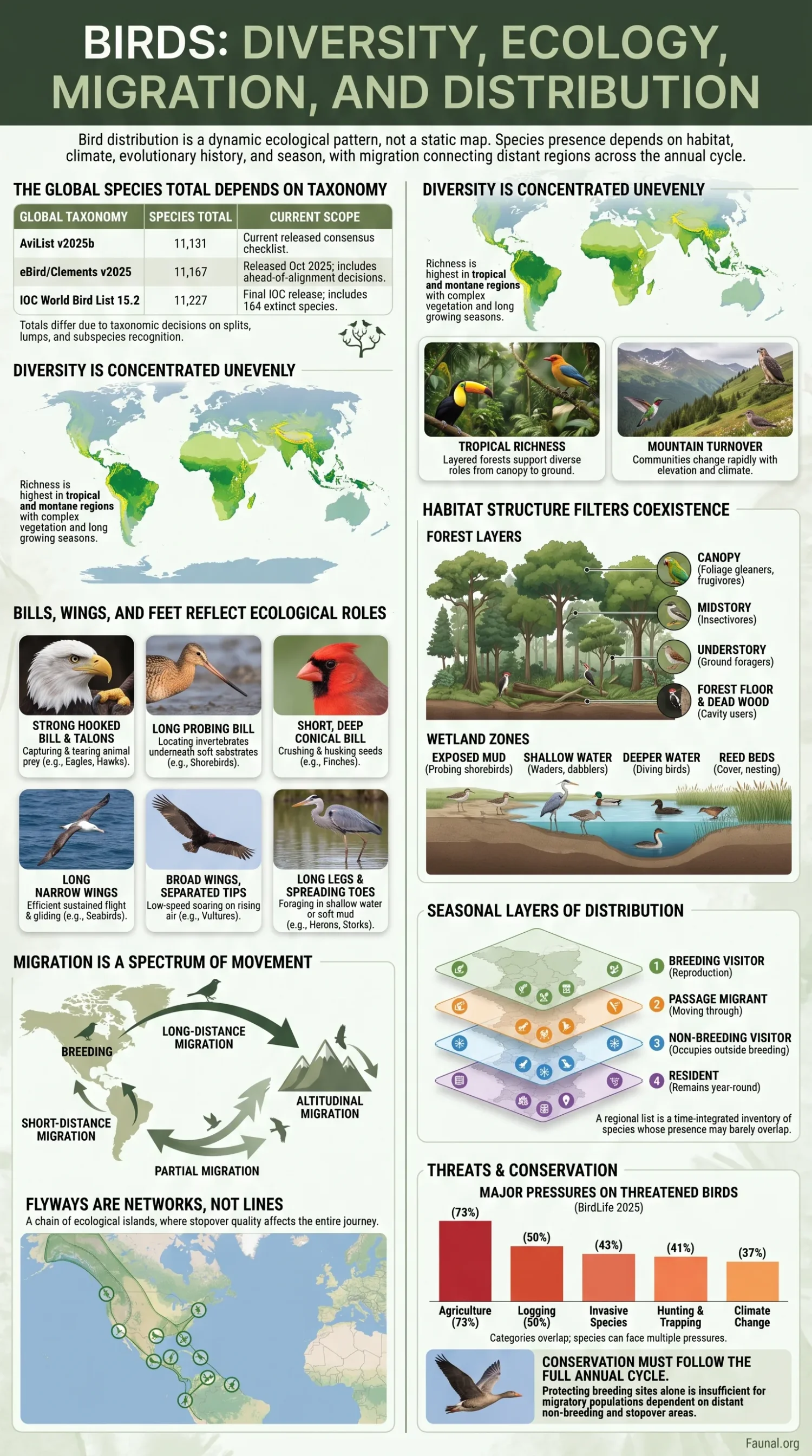
AviList was created to reduce long-standing disagreement among major global bird lists. Its current released version, v2025b, retains the core taxonomy of the first AviList release and recognizes 11,131 species, 19,879 subspecies, 46 orders, 252 families and 2,376 genera. AviList states that the next full taxonomic release, v2026, is planned for September or October 2026. AviList AviList 2026 update
| Global taxonomy | Species total | Current scope |
|---|---|---|
| AviList v2025b | 11,131 | Current released consensus checklist; core taxonomic fields unchanged from v2025. |
| eBird/Clements v2025 | 11,167 | Released in October 2025; includes several decisions implemented ahead of expected AviList v2026 alignment. |
| IOC World Bird List 15.2 | 11,227 | Final IOC release; total includes 164 extinct species and is being succeeded by AviList. |
The eBird/Clements v2025 total is 11,167 species. Its 2025 revision gained 40 species through splits and lost 18 through lumps, producing a net increase of 22 species from the preceding edition. The final IOC World Bird List, version 15.2, lists 11,227 species including 164 extinct species. These totals should therefore be reported with the taxonomy and version attached rather than presented as one permanent number. eBird/Clements v2025 IOC World Bird List 15.2
Why bird totals differ
A species total is partly a biological measurement and partly the result of taxonomic decisions. Different lists may recognize different splits, lumps, genera or subspecies at the same time. A global total without its taxonomic source can therefore be ambiguous.
Bird Diversity Is Concentrated Unevenly Across the Planet
Birds occur in every country and across nearly every major terrestrial habitat, but species richness rises sharply in some regions. Tropical South America, tropical and montane parts of Africa, Southeast Asia and several mountain systems support especially dense assemblages. Global macroecological work has repeatedly found tropical and montane regions among the centres of avian species richness, with particularly high richness in areas such as the tropical Andes and Himalayan slopes. PLOS ONE global diversity analysis
Tropical richness reflects more than warm temperatures
Tropical regions combine long growing seasons, high plant productivity in many ecosystems, complex vegetation, large numbers of plant and invertebrate lineages and a wide range of feeding opportunities. Structurally layered forests can support canopy specialists, understory insectivores, bark-foraging birds, terrestrial species, cavity users, fruit eaters and aerial feeders within the same landscape.
BirdLife habitat data illustrate the scale of the forest association. About 78% of bird species are recorded from forest habitats, while shrublands are used by about 41%. Human-modified terrestrial habitats are used by about 49%, although this does not mean that all of those species thrive in heavily altered landscapes. Grasslands, savannas and inland wetlands each support roughly one-fifth of extant bird species. The categories overlap because one species may use several habitat types during its life cycle. BirdLife global habitat assessment
Mountains create rapid turnover over short distances
Mountain systems can place warm lowland forest, cool montane forest, shrubland, grassland and alpine habitat within a relatively short horizontal distance. Temperature, moisture and vegetation change with elevation, so bird communities can be replaced rapidly along the slope. Valleys and isolated ridges may also reduce movement between populations. Over evolutionary time, that isolation can contribute to narrow ranges and endemism.
Islands may hold fewer species but more unique lineages
Oceanic isolation limits which birds can colonize an island, yet the populations that arrive may evolve independently for long periods. The result can be low total richness paired with high endemism. Island birds may occupy unusually narrow geographic ranges and can be especially exposed to habitat loss, invasive predators, disease or other pressures that affect a large fraction of their entire range at once.
Species richness and biological uniqueness measure different things. A continental forest can contain many more bird species than a small island, while the island may hold species found nowhere else.
Bills, Wings and Feet Reflect Different Ecological Jobs
Bird morphology records the demands of feeding and movement. Bill shape affects how food is captured or processed. Feet determine how a bird grips, walks, swims, climbs or handles prey. Wing geometry affects acceleration, manoeuvrability, soaring and the energetic cost of sustained flight. These relationships are not perfect one-to-one rules, but they help explain why bird groups repeatedly occupy different ecological niches.
| Trait pattern | Ecological use | Representative groups |
|---|---|---|
| Strong hooked bill with grasping talons | Capturing, holding and tearing animal prey or carrion | Eagles, hawks, falcons and many vultures |
| Long probing bill | Locating invertebrates beneath mud, sand or soft soil | Godwits, curlews, snipes and other shorebirds |
| Short, deep conical bill | Crushing or husking seeds | Many finches, grosbeaks and seed-eating passerines |
| Long narrow wings | Efficient sustained flight and gliding | Albatrosses, shearwaters and several other oceanic birds |
| Broad wings with separated primary tips | Low-speed soaring and use of rising air | Many vultures, eagles and storks |
| Shorter rounded wings | Rapid acceleration and manoeuvring in cluttered vegetation | Many woodland and understory birds |
| Webbed feet | Swimming and surface propulsion | Ducks, geese, gulls and many seabirds |
| Long legs and spreading toes | Foraging in shallow water or soft wet substrates | Herons, storks and many waders |
Ecological diversification is not explained by one trait alone. Closely related birds can diverge in body size, bill form, foraging height or habitat, reducing direct competition and opening new ecological roles. At larger evolutionary scales, changes in morphology, geography and resource use have contributed to the exceptional variety of living birds. Annual Review of avian diversity
Habitat Structure Filters Which Birds Can Coexist
A habitat label such as forest, wetland or grassland is only the first level of ecological description. Birds respond to vegetation height, canopy cover, water depth, soil exposure, nesting substrates, dead wood, plant composition, disturbance and food availability. Two sites assigned to the same broad habitat can therefore support markedly different bird communities.
Forest birds divide a three-dimensional habitat
Forests contain vertical and horizontal layers. Canopy foliage supports birds that feed on leaves, fruit, nectar or canopy arthropods. Midstory and understory vegetation support different insectivores, frugivores and foliage gleaners. The forest floor supports ground-foraging species. Bark, dead wood and tree cavities provide feeding and nesting sites that may be absent from younger or heavily simplified stands.
This means that forest cover alone cannot describe habitat quality for every forest bird. A mature forest with cavities, old trees and varied understory structure is ecologically different from a uniform plantation or a young stand even when both appear as tree cover on a coarse map.
Water depth partitions wetland bird communities
Exposed mud can support probing and surface-feeding shorebirds. Very shallow water can be used by small waders and dabbling species. Deeper shallows favour long-legged herons, egrets and storks. Reed beds provide cover and nesting habitat for rails, bitterns and reed-associated passerines. Open water supports swimming and diving birds. Small islands and sandbars can provide nesting or roosting sites separated from terrestrial predators.
Water level changes can therefore reorganize a wetland bird community without the wetland disappearing. A site may become less useful to probing shorebirds when feeding flats are submerged, while becoming more suitable for diving birds. Seasonal hydrology is part of the habitat itself.
Grasslands respond to height, density and disturbance
Short grass, tall grass, sparse steppe, shrub-dotted grassland and agricultural mosaics support different assemblages. Ground nesters may depend on vegetation that is neither too dense nor too frequently disturbed. Seed eaters can respond to seed production and bare-ground access, while aerial insectivores track flying prey. Grazing, mowing, fire and crop cycles can change these conditions over short periods.
Coasts connect land, freshwater and marine food webs
Rocky shores, sandy beaches, saltmarshes, tidal mudflats, estuaries and offshore waters should not be treated as one ecological unit. Tidal flats may support dense concentrations of benthic invertebrates used by migratory shorebirds. Estuaries combine marine and freshwater influences. Pelagic seabirds can spend most of their lives far from land and return to islands or cliffs mainly to breed.
Feeding Guilds Link Bird Diversity to Ecosystem Processes
Bird communities contain many feeding guilds, and the same species may switch foods with season or life stage. Insectivores consume terrestrial or aerial arthropods. Granivores exploit seeds. Frugivores move seeds away from parent plants. Nectar feeders can transfer pollen. Raptors take vertebrate and invertebrate prey. Scavengers remove carrion. Piscivorous birds connect aquatic production with terrestrial nesting and roosting sites.
These functions depend on both species identity and abundance. The mere presence of a frugivorous bird does not establish the amount of seed dispersal occurring at a site, just as the presence of a raptor does not quantify its effect on prey. Ecological function is produced by behaviour, population density, diet, season and interactions with other organisms.
Bird diversity has several dimensions: taxonomic diversity describes which species are present, functional diversity describes ecological traits and roles, and spatial diversity describes how those species and roles change among places.
Season Changes the Meaning of Bird Presence
A bird recorded within a country or region is not automatically a year-round resident. Many species divide the annual cycle among geographically separate areas. Others are resident in one part of their range but migratory elsewhere. Seasonal status therefore needs to be attached to distribution whenever the evidence allows it.
| Seasonal status | What the status indicates | What it does not establish |
|---|---|---|
| Resident | The species or population remains within the region through most or all of the annual cycle. | Equal abundance in every season or continuous occupancy across the whole mapped range. |
| Breeding visitor | The region is used for reproduction during a defined season. | Regular presence during the non-breeding season. |
| Non-breeding visitor | The region is occupied outside the breeding period. | Local nesting or successful reproduction. |
| Passage migrant | The region is used while moving between breeding and non-breeding areas. | Long seasonal residence or a local breeding population. |
| Vagrant | An individual or small number occurs outside the usual range or expected movement pattern. | An established regional population or routine distribution. |
This distinction changes how regional species totals should be interpreted. A national checklist may combine residents, breeding migrants, winter visitors, passage migrants and occasional vagrants. The total does not mean that all listed species are present simultaneously or use the country in the same ecological way.
Migration Is a Spectrum of Movement Strategies
Bird migration is usually associated with long journeys between breeding and non-breeding regions, but seasonal movement occurs on many scales. Some populations move between continents. Others shift only a few hundred kilometres. Mountain birds may move downslope rather than toward a different latitude. In partially migratory populations, some individuals migrate while others remain resident.
- Long-distance migration: regular seasonal movement linking widely separated breeding and non-breeding regions.
- Short-distance migration: seasonal movement within a continent or broad region rather than across major geographic zones.
- Altitudinal migration: movement between elevations as temperature, snow cover, flowering, fruiting or prey availability changes.
- Partial migration: only part of a population migrates, while other individuals remain in or near the breeding region.
- Irruptive movement: numbers and destinations vary strongly among years, often in response to variable food supplies.
- Nomadism: movement tracks spatially unpredictable resources rather than a fixed annual journey between the same seasonal endpoints.
Seasonal food availability is one of the main ecological reasons migration can be advantageous. Temperate and polar regions can produce abundant food during the breeding season but become far less productive in winter. Migrants can exploit the seasonal pulse and leave when conditions deteriorate. Day length, temperature, food conditions and internal biological rhythms all contribute to migration timing. Cornell Lab migration overview
Cold temperature by itself is therefore an incomplete explanation. Some birds remain in very cold climates when food remains accessible, while others leave relatively mild regions when the resources they depend on become scarce.
Migrating Birds Combine Several Navigation Systems
Migratory orientation is produced by multiple sensory cues rather than a single internal compass. Experimental and field research has shown use of the sun, star patterns, polarized light, the Earth’s magnetic field and geographic landmarks. Olfactory information also contributes to navigation in some bird groups. The weight given to each cue differs among species, age classes and environmental conditions.
Young migrants can possess inherited information about direction and timing, while experience can refine route choice and destination accuracy. Some birds migrate independently on their first journey. In other species, social learning and following experienced individuals matter more. Navigation is therefore a combination of inherited programs, sensory orientation and learning rather than one universal mechanism. Cornell Lab navigation review
A Flyway Is a Network of Seasonal Habitats, Not a Narrow Line
Flyways are broad migration systems connecting populations with breeding, stopover, moulting and non-breeding areas. They are especially useful for waterbirds and other migrants that repeatedly depend on geographically separated sites. They should not be interpreted as narrow aerial highways with fixed edges. Different species can use different routes inside the same broad flyway, routes can overlap, and some landbirds migrate across broad fronts rather than concentrating into a small corridor.
For waterbirds, the functional geography of a flyway can resemble a chain of ecological islands: wetlands, estuaries, floodplains, coastal flats and other sites separated by large areas that are crossed but not used for feeding or resting. The loss of one heavily used refuelling site can therefore affect birds that breed and winter in places far beyond the damaged habitat. Convention on Migratory Species flyway review
Stopover quality affects the whole annual cycle
Migration is not only time spent in sustained flight. Many migrants repeatedly land to rest and rebuild energy stores. Food availability, shelter, disturbance and weather conditions at stopover sites can affect departure condition and later stages of the journey. Poor conditions encountered during migration may influence survival or the timing at which birds reach breeding areas.
Geography creates migration bottlenecks
Mountain ridges, narrow straits, peninsulas, coastlines and land bridges can concentrate migration. Large soaring birds often use rising air over land and may converge where a sea crossing is narrow. Shorebirds can concentrate at productive tidal areas. Other species, including many nocturnal passerines, may travel across a much wider front. A migration hotspot therefore reflects the interaction between flight ecology, geography, wind and habitat rather than a universal route shared by all birds.
Bird Distribution Has Several Seasonal Layers
A single year-round range polygon can hide biologically different areas. For a migratory bird, the breeding range identifies where reproduction occurs, the non-breeding range identifies areas occupied outside that period, and migration ranges or stopover regions connect them. Resident portions of the range may overlap with seasonal populations of the same species.
Global studies of migratory diversity show that migration reorganizes local species richness through the year. At high northern latitudes, many areas contain substantially more bird species during the boreal breeding season than during winter because migrants arrive from lower latitudes. In many lower-latitude regions, the pattern reverses when migrants arrive for the non-breeding season. Global migratory diversity study
A regional bird list is therefore a time-integrated inventory. It can include species whose periods of occurrence barely overlap.
A Range Map Is Not an Abundance Map
A species range describes geographic occurrence under a defined method. It does not imply that the species occupies every square kilometre inside the boundary. Large mapped ranges can contain cities, unsuitable elevation zones, intensive agriculture, open water or other habitats the species rarely or never uses.
Abundance adds a different question: where within the range are more or fewer birds expected? eBird Status and Trends explicitly separates modeled range from relative abundance. Its range products estimate areas where a species occurs within specified seasons, while abundance products estimate the average number detected under a standardized checklist scenario. The same species can therefore have a broad seasonal range but be concentrated in a much smaller part of it. eBird Status and Trends
Presence, range and abundance are different measurements
A documented occurrence confirms evidence of a bird at a place and time. A range estimate describes a broader geographic pattern. Abundance estimates describe how numbers vary within that pattern. None of these measurements can be substituted automatically for another.
Observation Density Can Reflect Observer Effort as Well as Birds
Large observation databases have transformed knowledge of bird distribution, but raw record counts contain sampling effects. Accessible parks, roads, cities and famous birding locations often receive much more observer effort than remote forests, deserts or wetlands. A dense cluster of records may represent high bird abundance, high observer activity or both.
Conversely, a geographic gap in observations is not automatically proof that a species is absent. Detection probability varies with vocal activity, vegetation density, time of day, observer skill, season and species behaviour. Modern distribution models attempt to account for parts of this variation by combining observations with survey effort and environmental information, but the resulting maps remain estimates rather than direct censuses of every location.
This distinction matters when occurrence records are used to describe regional fauna. Records document reported evidence. They should not be converted directly into claims of continuous distribution, regional abundance or complete checklist coverage.
Geographic Barriers Still Matter to Animals That Can Fly
Flight allows birds to cross barriers that stop many terrestrial animals, but oceans, deserts, glaciers, high mountains and broad areas of unsuitable habitat still shape bird distributions. Crossing ability depends on body size, wing form, fuel reserves, weather, behaviour and the availability of places to land and feed.
Isolation produces endemism in different ways
Oceanic islands isolate populations across water. Mountains can isolate populations vertically, with cool or moist habitat separated by warm lowlands. Forest fragments can create another form of isolation when habitat specialists are reluctant or unable to cross open land. Over enough time, reduced gene flow can allow isolated populations to diverge.
Restricted range and rarity should not be treated as synonyms. A bird confined to one island may be locally common within suitable habitat while occupying a tiny global range. Another species may have an enormous range but occur at low density. Conservation assessments therefore consider several dimensions of risk rather than geographic range alone.
Climate Change Can Shift Both Bird Geography and Timing
Climate affects bird distributions through temperature, rainfall, snow cover, drought, vegetation and food webs. As environmental conditions move geographically, suitable areas may shift in latitude or elevation. Mountain specialists can face shrinking climatic space when suitable conditions move upslope toward a summit. Coastal and wetland birds can be affected when hydrology or inundation changes the feeding habitat they use.
Timing can shift as well. Migration, egg laying, flowering, insect emergence and peak prey abundance do not necessarily respond to environmental change at the same rate. A population can therefore experience an ecological mismatch even when the breeding range itself has not disappeared. For migratory birds, conditions encountered thousands of kilometres away can also affect arrival timing or physical condition at the next stage of the annual cycle.
Human-Modified Landscapes Create New Bird Assemblages
Cities, farmland, reservoirs, plantations and transport corridors replace or alter natural habitats but do not create a uniform biological response. Generalist birds with broad diets, flexible nesting behaviour and tolerance of disturbance may persist or expand. Habitat specialists can decline even while conspicuous urban or agricultural birds become more numerous.
High bird abundance in a human-modified habitat should therefore not be assumed to represent high native diversity. A city square occupied by large numbers of a few adaptable species can contain more individual birds than a nearby natural habitat while supporting fewer specialized species and fewer ecological roles.
Connectivity also remains relevant for flying animals. A forest specialist may cross a narrow opening but avoid a large treeless landscape. A wetland migrant may cross hundreds of kilometres yet still depend on a limited set of feeding sites. Physical ability to fly over unsuitable habitat does not mean that habitat fragmentation has no ecological cost.
Global Bird Declines Can Occur Before Species Disappear From Maps
Presence is a weak measure of population condition. A species can remain widespread while becoming much less numerous across large portions of its range. BirdLife International’s 2025 global assessment evaluated 11,185 bird species and classified 1,256, or 11.5%, as globally threatened. It also reported declining population trends for 61% of bird species, up from an estimated 44% in 2016. BirdLife 2025 Red List update
A 2026 review focused specifically on migratory birds found that 51% of migratory bird species are declining globally. That figure describes a different analytical scope from BirdLife’s 61% estimate for birds as a whole and should not be derived from or substituted for it. The migratory-bird review also emphasizes geographic monitoring gaps and the difficulty of identifying causes when a population moves across many ecological and political regions during one year. Nature Reviews Biodiversity, 2026
BirdLife International’s State of the World’s Birds 2026 assessment reports 1,843 migratory bird species worldwide and classifies 45% as declining, 30% as stable, 14% as increasing and 11% as having unknown global population trends. It also reports that 11% of migratory bird species—about one in nine—are threatened with extinction. The 45% figure is not a replacement for the 51% estimate above: BirdLife’s assessment uses IUCN Red List global trend data across its defined migratory-species set, while the Nature Reviews article presents a separate synthesis with its own analytical scope. State of the World’s Birds 2026
The Main Pressures Affecting Threatened Birds Are Not Mutually Exclusive
BirdLife’s 2025 synthesis identifies agriculture as affecting 73% of globally threatened bird species, logging 50%, invasive alien species 43%, hunting and trapping 41%, and climate change 37%. A species can be affected by several pressures, so the percentages overlap and must not be added together. State of the World’s Birds 2025
Pressures Affecting Globally Threatened Bird Species
Percentage of globally threatened bird species recorded as affected by each pressure in BirdLife's 2025 assessment data.
Source: BirdLife International, State of the World's Birds 2025 annual update. Categories overlap because individual species can face more than one pressure.
The ecological consequences vary among bird groups. Forest specialists are directly exposed to forest clearing and structural simplification. Grassland birds can be affected by conversion, mowing schedules, grazing regimes and intensive agriculture. Wetland birds respond to drainage, altered water levels, pollution and loss of shallow feeding habitat. Island birds can be highly exposed to introduced predators. Migratory species encounter different pressures at breeding sites, migration stopovers and non-breeding areas.
Migratory Bird Conservation Has to Follow the Full Annual Cycle
Protecting a breeding site does not protect every ecological requirement of a migratory population. The same birds may depend on a distant wintering landscape, several stopover sites, safe migration passages and suitable conditions at each location. Mortality or habitat loss at one stage can limit a population even when conditions remain favourable elsewhere.
This is one reason population declines can be difficult to diagnose. A breeding population monitored in one country may decline because of habitat change in another country that it occupies months later. The 2026 global review of migratory birds argues for conservation built around the complete annual cycle and for better monitoring in regions where population information remains sparse. Global migratory bird review
Marine flyways received new CMS action in 2026
Decisions adopted through the Convention on Migratory Species at COP15 expanded work on seabirds and marine flyways. CMS Decision 15.159 asks the Flyways Working Group to identify networks of sites within six marine flyways associated with breeding, foraging, stopover and wintering, including areas in national and international waters. The decision also calls for situation analyses and implementation planning for individual marine flyways. CMS COP15 marine flyway decisions
The decision reflects the biology of migratory seabirds: conservation areas separated by hundreds or thousands of kilometres can belong to one population’s annual habitat network. Protecting only the breeding colony or only the marine feeding grounds leaves other stages exposed.
Bird Diversity Is Dynamic Across Taxonomy, Space and Time
The bird community recorded at a place is produced by several layers operating together. Evolution and taxonomy determine which populations are recognized as species. Habitat structure filters which of those species can persist locally. Morphology and behaviour shape how they use resources. Geography limits or redirects dispersal. Seasonal resource changes move migratory populations between regions. Human land use and climate alter the suitability and connectivity of those places.
A scientifically useful account of bird distribution therefore needs more than a list of names or a coloured polygon. It needs the taxonomic version behind the species count, the season attached to presence, the habitat associated with occupancy, the distinction between occurrence and abundance, and the connections linking breeding, migration and non-breeding areas. Those distinctions turn a static inventory into an ecological account of where birds occur and why their distributions change.
Sources and Verification
- AviList: The Global Avian Checklist — Used for the current consensus checklist totals for species, subspecies, orders, families and genera.
- AviList Checklist v2025b — Used to verify that v2025b is the current released revision and that its core taxonomic fields remain unchanged from v2025.
- AviList Updates — June 2026 — Used for the stated publication window for AviList v2026 and current checklist-development context.
- eBird/Clements Checklist v2025 — Used for the 11,167-species total, family count and documented 2025 split and lump changes.
- IOC World Bird List v15.2 — Used for the final IOC species total, extinct-species scope and higher taxonomic counts.
- BirdLife DataZone: Global Bird Habitats — Used for global habitat-association percentages and the broad distribution of birds across major habitats.
- Avian Diversity: Speciation, Macroevolution, and Ecological Function — Used for the relationship among evolutionary diversification, geography, traits and ecological function.
- Cornell Lab: The Basics of Bird Migration — Used for migration timing, seasonal resource relationships, flyways and broad migration behaviour.
- Cornell Lab: Migration Navigation — Used for evidence on solar, stellar, magnetic, polarized-light and landmark navigation cues.
- CMS: A Bird’s Eye View on Flyways — Used for the ecological interpretation of flyways as connected networks of breeding, non-breeding, stopover and moulting sites.
- Mapping Global Diversity Patterns for Migratory Birds — Used for seasonal redistribution of avian richness and broad geographic patterns in migratory diversity.
- eBird Status and Trends — Used to distinguish modeled seasonal range, relative abundance, weekly occurrence patterns and population trends.
- BirdLife International: 2025 Red List Update — Used for the 11,185 assessed species, 1,256 globally threatened species and the 61% global declining-trend estimate.
- State of the World’s Birds 2025 Update — Used for the source-backed threat percentages shown in the chart.
- Status, Threats and Conservation of Earth’s Migratory Birds — Used for the 2026 synthesis reporting that 51% of migratory bird species are declining and for full-annual-cycle conservation evidence.
- State of the World’s Birds 2026 — Reports 1,843 migratory bird species worldwide, 45% with declining global population trends and 11% threatened with extinction.
- CMS COP15 Decisions 15.157–15.160: Seabirds and Marine Flyways — Used for the 2026 marine-flyway actions covering breeding, foraging, stopover and wintering site networks.
Birds of Europe: Species Diversity, Habitats, and Biogeographic Regions
For Europe’s birds, the focus is species diversity, habitats, and biogeographic regions, keeping habitat use central to the...
Birds of Turkey: Native, Migratory, and Rare Species
Native, migratory, and rare species frame the treatment of Turkey’s birds, relating bird movement to the routes and...
Birds of Turkish Wetlands: Lakes, Deltas, and Marshes
For birds of Turkish wetlands, the focus is lakes, deltas, and marshes, keeping habitat and geographic scope together.
Birdwatching Regions in Turkey: Important Bird Areas and Habitats
Birdwatching regions in Turkey link important bird areas and habitats, linking animal groups with the habitats stated.
Common Birds of Turkey: Species Often Seen Across the Country
Turkey’s common birds are described through species often seen across the country, framing the subject within the region...
Farmland Birds of Europe: Species Decline and Habitat Change
Europe’s farmland birds link species decline and habitat change, relating the species account to the environments named.
Forest Birds of Europe: Woodland Species and Breeding Habitats
Woodland species and breeding habitats frame the treatment of Europe’s forest birds, organizing the topic around habitat relationships.
Forest Birds of Turkey: Woodland Species and Habitats
Turkey’s forest birds are organized around woodland species and habitats, connecting species occurrence with habitat context.
Migratory Birds in Turkey: Major Flyways and Seasonal Patterns
Migratory birds in Turkey link major flyways and seasonal patterns, keeping flyways and seasonal habitat use in the...
Migratory Birds of Europe: Flyways, Seasons, and Stopover Habitats
Europe’s migratory birds are organized by flyways, seasons, and stopover habitats, linking movement timing with key resting areas.
Raptors of Europe: Eagles, Hawks, Falcons, and Vultures
Europe’s raptors are organized around eagles, hawks, falcons, and vultures, keeping attention on the animal groups named.
Raptors of Turkey: Eagles, Hawks, Falcons, and Vultures
For Turkey’s raptors, eagles, hawks, falcons, and vultures are brought together, keeping the taxonomic groups tied to their...
Seabirds of Europe: Coastal Colonies and Marine Habitats
For Europe’s seabirds, the focus is coastal colonies and marine habitats, keeping habitat use central to the species...
Steppe Birds of Turkey: Open-Country Species
Open-country species frame the treatment of Turkey’s steppe birds, distinguishing the regional habitats in the species account.
Urban Birds of Europe: Common Species in Towns and Cities
For Europe’s urban birds, common species in towns and cities are brought together, keeping the topic tied to...
Wetland Birds of Europe: Ducks, Herons, Waders, and Waterbirds
Europe’s wetland birds are described through ducks, herons, waders, and waterbirds, framing the listed species groups within the...
16 articles in Birds