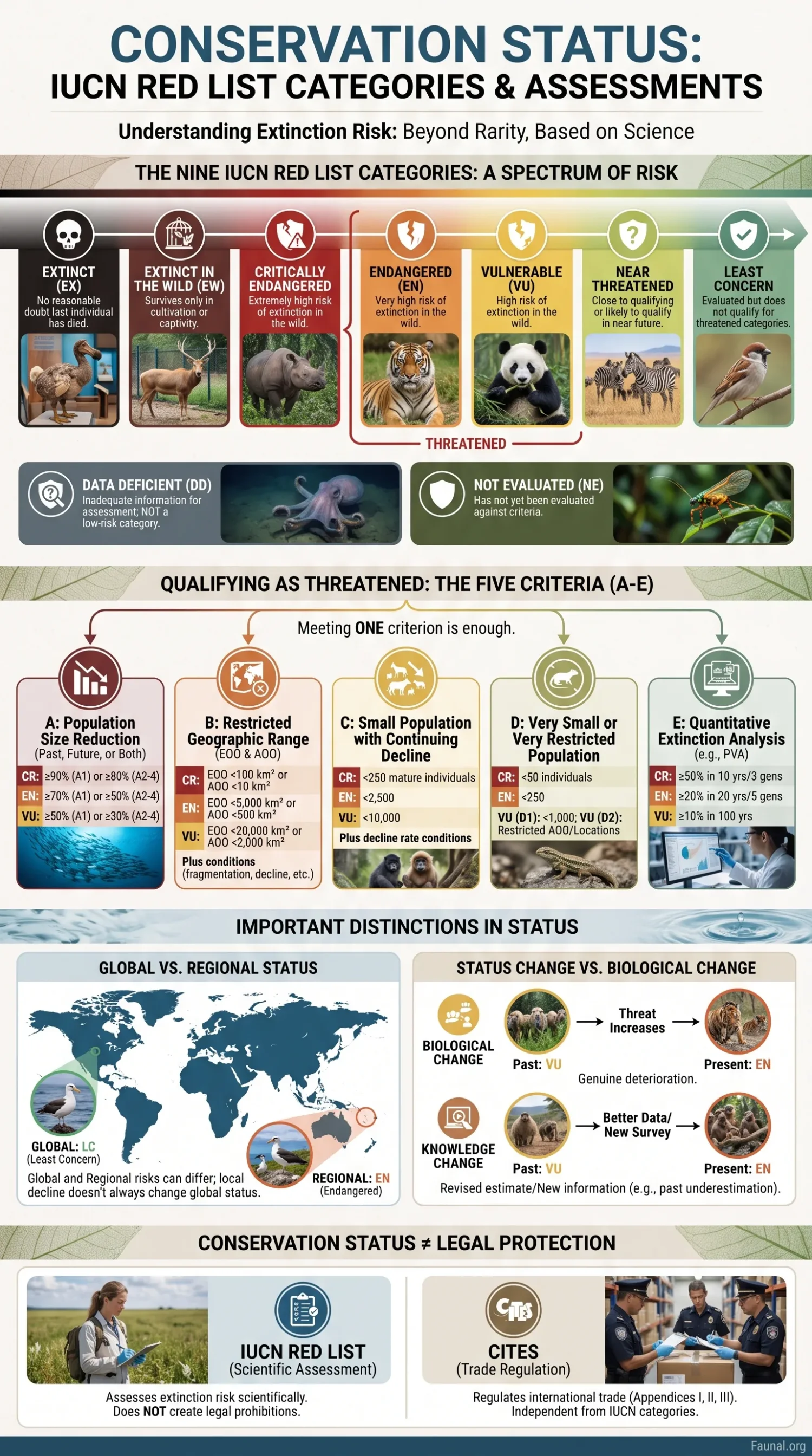
Conservation status describes the assessed risk that a species or other taxon will become extinct within a defined geographic scope. In the IUCN Red List system, the result is not based on rarity alone. Assessors examine population reduction, geographic range, population size and structure, restricted distribution, and, where suitable data exist, modeled probability of extinction.
A status therefore needs context. Critically Endangered, Endangered, and Vulnerable have precise meanings under the IUCN Red List Categories and Criteria. Data Deficient means the available evidence is insufficient for an adequate extinction-risk assessment, while Least Concern means the taxon has been evaluated and does not meet the thresholds for Near Threatened or a threatened category.
The Nine IUCN Red List Categories
The global IUCN system places assessed taxa along a set of categories ranging from extinction to comparatively low assessed risk. Only three of these categories—Vulnerable, Endangered, and Critically Endangered—are collectively defined by IUCN as threatened.
| Category | Code | Meaning | Threatened category? |
|---|---|---|---|
| Extinct | EX | There is no reasonable doubt that the last individual has died. | No |
| Extinct in the Wild | EW | The taxon survives only in cultivation, captivity, or as a naturalized population outside its past range. | No |
| Critically Endangered | CR | The evidence meets at least one threshold associated with an extremely high risk of extinction in the wild. | Yes |
| Endangered | EN | The evidence meets at least one threshold associated with a very high risk of extinction in the wild. | Yes |
| Vulnerable | VU | The evidence meets at least one threshold associated with a high risk of extinction in the wild. | Yes |
| Near Threatened | NT | The taxon does not currently qualify as CR, EN, or VU but is close to qualifying or is likely to qualify in the near future. | No |
| Least Concern | LC | The taxon has been evaluated and does not qualify for CR, EN, VU, or NT. | No |
| Data Deficient | DD | Available information is inadequate for a direct or indirect assessment of extinction risk. | Unknown |
| Not Evaluated | NE | The taxon has not yet been evaluated against the IUCN Red List criteria. | Unknown |
Data Deficient is not a low-risk category. A DD species may later prove to be Least Concern, threatened, or even at very high risk once enough distribution, abundance, demographic, or threat data become available.
How a Species Qualifies as Vulnerable, Endangered, or Critically Endangered
IUCN uses five criteria, labeled A through E. A taxon does not have to meet every criterion. Meeting the threshold for one criterion is enough to qualify for a threatened category, although assessors are expected to test as many criteria as the available evidence permits.
| Criterion | Biological signal assessed | Examples of evidence |
|---|---|---|
| A | Population size reduction | Observed, estimated, inferred, projected, or suspected population reduction over a defined period. |
| B | Restricted geographic range | Extent of occurrence, area of occupancy, fragmentation, locations, continuing decline, or extreme fluctuations. |
| C | Small population with continuing decline | Number of mature individuals combined with decline, population structure, or extreme fluctuations. |
| D | Very small or very restricted population | Very few mature individuals or, for VU D2, a highly restricted distribution exposed to a plausible rapid threat. |
| E | Quantitative extinction analysis | Modeled probability of extinction in the wild, often using population viability or comparable demographic analysis. |
Criterion A: population reduction
Criterion A measures population reduction over the longer of 10 years or three generations, subject to limits defined in the Red List criteria. A1 is used for a past reduction whose causes are understood, have ceased, and are reversible. A2 covers past reductions where those conditions are not all met. A3 deals with projected future reduction, while A4 covers a period spanning both past and future.
| Criterion A threshold | Critically Endangered | Endangered | Vulnerable |
|---|---|---|---|
| A1 population reduction | ≥90% | ≥70% | ≥50% |
| A2, A3, or A4 population reduction | ≥80% | ≥50% | ≥30% |
Criterion B: geographic range
A small geographic range does not by itself place a species in a threatened category under Criterion B. The taxon must fall below the relevant extent-of-occurrence or area-of-occupancy threshold and satisfy at least two additional conditions involving severe fragmentation or few locations, continuing decline, or extreme fluctuations.
| Range measure | Critically Endangered | Endangered | Vulnerable |
|---|---|---|---|
| B1: extent of occurrence | <100 km² | <5,000 km² | <20,000 km² |
| B2: area of occupancy | <10 km² | <500 km² | <2,000 km² |
| Locations under B(a), where applicable | 1 | ≤5 | ≤10 |
Extent of occurrence (EOO) and area of occupancy (AOO) are not interchangeable. EOO describes the spatial spread of the taxon’s occurrence, while AOO concerns the area within that range that is actually occupied under the Red List measurement rules. Habitat area, mapped range, EOO, and AOO therefore should not be treated as identical values.
Criterion C: small and declining populations
Criterion C combines a small number of mature individuals with evidence of continuing decline and specified population-structure or fluctuation conditions. A species with a small population does not automatically satisfy Criterion C unless the required decline and subcriteria are also met.
| Criterion C measure | Critically Endangered | Endangered | Vulnerable |
|---|---|---|---|
| Maximum number of mature individuals | <250 | <2,500 | <10,000 |
| C1 continuing decline | ≥25% in 3 years or 1 generation | ≥20% in 5 years or 2 generations | ≥10% in 10 years or 3 generations |
Criterion D: very small or restricted populations
Criterion D can identify extinction risk even when a rapid decline has not been demonstrated. Extremely small populations may be vulnerable to demographic, environmental, or chance events simply because so few mature individuals remain.
| Criterion D | Critically Endangered | Endangered | Vulnerable |
|---|---|---|---|
| Mature individuals | <50 | <250 | D1: <1,000 |
| Very restricted distribution | — | — | D2: typically AOO <20 km² or ≤5 locations, together with a plausible threat capable of causing a rapid move toward CR or EX |
Criterion E: modeled extinction probability
Criterion E uses quantitative analysis rather than a single range or abundance measure. The model must estimate the probability of extinction in the wild within a specified time horizon.
| Category | Criterion E threshold |
|---|---|
| Critically Endangered | ≥50% probability of extinction within 10 years or three generations, whichever is longer, subject to the 100-year limit |
| Endangered | ≥20% probability within 20 years or five generations, whichever is longer, subject to the 100-year limit |
| Vulnerable | ≥10% probability within 100 years |
The Category Is the Result; the Criteria Explain Why
A Red List entry such as EN A2cd contains more information than the word “Endangered.” The category reports the assessed level of extinction risk, while the criterion and subcriteria identify the evidence pathway that produced that result. Different species can therefore have the same Red List category for very different biological reasons.
One Endangered species may qualify because its population has undergone a severe reduction. Another may have a restricted range combined with continuing decline and few locations. A third may have a small declining population. The category alone should not be used as a substitute for reading the assessment rationale and criteria.
What Evidence Goes Into an IUCN Assessment?
Assessors use the best available evidence across the taxon’s assessment scope. Depending on the species and the criterion being tested, useful evidence may include field surveys, published research, monitoring programs, museum records, exploitation data, habitat information, generation length, population estimates, range measurements, threat information, demographic models, and expert inference supported by documented evidence.
- Taxonomy: the taxon being assessed must be clearly defined and consistent with the taxonomic standards used by the Red List.
- Geographic range: available records and mapped information may be used to estimate EOO, AOO, locations, fragmentation, and range change.
- Population: assessments may consider numbers of mature individuals, subpopulation structure, population reduction, continuing decline, and extreme fluctuations.
- Habitat and ecology: ecological requirements help establish where the species can persist and how habitat change may affect it.
- Threats: assessors document pressures such as habitat loss, exploitation, invasive taxa, pollution, disease, or other processes when evidence supports them.
- Conservation actions: existing measures are recorded, although the Red List category remains an extinction-risk assessment rather than a score for conservation effort.
- Distribution map: most published assessments include mapped distribution information, subject to the Red List’s spatial documentation rules.
Inference and projection are permitted under the criteria when direct counts are unavailable, but their assumptions must be documented. An assessment is therefore not restricted to species for which every individual has been counted.
Who Produces and Reviews Red List Assessments?
Many assessments are prepared through the IUCN Species Survival Commission, Red List Authorities, Red List Partners, and IUCN-led assessment projects. People outside those groups may also prepare assessments when they have sufficient expertise, but publication on the IUCN Red List requires submission through the Red List system and review against IUCN standards.
Before publication, assessments are checked for correct use of the criteria, required supporting information, consistency, taxonomy, and mapping requirements. The published result therefore represents more than an assessor choosing a category from a list.
Conservation Status Can Change Without the Species Becoming Safer or Less Safe
A move between categories does not automatically prove a real biological improvement or deterioration. Category changes can result from genuine population or range change, but they can also follow new information, revised estimates, altered interpretation of existing evidence, or taxonomic revision.
For trend analysis, this distinction matters. A species moving from Vulnerable to Endangered because better historical data revealed that its earlier assessment underestimated decline is different from a species moving to Endangered because its population genuinely deteriorated after the previous assessment.
IUCN aims to reassess species approximately every 5–10 years, depending on data availability, concern, and assessment capacity. There is no fixed interval for every taxon, and new information can trigger earlier reassessment.
Assessment Date Matters
A conservation status should be reported together with its assessment date or Red List version whenever precision matters. Species data change, new surveys become available, threats can intensify or ease, and taxonomic revisions may alter the unit being assessed.
As of September 2026, the most recent published IUCN Red List release is version 2026-1, released on 9 July 2026. A later update, version 2026-2, is scheduled for November 2026. Individual species assessments still retain their own assessment dates, so the current Red List release does not mean that every species was reassessed in 2026.
Global Status and Regional Status Are Different Questions
The standard IUCN Red List category normally describes extinction risk across the species’ global range. A species can be secure globally while being rare or at high risk within one country, state, island, river basin, or other region.
Regional Red Lists therefore require additional rules. For non-endemic species, movement across the regional boundary can alter local extinction risk. Migratory species, marginal populations, introduced populations, and populations supported by immigration require treatment that is not needed in the same way for a global assessment.
| Assessment scope | Question being answered | Important implication |
|---|---|---|
| Global | What is the extinction risk of the taxon across its global range? | This is the normal scope of an IUCN Red List species assessment. |
| Regional or national | What is the risk of regional extinction within the defined area? | Population exchange across the boundary and regional eligibility rules may affect the result. |
| Regional categories | Has the taxon disappeared locally, or should it be included in the regional assessment? | IUCN regional work can also use Regionally Extinct (RE) and Not Applicable (NA). |
A Local Decline Does Not Automatically Change the Global Category
A severe decline in one country can be biologically important without being large enough to change the extinction risk calculated across the species’ entire global population. The reverse can also occur: a species may remain locally common in one area while facing high global extinction risk.
Data Deficient Species Need Separate Treatment
Data Deficient is assigned when available information is inadequate to assess extinction risk directly or indirectly from distribution or population status. It may apply even when parts of the species’ biology are well studied if the information needed to judge abundance, distribution, decline, or another relevant criterion remains inadequate.
DD taxa should not be grouped automatically with Least Concern species. They also should not automatically be counted as threatened. Their risk is unresolved by the assessment. This uncertainty is one reason estimates of the percentage of species threatened within a taxonomic group are often presented as ranges when Data Deficient species are present.
Near Threatened Is Outside the Three Threatened Categories
Near Threatened species have been assessed against the Red List criteria but do not currently qualify as Vulnerable, Endangered, or Critically Endangered. They are close to qualifying for a threatened category or are considered likely to qualify in the near future.
The distinction matters in datasets and species counts. Combining NT with VU, EN, and CR under the formal IUCN term “threatened species” changes the meaning of the statistic.
Least Concern Does Not Mean No Conservation Problems
Least Concern means that a taxon has been evaluated and does not meet the thresholds for NT, VU, EN, or CR at the assessment scope and date. It does not mean that populations are identical everywhere, that no local declines exist, or that the species faces no threats.
A widespread species can remain LC despite declines that are not large enough to satisfy the Red List thresholds. Regional populations can also be much less secure than the global assessment suggests.
Conservation Status Is Not the Same as Legal Protection
An IUCN Red List category is a scientific assessment of extinction risk. It does not by itself create a legal prohibition on hunting, collecting, possession, habitat modification, or trade. Legal protection depends on national laws and international agreements that use their own listing rules.
CITES Appendices regulate international trade
CITES uses three Appendices to regulate international trade in listed wildlife. Appendix I includes species threatened with extinction that are or may be affected by trade and applies especially strict controls. Appendix II can include species that are not necessarily currently threatened with extinction but require controlled trade so that use does not become incompatible with their survival. Appendix III concerns species protected by a Party that has requested international assistance with trade control.
A CITES Appendix and an IUCN Red List category should therefore be stored as separate data fields. One describes a trade-control listing; the other describes an extinction-risk assessment.
Other Conservation Status Systems Use Different Scales
IUCN is the most widely used global species extinction-risk system, but “conservation status” is a broader term. NatureServe, for example, assigns conservation ranks at global, national, and subnational scales. Its global ranks include G1 Critically Imperiled through G5 Secure, together with additional ranks for extinction, uncertainty, and other situations.
| System | Primary purpose | Examples of labels | Should it be treated as an IUCN category? |
|---|---|---|---|
| IUCN Red List | Standardized extinction-risk assessment | LC, NT, VU, EN, CR | No conversion needed; these are IUCN categories. |
| IUCN regional assessment | Risk of extinction within a defined region | Regional CR, EN, VU, RE, NA | No. The assessment scope must remain explicit. |
| NatureServe | Conservation status at global, national, and subnational scales | G1–G5, N-ranks, S-ranks | No. The methodology and rank system differ. |
| CITES | International wildlife trade regulation | Appendix I, II, III | No. CITES listings are not Red List categories. |
A Conservation Status Record Needs More Than a Category Code
For biodiversity databases, species profiles, checklists, and conservation comparisons, recording only “EN” or “LC” removes information needed to verify what the status actually means. A useful conservation record should preserve the category together with its source, scope, and date.
| Field | Why it matters |
|---|---|
| Taxon name | Links the assessment to the scientific entity that was actually evaluated. |
| Category | Records the assigned extinction-risk class. |
| Criteria | Shows why a threatened or Near Threatened assessment was reached. |
| Assessment scope | Separates global results from regional or national results. |
| Assessment date | Shows when the evidence was evaluated. |
| Assessment version | Identifies the criteria system applied. |
| Population trend | Provides supporting context but should not replace the formal category. |
| Assessment citation | Allows the published result and supporting evidence to be checked. |
The IUCN Red List Categories and Criteria remain version 3.1. The detailed guidance used to interpret and apply those criteria is updated separately; the current Guidelines for Using the IUCN Red List Categories and Criteria are version 16, published in March 2024.
Sources and Verification
- [a] IUCN Red List Categories and Criteria — Used for the purpose, structure, and current Version 3.1 classification system.
- [b] IUCN Summary of the Five Criteria A–E — Used for population-reduction, geographic-range, mature-individual, restricted-distribution, and quantitative extinction thresholds.
- [c] Guidelines for Using the IUCN Red List Categories and Criteria — Used to verify that version 16, published in March 2024, is the current detailed guidance.
- [d] IUCN Red List Assessment Process — Used for assessment preparation, submission, review, taxonomic checks, supporting evidence, and publication procedures.
- [e] IUCN Red List Supporting Information — Used for the evidence fields included with published assessments, including population, geographic range, threats, habitat, criteria, and distribution maps.
- [f] IUCN Regional Red List Assessments — Used for global versus regional scope and the regional categories Regionally Extinct and Not Applicable.
- [g] IUCN Red List Assessment and Category Information — Used for the formal definition of threatened species and IUCN’s stated 5–10 year reassessment aim.
- [h] IUCN Red List Update Information — Used to verify that version 2026-1, released on 9 July 2026, is the latest published Red List release at the time of this page.
- [i] CITES Appendix Definitions — Used to distinguish international trade controls under Appendices I, II, and III from IUCN extinction-risk categories.
- [j] NatureServe Conservation Status Assessment — Used for the distinction between IUCN categories and NatureServe global, national, and subnational conservation ranks.
1 articles in Conservation Status Guides