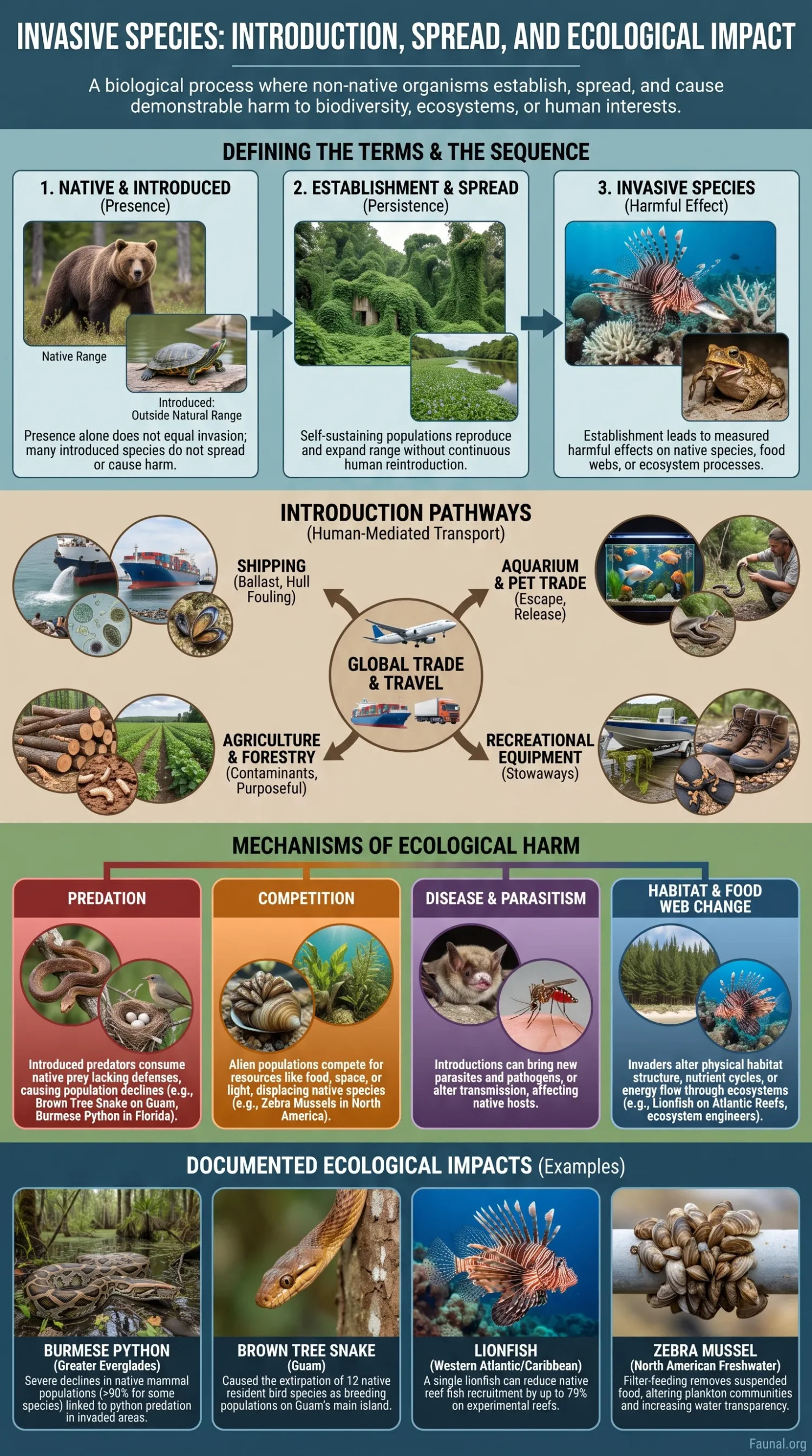
An invasive species is an organism moved outside its natural range that establishes, spreads and causes harmful ecological effects in the receiving environment. The terms alien, non-native, introduced and invasive are therefore not interchangeable. A species can live outside its native range without becoming invasive; invasion describes a biological process in which introduction is followed by establishment, spread and measurable harm.
The Convention on Biological Diversity defines invasive alien species in relation to introduction or spread outside natural past or present distribution and a resulting threat to biological diversity. The exact legal wording differs among jurisdictions, but modern invasion biology consistently separates simple non-native presence from harmful invasion. Convention on Biological Diversity
Alien, Introduced and Invasive Do Not Mean the Same Thing
| Term | Meaning | Does Harm Have to Be Demonstrated? |
|---|---|---|
| Native species | A species occurring within the geographic range in which it evolved or dispersed without a human-mediated introduction. | No. The term describes geographic origin. |
| Alien or non-native species | A species occurring outside its natural range after movement associated directly or indirectly with human activity. | No. |
| Introduced species | A non-native species whose presence in a new region results from intentional or unintentional human transport, release, escape or related activity. | No. |
| Established alien species | An introduced population that survives and reproduces sufficiently to persist without continual reintroduction. | No. |
| Invasive alien species | An alien species that establishes or spreads and produces harmful effects on biodiversity, ecosystems or other defined values. | Yes, under widely used ecological and institutional definitions. |
This distinction prevents a common error: treating every organism outside its native range as ecologically damaging. Many introduced populations remain localized, depend on continued human support or persist without documented harm. The invasive subset is defined by what happens after arrival.
A Biological Invasion Is a Sequence, Not a Single Event
The arrival of an organism is only the first barrier. Invasion research commonly separates transport, introduction, establishment and spread because a population can fail at any one of these stages. Ecological impact follows when the established population alters native populations, communities or ecosystem processes. This stage-based treatment is also useful because evidence of transport is not evidence of establishment, and evidence of establishment is not by itself evidence of ecological damage. Blackburn et al. 2011
| Stage | What Happens | What the Evidence Can Show |
|---|---|---|
| Transport | Individuals, eggs, larvae, seeds, spores or other viable material are moved beyond the native range. | A pathway exists, but arrival in a free-living environment may not yet have occurred. |
| Introduction | The organism reaches the receiving environment through release, escape, contamination, transport or another pathway. | Presence has occurred outside the native range. |
| Establishment | A population survives and reproduces enough to persist without repeated replenishment. | The population is self-sustaining at the location or region being assessed. |
| Spread | The established population expands into additional sites through its own dispersal or further human-assisted movement. | The occupied area is expanding beyond initial points of introduction. |
| Ecological impact | The population changes native species, food webs, habitat structure, ecosystem processes or other ecological properties. | Observed or experimentally supported effects can be attributed to the invader with a stated level of confidence. |
Failure at an early stage is common. Individuals may arrive but encounter unsuitable temperature, salinity, moisture, food resources or breeding conditions. A population may survive for years yet remain too small or isolated to expand. Conversely, repeated introductions can continually add individuals to a population and increase the chance that establishment succeeds.
How Species Cross Their Natural Range Boundaries
Human transport and trade move organisms across geographic barriers that they would rarely or never cross on their own. Some movements are deliberate. Others occur because organisms are attached to commodities, vessels, vehicles, soil, packaging, equipment or other transported material.
The CBD pathway classification groups introductions into six main categories. The system separates organisms deliberately moved for release, organisms deliberately transported but later escaping, accidental contaminants and stowaways, movement through human-made corridors, and natural secondary dispersal from an already invaded region. CBD introduction pathway guidance
| CBD Pathway | How Introduction Occurs | Typical Examples |
|---|---|---|
| Release | The organism is intentionally transported and deliberately placed into the open environment. | Fish released for fisheries, game animals, biological-control organisms or other purposeful releases. |
| Escape | The organism is intentionally transported for captivity, cultivation or controlled use but later reaches the wild. | Escaped pets, aquarium organisms, farmed animals, aquaculture species or organisms leaving zoological and botanical collections. |
| Transport contaminant | The organism is unintentionally carried with a commodity that is intentionally moved. | Pests in timber, organisms in nursery material, parasites on traded hosts, contaminated seed or organisms transported with soil. |
| Transport stowaway | The organism travels on or inside a vehicle, container, equipment or transport medium rather than as part of the commodity itself. | Ballast-water organisms, hull-fouling species, insects in containers, organisms on machinery or hitchhikers in luggage. |
| Corridor | Human-built connections allow organisms to move between areas that were previously separated. | Interconnected waterways, canals, tunnels or land connections. |
| Unaided | An alien species already established in one region disperses naturally into another region where it is also non-native. | Natural movement across a border after an earlier human-mediated introduction elsewhere. |
Introduction pathway and later spread are not necessarily the same. A species may first arrive in ballast water, establish in a port, and later spread naturally along a coastline. Another may escape from captivity and then be moved again by vehicles, boats or equipment.
Why Some Introductions Establish and Others Fail
There is no single biological trait that makes every species a successful invader. Establishment depends on the interaction between the introduced organism, the receiving environment and the circumstances of introduction. Climate and habitat must permit survival, enough individuals must persist to reproduce, and the population must obtain food, space or other resources while coping with predators, parasites, competitors and disturbance.
The same species can therefore have different outcomes in different places. It may fail to establish in one region, persist without wide spread in another, and become invasive elsewhere. Previous invasion success in comparable environments can be informative when assessing risk, but it does not make a future invasion inevitable. CBD invasive alien species information
Spread Begins After a Population Can Persist
Once established, an alien population can expand by walking, swimming, flying, drifting, producing mobile larvae or propagules, or using rivers and ocean currents. Human activity can accelerate the process by repeatedly moving organisms among watersheds, islands, ports, farms, forests and urban areas.
Secondary transport can matter as much as the original international introduction. Recreational watercraft can move aquatic organisms among lakes; firewood can carry forest insects over distances far beyond normal dispersal; fishing equipment can transfer aquatic organisms; and pets or aquarium animals can create new release points. The U.S. National Invasive Species Information Center lists shipping, ballast water, firewood, aquaculture, aquarium trade, recreational equipment and agricultural materials among documented pathways. National Invasive Species Information Center
Ecological Harm Can Occur Through Several Mechanisms
Ecological impact does not require the global extinction of a native species. An invader can reduce local abundance, change age structure, alter feeding relationships, remove prey, displace competitors, transmit disease, modify habitat or redirect energy and nutrient flows through an ecosystem. Effects may remain local or spread across entire regions.
Predation and Herbivory
Introduced predators can encounter prey that lack effective defenses against them. The result may be reduced recruitment, lower abundance or local disappearance. Invasive herbivores can similarly suppress native vegetation and alter the habitat available to other organisms.
Competition
Alien populations may compete with native species for food, nesting sites, light, nutrients, shelter or other limited resources. Competitive effects can be direct, or they can emerge indirectly when an invader changes resource availability for several species at once.
Disease and Parasitism
Introductions can move parasites and pathogens together with their hosts, while an introduced host may alter transmission among native organisms. Disease effects are especially difficult to assess when several host species, environmental conditions and infection routes interact.
Hybridization and Genetic Effects
Closely related introduced and native taxa can interbreed. Repeated hybridization may alter the genetic composition of small native populations and, in some cases, make taxonomic and conservation boundaries harder to maintain.
Food-Web and Habitat Change
An invader may change an ecosystem even when direct mortality is not the dominant effect. Filter-feeding organisms can remove suspended food from the water column, predators can reduce herbivores and indirectly alter vegetation or algae, and ecosystem engineers can change water flow, sediment, vegetation structure or shelter. Recent synthesis work on biological invasions describes effects from individual organisms through populations and communities to ecosystem-level processes. Biological Reviews, 2026
Measured Impacts in Invaded Ecosystems
| Invasive Species | Invaded Region | Impact Mechanism | Documented Ecological Effect |
|---|---|---|---|
| Brown tree snake (Boiga irregularis) | Guam | Predation | USGS-supported research found severe effects on 22 resident bird species; 12 were considered likely extirpated as breeding residents on the main island, while several others declined by at least 90% in surveyed areas. |
| Burmese python (Python bivittatus) | Greater Everglades, Florida | Predation | USGS research links the established python population with sharp declines in native mammals. A study using more than 4,000 removed pythons describes local declines greater than 90% in mesomammal populations within affected areas. |
| Lionfish (Pterois volitans and Pterois miles) | Western Atlantic and Caribbean | Predation and food-web effects | NOAA summarizes experimental research in which one lionfish on a coral reef reduced recruitment of native reef fishes by 79%. Predation on herbivorous fishes can also alter interactions between algae and corals. |
| Zebra mussel (Dreissena polymorpha) | North American freshwater systems | Filter feeding, competition and food-web change | USGS records large location-specific reductions in phytoplankton after invasion. Lake Erie studies reported an 82–91% decline in diatom abundance during the first years of invasion, together with increased water transparency. |
These examples show different forms of impact rather than a universal invasion pattern. Brown tree snakes remove vertebrate prey, pythons alter mammal communities through predation, lionfish suppress reef-fish recruitment, and zebra mussels redirect aquatic production by filtering material from the water column.
Brown Tree Snake on Guam
The brown tree snake was accidentally transported to Guam after the Second World War and subsequently spread across the island. USGS research documents severe losses among Guam’s native birds as the snake became an abundant generalist predator. One analysis of surveys from 1976 to 1998 found that 17 of 18 native resident bird species were severely affected and that 12 resident species were likely extirpated as breeding populations on the main island. U.S. Geological Survey
Burmese Python in the Greater Everglades
The Burmese python is now established across a large part of the Greater Everglades Ecosystem. Its cryptic behavior makes direct population estimation difficult, so ecological assessment relies on several forms of evidence, including diet studies, removals, telemetry and changes in prey communities. USGS describes the python as an important factor in sharp mammal declines and reports that reliable abundance estimates for the python itself remain unavailable. U.S. Geological Survey Burmese python research
A separate USGS publication using records from more than 4,000 wild pythons removed between 1995 and 2021 reports local declines exceeding 90% in mesomammal populations in invaded parts of southern Florida. USGS python demographic study
Lionfish on Atlantic Reefs
Two Indo-Pacific lionfish, Pterois volitans and Pterois miles, became established in western Atlantic waters. They are generalist predators that consume native fishes and invertebrates. NOAA reports research in which a single lionfish reduced recruitment of native reef fishes by 79% on an experimental reef. The effect can extend beyond the prey eaten directly because lionfish also consume herbivorous fishes that normally remove algae from reef surfaces. NOAA Fisheries
Zebra Mussels and Freshwater Food Webs
Zebra mussels, Dreissena polymorpha, can form dense colonies and filter large volumes of suspended material from freshwater. Their feeding removes phytoplankton and other particles that support pelagic food webs. USGS records from invaded North American waters document large changes in chlorophyll, phytoplankton biomass, diatom abundance and water transparency, although the size of the effect differs among sites and years. USGS Nonindigenous Aquatic Species Database
Local Population Loss Can Matter Before Global Extinction
Ecological damage is often visible long before a species disappears globally. A native animal can vanish from part of its range, become too scarce to perform its former ecological role or experience altered reproduction and recruitment. Loss of seed dispersers, herbivores, predators or filter feeders can then affect other species that were not directly interacting with the invader.
At the global scale, invasive alien species are associated with an unusually large share of recorded extinctions. IUCN, drawing on Red List and IPBES evidence, reports that invasive alien species have contributed alone or with other pressures to 60% of recorded global extinctions and were the only identified driver in 16%. Islands are especially exposed because many island species evolved in isolation from mammalian predators, novel competitors or introduced diseases. IUCN
The Global Scale Is Larger Than Species Lists Alone Suggest
Alien Species Moved Beyond Native Ranges
More than 37,000
Global total reported by the 2023 IPBES invasive alien species assessment for species introduced through human activities.
Recorded Global Extinctions With IAS Involvement
60%
Invasive alien species acting alone or together with other drivers, as reported from global assessment evidence.
Estimated Annual Economic Cost in 2019
More than US$423 billion
Global biological-invasion cost reported by the IPBES assessment.
The 2023 IPBES assessment reported more than 37,000 alien species introduced by human activities across regions and biomes. It also estimated that the annual global economic cost of biological invasions exceeded US$423 billion in 2019 and had risen by at least fourfold per decade since 1970. These figures combine many taxonomic groups and types of impact; they should not be interpreted as a count of animal invasions alone. UN Environment Programme summary of the IPBES assessment
Why Islands and Freshwater Systems Can Be Highly Exposed
Oceanic islands often contain endemic species that evolved for long periods without certain predators, competitors or diseases. When a new predator such as a rat, snake or carnivorous mammal arrives, native prey may lack behaviors that reduce predation. Small geographic ranges also mean that a single invasion can affect a large fraction of a species’ total population.
Freshwater ecosystems have a different exposure pattern. Boats, fishing equipment, aquaculture, canals and connected waterways can move organisms among drainage basins, while many aquatic invaders produce larvae or other life stages that are difficult to detect. Once spread through a connected river or lake system, physical removal may become difficult.
Ecological Impact Must Be Attributed, Not Assumed
A non-native species found near a declining native population is not automatically the cause of that decline. Habitat loss, pollution, harvest, climate, disease and other biological interactions may occur at the same time. Strong impact assessment therefore relies on evidence that connects the invader to the observed change.
Useful evidence can include before-and-after surveys, comparisons between invaded and uninvaded sites, manipulative experiments, diet analysis, demographic studies, long-term monitoring and repeated observations across independent locations. Different approaches have different weaknesses. A correlation across sites can reveal a pattern without proving mechanism, while a controlled experiment may establish mechanism at a small scale without showing the full regional effect.
Presence Records Are Not Impact Records
An occurrence record confirms that an organism was reported at a place and time. It does not by itself demonstrate establishment, continued spread or ecological harm. Those questions require additional evidence.
Recent reviews of biological invasions also emphasize that impact estimates can be complicated by simultaneous habitat alteration, pollution, climate effects and other pressures. The strongest interpretation is therefore tied to the geographic scale, study design, time period and biological mechanism actually measured. Biological Reviews
The Invasion Stage Changes the Available Response
The distinction between introduction, establishment and spread is practical as well as biological. Preventing arrival acts before a population exists. Early detection targets newly arrived or localized populations. Eradication attempts to remove every reproducing individual from a defined area, while containment and long-term control become more relevant after spread has made complete removal unrealistic.
CBD guidance places prevention first because stopping introductions generally requires fewer resources than managing a widespread population. Where prevention fails, rapid action while the population remains geographically restricted can preserve options that disappear after broad establishment. CBD Guiding Principles
Sources and Verification
- IPBES — Invasive Alien Species Assessment — Official citation record for the 2023 global assessment, including the report chapters on biological invasions, drivers and ecological impacts.
- United Nations Environment Programme — Invasive Alien Species Report — Used for the global total of alien species introduced through human activities and the 2019 economic-cost estimate reported from IPBES.
- Convention on Biological Diversity — What are Invasive Alien Species? — Used for invasive-alien-species terminology and the distinction between arrival, establishment, spread and harm.
- Convention on Biological Diversity — Guidance for Interpretation of Introduction Pathway Categories — Used for the six standardized pathway categories: release, escape, contaminant, stowaway, corridor and unaided dispersal.
- Blackburn et al. — A Proposed Unified Classification for Biological Invasions — Peer-reviewed basis for separating transport, introduction, establishment and spread as distinct invasion stages.
- Biological Reviews — The Impacts of Biological Invasions — Used for impact mechanisms, biological scales of effect and limits in attributing ecological change to an invader.
- U.S. Geological Survey — Impacts of the Brown Tree Snake on Guam’s Avifauna — Used for measured bird declines and breeding-population extirpations associated with Boiga irregularis.
- U.S. Geological Survey — Invasive Burmese Python Research in the Greater Everglades — Used for current establishment status, ecological context and limits on python population estimates.
- U.S. Geological Survey — Size Distribution and Reproductive Phenology of Invasive Burmese Pythons — Used for the long-term removal dataset and reported local declines in mesomammal populations.
- NOAA Fisheries — Impacts of Invasive Lionfish — Used for Atlantic lionfish ecology, reef-fish predation and the reported 79% reduction in native reef-fish recruitment.
- U.S. Geological Survey Nonindigenous Aquatic Species Database — Zebra Mussel — Used for Dreissena polymorpha food-web effects, phytoplankton changes and site-specific freshwater observations.
- IUCN — Invasive Alien Species: Impacts on Ecosystems and Human Well-being — Used for the reported contribution of invasive alien species to recorded global extinctions and the heightened exposure of island ecosystems.
- National Invasive Species Information Center — Pathways — Used for practical examples of intentional, accidental and secondary human-assisted movement.
- Convention on Biological Diversity — Guiding Principles for Invasive Alien Species — Used for the prevention-first hierarchy and the relationship between invasion stage and management options.
Invasive Freshwater Fish in Turkey: Impacts on Native Species
Invasive freshwater fish in Turkey are organized around impacts on native species, distinguishing introduced status from documented ecological...
Native, Introduced, and Invasive Animals in Regional Fauna Lists
Regional fauna lists separate native, introduced, and invasive animals by origin, establishment, spread, and documented ecological impact.
2 articles in Invasive Species Guides