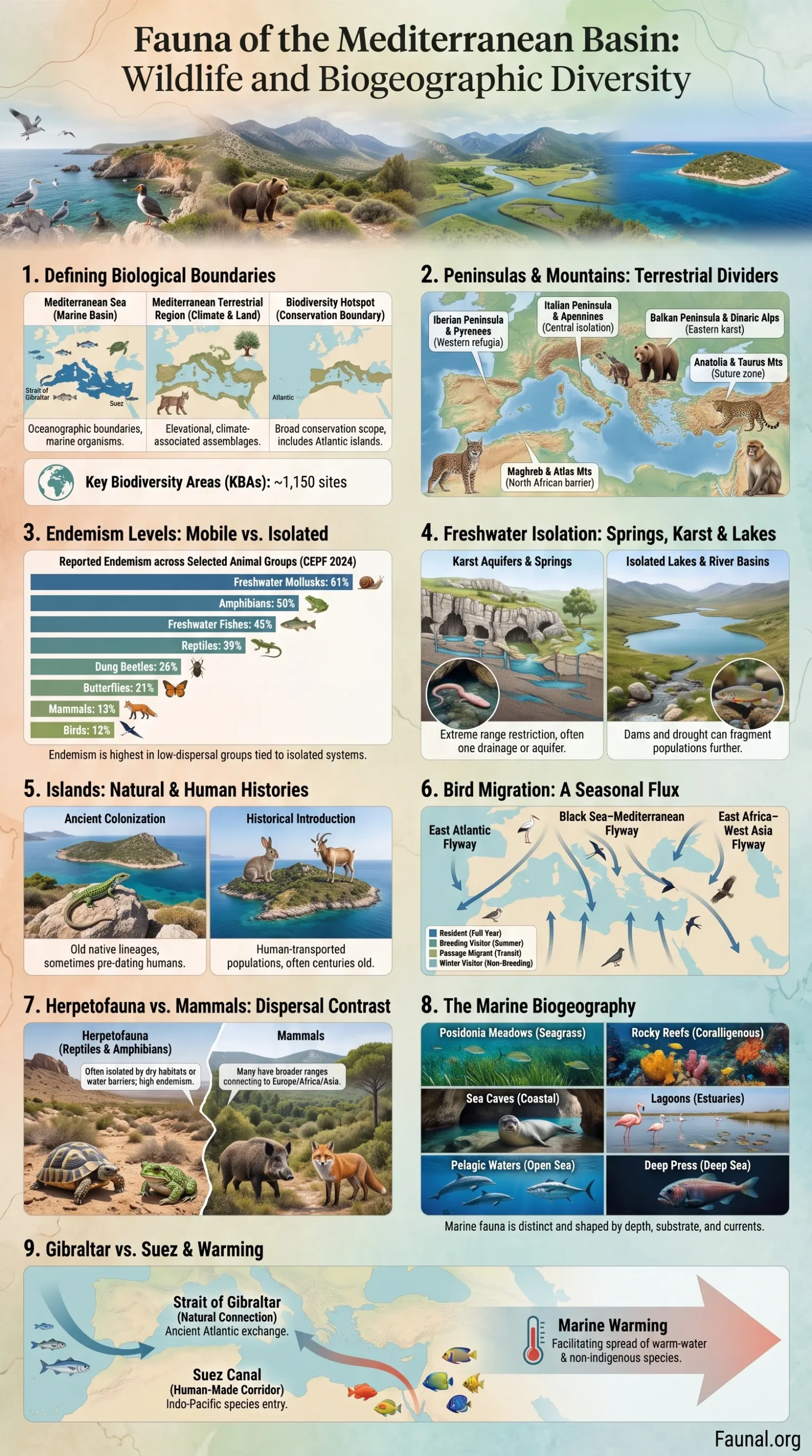
The Mediterranean Basin supports a mosaic of animal communities rather than one uniform Mediterranean fauna. Europe, North Africa and western Asia meet around a semi-enclosed sea, while peninsulas, mountain chains, islands, karst aquifers, short river systems and seasonal wetlands repeatedly separate animal populations. The result is strong geographic turnover: mammals and birds often retain broad continental connections, while freshwater fishes, amphibians, reptiles, mollusks and other low-dispersal groups can contain many species restricted to individual islands, drainage basins, mountain systems or groundwater networks.
The Mediterranean Basin Has More Than One Biological Boundary
“Mediterranean fauna” can refer to different geographic units. The Mediterranean Sea defines a marine system connected naturally to the Atlantic through the Strait of Gibraltar. Terrestrial Mediterranean environments extend around parts of southern Europe, North Africa and western Asia. Conservation assessments may use still another boundary. The CEPF Mediterranean Basin Biodiversity Hotspot Ecosystem Profile, for example, includes Mediterranean lands and islands but also parts of Macaronesia in the Atlantic.
| Geographic unit | What it represents | Faunal consequence |
|---|---|---|
| Mediterranean Sea | The marine basin between Europe, North Africa and western Asia, connected to the Atlantic through Gibraltar and to the Red Sea through the human-made Suez Canal. | Marine fish, invertebrates, cetaceans, turtles and other marine organisms follow oceanographic rather than terrestrial boundaries. |
| Mediterranean terrestrial region | Coasts, islands, lowlands, mountains, woodland, shrubland, grassland, wetlands and freshwater systems associated with the Mediterranean climatic and geographic zone. | Animal assemblages vary with elevation, rainfall, isolation, drainage and continental connection. |
| Mediterranean Basin Biodiversity Hotspot | A conservation boundary used by CEPF that extends beyond the shores of the Mediterranean and includes Atlantic island groups within Macaronesia. | Species totals published for the hotspot should not be presented as exact totals for the Mediterranean Sea or its immediate coastline. |
A species count is meaningful only when its geographic and taxonomic scope is stated. Hotspot totals, Mediterranean Sea totals, national checklists and occurrence databases measure different things.
IUCN Mediterranean assessments
6,000 species
Species assessed for the IUCN Red List within the Mediterranean programme’s stated scope.
Threatened among assessed species
25%
The percentage applies to the assessed set, not to every animal species occurring around the Mediterranean.
Key Biodiversity Areas
1,150
The current regional figure reported by IUCN across terrestrial, freshwater and marine biodiversity work.
These assessment figures come from the IUCN Mediterranean programme. They describe conservation assessment coverage and should not be converted into a total fauna estimate.
Peninsulas, Mountains and Refugia Split the Terrestrial Fauna
Mediterranean climates occur across much of the basin, but climate alone does not explain animal distribution. Iberia, Italy and the Balkans acted as major southern refugial areas for many European lineages during Pleistocene cold phases. Populations isolated in these peninsulas could remain separated long enough to develop distinct genetic lineages, while later warming allowed some groups to expand northward. Molecular biogeography also identifies Anatolia as an area where European, Caucasian and Middle Eastern lineages meet and where refugial populations persisted.
The Pyrenees, Alps, Apennines, Dinaric Alps, Hellenic ranges, Taurus Mountains and Atlas Mountains add another layer of separation. A mountain can block dispersal across its slopes while simultaneously preserving cooler or wetter habitats at higher elevations. Valleys, ridges and isolated massifs can therefore divide populations at short geographic distances.
This history explains why two Mediterranean landscapes with similar summer drought and winter rainfall may contain different reptiles, amphibians, small mammals or freshwater animals. Shared climate does not erase the effects of past isolation, drainage history or barriers to movement. Phylogeographic studies of European refugia and Anatolia document these repeated patterns of survival and differentiation.
| Faunal zone | Geographic core | Processes shaping the fauna | Typical biological signal |
|---|---|---|---|
| Iberian–Alboran | Iberian Peninsula, Strait of Gibraltar, Alboran margins and northwestern Maghreb | Iberian refugia, Atlantic proximity, mountain isolation and Europe–North Africa separation | Western Mediterranean lineages, localized amphibians and reptiles, and strong turnover across the Strait of Gibraltar |
| Tyrrhenian–Central Mediterranean | Italian Peninsula, Sicily, Sardinia, Corsica and nearby islands | Italian refugia, repeated sea-level change and long island isolation | Peninsular lineages beside old island populations and many human-mediated historical introductions |
| Adriatic–Dinaric | Eastern Adriatic and western Balkans | Limestone karst, caves, springs, short drainage systems and Balkan refugia | High concentration of freshwater, subterranean and amphibian range restriction |
| Aegean | Greece, Aegean archipelagos and western Anatolia | Archipelago fragmentation, former land connections and repeated island isolation | High reptile turnover and complex native-versus-introduced histories on islands |
| Anatolian–Levantine | Southern Anatolia, Cyprus and the Levant | Anatolian mountains, closed basins, West Asian connections and dryland transitions | Mediterranean fauna mixed with Anatolian and western Asian elements |
| Maghreb | Morocco, Algeria, Tunisia and adjoining North African systems | Atlas Mountains, Mediterranean coast, arid interior transition and long separation from Europe | North African mammals, reptiles and amphibians occurring beside western Mediterranean lineages |
Endemism Rises Where Dispersal Becomes Difficult
Animal groups do not respond equally to geographic isolation. A migratory bird can cross seas and mountain chains that completely isolate a spring fish or cave invertebrate. The 2024 CEPF profile illustrates this contrast. Its figures are drawn from assessments published in different years, and CEPF states that later taxonomic changes may alter some values, so they are best treated as a source-defined comparison rather than a synchronized census.
| Animal group | Native species in CEPF hotspot dataset | Endemic species | Reported endemism |
|---|---|---|---|
| Freshwater mollusks | 629 | 384 | 61% |
| Amphibians | 109 | 54 | 50% |
| Freshwater fishes | 622 | 280 | 45% |
| Reptiles | 299 | 117 | 39% |
| Dung beetles | 579 | 150 | 26% |
| Butterflies | 462 | 98 | 21% |
| Mammals | 298 | 38 | 13% |
| Birds | 534 | 63 | 12% |
The freshwater mollusk, butterfly and mammal rows in the CEPF table exclude Macaronesian islands. The table therefore should not be interpreted as one perfectly uniform geographic census. Its strongest biological signal is the contrast between mobile vertebrates and animals tied to isolated freshwater, island or terrestrial systems.
Endemism Across Selected Mediterranean Basin Hotspot Animal Groups
Reported endemic share for selected groups in CEPF's 2024 ecosystem profile.
CEPF 2024 Ecosystem Profile, Table 4.1. Values combine underlying assessments from different publication years and are presented by CEPF as illustrative; some groups exclude Macaronesia.
Springs, Karst and Isolated Lakes Produce Extremely Small Ranges
Freshwater geography fragments Mediterranean fauna more sharply than broad terrestrial climate zones. CEPF recognizes 26 freshwater ecoregions within its Mediterranean Basin scope and reports 622 freshwater fish species, including 280 endemics. The Balkans and Türkiye are repeatedly identified as centers of freshwater fish endemism because limestone systems, independent drainage basins, lakes, springs and short river networks isolate aquatic populations from one another.
The same mechanism affects mollusks, crustaceans and amphibians. A terrestrial mammal may move between adjacent valleys, but an aquatic species confined to a spring complex may have no natural route into the next watershed. A lake, cave aquifer or headwater can therefore contain a lineage with a geographic range measured in one drainage system rather than across an entire country.
A Small Water Body Can Hold an Entire Species Range
Range restriction is especially severe when a fish, mollusk or subterranean invertebrate depends on one spring, karst aquifer, lake or short drainage. Loss of that water system can remove most or all available habitat for the taxon, even when the surrounding terrestrial landscape remains intact.
The 2026 European Red List of Freshwater Fishes assessed all 558 native European freshwater fish species and classified 42% as threatened and another 18% as Near Threatened. The geographic scope is Europe rather than the entire Mediterranean Basin, but the habitat results are directly relevant to Mediterranean Europe. More than 90% of fish species resident in karst systems were threatened. Springs and intermittent rivers and streams were also identified as heavily affected freshwater habitats, with many of these systems concentrated in Mediterranean Europe.
The assessment also reported physical barriers such as dams and weirs affecting 69% of assessed species, pollution affecting more than 65%, invasive species affecting 56% and climate change already affecting 35%. These pressures act differently from broad habitat loss because they can sever movement between feeding, spawning and refuge habitats while leaving sections of river physically present.
Freshwater conservation work also reveals how many restricted-range species are concentrated into discrete sites. The IUCN Mediterranean freshwater KBA programme reports at least 167 qualifying freshwater Key Biodiversity Areas covering 302,557 km² and containing 491 KBA trigger species. Of those trigger species, 411 were restricted-range taxa and 377 were threatened with extinction under the assessment used for that programme.
Mediterranean Islands Preserve Both Natural and Human-Mediated Histories
Sicily, Sardinia, Corsica, Crete, Cyprus, the Balearic Islands and the many Aegean and Adriatic islands differ in age, area, distance from mainland sources and history of land connection. Their faunas cannot be explained by present-day sea distance alone. Lower sea levels repeatedly altered coastlines and exposed land bridges or shortened over-water crossings, while rafting and other natural dispersal occasionally established populations without a land connection.
Human transport later added another layer. Animals could move with agricultural settlement, shipping, traded goods or deliberate introductions. An island population that appears isolated today may therefore be an old native lineage, a prehistoric colonist, a historical introduction or a recent arrival.
A 2024 Journal of Biogeography study of the Italian wall lizard, Podarcis siculus, combined population genomics with palaeoshoreline reconstruction across four Italian and Croatian archipelagos. Some island populations were estimated to have been established long before known human settlement, with inferred colonization between about 230,000 and 12,000 years ago. Other island populations showed much more recent histories compatible with human-assisted movement. The study concerns one species and should not be generalized to every island animal, but it demonstrates why present-day presence alone cannot establish native origin.
Island Presence Is Not the Same as Island Endemism
An animal recorded on an island may be native but widespread, endemic to that island or archipelago, introduced from another Mediterranean region, or introduced from outside the basin. These categories describe different biological histories and should not be merged.
Bird Migration Makes Mediterranean Fauna Strongly Seasonal
Bird diversity behaves differently from the fauna of an isolated spring or island rock outcrop because many birds use the Mediterranean for only part of their annual cycle. The CEPF Mediterranean species account identifies the East Atlantic, Black Sea–Mediterranean and East Africa–West Asia flyways as major migration systems crossing the hotspot. Millions of migrants move between European breeding areas, Mediterranean staging or wintering areas and African destinations.
The sea can be both a corridor and a barrier. Some birds cross broad stretches of open water. Others concentrate around narrow crossings, coastlines, islands and wetland chains that reduce flight distance or provide feeding and resting habitat. Deltas, lagoons, saltmarshes, shallow lakes and islands may therefore hold very different bird assemblages in spring passage, breeding season, autumn passage and winter.
| Seasonal status | What it means for Mediterranean records | Why it matters |
|---|---|---|
| Resident | The species can remain within the region through the full annual cycle. | Presence still varies locally with habitat, elevation and food availability. |
| Breeding visitor | The species uses Mediterranean areas primarily during the breeding season. | A breeding record carries different information from a passage observation. |
| Passage migrant | The species occurs mainly while moving between breeding and non-breeding ranges. | Islands, wetlands and narrow crossings may hold temporary concentrations. |
| Winter visitor | The species enters or becomes more numerous during the non-breeding season. | Winter fauna may differ sharply from the same site’s summer community. |
A bird occurring somewhere in the Mediterranean Basin is not automatically a Mediterranean resident. Resident, breeding, passage and wintering records describe different ecological uses of the region.
Reptiles and Amphibians Record Isolation More Clearly Than Highly Mobile Vertebrates
CEPF reports 299 reptile species in its hotspot dataset, including 117 endemics, and 109 amphibians, including 54 endemics. Their endemism rates are much higher than those reported for birds or mammals in the same profile. Lower dispersal ability is part of the explanation, but habitat specialization and geographic history matter as well.
Rocky islands and dry slopes can isolate lizard populations even where flying animals move freely between landmasses. Mountain valleys may separate closely related reptile lineages. Amphibians face a different constraint: reproduction usually depends on freshwater or persistently moist microhabitats. In a region defined by seasonal summer drought, suitable ponds, streams, caves, shaded ravines and high-rainfall mountain zones form discontinuous habitat networks.
The Dinaric karst is one of the clearest examples. Cave and groundwater systems can support lineages that are absent from the dry surface landscape only a short distance away. CEPF cites the olm genus Proteus among old amphibian lineages associated with Mediterranean endemism. The broader pattern is more informative than one species: subterranean connectivity follows geology and groundwater, not national borders or surface vegetation maps.
Mammal Diversity Reflects the Meeting of Eurasian and African Faunas
Mediterranean mammals show stronger continental connections than many freshwater or herpetological groups. The 2024 CEPF profile reports 298 mammals in the hotspot dataset and 38 terrestrial endemics. Rodents and shrews account for much of the endemic component, while many larger mammals occupy ranges that extend beyond the Mediterranean climatic zone.
This produces several overlapping mammal assemblages. Iberia contains western European lineages and localized Iberian taxa. The Maghreb contributes North African elements such as Cuvier’s gazelle and Barbary macaque within parts of the hotspot. Anatolia and the Levant connect Mediterranean environments with Caucasian, Iranian and western Asian faunas. Islands such as Corsica and Sardinia add another history involving natural isolation, extinction and ancient human movement.
Large mammals are often the most visible examples, but small mammals can reveal regional differentiation more clearly. Shrews, voles, mice, gerbils, dormice and bats may retain distributions tied to mountain blocks, islands, forest refugia or dryland transitions. A basin-wide mammal list therefore hides much of the geography that explains the fauna.
The Mediterranean Sea Has a Different Biogeography From the Land Around It
Marine fauna follows temperature, salinity, depth, currents, productivity, substrate and connections with neighboring seas. The UNEP/MAP Mediterranean biodiversity account reports more than 17,000 marine species, with an estimated 20–30% of species endemic. This marine total includes a very large invertebrate component and should not be combined directly with terrestrial hotspot counts.
The western basin remains directly connected to Atlantic source populations through Gibraltar. Moving eastward, water becomes warmer and the influence of the Suez connection grows. The eastern Mediterranean is therefore not simply a warmer copy of the western basin; its faunal composition reflects a different balance of Atlantic-origin species, Mediterranean endemics, warm-affinity native taxa and organisms introduced from the Red Sea and Indo-Pacific region.
| Marine habitat | Faunal role | Representative animal groups |
|---|---|---|
| Posidonia oceanica meadows | Three-dimensional coastal habitat providing feeding, shelter and nursery structure over soft and mixed bottoms. | Fishes, crustaceans, mollusks, echinoderms and other mobile and attached invertebrates |
| Rocky reefs and coralligenous formations | Complex hard substrate with crevices and vertical structure. | Groupers and other reef fishes, sponges, bryozoans, mollusks, crustaceans and cnidarians |
| Sea caves and remote rocky coasts | Low-light marine habitat and, in suitable coastal caves, resting or breeding space for specialized animals. | Cave-associated invertebrates, fishes and Mediterranean monk seals in suitable coastal systems |
| Lagoons and estuaries | Variable salinity, shallow water and high exchange with terrestrial nutrient systems. | Juvenile fishes, euryhaline fishes, crustaceans, mollusks and feeding waterbirds |
| Pelagic waters | Open-water feeding and migration environment extending across national boundaries. | Tunas, sharks, cetaceans, sea turtles and pelagic invertebrates |
| Deep basin | Low-light habitat isolated from coastal communities by depth and oceanographic conditions. | Deep-water fishes, crustaceans, cephalopods and other benthic or pelagic deep-sea animals |
UNEP/MAP identifies seagrass beds, coralligenous assemblages and deep-water habitats among the Mediterranean’s sensitive marine systems. Habitat association does not establish continuous species presence: a fish associated with seagrass, for example, should not be assumed to occur in every meadow across the basin.
Gibraltar and Suez Connect the Sea in Very Different Ways
The Strait of Gibraltar is the Mediterranean’s natural marine connection with the Atlantic. Exchange through this gateway has shaped Mediterranean marine biogeography over geological time. The Suez Canal is different: it created a human-made corridor between the Mediterranean and Red Sea, allowing Indo-Pacific and Red Sea organisms to enter a basin that previously lacked that direct modern connection.
The current UNEP/MAP biodiversity account reports more than 1,000 non-indigenous marine species recorded in the Mediterranean and 618 considered established. The European Environment Agency identifies the Aegean–Levantine Sea as the Mediterranean subregion most affected in its assessed introduction-rate dataset and notes the contribution of Red Sea species entering a warming Mediterranean.
| Distribution process | Meaning | Mediterranean example of the process |
|---|---|---|
| Native range expansion | A species already native to the Mediterranean extends into parts of the basin where it was formerly absent or uncommon. | Warm-affinity Mediterranean animals expanding toward cooler parts of the basin as temperature conditions change. |
| Non-indigenous establishment | A species becomes established outside its historical native range after human-mediated transport or passage through a human-created corridor. | Red Sea or Indo-Pacific organisms establishing after movement through the Suez Canal. |
| Invasive spread | A non-indigenous species spreads and produces ecological, economic or other documented harm. | Only a subset of established non-indigenous species meets this impact-based concept. |
Non-indigenous and invasive are not synonyms. Establishment outside the native range identifies origin and status; invasion additionally involves spread and harmful effects.
Marine Warming Is Shifting the Basin Toward Warm-Water Faunas
A 2026 peer-reviewed review indexed in PubMed describes the Mediterranean Sea as undergoing tropicalisation through seawater warming and the expansion of tropical and warm-affinity species. The review compares northwestern and southeastern Mediterranean assemblages before and after the major climatic shift identified around the 1990s and records a stronger presence of Indo-Pacific species introduced through the Suez Canal.
Two processes therefore need to remain separate. A native warm-water Mediterranean species can expand northward or westward as thermal conditions become suitable without becoming an alien species. An Indo-Pacific species entering through Suez has a different biogeographic origin. Both processes can make a local community more warm-affinity in composition, but they describe different histories.
Human shipping adds another pathway. Hull fouling, ballast water, aquaculture and movement of live marine organisms can transport taxa independently of Suez. The resulting fauna is shaped simultaneously by natural Atlantic exchange, native range shifts, canal-mediated movement and direct human transport.
Species Richness and Endemism Map Different Parts of Mediterranean Diversity
A place with many species is not automatically the place with the most restricted species. Species richness measures how many taxa occur within a defined area. Endemism asks how many are confined to a stated geographic region. Geographic turnover measures how strongly the species assemblage changes between locations.
These measures can point to different Mediterranean landscapes. Migratory wetlands may accumulate high seasonal bird richness without containing many bird species restricted entirely to one wetland. A small spring system may support few vertebrate species but include a fish found nowhere outside that drainage. An island may contain fewer total mammals than a mainland region while holding a lineage absent everywhere else.
For this reason, Mediterranean biodiversity cannot be ranked accurately with one species-total column. Freshwater isolation, island endemism, seasonal migration and continental species richness describe different dimensions of the fauna.
Faunal Boundaries Are Moving While Some Populations Become More Isolated
Current change does not move every Mediterranean boundary in the same direction. Marine warming can allow mobile warm-water species to extend their ranges. Suez provides a corridor for additional marine colonists. On land and in freshwater, dams, water abstraction, urban growth, intensive agriculture and transport infrastructure can reduce connectivity and divide populations into smaller habitat fragments.
Freshwater systems show the isolation effect most clearly. A dam can interrupt migration while altered flow changes downstream habitat. Groundwater extraction can reduce spring discharge. Repeated drought can shorten the period during which temporary streams remain connected. These processes can contract already small aquatic ranges even when a species is not physically removed from every occupied locality.
Marine communities face a different combination of pressures. Warming changes thermal suitability, non-indigenous species add new competitors and predators, fishing alters population structure, and degradation of seagrass, coralligenous habitat and coastal nursery areas removes habitat used by multiple species. UNEP/MAP treats habitat degradation, non-indigenous species, fishing pressure, pollution and climate change as interacting rather than isolated causes of marine biodiversity change.
Why One Mediterranean Species List Cannot Represent the Basin
A single checklist would have to decide whether to include the Mediterranean Sea only, coastal drainage basins, the full terrestrial hotspot, Macaronesian islands, migratory birds recorded only in passage, introduced populations, recently established marine species, vagrants and taxa whose accepted names have changed. Different decisions produce different totals.
The most defensible description of Mediterranean Basin fauna is therefore geographic as well as taxonomic. Iberian and Maghreb faunas meet across a narrow marine barrier. Italy and the Balkans preserve different refugial histories. Dinaric and Anatolian watersheds hold isolated freshwater lineages. Aegean and other island groups preserve old colonization events alongside human introductions. Migratory birds transform the visible fauna by season. The Mediterranean Sea adds an Atlantic-connected marine community that is now being reshaped by warming, Suez-mediated arrivals and other human transport pathways.
The phrase Mediterranean fauna is therefore most accurate when it refers to a connected set of regional assemblages rather than one fixed list of animals. The shared basin links those assemblages, but mountains, islands, drainage divides, climatic history, migration routes and marine gateways determine which animals occur in each part of it.
Sources and Verification
- CEPF — Mediterranean Basin Biodiversity Hotspot Ecosystem Profile 2024 — Used for hotspot geographic scope, selected animal-group counts, endemism values, freshwater ecoregions and regional fauna context.
- CEPF — Mediterranean Basin Species — Used for mammals, birds, reptiles, amphibians, fishes and the East Atlantic, Black Sea–Mediterranean and East Africa–West Asia bird flyways.
- IUCN — Mediterranean — Used for the regional Red List assessment count, threatened share among assessed species and current Key Biodiversity Area total.
- IUCN — European Red List of Freshwater Fishes, 2026 release — Used for the 558-species European assessment, threatened and Near Threatened shares, karst risk and freshwater threat data relevant to Mediterranean Europe.
- IUCN — Key Biodiversity Areas in the Mediterranean — Used for freshwater KBA area, site and trigger-species figures.
- UNEP/MAP — Biological Diversity in the Mediterranean — Used for marine species richness, marine endemism, non-indigenous species and established-species figures.
- UNEP — Mediterranean Action Plan and Barcelona Convention — Used for Mediterranean marine habitats, marine biodiversity context and major ecological pressures.
- European Environment Agency — Marine Non-Indigenous Species in Europe’s Seas — Used for introduction patterns and the high non-indigenous-species pressure reported for the Aegean–Levantine Sea.
- Azzola et al. — The Tropicalisation of the Mediterranean Sea, 2026 — Used for seawater warming, warm-affinity range change and the growing Indo-Pacific component associated with the Suez Canal.
- Sherpa et al. — Reconstructing the Complex Colonisation Histories of Lizards Across Mediterranean Archipelagos — Used for genomic evidence separating old natural island colonization from more recent human-associated movement in Podarcis siculus.
- Schmitt — Molecular Biogeography of Europe: Pleistocene Cycles and Postglacial Trends — Used for Iberian, Italian and Balkan refugial patterns and geographic differentiation during glacial cycles.
- Bilgin — Back to the Suture: Genetic Diversity in and Around Anatolia — Used for Anatolia’s refugial role and its position between European, Caucasian and Middle Eastern biogeographic systems.
Bats of the Mediterranean Basin: Cave, Forest, and Urban Species
For Mediterranean Basin bats, cave, forest, and urban species are brought together, organizing the subject within its stated...
Island Mammals of the Mediterranean: Native and Introduced Species
Mediterranean island mammals are organized around native and introduced species, organizing the subject within its stated geographic boundaries.
Large Carnivores of the Mediterranean: Wolves, Bears, Lynx, and Wild Cats
Wolves, bears, lynx, and wild cats frame the treatment of Mediterranean large carnivores, relating the listed taxa to...
Mammals of the Mediterranean Basin: Native Species and Habitats
Mediterranean Basin mammals are organized around native species and habitats, linking animal groups with the habitats stated.
Marine Mammals of the Mediterranean Sea
Mediterranean Sea marine mammals are presented through species, habitat, and regional occurrence within the basin’s broader marine fauna.
Mediterranean Ungulates: Deer, Goats, Sheep, and Wild Boar
Mediterranean ungulates link deer, goats, sheep, and wild boar, keeping the taxonomic groups tied to their regional setting.
Small Mammals of the Mediterranean: Rodents, Hedgehogs, and Shrews
For Mediterranean small mammals, the focus is rodents, hedgehogs, and shrews, framing the subject within the region named.
7 articles in Fauna of the Mediterranean Basin