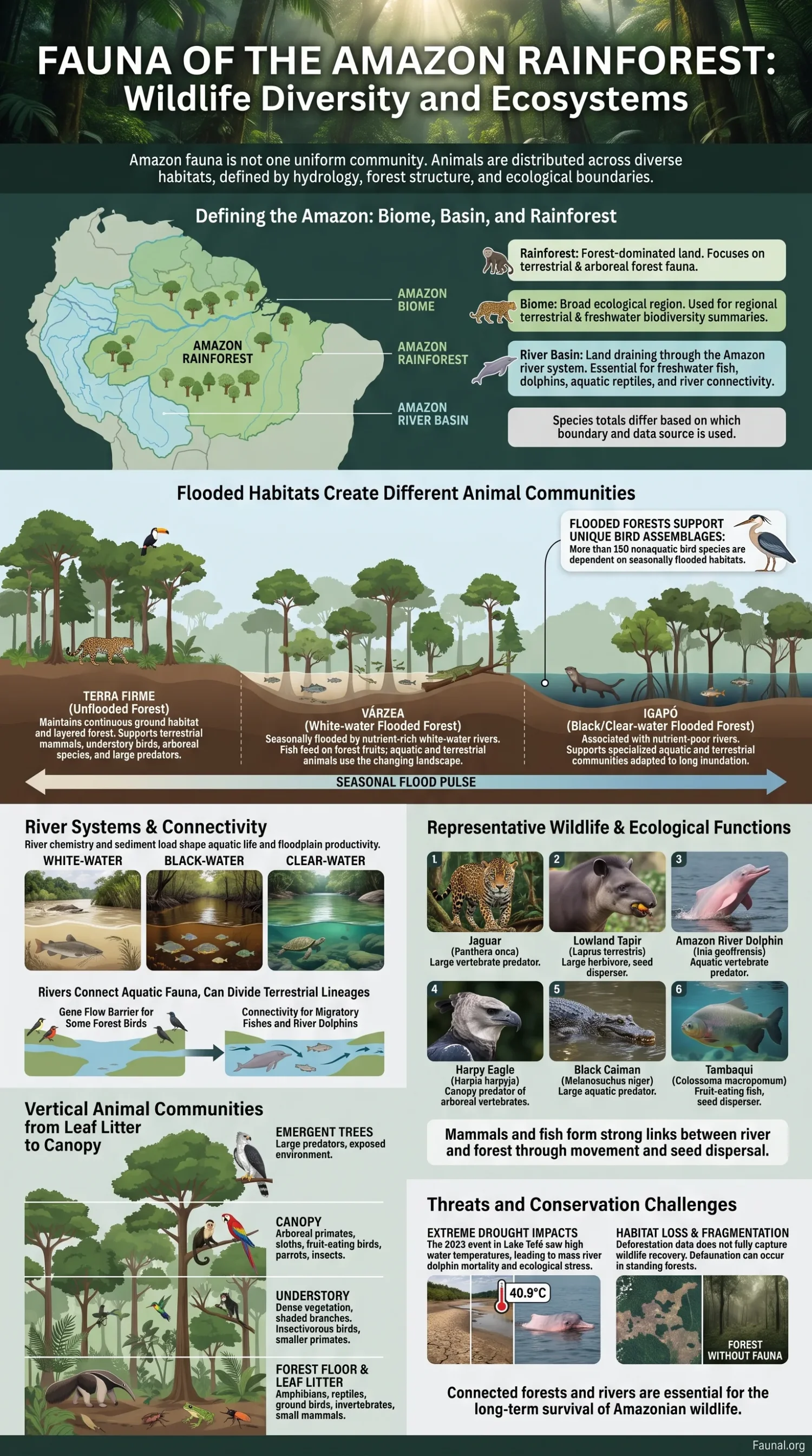
The fauna of the Amazon rainforest is not one uniform animal community. Animals are distributed across unflooded terra firme forest, seasonally inundated várzea and igapó, river islands, channels, floodplain lakes, headwaters and major rivers. Water level, sediment, forest structure, river barriers and seasonal access to food can change the fauna over distances that appear small on a continental map.
This distinction matters because the Amazon rainforest, Amazon biome and Amazon drainage basin are related but not identical geographic units. A mammal inventory based on forest habitat and a freshwater fish inventory based on drainage boundaries do not measure the same region. Published species totals therefore need a named geographic scope and data source rather than being combined into a single Amazon wildlife total. WWF Amazon overview
The Amazon Has More Than One Biological Boundary
Terrestrial fauna is often discussed within forest or biome boundaries, while freshwater fauna is more naturally organized by drainage basins and sub-drainages. A species total for one boundary should not be presented as a total for another.
Rainforest, Biome, and River Basin Define Different Faunas
The Amazon extends across Brazil, Bolivia, Peru, Ecuador, Colombia, Venezuela, Guyana and Suriname, as well as French Guiana. WWF describes the wider Amazon Basin as roughly 2.7 million square miles, about 40% of South America. The forested biome does not match the drainage boundary exactly, and freshwater studies may apply still narrower hydrological definitions.
| Geographic unit | What the boundary represents | Faunal use | Main interpretation risk |
|---|---|---|---|
| Amazon rainforest | Forest-dominated landscapes commonly identified as Amazon rainforest. | Terrestrial and arboreal forest fauna, together with animals using forest wetlands and edges. | Treating every aquatic species in the full drainage basin as a rainforest species. |
| Amazon biome | A broad ecological region extending across eight countries and French Guiana. | Regional terrestrial and freshwater biodiversity summaries where the cited dataset follows the biome boundary. | Assuming the biome and river basin have identical borders. |
| Amazon Basin | Land draining through the Amazon river system under the hydrological definition used by a study. | Freshwater fish, river dolphins, aquatic reptiles, river connectivity and sub-drainage analyses. | Using a basin count as if it were restricted to rainforest habitat. |
| Sub-drainage | A smaller hydrological unit within the basin. | Fish occurrence, endemism, sampling density and local river-system comparisons. | Generalizing a well-sampled tributary to the whole basin. |
Why Amazon Species Totals Do Not Match
Large institutional summaries place Amazon animal diversity among the highest recorded for any terrestrial-freshwater region. The Global Environment Facility lists more than 2,400 freshwater fish species, about 1,300 bird species, 425 mammals, 427 amphibians and 371 reptiles for its Amazon scope. These figures are useful regional indicators, but they should not be treated as a frozen taxonomic inventory. Global Environment Facility Amazon data
Freshwater fish show why the count can move. The AmazonFish database published in 2020 contained 2,406 native, valid freshwater fish species, based on 590 data sources, 21,500 sampling localities and 232,936 georeferenced records. Of those 2,406 species, 1,402 were classified in that dataset as occurring only in the Amazon Basin. Its hydrological definition excluded the Tocantins basin and Guiana coastal streams. The database also stated that several sub-drainages remained poorly sampled and that newly described species and taxonomic changes would require updates. AmazonFish dataset paper
A WWF freshwater report released in September 2026 refers to more than 2,700 Amazon freshwater fish species. The newer figure should not be substituted backward into the 2020 AmazonFish dataset or used to recalculate its endemic total. It represents a newer biodiversity summary with a different publication date and potentially different taxonomic and geographic treatment. WWF Amazon Forgotten Fishes
| Published source | Animal data | Scope that must be retained |
|---|---|---|
| GEF Amazon biodiversity page | More than 2,400 freshwater fishes; about 1,300 birds, 425 mammals, 427 amphibians and 371 reptiles. | Institutional Amazon biome-level biodiversity summary. |
| AmazonFish, 2020 | 2,406 native valid freshwater fish species; 1,402 classified as exclusive to the Amazon Basin in that dataset. | Defined Amazon drainage, 144 sub-drainages, records compiled through 2019. |
| WWF Amazon Forgotten Fishes, 2026 | More than 2,700 freshwater fish species. | Current basin-wide freshwater conservation summary. |
Described species, recorded species, estimated diversity and endemic species are different measurements. They should not be added or compared without matching geography, taxonomy, date and inclusion rules.
Terra Firme, Várzea, and Igapó Create Different Animal Communities
Much of the apparent continuity of Amazon forest disappears when hydrology is considered. Three forest settings are especially important for fauna: terra firme that remains above seasonal river flooding, várzea associated with sediment-rich white-water rivers, and igapó associated mainly with nutrient-poor black- and clear-water systems.
A basin-wide analysis of Amazon forest plots found that várzea and igapó differ strongly from adjacent terra firme in tree composition. The difference becomes especially pronounced where annual floods are deeper and last longer. In central portions of the flood wave, seasonal water-level amplitudes can exceed 8 m and inundation can persist for much of the year. The vegetation changes matter to fauna because fruiting patterns, dry ground, nesting sites, prey availability and access to flooded forest all change with the water cycle. Amazon floodplain forest study
| Amazon habitat | Hydrological setting | Faunal consequences | Representative relationships |
|---|---|---|---|
| Terra firme | Forest above normal seasonal river flooding. | Maintains continuous ground habitat and vertically layered forest from leaf litter to canopy. | Terrestrial mammals, understory birds, arboreal primates, canopy predators, litter amphibians and large invertebrate communities. |
| Várzea | Seasonally flooded forest along sediment-rich white-water rivers, often with relatively fertile alluvial substrates. | Dry ground contracts during high water while fishes gain temporary access to forest food resources. | Fruit-eating fishes, caimans, turtles, aquatic mammals, waterbirds and terrestrial animals shifting toward unflooded ground. |
| Igapó | Seasonally flooded forest associated mainly with black- and clear-water rivers with lower sediment and nutrient loads. | Long inundation and lower productivity create a different vegetation and food environment from nearby terra firme. | Specialized fish assemblages, aquatic predators and terrestrial mammals using the forest during accessible low-water phases. |
| River islands and floodplain channels | Dynamic land-water features created and reshaped by river flow and sediment. | Provide narrow-range habitat, nesting sites, feeding areas and movement routes that can change through time. | River-island birds, fishes, turtles, caimans, dolphins and edge-associated wildlife. |
| Floodplain lakes and oxbows | Standing or slow-moving waters connected to rivers at varying stages of the annual flood. | Concentrate aquatic fauna as water recedes and reconnect with broader floodplains during rising water. | Fishes, river dolphins, caimans, aquatic birds and other animals using seasonal prey concentrations. |
Flooded Forests Support Their Own Bird Assemblages
Seasonal flooding is not a minor edge condition. A Nature Communications analysis described Amazonia as a landscape mosaic in which floodplain habitats sustain specialized biota and reported that more than 150 nonaquatic Amazon bird species are restricted to or strongly dependent on seasonally flooded habitats, including species specialized on river islands. Amazon flooded-habitat bird study
The Annual Flood Pulse Moves Fauna Through the Forest
During rising water, forest that functioned as terrestrial habitat can become accessible to fishes and other aquatic animals. During falling water, the same area returns to terrestrial use. This repeated exchange changes where food is available, where predators encounter prey and how far animals can move through connected habitats.
For terrestrial mammals, high water can remove large areas of walkable ground. During low water, exposed floodplain forest becomes available again and can provide seasonal fruits, seeds and shoots. A camera-trap study in Central Amazon blackwater forest recorded 31 non-volant mammal species across terra firme and igapó. Although most of the evaluated species occurred in both environments, their assemblage composition and abundance structure differed, showing that adjacent forest types cannot be treated as ecologically interchangeable. Central Amazon mammal habitat study
Some Amazon Fishes Become Forest Seed Dispersers
The land-water connection is especially clear in fruit-eating fishes. When várzea floods, fishes can move between tree trunks and feed directly on fruits and seeds produced by floodplain vegetation. Seeds may then be moved away from parent trees through the aquatic system.
A basin-scale study published in 2025 analyzed 29 specialized fruit-eating fish species from nine families and 10,058 occurrence records. Greater floodplain-forest extent, higher tree richness and longer flooding were associated with richer assemblages of these fishes. The relationship runs in both directions: floodplain forest supplies seasonal food and access, while fishes participate in plant-seed movement. Basin-scale fruit-eating fish study
A 2026 várzea study added finer-scale evidence. Field collections and literature records identified 40 fish species consuming fruits or seeds from 188 tree species. In the field component, researchers recovered 5,012 intact seeds representing 49 tree morphotypes from the digestive tracts of 241 fishes belonging to 11 species. Tambaqui (Colossoma macropomum) had the broadest recorded plant interaction in the compiled network, followed by pirapitinga (Piaractus brachypomus) and Mylossoma albiscopum. 2026 várzea fish-seed study
White-Water, Black-Water, and Clear-Water Rivers Are Different Ecological Settings
Amazon rivers differ in sediment load, dissolved organic matter, acidity, nutrient availability, channel behavior and floodplain vegetation. These differences are not merely visual descriptions of water color. They help determine which plants grow along a river, how productive a floodplain can be and which fishes and other aquatic organisms can use it.
White-water systems carry large sediment loads, much of it ultimately derived from the Andes, and are associated with productive várzea floodplains. Black-water systems contain dark dissolved organic material, low suspended sediment and generally nutrient-poor conditions. Clear-water systems also carry lower sediment loads than white-water rivers but differ chemically and geographically from classic black-water systems. Igapó can occur along black- and clear-water rivers.
A fish recorded in one tributary should therefore not automatically be expected in another nearby tributary. Water chemistry, connectivity, elevation, waterfalls, historical drainage changes and habitat structure can all alter freshwater assemblages.
Rivers Connect Aquatic Fauna but Can Divide Terrestrial Lineages
For freshwater animals, connected rivers can provide routes for dispersal, migration and access to seasonal floodplains. For animals that rarely cross wide water channels, the same river can reduce gene flow between populations on opposite banks.
Western Amazon Fish Richness Carries a Deep Geological History
A 2023 evolutionary analysis reconstructed changing South American river networks through deep time and found that Andean uplift and repeated small river-capture events helped produce the exceptional freshwater fish richness of western Amazonia. Drainage rearrangement can connect populations that were separated, isolate populations that were connected and create new opportunities for dispersal and speciation. Western Amazon fish-diversity study
A Major River Is Not an Absolute Wall for Every Forest Bird
Research on Amazon understory birds supports major rivers as evolutionary barriers, but also shows that the barrier can be permeable. Genomic data indicate episodes of gene flow across rivers even while divergence accumulates between opposite-bank populations. Barrier strength therefore varies among lineages and through time rather than operating as a simple rule that every species stops at every major channel. Amazon river-barrier bird study
Animal Communities Change from Leaf Litter to the Emergent Canopy
Hydrology separates Amazon habitats horizontally, while forest structure separates them vertically. Ground-level conditions, understory vegetation, trunks, canopy crowns and emergent trees offer different food resources, movement surfaces, temperatures and exposure to predators.
Forest Floor and Leaf Litter
The forest floor supports terrestrial mammals, ground-foraging birds, snakes, lizards, frogs, ants, beetles, spiders and decomposer communities. Fallen fruit and seeds attract rodents, peccaries and other vertebrates, while leaf litter retains moisture and creates small thermal and humidity gradients that matter to amphibians and invertebrates.
Understory
Understory fauna uses dense vegetation, shaded branches, trunks and low foliage. Many insect-eating birds occupy this layer, and some of the bird lineages used to study river barriers are understory specialists whose movement across broad channels is limited compared with more mobile open-air species.
Canopy and Emergent Trees
The canopy supports arboreal primates, sloths, fruit-eating birds, parrots and many insects. Harpy eagles (Harpia harpyja) use mature forest and prey on arboreal vertebrates including monkeys and sloths. BirdLife currently lists the species as Near Threatened globally. BirdLife International
Mammals Link Predation, Seed Movement, Forest Floor, and Freshwater Habitats
Amazon mammal diversity includes large terrestrial predators, fruit-eating ungulates, canopy primates, rodents, bats and mammals that spend most or all of their lives in freshwater. Their ecological roles overlap, but they are not interchangeable.
The jaguar (Panthera onca) is a large predator with a distribution extending across much of tropical South America, including the Amazon. The lowland tapir (Tapirus terrestris) is a large-bodied browser and frugivore capable of moving seeds over distances that smaller fruit consumers may not reproduce. Both accepted names are recognized by the Mammal Diversity Database. Jaguar taxonomy Lowland tapir taxonomy
Freshwater mammals form a separate ecological group. The Amazon river dolphin (Inia geoffrensis) occupies much of the Amazon and Orinoco systems; the tucuxi (Sotalia fluviatilis) is a smaller river dolphin of the Amazon and Orinoco drainage systems; the giant otter (Pteronura brasiliensis) is a fish-eating mustelid associated with rivers, lakes and wetlands; and the Amazonian manatee (Trichechus inunguis) is an aquatic herbivore of Amazon freshwater systems. Amazon river dolphin taxonomy Tucuxi taxonomy Giant otter taxonomy Amazonian manatee taxonomy
Bird Diversity Follows Forest Height, Flooding, River Islands, and Food
Amazon birds are often grouped under one rainforest label even though canopy fruit-eaters, understory insectivores, river-island specialists, floodplain birds and aquatic birds use very different ecological settings. Forest height and flooding can therefore separate bird communities even where the surrounding climate appears similar.
Macaws and other parrots provide a well-studied example of localized resource use. At 18 parrot clay licks in southeastern Peru, soils selected by parrots contained on average about four times more available sodium than nearby uneaten control soils. The result supports available sodium as an important part of clay-lick selection at those sites rather than a general claim that every Amazon parrot visits mineral licks. Peruvian parrot clay-lick study
Reptiles and Amphibians Track Water at Different Scales
Amazon reptiles include river and floodplain predators, arboreal snakes, terrestrial lizards and turtles that move between aquatic feeding habitat and exposed nesting areas. Amphibians can respond to much smaller habitat differences, including leaf litter moisture, temporary pools, stream margins, bromeliads and low vegetation.
The black caiman (Melanosuchus niger) is an Amazonian crocodilian associated with freshwater habitats across much of northern South America. The green anaconda (Eunectes murinus) is a large boid associated with aquatic and wetland habitats over a broad South American range. Both names are currently recognized by the Reptile Database. Black caiman taxonomy Green anaconda taxonomy
For amphibians, broad Amazon-wide totals conceal strong local turnover. A frog recorded in humid terra firme leaf litter, a species breeding along a forest stream and another using temporary floodplain water may all occur within the rainforest biome while depending on different microhabitats. Presence in the biome is therefore not evidence of presence throughout the biome.
Freshwater Fish Form the Strongest Direct Link Between River and Forest
Amazon freshwater fish include predators, detritivores, algal feeders, insect feeders, fruit and seed consumers, electric fishes and long-distance migrants. Their distributions follow drainage connectivity rather than political borders, and even neighboring sub-basins can differ in species composition.
The AmazonFish database demonstrates both the richness and the incomplete state of knowledge. Its 2020 version assembled more than 235,000 occurrence records, including 232,936 georeferenced records, but sampling density remained uneven among sub-drainages. A data-rich river should not be interpreted as automatically containing more animals than a poorly sampled tributary; record density reflects collecting history and research effort as well as biological presence.
Connectivity is especially important for migratory fishes and species that enter floodplains to feed. Dams, altered flow, disconnected floodplains, degraded water quality and overfishing can therefore affect fauna through different pathways even when forest remains along part of a river. WWF’s 2026 freshwater assessment places connected rivers, floodplains and wetlands at the center of Amazon fish conservation.
Most Amazon Animal Diversity Is Not Represented by Large Vertebrates
Jaguar, macaw, tapir, anaconda and river dolphin are useful ecological examples, but they represent only a small share of Amazon animal diversity. Arthropods and other invertebrates occupy forest soil, leaf litter, dead wood, foliage, canopy, streams and freshwater sediments in enormous taxonomic variety.
Ants and termites alter soil and process plant material. Beetles occupy roles ranging from wood decomposition to predation and dung processing. Bees, flies, beetles, butterflies and moths interact with flowering plants. Spiders and other predatory arthropods form dense small-prey networks. Aquatic insects and other freshwater invertebrates transfer energy through river and stream food webs.
No single verified Amazon-wide inventory currently supports an exact total for all invertebrate species. Claims of a complete Amazon animal count should therefore be treated cautiously unless the source states its taxonomic and geographic limits.
Representative Amazon Wildlife by Habitat and Ecological Function
The species below are selected to show ecological relationships, not to act as a complete Amazon checklist. Many have ranges extending beyond the Amazon, and none should be interpreted as occurring across every part of the biome or basin.
| Species | Main Amazon habitat relationship | Ecological function represented here |
|---|---|---|
| Jaguar (Panthera onca) | Terra firme forest, floodplain mosaics and river-edge landscapes within its regional range. | Large vertebrate predator. |
| Lowland tapir (Tapirus terrestris) | Lowland forest and wetland mosaics. | Large herbivore and fruit consumer capable of moving large seeds. |
| Harpy eagle (Harpia harpyja) | Mature forest canopy and emergent-tree environments. | Predator of arboreal vertebrates. |
| Amazon river dolphin (Inia geoffrensis) | Large rivers, channels, lakes and seasonally connected freshwater habitats. | Aquatic vertebrate predator. |
| Tucuxi (Sotalia fluviatilis) | Amazon and Orinoco freshwater river systems. | Riverine predator. |
| Giant otter (Pteronura brasiliensis) | Rivers, lakes and wetlands. | Fish-eating aquatic and semiaquatic predator. |
| Amazonian manatee (Trichechus inunguis) | Freshwater rivers, lakes and connected floodplain waters. | Large aquatic herbivore. |
| Black caiman (Melanosuchus niger) | Rivers, lakes, channels and floodplain waters. | Large aquatic predator. |
| Green anaconda (Eunectes murinus) | Wetlands, slow waters and flooded landscapes within its range. | Large ambush predator associated with aquatic habitat. |
| Tambaqui (Colossoma macropomum) | River-floodplain system with seasonal access to flooded forest. | Fruit and seed consumer involved in aquatic seed dispersal. |
Endemism Is Uneven Across the Amazon
Amazon endemism is not distributed evenly. Headwaters, isolated tributaries, river islands, opposite banks of large rivers and specialized floodplain habitats can contain lineages with restricted distributions. A basin-wide label can therefore hide much smaller biological regions.
The 2020 AmazonFish dataset classified 1,402 of its 2,406 native valid freshwater fish species as occurring only in its defined Amazon Basin. That is a dataset-specific endemism result, not a current count of every endemic Amazon fish under every modern taxonomy. It also does not mean those fishes are rare, threatened or confined to one small locality. Endemic describes geographic restriction, not population condition.
For terrestrial vertebrates, major rivers can help produce opposite-bank turnover, while floodplain specialists can follow habitat strips that cross political borders. For fishes, drainage capture and isolation can create different evolutionary boundaries. Endemism should therefore always be tied to the exact area used by the underlying study.
A Forest Can Lose Animal Functions Before It Loses Its Canopy
Defaunation describes the loss or severe depletion of animal populations and ecological interactions even where vegetation remains standing. Large seed dispersers, predators and other vertebrates can disappear locally through hunting, fragmentation or other pressures while satellite imagery still shows forest cover.
A 2026 Amazon experiment used exclusions to simulate different levels of mammal loss and followed removal of 1,800 seeds from six tree species. Excluding medium- and large-bodied mammals reduced seed removal, with the response depending on plant species and the animals capable of handling particular seeds. The result illustrates why intact forest area and intact fauna are related but different conservation measurements. 2026 Amazon defaunation experiment
Extreme Drought Can Compress Aquatic Habitat Into Hot, Shallow Refuges
The effects of extreme drought on Amazon fauna are especially direct in floodplains, channels and lakes. Falling water reduces habitat volume, disconnects aquatic areas, concentrates animals and can expose shallow water to rapid heating.
Lake Tefé During the 2023 Drought
A Central Amazon study documented 209 river dolphin deaths in less than two months, fish kills, altered caiman concentrations, changes in waterbird abundance and lower floodplain-tree fruit production. Lake temperatures reached as high as 40.9°C at monitored locations. These measurements describe an extreme event around Tefé and should not be treated as a basin-wide wildlife mortality count.
Both Amazon river dolphins (Inia geoffrensis) and tucuxis (Sotalia fluviatilis) died in the Lake Tefé event. Researchers estimated that the 209 deaths represented about 12% of the local river-dolphin population. The lake became extremely shallow over broad areas, and unusually hot water was identified as the main likely cause of the aquatic-fauna mortality pattern. Central Amazon 2023 drought study
A separate basin-scale analysis published in July 2026 ranked Amazon droughts from 1980 to 2024 and identified the 2023/24 event as the strongest in that series. The study estimated that it affected 88% of the basin and found that rising atmospheric evaporative demand associated with higher temperatures now contributes more strongly to severe drought conditions than it did in earlier decades. 2026 Amazon drought analysis
Recent Brazilian Deforestation Data Do Not Measure Amazon-Wide Fauna Recovery
Brazil’s National Institute for Space Research reported a consolidated PRODES deforestation rate of 5,731 km² for the Brazilian Amazônia Legal monitoring area in 2025, covering the period from 1 August 2024 through 31 July 2025. This was 12.07% below the 2024 rate of 6,518 km². INPE PRODES 2025 data
Amazônia Legal is a Brazilian monitoring and administrative boundary, not the entire Amazon biome or drainage basin. A lower annual forest-clearing rate also does not establish that wildlife populations have recovered. Fauna can remain affected by earlier habitat loss, fragmentation, hunting, fire, pollution, altered river flow and loss of connectivity.
Connected Forests and Connected Rivers Support Different Parts of the Same Fauna
Amazon fauna cannot be maintained only by protecting isolated forest patches. Terrestrial animals need habitat large enough for movement, feeding and reproduction, while freshwater animals depend on connected channels, seasonal access to floodplains and water conditions that allow movement between feeding, nursery and refuge habitats.
For fruit-eating fishes, a forest separated from its natural flood cycle loses part of its seasonal function as fish habitat. For terrestrial mammals, prolonged inundation can make nearby terra firme essential as dry-ground refuge. For river dolphins and migratory fishes, barriers or disconnected channels can alter movement over much larger distances. For river-island and opposite-bank bird communities, the geometry of the river itself contributes to biological separation.
This is why Amazon conservation planning increasingly treats forest and freshwater connectivity as linked biological problems. A 2025 WWF basin analysis identified priority areas by combining jaguar landscapes with freshwater migration and river-dolphin needs, while its 2026 freshwater fish assessment emphasizes free-flowing rivers, floodplain connectivity, water quality and fisheries management. Amazon wildlife connectivity analysis
Sources and Verification
- WWF — Amazon — Geographic scope, countries, basin scale and regional biodiversity context.
- Global Environment Facility — Amazon — Institutional species-group totals used only within the stated Amazon-level scope.
- Jézéquel et al. — A Database of Freshwater Fish Species of the Amazon Basin — AmazonFish species totals, endemic count, records, sampling localities, drainage definition and data limitations.
- WWF — Amazon Forgotten Fishes — 2026 freshwater fish diversity summary and river-connectivity pressures.
- One Sixth of Amazonian Tree Diversity Is Dependent on River Floodplains — Terra firme, várzea and igapó definitions, flood-wave structure and floodplain ecological differences.
- Rainfall and Sea Level Drove the Expansion of Seasonally Flooded Habitats and Associated Bird Populations Across Amazonia — Flooded-habitat specialization and Amazon bird dependence on floodplains and river islands.
- Composition of Terrestrial Mammal Assemblages and Their Habitat Use in Unflooded and Flooded Blackwater Forests — Camera-trap evidence for mammal use of terra firme and igapó in Central Amazonia.
- Floodplain Forests Drive Fruit-Eating Fish Diversity at the Amazon Basin-Scale — Basin-scale associations among floodplain forest, hydrology and fruit-eating fish richness.
- The Flooding Gradient Affects Seed Dispersal by Fruit-Eating Fishes in Amazonian Whitewater Floodplain Forests — 2026 fish-fruit and fish-seed interaction data from várzea.
- Freshwater Fish Diversity in the Western Amazon Basin Shaped by Andean Uplift Since the Late Cretaceous — Drainage rearrangement, river capture and western Amazon fish diversification.
- Amazonian Rivers Are Leaky Barriers to Gene Flow in Forest Understory Birds — Evidence for river-mediated divergence with episodic cross-river gene flow.
- BirdLife International — Eagle Species — Harpy eagle accepted scientific name and current global Red List category displayed by BirdLife.
- Parrots Take It with a Grain of Salt — Sodium measurements from parrot clay licks in southeastern Peru.
- Mammal Diversity Database — Panthera onca — Jaguar accepted mammal taxonomy and geographic range record.
- Mammal Diversity Database — Tapirus terrestris — Lowland tapir accepted taxonomy and range record.
- Mammal Diversity Database — Inia geoffrensis — Amazon river dolphin accepted taxonomy and basin distribution.
- Mammal Diversity Database — Sotalia fluviatilis — Tucuxi accepted taxonomy and freshwater distribution.
- Mammal Diversity Database — Pteronura brasiliensis — Giant otter accepted taxonomy and South American distribution.
- Mammal Diversity Database — Trichechus inunguis — Amazonian manatee accepted taxonomy and Amazon freshwater distribution.
- The Reptile Database — Melanosuchus niger — Black caiman accepted taxonomy and documented distribution.
- The Reptile Database — Eunectes murinus — Green anaconda accepted taxonomy and documented distribution.
- Animal–Plant Interactions Under Defaunation — Experimental evidence linking mammal exclusion with altered seed removal in Amazon forest.
- Unprecedented Social-Ecological Impacts of the 2023 Extreme Drought in the Central Amazon — Lake Tefé water temperature, river-dolphin mortality, fish kills, caiman observations, waterbirds and floodplain-tree responses.
- Temperature-Induced Shift in 21st-Century Amazon Droughts — 1980–2024 drought ranking, 2023/24 basin coverage and atmospheric evaporative-demand analysis.
- INPE — PRODES 2025 Amazônia Legal Deforestation Rate — Consolidated 2025 Brazilian Amazônia Legal monitoring result and comparison with 2024.
- WWF — Protecting the Amazon’s Critical Wildlife Areas — Basin-scale terrestrial and freshwater connectivity context for jaguars and migratory freshwater fauna.