Complete guides: •Conservation Status Guides•Regional Fauna Guides•Mammals•Fauna of Europe
Updated: September 16, 2026 What changed?
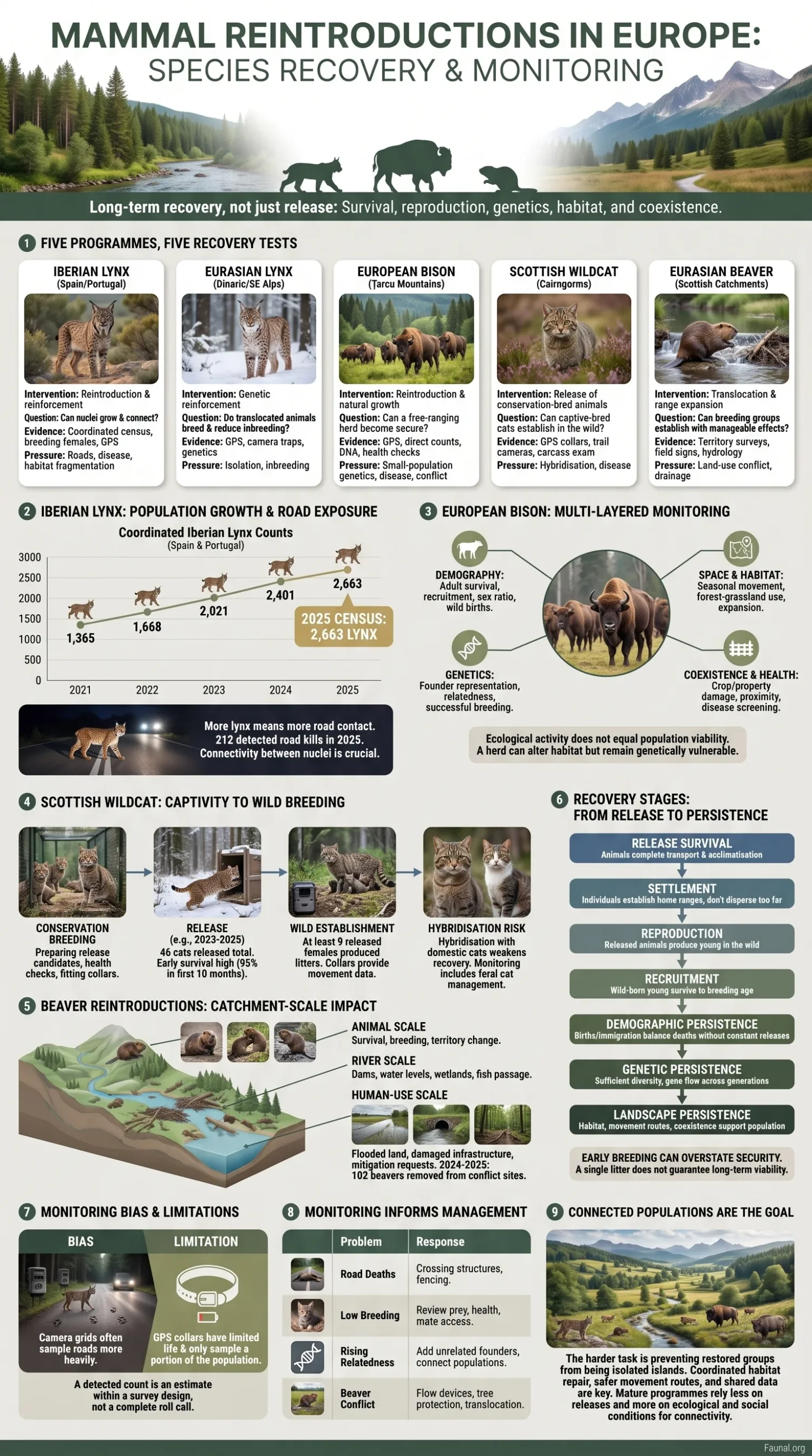
European mammal reintroductions are long-term conservation translocations, not single release events. A programme begins with the movement or release of animals, but recovery is demonstrated later through survival, reproduction, genetic contribution, connected habitat use and manageable interaction with people. The monitoring design therefore has to match the biology of the species and the reason it disappeared.
The European examples with the clearest monitored outcomes do not all represent the same intervention. Iberian lynx have been reintroduced into former range and moved between population units. Eurasian lynx in the Dinaric Mountains received genetic reinforcement. European bison have been rebuilt as free-ranging herds. Captive-bred European wildcats have been released in Scotland. Eurasian beavers have been translocated into river catchments where their ecological effects and land-use conflicts must be followed together.
A Return to Former Range Is Not Always a Reintroduction
The IUCN uses conservation translocation for the deliberate movement and release of organisms where the main purpose is conservation. Within that broad practice, reintroduction returns a taxon to part of its indigenous range after local disappearance, while reinforcement adds individuals to an existing population. Natural recolonisation is different because animals expand without a planned release. [a]
Natural Comeback Is Outside This Page’s Main Scope
Growing wolf, brown bear or golden jackal populations are sometimes described as reintroductions even where recovery followed legal protection, changing land use and unaided dispersal. Those returns matter for European conservation, but they do not provide the same release, founder and post-translocation evidence examined here.
Scientific names used below follow the American Society of Mammalogists’ Mammal Diversity Database. [b] The case studies are not intended as a complete inventory of every mammal translocation in Europe. They were selected because each exposes a different test of recovery and has an institutional monitoring record.
Five Programmes, Five Different Tests of Recovery
| Species and programme setting | Intervention | Recovery question | Main monitoring evidence | Pressure that remains |
|---|---|---|---|---|
| Iberian lynx (Lynx pardinus), Spain and Portugal | Reintroduction, reinforcement and managed expansion | Can separate nuclei grow, reproduce and become connected? | Coordinated census, breeding females, cubs, camera identification, mortality records and telemetry | Road mortality, rabbit fluctuations, disease and fragmented links between nuclei |
| Eurasian lynx (Lynx lynx), Dinaric Mountains and south-eastern Alps | Genetic reinforcement and a new Alpine stepping-stone population | Do translocated animals breed and reduce the effects of inbreeding? | GPS collars, camera traps, genetic samples, parentage and spatial population models | Isolation, renewed inbreeding and weak exchange with neighbouring populations |
| European bison (Bison bonasus), Țarcu Mountains | Reintroduction followed by restocking and natural herd growth | Can a free-ranging herd become demographically and genetically secure? | GPS movement, direct counts, DNA from dung, health checks, calf recruitment and conflict records | Small-population genetics, disease, roads and contact with farms or settlements |
| European wildcat (Felis silvestris), Cairngorms | Release of conservation-bred animals | Can captive-bred cats survive, hunt, establish ranges and reproduce in the wild? | GPS-radio collars, trail cameras, carcass examination, genetics and kitten detection | Hybridisation and disease transfer from domestic and feral cats |
| Eurasian beaver (Castor fiber), Scottish catchments | Conservation translocation and licensed range expansion | Can breeding groups establish while catchment effects remain manageable? | Territory surveys, field signs, breeding evidence, hydrology, fish monitoring and mitigation records | Drainage, crop, tree, fishery and infrastructure conflicts |
Iberian Lynx Recovery Has Outgrown a Simple Headcount
The Iberian lynx programme combines captive breeding, releases, prey management, habitat work, mortality reduction and movement between population units. Its growth is documented through coordinated counts across Spain and Portugal. The series rose from 1,365 lynx in 2021 to 2,663 in 2025, including 1,711 adults or subadults and 952 cubs in the 2025 count.
Coordinated Iberian Lynx Counts, 2021–2025
Annual totals for Spain and Portugal include adults, subadults and cubs detected in each census year.
MITECO coordinated totals: 1,365 in 2021 [c], 1,668 in 2022 [d], 2,021 in 2023 [e], 2,401 in 2024 [f] and 2,663 in 2025 [g]. The final figure is treated as a minimum because individual detection becomes harder as the population and occupied area grow.
The total alone cannot show whether recovery is evenly distributed. In 2025, reproduction was detected in 18 of 26 geographic nuclei, and 542 females were classed as reproductive or territorial. These measures reveal whether growth depends on a few productive areas or is spreading through the wider metapopulation.
More Lynx Also Means More Exposure to Roads
Range expansion creates new movement routes between breeding nuclei, but it also increases contact with transport infrastructure. MITECO recorded 273 detected deaths in 2025; 212 were road kills. A rising population can therefore coexist with a growing absolute number of preventable deaths. Mortality must be mapped against dispersal routes, road sections and the age or breeding value of the animals lost.
The IUCN moved the Iberian lynx from Endangered to Vulnerable in 2024. That change reflected the increase from 62 mature individuals in 2001 to 648 in 2022, wider occupied range, releases and translocations, habitat work and reduced human-caused mortality. The assessment also retained concerns about rabbit disease, domestic-cat disease, poaching, roads and climate-related habitat change. [h]
A Larger Census Does Not Remove the Connectivity Test
Population growth can conceal weak exchange between nuclei. A recovery programme must establish whether dispersers survive the journey, reproduce after arrival and carry genes between population units rather than merely appearing once in corridor habitat.
Dinaric–South-Eastern Alpine Lynx: Genetic Rescue Must Produce Descendants
The Dinaric lynx population arose from an earlier reintroduction but later declined after isolation and inbreeding. The LIFE Lynx response was therefore not a standard return to an empty range. It added unrelated animals from the Carpathians to the remaining Dinaric population and established a new group in the south-eastern Alps to improve future connection with Alpine lynx.
The project moved 18 lynx: 12 into the Dinaric population and six into the Alpine area. European Commission reporting states that the intervention reversed the decline, expanded the reported distribution from about 1,500 to 3,300 square kilometres and continued genetic and cross-border monitoring after the funded project period. [i]
Integration Is Measured Through Breeding, Not Release Survival Alone
A translocated lynx contributes to genetic rescue only when it survives long enough to reproduce and its descendants remain in the breeding population. GPS collars establish movement, settlement and mortality. Camera traps use flank patterns to identify adults and kittens. Hair, scat or tissue can confirm identity, parentage and ancestry. When these records are combined, managers can distinguish a released animal that merely lived in the area from one that changed the genetic composition of the population.
The biological unit being restored is not the released lynx. It is the breeding network formed by resident animals, translocated founders and their descendants.
The Donor Population Is Part of the Risk Assessment
Removing animals from Romania or Slovakia creates a second monitoring duty. Source populations need enough animals, suitable age and sex structure, and genetic breadth to tolerate removals. Health screening must protect both source and recipient populations. A successful reinforcement cannot be defined only by gains in the release area if extraction weakens the donor population or transfers disease.
European Bison: Herd Growth Comes Before Long-Term Security
European bison reintroduction in the Țarcu Mountains tests recovery at a different scale. The animals form mobile herds, use forest–grassland mosaics, cross roads and administrative boundaries, and can affect vegetation through browsing, grazing, trampling, wallowing and nutrient movement. Monitoring must follow individuals, herd structure, habitat effects and contact with people.
The active LIFE with Bison project is designed to increase the Țarcu population, widen genetic diversity, monitor health, expand occupied habitat and reduce conflict. Its stated target is at least 250 free-ranging bison, supported by natural growth and the translocation of at least 40 animals, with demographic tracking used to guide management. [j]
WWF-Romania reported in April 2026 that around 250 bison were roaming freely in the Țarcu Mountains. That total indicates that a former release project has become a large free-ranging herd, but it does not by itself establish genetic security, balanced founder representation or acceptable conflict levels. [k]
Bison Monitoring Has Four Linked Layers
- Demography: adult survival, calf recruitment, sex ratio, herd division and the proportion born in the wild.
- Genetics: founder representation, relatedness, successful breeding by newly added animals and loss of diversity through drift.
- Space and habitat: seasonal movement, road crossings, elevation use, forest–grassland selection and expansion into neighbouring areas.
- Coexistence and health: crop or property damage, proximity to livestock, disease screening, parasite load and the effectiveness of fences or rapid-response measures.
Ecological Activity Is Not the Same as Population Viability
A small herd may already alter vegetation and create wallows, yet remain vulnerable to disease, skewed sex ratio or close relatedness. Ecological effects and population security must be reported as separate outcomes.
Scottish Wildcats: Captive-Bred Animals Must Become a Wild Breeding Population
The Scottish wildcat programme begins with conservation breeding because hybridisation with domestic cats left no viable wild population that could recover unaided. Release candidates are prepared away from visitors, assessed for health and identity, fitted with GPS-radio collars and placed in selected parts of the Cairngorms landscape.
Saving Wildcats released 19 cats in 2023, nine in 2024 and 18 in 2025, giving a total of 46. By the end of the 2025 reporting period, at least nine released females had produced litters in the wild. Trail cameras supplied the first evidence of wild-born kittens, while collars provided daily movement and habitat-use data. [l]
Research on the first cohort reported 95 percent survival during the first ten months after release. That result is strong evidence for release preparation and early adaptation, but the long-term test remains whether several generations can persist without repeated replacement from captivity. [m]
Hybridisation Can Weaken Recovery Without Killing the Animal
Road death, starvation and disease remove individuals and are visible in survival data. Hybridisation acts differently. A cat may survive and reproduce while passing domestic-cat ancestry into the recovering population. Field identification from coat pattern is useful but cannot replace genetic testing where ancestry determines breeding or management decisions.
Monitoring domestic and feral cats around the release area is therefore part of wildcat recovery. Trap-neuter-vaccinate-return work reduces mating opportunities and disease transmission. The programme must also track whether released cats disperse beyond the intensively managed area, because contact risk can change sharply at the edge of the monitored landscape.
Beaver Translocations Are Judged at Catchment Scale
A beaver release cannot be assessed only by counting lodges or confirming kits. Beavers alter channels, water levels, tree cover and wetland extent. The same dam can create habitat while blocking a drain, flooding a field or changing conditions near fishery infrastructure. The monitored unit must therefore include the animals, the river system and the affected land uses.
NatureScot’s 2024–2025 management report records both expansion work and conflict response. During that period, 102 beavers were removed under licence from 19 conflict sites, and 79 of those animals were trapped and moved rather than killed. Funding also supported fish-impact monitoring and population modelling for future translocation decisions. [n]
For approved releases in the River Beauly catchment, NatureScot committed to a mitigation and monitoring group for at least ten years after release. This is a useful example of monitoring duration being set by catchment change and stakeholder response rather than by the date on which animals leave their transport crates. [o]
Three Scales Must Be Recorded Together
- Animal scale: pair establishment, survival, breeding, territory change and dispersal.
- River scale: dams, lodges, water levels, wetland formation, tree use, channel change and fish passage.
- Human-use scale: flooded land, blocked culverts, damaged trees, mitigation requests, licence actions and repeat conflict at the same site.
The Release Pipeline Is a Chain of Biological Tests
A release should not proceed simply because suitable animals and apparently suitable habitat are available. Each stage tests a different failure route, and a weak result at an early stage can invalidate later work.
| Stage | Question that must be answered | Evidence commonly required |
|---|---|---|
| Historical and ecological scope | Is the site within indigenous range, and is the proposed intervention biologically justified? | Historical records, range evidence, habitat reconstruction and taxonomic identity |
| Threat removal | Have the causes of local loss been reduced enough for release to be defensible? | Mortality data, prey or food surveys, disease evidence, legal protection and conflict assessment |
| Habitat capacity | Can the area support settlement, breeding, seasonal movement and dispersal? | Habitat models, field surveys, connectivity analysis and land-use pressure |
| Founder selection | Will chosen animals add suitable age, sex, behaviour and genetic representation? | Pedigree, genomic or marker data, demographic modelling and behavioural assessment |
| Veterinary screening | Could movement introduce disease, parasites or welfare risks? | Clinical examination, laboratory tests, quarantine and mortality review |
| Release design | Does the species need acclimatisation, supplementary support or direct release? | Species behaviour, prior release outcomes, enclosure performance and welfare criteria |
| Early post-release period | Are animals alive, moving normally and establishing ranges? | Telemetry, direct observations, feeding signs, camera records and mortality sensors |
| Population establishment | Are released animals breeding, recruiting young and interacting with resident animals? | Parentage, litter or calf records, juvenile survival and repeated individual detection |
| Long-term persistence | Can the population persist without permanent releases or emergency intervention? | Population trend, effective population size, connectivity, threat rates and scenario models |
Monitoring Methods Answer Different Biological Questions
No single device can demonstrate recovery. Telemetry may show where an animal moved but not whether it reproduced. A camera may confirm survival but miss ancestry. DNA may identify a breeder without describing its seasonal habitat use. Programmes gain stronger evidence by combining methods whose weaknesses do not overlap.
| Method | Question it can answer | Main limitation |
|---|---|---|
| GPS or GPS-radio collar | Where does the animal settle, disperse or cross risky infrastructure? | Collared animals may be a small or non-random part of the population; batteries and drop-off devices limit duration. |
| VHF tracking | Is a tagged animal still present and alive within a search area? | Requires repeated field effort and provides less detailed movement data than GPS. |
| Camera trapping | Which marked individuals remain, where are young detected and how often are sites used? | Detection depends on camera placement, animal behaviour and image quality. |
| Non-invasive genetics | Who produced a sample, how related are individuals and did a founder reproduce? | Sample degradation, contamination and uneven collection can reduce certainty. |
| Direct count or coordinated census | What minimum number is documented within a defined period and area? | Effort changes, duplicate risk and missed individuals make broad comparisons difficult. |
| Carcass examination | What killed the animal, and were disease or injury involved? | Only animals that are found and recovered can be examined. |
| Prey, vegetation or hydrology survey | Is the ecological setting supporting the population, and is the species changing its habitat? | Observed change may have several causes and needs controls or repeated sampling. |
| Conflict and mitigation record | Where do impacts occur, which responses were used and did the problem recur? | Reporting depends on compensation, trust, inspection access and local definitions. |
| Population viability model | How might survival, breeding, genetics and future management alter extinction risk? | Outputs depend on assumptions and the quality of field data used to set parameters. |
Release Success and Population Recovery Are Separate Thresholds
Programmes can report a technically successful release while the new population remains insecure. The evidence becomes stronger in stages:
- Release survival: animals complete transport, acclimatisation and the first high-risk weeks.
- Settlement: individuals establish home ranges or stable herd membership rather than leaving the managed area or dying during dispersal.
- Reproduction: released animals produce young in the wild.
- Recruitment: wild-born young survive long enough to enter the breeding population.
- Demographic persistence: births and immigration can balance deaths without permanent emergency releases.
- Genetic persistence: effective population size, founder contribution and gene flow remain sufficient across generations.
- Landscape persistence: habitat, movement routes and coexistence measures continue to support the population as its range changes.
Early Breeding Can Overstate Security
One litter, one calf crop or one occupied territory proves that reproduction is possible. It does not show that juveniles recruit, unrelated adults can meet, mortality remains tolerable or the next generation will retain enough genetic diversity.
Detection Bias Can Make Recovery Look Better or Worse Than It Is
Monitoring results reflect both animal biology and the survey design. More cameras, longer collar life or a larger volunteer network can raise the number of detections even when the population has not changed. The reverse also occurs when animals disperse beyond the survey boundary, collars fail or field access declines.
- Camera grids often sample tracks, forest roads and marking sites more heavily than the surrounding habitat.
- Collared animals may differ in age, sex, origin or behaviour from uncollared animals.
- Cubs, kittens and calves are less likely to be detected than adults during parts of the year.
- Cross-border animals can disappear from one dataset and reappear in another unless identities are shared.
- Public observations are concentrated near roads, paths and settlements and may include mistaken identification.
- Unrecovered carcasses cause cause-specific mortality to be underestimated.
- Genetic samples may cluster where field teams can search repeatedly rather than where animals are most abundant.
A reported count is an estimate or documented minimum within a stated survey design. It is not a complete roll call of every animal in the landscape.
Monitoring Has Value Only When It Changes Management
| Detected problem | Likely management response | Evidence needed after action |
|---|---|---|
| Repeated road deaths on a dispersal route | Crossing structures, fencing, traffic measures or release-site revision | Crossing use, collision rate and survival before and after intervention |
| Low breeding despite adult survival | Review sex ratio, prey or food supply, disturbance, health and mate access | Breeding attempts, reproductive success and juvenile recruitment |
| Rising relatedness | Add unrelated founders, protect dispersal routes or connect population units | Parentage, effective population size and gene flow in later cohorts |
| Released animals leave the target area | Reassess habitat choice, release timing, acclimatisation and nearby barriers | Movement paths, settlement rate and survival in revised releases |
| Disease detected | Quarantine, treatment, vaccination where justified, release pause or livestock separation | Repeat screening, transmission evidence and population-level health effects |
| Recurring beaver conflict | Flow devices, tree protection, dam management, trapping or translocation under licence | Water level, repeat damage, welfare outcome and movement after intervention |
| Wildcat contact with domestic cats | Targeted neutering, vaccination, owner engagement and intensified genetic surveillance | Domestic-cat density, hybrid mating evidence and disease exposure |
| Bison approach farms or settlements repeatedly | Rapid response, deterrence, fencing, attractant removal and herd movement review | Recurrence, seasonal pattern, damage and animal welfare |
Connected Populations Are the Next European Test
Europe has several examples of animals surviving release and producing young. The harder task is preventing each restored group from becoming a separate population island. Iberian lynx need safe exchange among expanding nuclei. Dinaric and Alpine lynx need continuing gene flow. European bison need room for several herds and movement that does not create repeated conflict. Wildcats must expand without losing genetic identity. Beaver range expansion requires long-term catchment management rather than repeated crisis response.
The EU Nature Restoration Regulation entered into force in August 2024. The 1 September 2026 deadline for draft national restoration plans has now passed, and Member States submitted their drafts to the European Commission. The Commission, with support from the European Environment Agency, is assessing the plans and will provide observations to Member States; final national restoration plans are to be completed within one year. The plans cover restoration measures, areas, timing and monitoring. For mammal reintroductions, the useful contribution is not a target number of releases. It is coordinated habitat repair, safer movement routes, shared population data and funding that continues after the first breeding records. [p]
A mature programme should eventually rely less on handling animals and more on maintaining the ecological and social conditions that allow them to move, breed and remain connected. Further releases may still be needed for genetics or local recovery, but they should be triggered by measured population needs rather than treated as the main evidence of success.
Sources and Verification
- [a] IUCN Guidelines for Reintroductions and Other Conservation Translocations — Used to distinguish conservation translocation, reintroduction and reinforcement.
- [b] Mammal Diversity Database — Used for accepted mammal names and family-level taxonomy.
- [c] MITECO Iberian Lynx Census for 2021 — Used for the coordinated total of 1,365 lynx in Spain and Portugal.
- [d] MITECO Iberian Lynx Census for 2022 — Used for the coordinated total of 1,668 lynx.
- [e] MITECO Iberian Lynx Census for 2023 — Used for the coordinated total of 2,021 lynx and the 2023 breeding-female count.
- [f] MITECO Iberian Lynx Census for 2024 — Used for the coordinated total of 2,401 lynx and the 2024 census composition.
- [g] MITECO Iberian Lynx Census for 2025 — Used for the 2,663 minimum count, breeding nuclei, reproductive females, cubs and detected mortality causes.
- [h] IUCN Iberian Lynx Red List Update — Used for the 2024 Vulnerable assessment, mature-population evidence and remaining threats.
- [i] European Commission LIFE Projects for Large Carnivores — Used for LIFE Lynx translocation totals, range change and continued genetic monitoring.
- [j] European Commission LIFE with Bison Project Record — Used for the Țarcu programme’s population, genetic, health, range and coexistence objectives.
- [k] WWF-Romania 2026 European Bison Update — Used for the reported free-ranging population of around 250 bison in the Țarcu Mountains.
- [l] Saving Wildcats Conservation Timeline — Used for annual release totals, GPS-radio monitoring, wild-born kittens and breeding by released females.
- [m] NatureScot First-Year Wildcat Release Study — Used for the first cohort’s ten-month survival result and release design.
- [n] NatureScot Beaver Management Report 2024–2025 — Used for licensed removals, translocations, fish monitoring and population-modelling work.
- [o] NatureScot Beauly Beaver Release Decision — Used for the catchment release approvals and the ten-year mitigation and monitoring commitment.
- [p] European Commission — EU Countries Submit Draft Plans on Restoring Nature — Used for the draft-plan submission, Commission and EEA assessment phase, and the timetable for final national restoration plans.