Complete guides: •Marine Animals•Fauna of the Mediterranean Basin•Regional Fauna Guides•Mammals
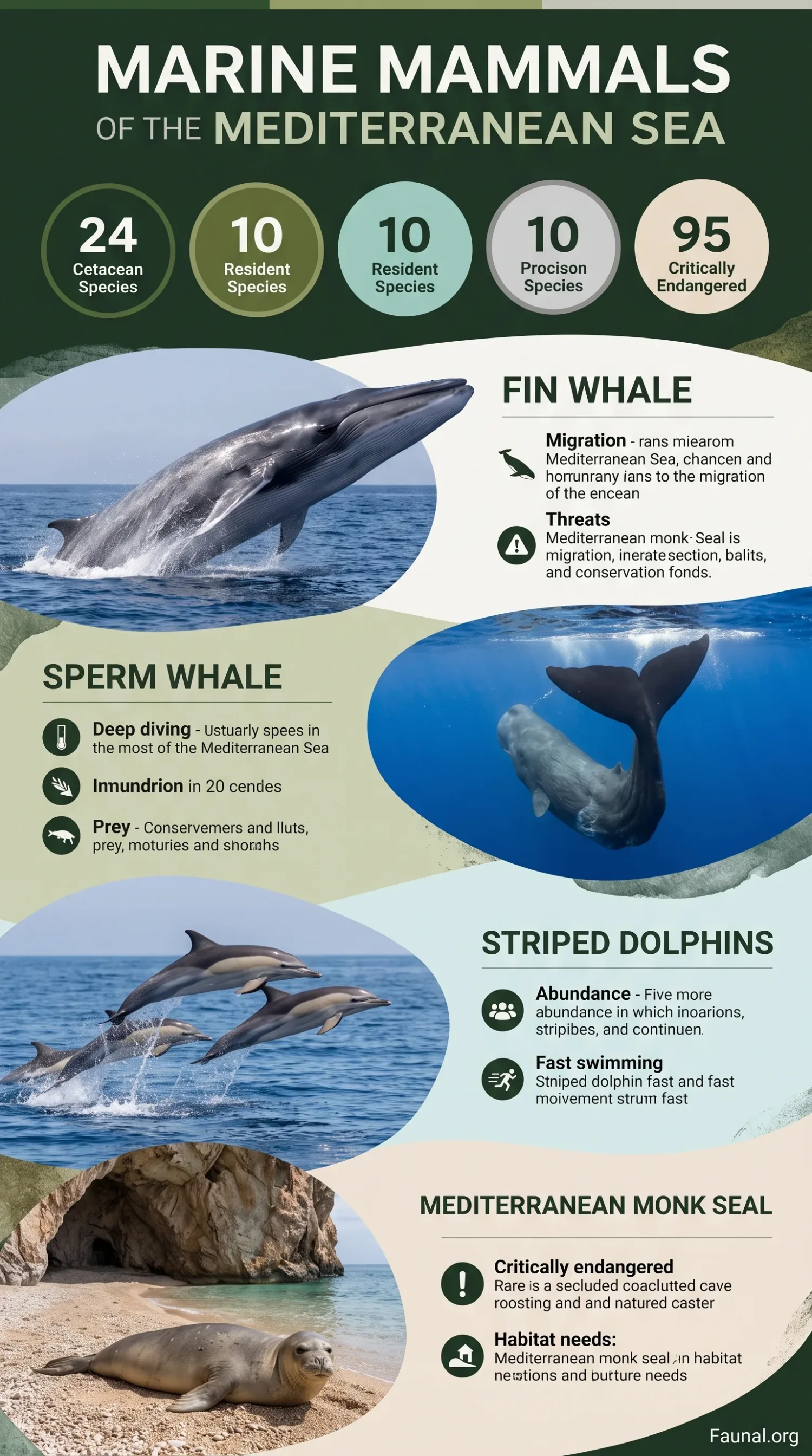
Marine mammals of the Mediterranean Sea include a resident core of whales, dolphins and one seal, together with visitors and exceptional records from the Atlantic, Black Sea and other adjacent waters. The IUCN Mediterranean cetacean assessment records 24 cetacean species in the sea and treats 10 species as resident. The Mediterranean monk seal, Monachus monachus, is the basin’s resident pinniped. These figures describe different levels of occurrence and should not be mixed with every historical stranding or exceptional visitor record.
Why Mediterranean marine-mammal totals differ
A 2016 review reported 28 different marine mammal species known to occur, or to have occurred, in the Mediterranean under the records and taxonomy available at the time. Later evidence changed the record set: IUCN’s newer cetacean treatment includes Bryde’s whale among recorded vagrants, while a grey seal was formally reported as the first Mediterranean record of that species in 2023. The safest current approach is therefore to keep resident populations, current cetacean occurrence records and historical or exceptional pinniped records separate rather than create a total by simply adding older lists together.
The Resident Marine Mammal Core of the Mediterranean
Current regional assessments distinguish permanent Mediterranean populations from animals that merely enter the basin. The accepted scientific names below follow the Society for Marine Mammalogy taxonomy list updated in April 2026. Conservation categories refer to Mediterranean subpopulations where IUCN has defined them; they are not substitutes for a species’ global Red List category.
| Marine mammal | Scientific name | Mediterranean occurrence | Main habitat pattern | Regional assessment context |
|---|---|---|---|---|
| Fin whale | Balaenoptera physalus | Resident | Pelagic waters, continental slope and productive offshore areas | Mediterranean subpopulation: Endangered |
| Sperm whale | Physeter macrocephalus | Resident | Deep slope, trenches and offshore waters | Mediterranean subpopulation: Endangered |
| Cuvier’s beaked whale | Ziphius cavirostris | Resident | Deep slopes, canyons and offshore waters | Mediterranean subpopulation: Vulnerable |
| Short-beaked common dolphin | Delphinus delphis | Resident | Coastal, shelf, slope and some offshore habitats | Inner Mediterranean and Gulf of Corinth assessed separately |
| Long-finned pilot whale | Globicephala melas | Resident, mainly western Mediterranean | Deep pelagic and slope waters | Inner Mediterranean and Strait of Gibraltar assessed separately |
| Risso’s dolphin | Grampus griseus | Resident | Continental slope, submarine canyons and deep water | Mediterranean subpopulation: Endangered |
| Killer whale | Orcinus orca | Resident boundary population in the Strait of Gibraltar; other Mediterranean records can be vagrant | Strait of Gibraltar and adjoining Atlantic-Alboran waters | Strait of Gibraltar subpopulation: Critically Endangered; treated separately from the 13 endemic Mediterranean subpopulations |
| Striped dolphin | Stenella coeruleoalba | Resident | Deep pelagic and slope waters | Mediterranean and Gulf of Corinth subpopulations assessed separately |
| Rough-toothed dolphin | Steno bredanensis | Resident; recognition strengthened by records from the eastern basin | Warm offshore and slope waters, with a strong eastern Mediterranean association | Mediterranean subpopulation: Near Threatened |
| Common bottlenose dolphin | Tursiops truncatus | Resident | Coastal waters and continental shelf, with some offshore use | Mediterranean and Gulf of Ambracia subpopulations assessed separately |
| Mediterranean monk seal | Monachus monachus | Resident pinniped | Rocky coasts, coastal waters and terrestrial resting or breeding sites, often caves | Global species assessment is separate from the cetacean subpopulation assessment |
Recorded Cetaceans Beyond the Resident Core
A Mediterranean record does not automatically establish a resident population. The IUCN review separates animals that occur repeatedly as visitors from taxa known mainly through unusual sightings or strandings. Its occurrence table also retains two cases that need special handling: rough-toothed dolphins are now accepted as resident, while killer whales include a resident Strait of Gibraltar unit as well as vagrant records elsewhere. Bryde’s whale is included on the basis of confirmed Mediterranean strandings even though ACCOBAMS considered its regional presence doubtful when the record set was compiled.
| Cetacean | Scientific name | IUCN Mediterranean occurrence treatment | Evidence context |
|---|---|---|---|
| Common minke whale | Balaenoptera acutorostrata | Visitor | Repeated Mediterranean records, but no resident Mediterranean population is recognised. |
| Sei whale | Balaenoptera borealis | Vagrant | Very few Mediterranean records. |
| Bryde’s whale | Balaenoptera edeni | Vagrant | Included after confirmed strandings; regional occurrence had previously been considered doubtful. |
| Grey whale | Eschrichtius robustus | Vagrant | Exceptional Mediterranean occurrence, including the widely documented 2010 individual. |
| North Atlantic right whale | Eubalaena glacialis | Vagrant / historical occurrence evidence | No resident Mediterranean population. |
| Short-finned pilot whale | Globicephala macrorhynchus | Vagrant | A small group was documented in the Adriatic in 2010. |
| Northern bottlenose whale | Hyperoodon ampullatus | Vagrant | Known from a small number of Mediterranean reports. |
| Dwarf sperm whale | Kogia sima | Vagrant | Extremely limited Mediterranean occurrence evidence. |
| Humpback whale | Megaptera novaeangliae | Visitor | Records became more frequent after 1990, but the species is not considered a Mediterranean resident. |
| Sowerby’s beaked whale | Mesoplodon bidens | Vagrant | Rare extralimital records. |
| Blainville’s beaked whale | Mesoplodon densirostris | Vagrant | Only rare Mediterranean records are known. |
| Gervais’ beaked whale | Mesoplodon europaeus | Vagrant | Occurrence evidence includes an exceptional Mediterranean stranding. |
| Atlantic harbour porpoise | Phocoena phocoena | Vagrant | The Atlantic form is not a Mediterranean resident. |
| False killer whale | Pseudorca crassidens | Visitor; possible regular occurrence remains under discussion | Observed on multiple occasions, but a resident Mediterranean population has not been established in the same way as the resident core. |
| Killer whale | Orcinus orca | Boundary resident population plus vagrant records | The Strait of Gibraltar subpopulation is distinct; other records can involve animals entering from the Atlantic. |
| Indian Ocean humpback dolphin | Sousa plumbea | Vagrant | Exceptional eastern Mediterranean occurrence evidence has been reported. |
| Rough-toothed dolphin | Steno bredanensis | Now resident | Earlier assessments treated the species as a visitor or vagrant; later evidence supported a Mediterranean subpopulation. |
The table above follows the occurrence treatments presented in the 2023 IUCN regional report. It should not be converted into a second independent species total by adding every row to the resident table: several rows document changes of status, boundary populations or taxonomic scope rather than mutually exclusive groups.
The Pinniped Record Is Dominated by One Resident Seal
The Mediterranean monk seal is the only pinniped with a resident breeding population in the Mediterranean. Other seals have reached the basin, but their presence is exceptional and should not be represented as part of the normal Mediterranean seal community.
| Seal | Scientific name | Mediterranean evidence |
|---|---|---|
| Mediterranean monk seal | Monachus monachus | Resident and breeding; the only resident seal species in the Mediterranean. |
| Hooded seal | Cystophora cristata | Exceptional records, including strandings and sightings of animals far outside the normal North Atlantic range. |
| Harp seal | Pagophilus groenlandicus | Exceptional extralimital record. |
| Harbour seal | Phoca vitulina | Very rare Mediterranean occurrence. |
| Grey seal | Halichoerus grypus | Vagrant. A female reaching Eivissa in 2020 became the first formally published Mediterranean record; later evidence documented another Atlantic individual entering Mediterranean waters in 2022. |
Grey seal evidence is an example of why an older basin-wide checklist cannot be treated as permanently closed. The first Mediterranean grey seal record was published after the major 2016 marine-mammal overview. A separate 2026 study traced another vagrant male that entered the western Mediterranean after travelling from the Atlantic.
One Species Can Represent More Than One Mediterranean Conservation Unit
Regional conservation status cannot be assigned safely from the common name alone. IUCN now recognises separate Mediterranean subpopulations for several dolphins. Common dolphins are divided between the Inner Mediterranean and Gulf of Corinth units; striped dolphins between the Mediterranean and Gulf of Corinth; long-finned pilot whales between the Inner Mediterranean and Strait of Gibraltar; and common bottlenose dolphins between the wider Mediterranean and Gulf of Ambracia.
Ten of the 13 resident endemic cetacean subpopulations assessed by IUCN are in threatened categories: three Critically Endangered, six Endangered and one Vulnerable. One is Near Threatened and two are Least Concern. These are subpopulation-level categories, not a statement that the same species has the same status worldwide.
| Species | Mediterranean assessment unit | IUCN category |
|---|---|---|
| Fin whale | Mediterranean subpopulation | Endangered |
| Short-beaked common dolphin | Inner Mediterranean subpopulation | Endangered |
| Short-beaked common dolphin | Gulf of Corinth subpopulation | Critically Endangered |
| Long-finned pilot whale | Inner Mediterranean subpopulation | Endangered |
| Long-finned pilot whale | Strait of Gibraltar subpopulation | Critically Endangered |
| Risso’s dolphin | Mediterranean subpopulation | Endangered |
| Striped dolphin | Mediterranean subpopulation | Least Concern |
| Striped dolphin | Gulf of Corinth subpopulation | Endangered |
| Rough-toothed dolphin | Mediterranean subpopulation | Near Threatened |
| Common bottlenose dolphin | Mediterranean subpopulation | Least Concern |
| Common bottlenose dolphin | Gulf of Ambracia subpopulation | Critically Endangered |
| Sperm whale | Mediterranean subpopulation | Endangered |
| Cuvier’s beaked whale | Mediterranean subpopulation | Vulnerable |
IUCN Categories Across 13 Resident Mediterranean Cetacean Subpopulations
The chart counts independently assessed Mediterranean subpopulations rather than species.
IUCN Mediterranean cetacean assessment; categories come from assessments published during 2019–2022. Values are counts of subpopulations.
The Strait of Gibraltar killer whale is assessed separately
The Strait of Gibraltar killer whale subpopulation is Critically Endangered, but IUCN excludes it from the 13 endemic Mediterranean subpopulations plotted above because its distribution extends materially into the eastern Atlantic. Its category should therefore not be added as a fourteenth value to this chart.
Depth and Seafloor Shape Separate Mediterranean Mammal Habitats
The Mediterranean is not one uniform habitat. Shelf width, steep continental margins, submarine canyons, deep trenches, fronts and offshore productive zones create different ecological settings within a relatively enclosed sea. A 2026 habitat-suitability analysis of eight Mediterranean cetaceans found clear species-level differences associated with variables such as bathymetry, slope, distance from the coast and ocean productivity.
Fin Whales Use Productive Offshore Waters Rather Than a Single Fixed Area
Fin whales are the regular baleen whale of the resident Mediterranean assemblage. Their strongest documented seasonal concentrations occur in parts of the north-western basin. Satellite-tagging and habitat modelling have identified recurring use along the Catalan coast, the Gulf of Lion and western parts of the Pelagos region during spring and summer. These areas are linked to feeding rather than representing a simple year-round boundary around a closed population.
Movement data from the north-western Mediterranean fin whale tracking study also show why an observation map alone cannot describe habitat use. Individual whales can move between spring and summer feeding areas while still belonging to the Mediterranean population unit.
Sperm Whales, Cuvier’s Beaked Whales and Risso’s Dolphins Track Deep Topography
Deep-diving odontocetes are strongly associated with bathymetric structure. Sperm whales use deep slope and trench habitats, including the Hellenic Trench. Cuvier’s beaked whales are also associated with deep water and steep submarine topography. Risso’s dolphins occur widely but show a pronounced relationship with continental slopes, canyon systems and deep-water feeding habitat.
A 12-year study off Catalonia found Risso’s dolphin occurrence closely related to slope and slope variation, with northern Catalan submarine canyons forming important habitat. The study describes Mediterranean habitat use mainly over steep slopes and deep waters, reflecting the species’ diet dominated by cephalopods. The north-western Mediterranean canyon study also illustrates why distance from shore cannot by itself predict whether a marine mammal is a coastal or offshore specialist.
Bottlenose Dolphins Occupy More Shelf and Coastal Habitat
Common bottlenose dolphins have a much stronger association with continental shelf and coastal environments than most deep-diving Mediterranean cetaceans. Bays, island shelves, coastal feeding grounds and areas around fisheries can all form part of their habitat. This does not mean the species is confined to shallow water everywhere; it means its Mediterranean distribution overlaps nearshore human activity more consistently than that of animals centred on the deep continental slope.
Striped Dolphins Are a Characteristic Deep-Water Dolphin
Striped dolphins have a broad Mediterranean distribution and a strong association with offshore and deeper waters. Large-scale survey work has repeatedly recorded the species across the basin, while local isolation creates exceptions to the basin-wide picture. The Gulf of Corinth striped dolphin subpopulation, for example, is assessed separately from the broader Mediterranean subpopulation.
Rough-Toothed Dolphins Have a Strong Eastern Mediterranean Signal
Rough-toothed dolphins show why occurrence classifications can change as monitoring improves. Earlier regional assessments treated the species as a visitor or vagrant. Repeated evidence, especially from the eastern Mediterranean, supported recognition of a Mediterranean subpopulation. IUCN now assesses that population as Near Threatened.
The Gulf of Corinth Compresses Several Dolphin Ecologies Into One Small Basin
The Gulf of Corinth is unusually informative because steep slopes and deep central water lie beside much shallower habitat within a semi-enclosed gulf. Striped dolphins occupy its deep pelagic sector, while common bottlenose dolphins are associated with shallower areas. Short-beaked common dolphins occur in mixed groups with striped dolphins, and Risso’s dolphin has also been documented in the deep-water community.
Mark-recapture work estimated only about 22 common dolphins in the Gulf of Corinth population used in the assessment, supporting treatment of that population as a separate Critically Endangered conservation unit. The Gulf’s striped dolphins are also assessed independently and are Endangered. The Gulf of Corinth Important Marine Mammal Area account documents the unusual mixed-species dolphin society and the isolation of these local populations.
The same principle applies in the Gulf of Ambracia, where common bottlenose dolphins are assessed as a separate Critically Endangered subpopulation rather than being assigned the Least Concern category of the wider Mediterranean bottlenose dolphin population.
Mediterranean Monk Seals Depend on Both Sea and Terrestrial Refuge
Monachus monachus differs ecologically from the resident cetaceans because it must leave the water to rest, breed and rear pups. Rocky coastlines, secluded landing sites and coastal caves therefore form part of its habitat in a way that has no cetacean equivalent. Disturbance at a breeding cave can affect habitat even when surrounding marine water remains physically available.
IUCN monitoring guidance reports that the species was reassessed as Vulnerable in 2023 and gives a current global estimate of about 815–997 individuals of all age classes. That figure includes the eastern Mediterranean and the central-eastern Atlantic reproductive subpopulations and must not be presented as a Mediterranean-only abundance estimate. IUCN’s monk seal monitoring guidance also reports continued pressure from disturbance and habitat loss despite evidence of range recovery.
The modern Mediterranean breeding core remains concentrated in the eastern part of the basin, particularly around Greece, Türkiye and Cyprus. The species also has reproductive populations outside the Mediterranean in the eastern Atlantic. The regional conservation strategy maintained by SPA/RAC therefore treats breeding habitat, recolonisation areas and disturbance control as separate management needs rather than assuming that a higher global population estimate removes local habitat risk.
Shipping, Fishing and Underwater Noise Affect Different Species in Different Ways
The main pressures on Mediterranean marine mammals overlap their ecology unevenly. A deep-water whale crossing a shipping corridor does not face the same exposure pattern as a monk seal using a coastal cave or a bottlenose dolphin feeding around coastal fisheries.
| Pressure | Marine mammals most directly linked to the issue | Mediterranean mechanism |
|---|---|---|
| Ship strikes | Fin whales, sperm whales | Dense vessel routes cross whale movement and feeding habitat; deep water close to major routes creates exposure in several subregions. |
| Fishing-gear mortality and entanglement | Dolphins, whales and monk seals | Marine mammals can be caught incidentally, become entangled or interact with fishing operations while feeding. |
| Fishery competition and depredation conflict | Bottlenose dolphins, common dolphins, monk seals and other predators | Shared prey and animals taking fish from gear can increase direct interactions with fisheries. |
| Underwater noise | Cuvier’s beaked whales, sperm whales and other cetaceans | Acoustic disturbance overlaps species that depend heavily on sound for orientation, communication and foraging. |
| Coastal disturbance and habitat loss | Mediterranean monk seal, coastal bottlenose dolphins | Development, vessel activity and human access can affect nearshore habitat; monk seals are additionally dependent on terrestrial resting and breeding sites. |
| Persistent pollutants and marine debris | Long-lived marine predators across several taxa | Contaminants can accumulate through food webs, while debris can cause ingestion or entanglement. |
The Hellenic Trench Shows How Whale Habitat and Shipping Routes Can Overlap
The Hellenic Trench is a core habitat for sperm whales in the eastern Mediterranean. Research combining whale sightings, density information and vessel traffic found major routes running close to the deep-water contour used by sperm whales. The study modelled that a relatively small offshore shift in routes could reduce collision risk in the study area by about 70%. The Hellenic Trench ship-strike study demonstrates why open-water habitat cannot be assumed to be low-risk merely because it is far from dense coastal development.
Large-Scale Surveys Separate Presence From Abundance
A sighting confirms that an animal was detected at a place and time; it does not by itself establish population size or a complete distribution. This distinction is especially important in the Mediterranean because survey effort has historically been uneven between subregions and between coastal and offshore waters.
The first ACCOBAMS Survey Initiative produced one of the broadest coordinated Mediterranean cetacean datasets. Its aerial component surveyed more than 55,000 km of transects across almost 1.9 million km², completing about 91% of the planned transects. Nine cetacean species were identified during on-effort aerial observations, alongside observations that could only be assigned to broader taxonomic groups. The resulting estimates use detection models rather than treating raw sighting counts as population totals. The published ACCOBAMS aerial-survey analysis provides the survey design and detection results.
The 2026 basin-scale survey is a new data collection cycle
ACCOBAMS launched ASI-II in 2025 for work extending through 2028, with a new Mediterranean survey campaign in 2026 using aerial observations, vessel-based line transects and passive acoustic monitoring. ACCOBAMS is reporting active campaign work during 2026. New basin-wide abundance values should not be substituted for the published ASI-I and IUCN assessment figures until the coordinated analysis has been released.
The ACCOBAMS Survey Initiative II is particularly relevant for species whose apparent distribution can change with survey coverage. Deep-diving whales may be easier to detect acoustically than visually, while some dolphins are patchily distributed and coastal records can be much denser simply because observation effort is higher near land.
Sources and Verification
- IUCN — The conservation status of cetaceans in the Mediterranean Sea — Provides the 24 recorded cetacean species and 10 resident-species scope and the regional Red List assessment context.
- IUCN / ACCOBAMS — Mediterranean cetacean regional assessment report — Provides resident subpopulation boundaries, visitor and vagrant treatments, Red List categories and the 13-subpopulation category distribution.
- Notarbartolo di Sciara — Marine Mammals in the Mediterranean Sea: An Overview — Provides the 2016 whole-basin marine-mammal occurrence inventory and historical resident, visitor and rare-record context.
- Society for Marine Mammalogy — List of Marine Mammal Species and Subspecies — Used to check current scientific names against the April 2026 taxonomy list.
- University of the Balearic Islands — First record of Grey Seal in the Mediterranean Sea — Documents the first published Mediterranean occurrence of Halichoerus grypus.
- Journal of Helminthology — Grey seal journey from the Wadden Sea to the Mediterranean — Documents an additional Atlantic grey seal that entered Mediterranean waters.
- IUCN — Mediterranean monk seal monitoring guidance — Provides the 2023 Vulnerable assessment context, global population estimate and current breeding-population information.
- SPA/RAC — Mediterranean monk seal conservation strategy — Provides regional breeding-habitat and conservation planning context.
- Frontiers in Marine Science — Modeling habitat suitability for eight cetacean species in the Mediterranean Sea — Provides recent species-specific habitat suitability evidence across the basin.
- Frontiers in Marine Science — ACCOBAMS synoptic cetacean survey — Provides aerial-survey coverage, species detections and methods used for basin-scale abundance estimation.
- ACCOBAMS — Survey Initiative II — Provides the scope and 2026 Mediterranean survey design for the current regional monitoring cycle.
- Fin whale tracking and habitat modelling study — Supports spring and summer habitat use and feeding-area descriptions in the north-western Mediterranean.
- Frontiers in Marine Science — Risso’s dolphin submarine canyon study — Supports the relationship between Risso’s dolphin occurrence, steep slopes and submarine canyons.
- IUCN Marine Mammal Protected Areas Task Force — Gulf of Corinth IMMA — Supports the local dolphin community, common-dolphin population estimate and mixed-species occurrence.
- Hellenic Trench sperm whale and shipping study — Provides the documented overlap between sperm whale habitat and vessel routes and the modelled collision-risk reduction from route displacement.
Related Topics
- → Mammals of the Mediterranean Basin: Native Species and Habitats
- → Bats of the Mediterranean Basin: Cave, Forest, and Urban Species
- → Island Mammals of the Mediterranean: Native and Introduced Species
- → Small Mammals of the Mediterranean: Rodents, Hedgehogs, and Shrews
- → Large Carnivores of the Mediterranean: Wolves, Bears, Lynx, and Wild Cats
- → Mediterranean Ungulates: Deer, Goats, Sheep, and Wild Boar