Complete guides: •Marine Animals•Regional Fauna Guides•Mammals•Fauna of Europe
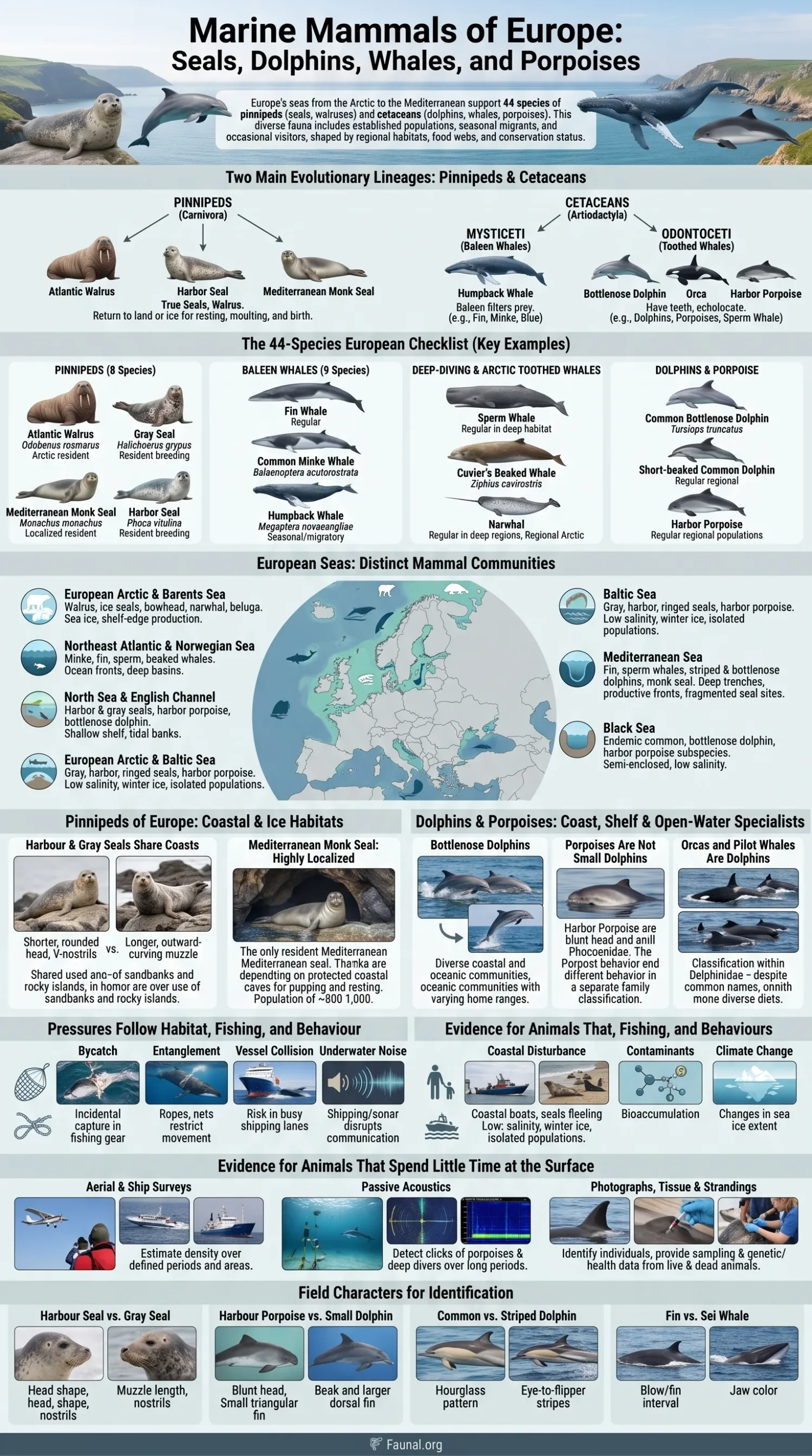
Europe’s regional seas support seals and other pinnipeds, dolphins, porpoises, baleen whales and toothed whales across a range extending from Svalbard sea ice to the Mediterranean and Black Sea. The European Environment Agency’s broad regional-sea account uses a total of 44 marine mammal species, but that figure combines established populations, seasonal visitors and species known mainly from uncommon records. The fauna is therefore best understood by separating taxonomy, regional occurrence and population status rather than treating every listed animal as equally widespread. [a]
Broad European scope
44 species
EEA regional-sea inventory, including regular and occasional occurrence.
Pinnipeds in that scope
8 species
Seven true seals plus the Atlantic walrus.
Black Sea cetaceans
3 endemic subspecies
Common dolphin, bottlenose dolphin and harbour porpoise forms.
Baltic year-round cetacean
Harbour porpoise
Several management populations occur around the Baltic region.
Four Familiar Labels, Two Main Evolutionary Lineages
“Seal,” “dolphin,” “whale” and “porpoise” are not four equivalent taxonomic ranks. Europe’s seals and walrus are pinnipeds within Carnivora. Whales, dolphins and porpoises are cetaceans within Artiodactyla in the current Society for Marine Mammalogy list. The same list places the walrus in Odobenidae, the true seals in Phocidae, dolphins in Delphinidae and the harbour porpoise in Phocoenidae. Its April 2026 edition is also the taxonomic basis for the accepted scientific names used below. [b]
Cetaceans divide into Mysticeti, the baleen whales, and Odontoceti, the toothed whales, dolphins and porpoises. Baleen whales filter prey through keratin plates. Odontocetes have teeth and include echolocating species such as sperm whales, beaked whales, dolphins and porpoises. Common names can obscure those relationships: the killer whale, false killer whale, pygmy killer whale, melon-headed whale and both pilot whales are members of the dolphin family. [c]
| Common label | Taxonomic placement | European examples | Biological distinction |
|---|---|---|---|
| True seals | Carnivora; Pinnipedia; Phocidae | Harbour, gray, monk, ringed, harp, hooded and bearded seals | Return to land or ice for resting, moulting, birth and nursing; no external ear pinnae. |
| Walrus | Carnivora; Pinnipedia; Odobenidae | Atlantic walrus | A pinniped, but not a true seal; adults have tusks and feed largely on benthic prey. |
| Baleen whales | Artiodactyla; Cetacea; Mysticeti | Minke, fin, blue, sei, humpback, bowhead, right and gray whales | Use baleen rather than teeth to capture krill or schooling prey. |
| Oceanic dolphins | Artiodactyla; Cetacea; Odontoceti; Delphinidae | Bottlenose, common, striped and Risso’s dolphins, orca and pilot whales | Toothed, echolocating cetaceans with varied social and feeding systems. |
| Porpoises | Artiodactyla; Cetacea; Odontoceti; Phocoenidae | Harbour porpoise | Separate family from dolphins; small body, blunt head and spade-shaped teeth. |
| Other toothed whales | Artiodactyla; Cetacea; Odontoceti | Sperm, beaked, beluga and narwhal | Includes deep-diving squid hunters and Arctic monodontids. |
The 44-Species European Regional-Sea Checklist
The checklist below reconciles the EEA’s broad 44-species scope with the European Commission Joint Research Centre’s marine-mammal reference work and current accepted names. The JRC list was built for EU Marine Strategy Directive reporting from Member State reports, EU nature law, regional-sea conventions and international taxonomic or conservation sources. The JRC report explicitly states that its reporting lists were not designed as all-time inventories of every stray record. [d]
Why a record does not always mean a resident population
The operational list includes species associated with the European Arctic, Macaronesia and contiguous Atlantic waters as well as the Baltic, North Sea, Mediterranean and Black Sea. “Exceptional” means that documented evidence exists within this broad scope, not that a breeding population is established. An all-time ledger of single vagrants would be longer and would change whenever a new record is verified.
Pinnipeds: Eight Species from Sea Caves to Arctic Ice
| Common name | Accepted scientific name | Strongest European association | Occurrence pattern |
|---|---|---|---|
| Atlantic walrus | Odobenus rosmarus | European Arctic: Svalbard and the Barents Sea | Regional Arctic resident |
| Hooded seal | Cystophora cristata | Greenland and Norwegian seas; occasional farther south | Arctic and North Atlantic migrant |
| Bearded seal | Erignathus barbatus | Svalbard and other ice-influenced Arctic waters | Regional Arctic resident |
| Gray seal | Halichoerus grypus | Northeast Atlantic, North Sea and Baltic Sea | Resident breeding populations |
| Mediterranean monk seal | Monachus monachus | Eastern Mediterranean and eastern Atlantic colonies | Resident, highly localized |
| Harp seal | Pagophilus groenlandicus | Greenland, Norwegian and Barents seas | Migratory ice-associated species |
| Harbour seal | Phoca vitulina | Northeast Atlantic coasts, North Sea and Baltic margins | Resident breeding populations |
| Ringed seal | Pusa hispida | European Arctic and northern Baltic Sea | Resident, ice-associated populations |
Baleen Whales: Nine Species in the Regional-Sea Scope
| Common name | Accepted scientific name | Strongest European association | Occurrence pattern |
|---|---|---|---|
| Bowhead whale | Balaena mysticetus | Svalbard–Barents Sea sector of the European Arctic | Regional Arctic occurrence |
| North Atlantic right whale | Eubalaena glacialis | Eastern North Atlantic and European coasts | Exceptional modern record; historical range |
| Gray whale | Eschrichtius robustus | Atlantic-facing European and Mediterranean records | Exceptional vagrant |
| Common minke whale | Balaenoptera acutorostrata | North Atlantic, North Sea, Norwegian and Arctic waters | Regular and seasonal |
| Sei whale | Balaenoptera borealis | Deep Northeast Atlantic waters | Seasonal or occasional |
| Bryde’s whale | Balaenoptera edeni | Macaronesian and warm eastern Atlantic waters | Regional and uncommon |
| Blue whale | Balaenoptera musculus | North Atlantic and European Arctic | Seasonal and scarce |
| Fin whale | Balaenoptera physalus | Northeast Atlantic and Mediterranean Sea | Regular in more than one region |
| Humpback whale | Megaptera novaeangliae | North Atlantic, Norwegian and Arctic waters | Seasonal and migratory |
Deep-Diving and Arctic Toothed Whales
| Common name | Accepted scientific name | Strongest European association | Occurrence pattern |
|---|---|---|---|
| Sperm whale | Physeter macrocephalus | Deep Northeast Atlantic and Mediterranean waters | Regular in suitable deep habitat |
| Pygmy sperm whale | Kogia breviceps | Macaronesia and scattered offshore or stranding records | Occasional |
| Dwarf sperm whale | Kogia sima | Warm eastern Atlantic and rare European records | Exceptional or occasional |
| Northern bottlenose whale | Hyperoodon ampullatus | Deep North Atlantic and Norwegian Sea | Regular offshore, rarely observed |
| Sowerby’s beaked whale | Mesoplodon bidens | Temperate and cold Northeast Atlantic | Regular offshore, rarely observed |
| Blainville’s beaked whale | Mesoplodon densirostris | Macaronesia; isolated records elsewhere | Regional and occasional |
| Gervais’ beaked whale | Mesoplodon europaeus | Warm eastern Atlantic and Macaronesia | Regional and rare |
| True’s beaked whale | Mesoplodon mirus | Deep North Atlantic, including Macaronesia | Rarely recorded |
| Cuvier’s beaked whale | Ziphius cavirostris | Mediterranean slopes, Atlantic islands and deep oceanic waters | Regular in deep-water regions |
| Beluga | Delphinapterus leucas | Svalbard and European Arctic waters | Regional Arctic resident; rare vagrant south |
| Narwhal | Monodon monoceros | High Arctic waters near Greenland and Svalbard | Regional Arctic occurrence |
Dolphins and the Harbour Porpoise
| Common name | Accepted scientific name | Strongest European association | Occurrence pattern |
|---|---|---|---|
| Short-beaked common dolphin | Delphinus delphis | Northeast Atlantic, Mediterranean and Black Sea | Regular, with regional populations |
| Pygmy killer whale | Feresa attenuata | Warm eastern Atlantic and Macaronesia | Exceptional or regional rare |
| Short-finned pilot whale | Globicephala macrorhynchus | Macaronesia and warm contiguous Atlantic waters | Regional |
| Long-finned pilot whale | Globicephala melas | Northeast Atlantic and parts of the western Mediterranean | Regular offshore |
| Risso’s dolphin | Grampus griseus | Northeast Atlantic and Mediterranean slopes | Regular in deep and slope waters |
| Fraser’s dolphin | Lagenodelphis hosei | Warm Atlantic and Macaronesian records | Exceptional or regional rare |
| White-beaked dolphin | Lagenorhynchus albirostris | North Sea and cold Northeast Atlantic shelf waters | Regular |
| Atlantic white-sided dolphin | Leucopleurus acutus | Temperate and cold Northeast Atlantic | Regular offshore |
| Killer whale | Orcinus orca | European Arctic and Northeast Atlantic; scarce in the Mediterranean | Regional and wide-ranging |
| Melon-headed whale | Peponocephala electra | Warm eastern Atlantic and Macaronesian records | Exceptional or regional rare |
| False killer whale | Pseudorca crassidens | Macaronesia and occasional Mediterranean or Atlantic records | Regional rare or occasional |
| Striped dolphin | Stenella coeruleoalba | Mediterranean and warm offshore Atlantic waters | Regular |
| Atlantic spotted dolphin | Stenella frontalis | Macaronesia and warm eastern Atlantic | Regional |
| Rough-toothed dolphin | Steno bredanensis | Warm Atlantic and parts of the Mediterranean | Regional and uncommon |
| Common bottlenose dolphin | Tursiops truncatus | Atlantic coasts, North Sea, Mediterranean and Black Sea | Regular, coastal and offshore forms |
| Harbour porpoise | Phocoena phocoena | Northeast Atlantic, Baltic, Black Sea and northern Aegean | Regular; regional populations differ |
Atlantic white-sided dolphin taxonomy changed in the 2026 list
The accepted name used here is Leucopleurus acutus. Older European reports frequently place the species in Lagenorhynchus as Lagenorhynchus acutus. Searches of older datasets should account for both genus combinations, while the white-beaked dolphin remains Lagenorhynchus albirostris.
European Seas Produce Different Mammal Communities
Latitude alone does not explain the pattern. Sea ice, salinity, shelf width, submarine canyons, seasonal productivity, prey movement and access to undisturbed resting or breeding sites all shape which mammals occur in each region. A species may also occupy several habitat types: bottlenose dolphins include coastal communities and offshore forms, while fin whales use both Northeast Atlantic and Mediterranean waters.
| European marine region | Characteristic marine mammals | Habitat pattern that shapes occurrence |
|---|---|---|
| European Arctic and Barents Sea | Atlantic walrus, bearded, harp, hooded and ringed seals; bowhead, minke, humpback and blue whales; beluga, narwhal and orca | Seasonal sea ice, shelf-edge production and dense fish or zooplankton patches. |
| Norwegian Sea and Northeast Atlantic | Minke, fin, humpback, sei and sperm whales; long-finned pilot whale; Atlantic white-sided and white-beaked dolphins | Ocean fronts, migration routes, deep basins and productive shelf breaks. |
| North Sea and English Channel | Harbour and gray seals, harbour porpoise, white-beaked dolphin and localized bottlenose dolphin communities | Shallow shelf waters, tidal banks, estuaries and heavily used coastal corridors. |
| Baltic Sea | Gray, harbour and ringed seals; harbour porpoise | Low salinity, restricted exchange with the North Sea, northern winter ice and isolated population structure. |
| Bay of Biscay and Iberian Atlantic | Common, bottlenose and Risso’s dolphins; pilot, sperm and beaked whales; several baleen whales | A narrow shelf, steep slopes, submarine canyons and nearby deep water. |
| Macaronesia and contiguous Atlantic | Short-finned pilot whale, Atlantic spotted dolphin, bottlenose dolphin, Bryde’s whale and several rarely recorded warm-water odontocetes | Oceanic islands, steep volcanic slopes and warm deep waters close to shore. |
| Mediterranean Sea | Fin and sperm whales; Cuvier’s beaked, long-finned pilot, Risso’s, striped, common and bottlenose dolphins; Mediterranean monk seal | Semi-enclosed basin with deep trenches, slope habitat, productive fronts and fragmented seal breeding sites. |
| Black Sea | Black Sea common dolphin, Black Sea bottlenose dolphin and Black Sea harbour porpoise | Semi-enclosed low-salinity basin with endemic subspecies and limited exchange through the Turkish Straits. |
Pinnipeds of Europe: Coastal Haul-Outs, Sea Caves and Breeding Ice
Harbour and Gray Seals Share Coasts but Not the Same Profile
Harbour seals and gray seals overlap around the North Sea, British and Irish coasts, and parts of the Baltic region. Harbour seals usually show a shorter, rounded head, a marked forehead and nostrils that form a V-like pattern when closed. Gray seals have a longer head with a straighter or outward-curving muzzle. Adult male gray seals can be much more heavily built than harbour seals. Colour alone is unreliable because age, moult, wet fur and light alter the apparent pattern.
Both species need haul-out sites, yet they use them differently across regions. Sandbanks, tidal flats, rocky islands and sheltered beaches may serve as resting, moulting or breeding sites. A change in the number of seals visible ashore can reflect tide, weather, season or disturbance rather than an immediate change in population size.
Ice-Associated Pinnipeds Separate the Arctic from the Baltic
Bearded, harp and hooded seals are centred on Arctic or sub-Arctic waters. Atlantic walruses also belong to the European Arctic fauna, where shallow feeding grounds and accessible resting surfaces matter. Ringed seals occur in the high Arctic and as the Baltic subspecies Pusa hispida botnica. Ringed seals create or use snow-covered structures on sea ice for birth and early pup protection, linking their reproductive success directly to winter ice and snow conditions.
The northern Baltic is not a small copy of the Arctic Ocean. Its low salinity, enclosed geography and isolated seal populations create a different management setting. Gray seals are widely distributed around the basin, while ringed seals are concentrated in northern and eastern ice-forming areas. Harbour seals have a much narrower Baltic distribution than in the Northeast Atlantic.
Mediterranean Monk Seals Depend on a Small Set of Secure Breeding Sites
The Mediterranean monk seal is the only resident seal species in the Mediterranean. Many breeding groups use coastal caves with protected interior beaches, although open beaches remain part of the species’ natural habitat where disturbance is low. Loss or disturbance of pupping sites, deliberate killing, prey and fishery interactions, and entanglement have all contributed to its restricted distribution. In June 2023, IUCN moved the species from Endangered to Vulnerable after evidence of recovery and reoccupation in parts of its range. [i]
An IUCN account published in 2026 placed the global population at roughly 800–1,000 individuals, with the main surviving groups in Greece, Türkiye and Cyprus, as well as Madeira and Cabo Blanco in the eastern Atlantic. The lower threat category records measurable improvement; it does not remove the risks created by a small number of breeding areas and human activity near caves. [j]
Dolphins and Porpoises: Coast, Shelf and Open-Water Specialists
Bottlenose Dolphins Cannot Be Reduced to One Coastal Pattern
Common bottlenose dolphins occur in coastal embayments, estuaries, shelf waters and oceanic habitat. Some communities have limited home ranges and can be followed through photographs of dorsal-fin notches and scars. Others travel over much larger areas. This difference matters when interpreting sightings: repeated observations near one estuary may represent a local community, while offshore records can belong to a separate ecological grouping.
Short-beaked common dolphins often form fast-moving groups over productive shelf or oceanic waters. Striped dolphins are especially characteristic of warm open waters in the Mediterranean. Risso’s dolphins are associated with slope habitat and squid prey; adults often become pale from accumulated skin scarring. White-beaked dolphins are tied more strongly to cool Northeast Atlantic shelf waters, while Atlantic white-sided dolphins are more oceanic.
Porpoises Are Not Small Dolphins
The harbour porpoise belongs to Phocoenidae rather than Delphinidae. It has a blunt head without the long beak seen in many dolphins, a small triangular dorsal fin and a compact body. Its surfacing is often brief and low. Those traits make visual surveys harder than for species that leap or approach vessels, and they help explain the wide use of passive acoustic detectors in Baltic and North Sea research.
The same species name does not imply one uniform European population. Harbour porpoises in the North Sea, Belt Sea, Baltic Proper and Black Sea differ in population structure and conservation setting. Regional or subpopulation assessments can therefore be far more severe than the global species assessment.
Orcas and Pilot Whales Are Dolphins with Whale Names
Orcas are the largest delphinids. European groups do not all use the same prey: some North Atlantic communities specialize heavily on fish, while others take marine mammals or mixed prey. Long-finned pilot whales occupy deep Atlantic and some western Mediterranean waters and feed largely on cephalopods. Short-finned pilot whales are more closely associated with warmer waters around Macaronesia. Their common names describe body form and tradition, not membership in a separate whale family.
Whales of Europe: Filter Feeders and Deep-Diving Hunters
Minke, Fin and Humpback Whales Account for Many Regular Baleen-Whale Records
Common minke whales are the smallest baleen whales regularly seen across northern European waters. Their narrow, pointed head and the white band on the flipper of North Atlantic animals can aid identification. Fin whales are much larger and occur in both the Northeast Atlantic and the Mediterranean. The lower jaw is asymmetrically coloured, with a pale right side, but that feature is rarely visible at distance.
Humpback whales use North Atlantic migration routes and northern feeding grounds. Their long flippers, knobbled head and individually marked tail flukes make them suitable for photo-identification. Blue and sei whales also occur in the North Atlantic, although encounters in many European sectors are sparse. The North Atlantic right whale is now an exceptional modern record in eastern Atlantic waters, while gray-whale records are treated as vagrancy rather than evidence of a restored European population.
The Mediterranean Fin Whale Is a Regional Population, Not a Generic Atlantic Record
The Mediterranean’s regularly occurring baleen whale is the fin whale. ACCOBAMS survey reporting has placed the basin-wide estimate slightly above 2,000 animals, while also stressing uneven seasonal distribution and the need to separate Mediterranean patterns from adjacent Atlantic occurrence. [k] The species overlaps with busy shipping areas, so population work combines line-transect surveys, photo-identification, acoustic data and evidence from collisions.
Mediterranean cetacean assessments also treat sperm whales, Cuvier’s beaked whales, long-finned pilot whales, Risso’s dolphins and several smaller dolphins as regional populations rather than extensions of a single undivided Atlantic stock. The IUCN Mediterranean reassessment published in 2023 brought together assessments completed from 2018 to 2022 and showed why basin-level status can differ from a species’ global category. [h]
Sperm and Beaked Whales Reveal the Importance of Deep Water
Sperm whales hunt squid at depth and are recognized at the surface by a low blow angled forward and to the left. Cuvier’s beaked whales, northern bottlenose whales and Mesoplodon species spend little time at the surface and may be difficult to identify even under good conditions. Deep canyons, continental slopes and oceanic island margins are therefore central parts of Europe’s marine-mammal habitat, not empty water between coastal populations.
Beaked-whale evidence often comes from acoustic detections, strandings, genetic samples and a limited number of confirmed photographs. A species recorded from one carcass or one verified encounter should not be mapped as continuously present across the surrounding sea.
Population Scale Changes the Conservation Answer
A species can be widespread at ocean scale while one European population is isolated, small or exposed to a particular pressure. Conservation categories must be attached to the assessed unit and assessment year. Applying a global category to the Baltic Proper, Mediterranean or Black Sea without checking the regional assessment can hide the condition that matters locally.
Baltic Proper Harbour Porpoise
The Baltic Proper harbour porpoise is treated as a separate management population and remains Critically Endangered in the 2023 IUCN assessment and the 2025 HELCOM red-list work cited by ASCOBANS. The 2026 Jastarnia Plan progress report identifies bycatch, underwater noise, habitat use and coordinated monitoring as continuing work areas. Its second basin-scale passive-acoustic survey, SAMBAH II, ended in August 2025; abundance and distribution analysis is being carried out through the CUMBIAH project, which began in 2026. A new abundance figure should not be inferred before that analysis is released. [f]
A Baltic detection may belong to another population
Harbour porpoises from the Belt Sea and adjacent waters can enter parts of the Baltic. An acoustic detection or stranded animal within the basin does not automatically prove that the individual belongs to the Baltic Proper population. Distribution season, genetics and location are needed when population identity matters.
Three Endemic Cetacean Subspecies in the Black Sea
The Black Sea supports three resident cetacean forms: Delphinus delphis ponticus, Tursiops truncatus ponticus and Phocoena phocoena relicta. A coordinated aerial survey in summer 2019 recorded 1,744 cetacean sightings along 7,344 kilometres of transects and produced the first basin-scale summer abundance and density estimates for all three. The authors cautioned that the values are survey-period estimates and that prey depletion, bycatch, pollution and disease remain active pressures. [g]
The Black Sea is connected to the Mediterranean through a narrow strait system, yet its cetaceans should not be merged into a general Mediterranean account. Endemic subspecies, low salinity, regional prey dynamics and a history of direct exploitation create a separate biological and assessment unit.
North-East Atlantic Assessments Leave Many Unknowns
OSPAR’s 2023 regional assessment found that the condition of seals and small toothed cetaceans was not good in the assessed North-East Atlantic context, while the state of many other marine mammals remained unknown because available indicators did not cover every species or region. [e] “Unknown” is not evidence of safety; it means the checked monitoring and assessment system did not support a firm status result.
Pressures Follow Habitat, Fishing Method and Behaviour
| Pressure | Groups often exposed | How the pressure operates in European waters |
|---|---|---|
| Incidental capture in fishing gear | Harbour porpoises, dolphins and seals | Animals caught in gillnets, trawls or other gear may drown, suffer injury or be lost before reaching shore. |
| Entanglement | Large whales, seals and smaller cetaceans | Ropes, nets and discarded gear can restrict movement, feeding or breathing and may cause long-term wounds. |
| Vessel collision | Fin, sperm and other large whales | Risk rises where feeding, travelling or surface-resting habitat overlaps dense and fast ship traffic. |
| Continuous underwater noise | Porpoises, dolphins and other toothed whales | Shipping can reduce communication space and alter habitat use over long periods. |
| Impulsive sound | Beaked whales, porpoises and other sound-sensitive cetaceans | Sonar, piling, explosions and seismic sources can disturb behaviour; risk varies with sound type, distance and species. |
| Coastal disturbance | Breeding or resting seals and coastal dolphins | Repeated approach, cave entry, dogs, watercraft and coastal construction can displace animals from needed sites. |
| Contaminants | Long-lived predators with high trophic positions | Persistent chemicals can accumulate in blubber and move from mothers to offspring. |
| Sea-ice and snow change | Ringed, harp, hooded and bearded seals; walrus | Changes in ice timing, stability and snow cover alter resting, pupping or feeding access. |
| Prey change | All groups, with different diets | Fishing pressure and ecosystem change can shift the amount, size and location of fish or cephalopod prey. |
Bycatch is especially difficult to measure because many carcasses sink, drift away or are not recovered. OSPAR’s marine-mammal bycatch assessment therefore combines observer data, monitoring programmes, strandings and population information, while acknowledging gaps in fleet and species coverage. [l] A low number of recovered animals cannot be treated as the total number killed.
Evidence for Animals That Spend Little Time at the Surface
Aerial and Ship Surveys Estimate Density over Defined Periods
Line-transect surveys record animals along a designed route and model the number missed by observers. Their estimates refer to a stated area, season and set of sea conditions. They are not permanent counts. Weather, group size, diving behaviour and the observer’s ability to identify a species all affect detection.
Passive Acoustics Can Reveal Porpoises and Deep Divers
Fixed detectors record echolocation clicks over months or years and are especially useful for harbour porpoises. Towed or fixed hydrophones also detect sperm whales and some beaked whales. Acoustic detections can show presence and seasonal activity, but converting detections into abundance requires calibration, detection-range estimates and survey design. A raw click count is not an animal count.
Photographs, Tissue and Strandings Answer Different Questions
Dorsal fins, saddle patches and tail flukes can identify individuals when markings are stable enough. Biopsy and stranded-animal samples support genetic, contaminant, diet and health work. Strandings also document species that are rarely seen alive, yet the stranding location may not equal the animal’s normal habitat. Currents, decomposition and search effort affect what reaches shore and what is reported.
Field Characters That Separate Europe’s Commonly Confused Groups
| Identification problem | Useful characters | Frequent source of error |
|---|---|---|
| Harbour seal or gray seal | Head profile, muzzle length, nostril shape and adult body proportions | Coat colour changes with wetness, age and moult. |
| Harbour porpoise or small dolphin | Blunt head, compact body, low surfacing and small triangular dorsal fin in the porpoise | Distance can hide the beak and make body size difficult to judge. |
| Common or striped dolphin | Hourglass-like flank pattern in the common dolphin; dark eye-to-flipper and eye-to-anus stripes in the striped dolphin | Glare and partial surfacing conceal flank markings. |
| White-beaked or Atlantic white-sided dolphin | White-beaked dolphin is more heavily built with a pale beak; Atlantic white-sided dolphin has a more elongated pale flank patch | Pattern varies and offshore views are brief. |
| Fin or sei whale | Fin whale often shows asymmetric right-side jaw colour and a long interval between blow and dorsal fin; sei whale generally shows the fin sooner | Body colour and blow height overlap under poor viewing conditions. |
| Sperm whale or baleen whale | Sperm whale has a block-shaped head, low left-angled blow and wrinkled body surface | Only part of the back may be visible. |
| Beaked whale species | Beak shape, forehead, tooth position in adult males, scars, body proportions and genetic evidence | Many females and young animals cannot be assigned safely from a distant sighting. |
A seal ashore is not automatically stranded
Seals routinely leave the water to rest, moult, give birth or nurse. A lone animal on a beach should be given space, with people and dogs kept away. Visible injury, entanglement, repeated harassment or an animal far outside suitable habitat should be reported to the responsible local wildlife authority rather than handled or pushed into the sea.
Sources and Verification
- [a] WISE Marine: Marine Mammals — Used for the 44-species regional-sea total, the eight-pinniped scope and the distinction between regular and occasional cetaceans.
- [b] Society for Marine Mammalogy: List of Marine Mammal Species and Subspecies — Used for accepted species names, family placement and the April 2026 treatment of Leucopleurus acutus.
- [c] International Whaling Commission: Classification of Cetacea — Used for the baleen-whale and toothed-whale division and the placement of dolphins and porpoises within Odontoceti.
- [d] European Commission JRC: Reference Lists of MSFD Species and Habitats — Used for the EU marine-mammal reporting scope, source hierarchy and the stated non-exhaustive purpose of the MSFD reference list.
- [e] OSPAR Quality Status Report 2023: Marine Mammals — State — Used for the North-East Atlantic assessment finding for seals, small toothed cetaceans and unassessed or unknown outcomes.
- [f] ASCOBANS: 2026 Progress Report on the Jastarnia Plan — Used for the Baltic Proper harbour porpoise category, SAMBAH II completion, CUMBIAH analysis and current pressure priorities.
- [g] Paiu et al. 2024: Black Sea Cetacean Aerial Survey — Used for the three endemic subspecies, survey distance, sighting total and basin-scale summer estimates.
- [h] IUCN: Conservation Status of Cetaceans in the Mediterranean Sea — Used for the regional assessment approach and the 2018–2022 Mediterranean cetacean assessment cycle.
- [i] Marine Mammal Commission: Mediterranean Monk Seal — Used for the June 2023 change from Endangered to Vulnerable and the principal documented threats.
- [j] IUCN: Mediterranean Monk Seal Population Account, 2026 — Used for the reported global estimate of 800–1,000 animals and the main surviving regional groups.
- [k] ACCOBAMS Survey Initiative: 2023 Results Brochure — Used for the Mediterranean fin-whale context and basin-level abundance estimate.
- [l] OSPAR Quality Status Report 2023: Marine Mammal Bycatch — Used for bycatch evidence sources, fleet-coverage limits and the gap between recovered carcasses and total mortality.
Related Topics
- → Mammals of Europe: Native Species, Habitats, and Distribution
- → Aquatic Fauna Explained: Freshwater and Marine Animal Life
- → Coastal Fauna vs Inland Fauna: Species and Habitat Patterns
- → Wildlife of Western Europe: Landscapes, Species, and Conservation
- → Wildlife of Eastern Europe: Forests, Wetlands, and Steppe Species
- → Wildlife of Northern Europe: Boreal Forests, Tundra, and Coasts