Complete guides: •Marine Animals•Regional Fauna Guides•Birds•Fauna of Europe
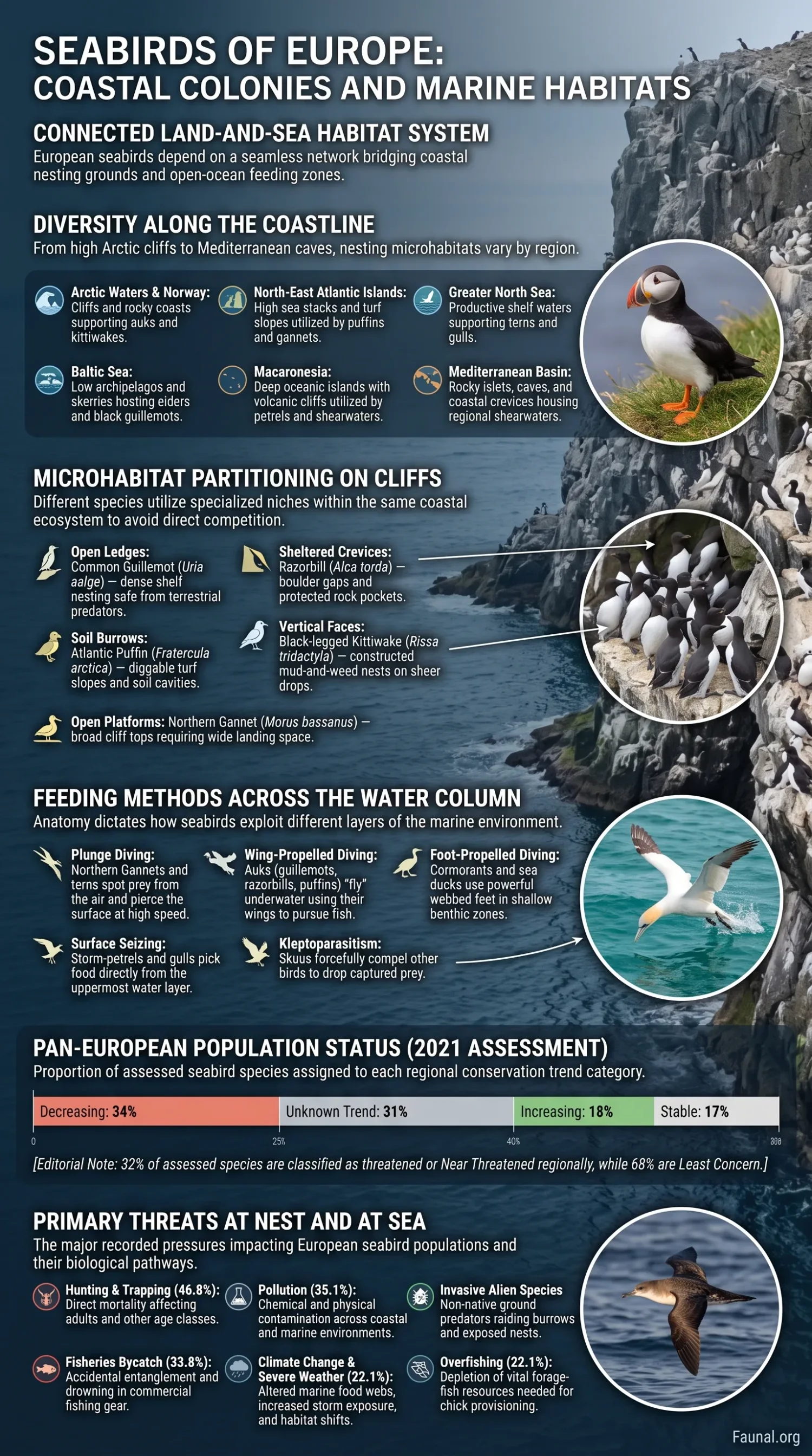
European seabirds depend on a connected land-and-sea habitat system. Cliffs, islands, beaches, burrows and rock cavities hold eggs and chicks during breeding, while continental shelves, tidal fronts, shallow banks and open-ocean waters provide most of their food. For many species, the visible coastal colony is only the land-based end of a much larger habitat network that changes with breeding stage, season and migration.
A European Seabird Total Depends on the Boundary Being Used
“Seabird” is an ecological term rather than a single taxonomic group, and European datasets do not all apply the same geographic or ecological boundary. The European Commission’s Biodiversity Information System for Europe reports 79 seabird species regularly found on European seas, including petrels, shearwaters, gannets, cormorants, skuas, gulls, terns and auks.
A broader pan-European treatment used by BirdLife Europe and Central Asia covers more than 80 species across 48 countries and territories, from Greenland and Svalbard south to Malta and from the Atlantic archipelagos east to the Urals and Caucasus. That assessment also includes marine-associated groups such as sea ducks, divers and grebes. A species total therefore needs its geographic boundary, seasonal rule and ecological definition attached to it.
Why European seabird totals differ
A list restricted to birds regularly using European seas is not identical to a pan-European assessment of breeding and wintering birds. Passage-only species may also be handled separately. Species counts from different European datasets should not be combined unless their geography and inclusion rules match.
Scientific names used here follow the current consensus taxonomy in AviList v2025b, published in June 2026. Conservation categories and trend figures retain the scope and assessment year of the dataset that produced them; a taxonomic checklist and a regional Red List answer different questions.
From Svalbard to the Mediterranean, Colony Habitat Changes with the Sea
Europe does not contain one continuous seabird habitat. A high Arctic cliff, a Baltic skerry, a Mediterranean cave and a Macaronesian oceanic island can all support seabirds, but the nesting surfaces, nearby prey fields and seasonal conditions differ. The marine region surrounding a colony often explains as much about its bird community as the coastline itself.
| European marine region | Typical colony setting | Marine habitat connection | Representative seabird groups |
|---|---|---|---|
| Arctic waters and northern Norway | Cliffs, offshore islands, scree and exposed rocky coasts | Cold shelves, frontal zones and seasonally productive high-latitude waters | Auks, Black-legged Kittiwake, Northern Fulmar, skuas and other Arctic marine birds |
| Iceland, Faroes and the northeast Atlantic islands | High cliffs, sea stacks, turf-covered slopes and offshore islands | Continental margins and oceanic feeding grounds reached from dense colonies | Atlantic Puffin, Common Guillemot, Razorbill, Northern Fulmar and Northern Gannet |
| Greater North Sea and Celtic Seas | Cliffs, islands, low tern colonies and coastal nesting sites | Productive shelf waters where small forage fish can influence breeding output | Gannets, auks, kittiwakes, gulls and terns |
| Baltic Sea | Low islands, archipelagos, skerries, shorelines and a limited number of cliff colonies | Shallow brackish basins, coastal feeding areas and wintering waters | Common Eider, Black Guillemot, gulls, terns and locally breeding Common Guillemots and Razorbills |
| Bay of Biscay and Atlantic Iberia | Rocky coasts and islands linked to extensive offshore use | Shelf margins, oceanic fronts and productive Atlantic waters used by resident and passage birds | Gannets, shearwaters, storm-petrels, gulls and other pelagic migrants |
| Macaronesia | Oceanic islands with cliffs, burrows, cavities and remote mountain or islet nesting sites | Deep Atlantic pelagic waters; some breeders travel far from small nesting ranges | Zino’s Petrel, Desertas Petrel, Monteiro’s Storm Petrel and other petrels and shearwaters |
| Mediterranean and adjoining Black Sea routes | Rocky islets, caves, crevices, coastal islands and low ground colonies | Coastal feeding areas, basin-scale movements and migration between Mediterranean and Black Sea waters | Yelkouan Shearwater, Balearic Shearwater, Mediterranean shearwaters, storm-petrels, gulls and terns |
The Baltic illustrates why a regional label needs its own scope. HELCOM’s 2024 assessment describes the Baltic as seasonally important for around 80 species under its broad seabird and coastal-waterbird treatment. Many arrive to breed or winter rather than remaining in the basin throughout the year. That figure is not directly interchangeable with the European Commission’s 79 regularly occurring seabirds because the inclusion rules differ.
A Seabird Cliff Is Partitioned into Ledges, Burrows, Crevices and Open Ground
Large mixed colonies are not simply crowds of birds occupying the same rock. Species separate partly by nesting substrate and exposure. Narrow ledges, turf, cavities, cliff tops and low islands create different nesting opportunities, allowing several species to breed within a small coastal area while using different microhabitats.
| Species or group | Typical nesting microhabitat | Ecological consequence |
|---|---|---|
| Common Guillemot (Uria aalge) | Open, narrow rock ledges and cliff shelves | Dense ledge nesting allows many breeding birds to occupy steep faces inaccessible to most terrestrial predators. |
| Razorbill (Alca torda) | Crevices, boulder gaps and more sheltered ledges | Uses protected spaces within the same cliff systems occupied by open-ledge nesters. |
| Atlantic Puffin (Fratercula arctica) | Soil burrows, turf slopes and rock cavities | Needs diggable ground or suitable cavities rather than an exposed cliff ledge. |
| Black-legged Kittiwake (Rissa tridactyla) | Constructed nests on narrow cliff faces and ledges | Can use near-vertical nesting surfaces while remaining close to marine feeding areas. |
| Northern Gannet (Morus bassanus) | Exposed islands, broad ledges, cliff tops and open nesting platforms | Colonies require enough open surface for large birds to land, depart and maintain nest spacing. |
| Petrels, storm-petrels and many shearwaters | Burrows, deep crevices, cavities and caves | Concealed nesting reduces exposure but makes island colonies vulnerable when non-native mammals enter nesting spaces. |
| Many terns | Low islands, shingle, sand, gravel or sparsely vegetated ground | Open ground permits colonial nesting but leaves eggs and chicks exposed to flooding, disturbance and predators. |
Suitable coastline is not enough. A colony site has to combine usable nesting substrate with marine feeding habitat that adults can reach repeatedly while incubating eggs or provisioning chicks.
The Sea Around a Colony Controls Access to Food
A nesting cliff may remain physically unchanged while breeding conditions at the colony deteriorate because prey availability changes offshore. Seabirds respond to ocean structure: water depth, currents, tidal mixing, frontal zones and the position of prey in the water column can alter where feeding becomes profitable.
| Marine habitat | What can concentrate prey | Seabird use |
|---|---|---|
| Nearshore and shallow coastal water | Shallow fish schools, benthic prey, tidal channels and coastal productivity | Terns, cormorants, gulls and some diving marine birds can make repeated short trips from nearby colonies. |
| Tidal fronts and races | Mixing between water masses can aggregate fish and plankton | Surface-feeders and pursuit divers may gather where prey is forced into reachable depths. |
| Continental shelf | Relatively shallow, productive water supporting forage-fish food webs | Many North Sea and northeast Atlantic colony breeders depend on shelf feeding opportunities during chick rearing. |
| Shelf edge and oceanic fronts | Changes in depth and water masses can create predictable feeding zones | Shearwaters, petrels, gannets and other mobile marine birds may use these zones far from land. |
| Deep pelagic water | Oceanographic fronts, dispersed squid, fish and zooplankton resources | Petrels and shearwaters can travel far beyond the coastal shelf and may spend most of the non-breeding season offshore. |
| Shallow benthic feeding areas | Mussels, crustaceans and other bottom-associated prey | Sea ducks and other benthic-feeding marine birds depend on seabed prey rather than the surface forage-fish pathway used by many cliff breeders. |
Breeding Adults Become Central-Place Foragers
Once an adult is tied to an egg or chick, its movement is constrained by the need to return to the colony. Ecologists describe this as central-place foraging. The usable marine habitat during breeding is therefore shaped by a trade-off between the energetic value of a feeding area and the cost of reaching it. A review in the Journal of Applied Ecology emphasizes that commuting costs and prey benefits help structure at-sea distributions around breeding colonies.
There is no defensible single “seabird foraging radius” for Europe. Distance varies among species, colonies, breeding stages, years and prey conditions. Even within petrels, trip scale can be extreme: BirdLife’s European synthesis cites Desertas Petrel (Pterodroma deserta) foraging trips of up to 12,000 km over deep pelagic water. That is an exceptional case rather than a standard colony radius, but it demonstrates why a small breeding island can depend on an enormous marine area.
European Seabirds Divide the Water Column by Feeding Method
Species breeding side by side do not necessarily compete for prey in the same way. Their anatomy and capture method determine whether they exploit the surface, dive through the water column or feed near the seabed.
| Feeding mode | European examples | Part of the marine habitat used |
|---|---|---|
| Plunge diving | Northern Gannet and many terns | Birds locate prey from the air and enter the water from above, targeting fish within accessible diving depth. |
| Wing-propelled pursuit diving | Common Guillemot, Razorbill and Atlantic Puffin | Auks pursue fish underwater using their wings, giving them access to prey below the surface layer. |
| Foot-propelled pursuit diving | Cormorants and several sea ducks | Birds propel themselves underwater with their feet; some work through shallow coastal or benthic feeding areas. |
| Surface seizing and dipping | Storm-petrels, gulls and some terns | Prey must occur at or close to the surface, making these feeders sensitive to whether fish and plankton remain within reach. |
| Surface feeding combined with diving | Many shearwaters | Foraging can shift between surface capture and underwater pursuit according to species, prey and sea conditions. |
| Kleptoparasitism | Skuas | Food can be obtained by forcing other seabirds to release captured prey, linking the predator’s feeding success to other marine foragers. |
Forage Fish Can Link Ocean Conditions Directly to Chick Production
The OSPAR 2023 marine-bird breeding-productivity assessment found poor breeding productivity for many assessed species in Arctic Waters, the Greater North Sea and Celtic Seas. In the Greater North Sea, many species falling below productivity thresholds were surface feeders dependent on small fish. OSPAR identifies sandeel, sprat, herring and capelin among the forage-fish resources relevant to these food webs.
The biological pathway is direct: when suitable prey is scarce near the surface or farther from the colony, adults may spend more time travelling and searching, deliver fewer or lower-quality meals, or fail to provision chicks often enough. The response differs among feeding guilds because a guillemot capable of underwater pursuit does not encounter the same prey-access limit as a kittiwake taking food at the surface.
The Colony Is Seasonal Even When the Species Remains Marine All Year
Breeding brings adults back to fixed terrestrial sites, but the end of breeding can dissolve that spatial constraint. Adults and juveniles disperse, moult, migrate or move to winter feeding areas. A cliff that is densely occupied during nesting can hold few birds outside the breeding season even though the same population remains entirely dependent on marine habitat.
The annual range can extend far beyond Europe. BirdLife records European breeders using waters off Africa and across the Atlantic, while the breeding island itself may occupy only a tiny fraction of the annual range. This is why “breeds in Europe” and “lives in European waters throughout the year” must not be treated as equivalent occurrence statements.
Marine Flyways Connect Colonies to Distant Feeding and Wintering Areas
The land-sea connection is now being treated at a larger migratory scale. In July 2026, CMS Decision 15.159 directed work on critical networks of sites within six marine flyways. The requested site networks include breeding, foraging, stop-over and wintering areas in both national and international waters.
For European seabirds, this scale matters because protection at a nesting island cannot address mortality or habitat loss occurring on a migration corridor or wintering ground hundreds or thousands of kilometres away. Tracking data can therefore reveal habitat connections that colony counts alone cannot show.
Colony Totals Are Not Comparable Until the Count Unit Matches
A large colony number can refer to nests, burrows, territories, occupied sites or individual birds. These are not interchangeable biological units. UK seabird monitoring provides a clear example because different species are deliberately counted using units suited to their nesting ecology. The BTO Research Report 754 documents the count units used in seabird census and monitoring datasets.
| Monitoring unit | Meaning | Examples in the BTO review |
|---|---|---|
| AON | Apparently occupied nests | Northern Gannet, Shag, Cormorant, Black-legged Kittiwake and many gulls and terns |
| AOS | Apparently occupied sites | Northern Fulmar |
| AOT | Apparently occupied territories | Arctic Skua and Great Skua |
| IND | Individuals | Common Guillemot, Razorbill and Black Guillemot |
| AOB | Apparently occupied burrows | Atlantic Puffin |
A colony count is not automatically a breeding-pair estimate
Twenty thousand counted individual guillemots, twenty thousand occupied gannet nests and twenty thousand occupied puffin burrows describe different census units. Colony rankings should not combine such figures as though they measure the same thing.
Pan-European Data Show Both Decline and Large Information Gaps
BirdLife’s 2024 synthesis reports results from the 2021 European Red List assessment, which evaluated birds breeding and wintering in Europe using population information for 2013–2018. At pan-European level, 32% of assessed seabird species were classified as threatened or Near Threatened, while 53 species, representing 68%, were Least Concern. These are regional assessment results and should not be silently substituted for a species’ global IUCN category.
Population-trend categories show a second pattern: 34% of assessed species were decreasing, but another 31% had an unknown trend. The unknown share matters because it prevents the trend dataset from being treated as a complete measurement of change across every European seabird.
Population trend categories in the 2021 pan-European seabird assessment
Share of assessed seabird species assigned to each European population-trend category.
BirdLife Europe and Central Asia, European Red List assessment reported in the 2024 Seabirds of Europe report. Values are shares of assessed species, not percentage changes in seabird abundance.
Five passage-only species in BirdLife’s pan-European seabird list were not included in those Red List statistics because they did not regularly occur in Europe during breeding or wintering. That distinction again separates occurrence in European waters from eligibility for a European breeding-and-wintering assessment.
North-East Atlantic Productivity Adds a Demographic Warning
OSPAR evaluates marine birds at basin and regional scale rather than reproducing the pan-European Red List. Its 2023 assessment found that breeding productivity was below the adopted threshold for many species in Arctic Waters, the Greater North Sea and Celtic Seas. Productivity measures young fledged per pair, clutch or nest, so it can deteriorate before a reduction becomes obvious in counts of long-lived adults.
This distinction is biologically important. A colony can still contain many experienced adults while producing too few young to replace future losses. Adult abundance, breeding productivity and Red List category are therefore related indicators, not substitutes for one another.
The Baltic Assessment Uses a Broader Regional Bird Set
HELCOM’s 2024 Red List II evaluated 85 breeding bird species within its Baltic seabird assessment process. Eighteen were placed in threatened categories from Critically Endangered through Vulnerable, while 31 were red-listed across categories from Critically Endangered through Data Deficient. Twenty-eight of the 85 breeding taxa were classed Not Applicable under the regional assessment rules. The dataset includes coastal and waterbird taxa beyond the narrower colony-forming marine groups emphasized on this page, so its percentages should not be merged with BirdLife’s pan-European figures.
Pressures at the Nest and Pressures at Sea Act Through Different Pathways
A seabird can encounter one set of pressures while incubating on an island and another while feeding offshore. BirdLife’s European threat synthesis separates several of these pathways. Because one species can face more than one pressure, the percentages below overlap and must not be added to produce a total.
| Where the pressure acts | Pressure in the European analysis | Share of species recorded as affected | Main biological pathway |
|---|---|---|---|
| Breeding sites and adjacent land | Hunting and trapping | 46.8% | Direct mortality of adults or other age classes where exploitation occurs |
| Land and coastal environment | Pollution | 35.1% | Exposure to contaminants, waste or other pollution pathways |
| Breeding islands and colonies | Invasive alien species | 33.8% | Predation or disturbance affecting eggs, chicks and nesting adults |
| At sea | Fisheries bycatch | 33.8% | Accidental capture and mortality in fishing gear |
| At sea and breeding sites | Climate change and severe weather | 22.1% | Changes in prey, weather exposure, breeding conditions and marine habitat |
| At sea | Overfishing | 22.1% | Changes in prey availability and competition for fish resources |
Bycatch Can Affect the Adults a Slow-Breeding Population Depends On
Many seabirds are long-lived, mature relatively late and produce few young in a breeding attempt. That life history allows adults to survive across many seasons, but it also means persistent additional adult mortality can be difficult to replace. Bycatch can therefore affect population dynamics differently from a single season of poor chick production.
Burrow and Cavity Colonies Are Exposed When Non-Native Mammals Reach Islands
Remote islands often function as breeding refuges because terrestrial mammal predators are naturally absent. Introduced rats, mice, cats and other mammals can remove that advantage. Eggs, chicks and adults in burrows or cavities may be accessible in spaces evolved under predator conditions very different from those created after mammal introduction. The pressure is especially relevant to petrels, storm-petrels and shearwaters nesting on small islands.
Offshore Energy Effects Depend on Species, Site and Behaviour
Offshore energy infrastructure cannot be represented by one universal seabird response. Relevant pathways include collision risk, displacement from feeding habitat, barrier effects on repeated journeys between colony and feeding areas, and disturbance during construction or operation. Exposure depends on flight height, avoidance behaviour, colony location, migration route and the position of feeding grounds. A development far from nesting cliffs can still intersect habitat used during daily foraging or seasonal migration.
Avian Influenza Remains a Changing Colony-Surveillance Problem
Highly pathogenic avian influenza has continued to circulate in European wild birds, but the affected bird community changes between reporting periods. In the June–September 2025 ECDC/EFSA overview, more than 75% of wild-bird HPAI detections were associated with colony-breeding seabirds, particularly European Herring Gulls.
The pattern had changed by spring 2026. The March–May 2026 European overview recorded 763 HPAI A(H5) detections in wild birds between 28 February and 4 June across the reporting area and described a continuing decline from the winter peak after intense circulation in waterfowl. Detection counts are surveillance records, not estimates of how many wild birds were infected or how large a seabird population is.
The 2025–26 Atlantic seabird wreck
BirdLife Europe and Central Asia reported more than 38,000 stranded seabirds along the Atlantic coasts of Spain, Portugal and France after the 2025–26 winter, with hundreds of dead Atlantic Puffins also reported from Cornwall. A seabird wreck is a mass stranding event often associated with severe winter conditions, exhaustion and failure to obtain enough food. The reported strandings are not a population census: birds that die offshore and never reach land are absent from beach counts, and the event should not be converted directly into a percentage population loss.
The wreck also illustrates a feature that colony-only monitoring can miss. Mortality accumulated during winter at sea can affect how many adults are available to return to nesting sites months later. Breeding-ground observations and marine-season events belong to the same annual life cycle even when they occur in different countries.
Climate Pressure Can Reach a Colony Through Food, Weather and Timing
For seabirds, climate-related change is not limited to warmer air at a nest. Marine temperature and circulation can alter where prey occurs and when prey becomes available. Adults may then encounter suitable fish farther from the colony, at a different depth, or at a different point in the chick-rearing period.
- Prey redistribution: shifts in fish or plankton can change commuting distance and feeding success.
- Prey depth: food may remain present in a region while moving below the reach of surface-feeding species.
- Breeding timing: the seasonal peak in prey availability can move relative to incubation or chick-rearing dates.
- Extreme weather: storms can impede feeding at sea, while heavy rain, flooding, heat or wave exposure can reduce nesting success on land.
- Range and site suitability: marine and terrestrial conditions can change at different rates, separating a historically productive colony from the feeding conditions that once supported it.
These mechanisms should be separated from claims about a single event. A storm-related wreck, one failed breeding season or one warm-water anomaly does not by itself establish a long-term population trend. Trend assessment requires repeated demographic or abundance evidence over an appropriate period.
Yelkouan Shearwater Shows the Mediterranean Island–Sea Connection
The Yelkouan Shearwater (Puffinus yelkouan) is a European-endemic seabird whose nesting distribution makes the colony–marine habitat connection especially clear. BirdLife reported in January 2026 that the species nests mainly on rocky coastal and offshore islands and islets from southern France and eastern Algeria east to Greece and Bulgaria. The same account reports that nine colonies have disappeared during the past 60 years.
The breeding site does not define the full range. Yelkouan Shearwaters also use Aegean feeding areas and some migrate seasonally into the Black Sea. A protected nesting islet can therefore remain biologically connected to waters outside the immediate colony boundary. Bycatch at sea and introduced predators at colonies operate on different parts of the same population.
Macaronesian Petrels Pair Tiny Breeding Ranges with Open-Ocean Movement
Macaronesia contains some of Europe’s most geographically restricted seabird breeders. BirdLife identifies Zino’s Petrel (Pterodroma madeira) and Monteiro’s Storm Petrel (Hydrobates monteiroi) among European endemics with small breeding ranges and small populations. Desertas Petrel (Pterodroma deserta) provides the opposite spatial perspective once birds leave land: individuals can cover enormous distances while foraging over deep pelagic water.
This combination makes breeding-range area a poor proxy for annual habitat area. A species can be restricted to a small number of nesting locations while using a large oceanic range. Conversely, a bird observed widely at sea may still depend on very few places suitable for reproduction.
Stora Karlsö Shows Marine Nutrients Moving Back onto Land
Seabird colonies do more than consume marine prey. They also move marine-derived nutrients onto islands through guano, food remains, feathers, eggs and carcasses. A peer-reviewed study of Stora Karlsö in the Baltic Sea examined this transfer around a major colony of Common Guillemots and Razorbills.
At the time of that study, the island supported about 15,700 breeding pairs of Common Guillemots and 12,000 pairs of Razorbills. The birds fed largely on marine fish such as sprat and herring, then transported nutrients to the island. The resulting nutrient pathway was associated with large numbers of non-biting midges, which in turn provided food for breeding House Martins. It is a direct example of an offshore food web influencing a terrestrial insectivore through a seabird colony.
Protecting a Colony Requires the Full Land–Sea Connection to Remain Functional
A breeding site can be physically intact while the population using it faces problems elsewhere in the annual cycle. Effective seabird conservation therefore operates across several connected spatial units rather than ending at the cliff edge.
- Nesting habitat: ledges, burrows, caves, beaches and islands need suitable substrate, low disturbance and predator conditions compatible with breeding.
- Colony-linked feeding grounds: marine areas used repeatedly during incubation and chick rearing determine how costly it is for adults to deliver food.
- Prey systems: the amount, quality, depth and timing of forage fish or other prey can affect breeding performance even when nesting space remains unchanged.
- Fisheries interactions: bycatch can cause mortality far from colonies, while changes in prey extraction or discards can alter food availability for different feeding guilds.
- Migration and winter habitat: mortality and habitat conditions outside Europe or outside a breeding country can affect the number of adults returning to European colonies.
- Disease surveillance: colony mortality and wild-bird detections need current seasonal evidence because the species groups affected by HPAI can change between reporting periods.
The 2026 CMS marine-flyway decision reflects this connected geography by calling for networks of breeding, foraging, stop-over and wintering sites across six flyways. At the regional-sea scale, OSPAR and HELCOM add separate evidence on abundance, productivity and regional Red List status. Together, these datasets show why a European seabird colony is best treated as one node in a mobile marine system rather than as an isolated coastal population.
Sources and Verification
- BirdLife Europe and Central Asia — Seabirds of Europe: Current Status, Main Threats and Way Forward — Pan-European geographic scope, seabird species scope, 2021 European Red List results, population-trend categories, ecological context and threat data.
- European Commission, Biodiversity Information System for Europe — Coasts and Seas — Regular European-sea seabird count and the major seabird groups included in that marine scope.
- AviList — Global Avian Checklist v2025b — Current avian taxonomic and nomenclatural baseline used for scientific names.
- OSPAR Quality Status Report 2023 — Marine Bird Breeding Productivity — Regional breeding-productivity thresholds, feeding-guild differences and forage-fish context in the North-East Atlantic.
- OSPAR Quality Status Report 2023 — Marine Bird Abundance — Feeding-guild abundance patterns and regional marine-bird status across North-East Atlantic assessment areas.
- HELCOM — 2024 Red List II of Seabirds — Baltic seasonal scope, breeding and wintering assessment totals, regional categories and applicability rules.
- Journal of Applied Ecology — Review of Colony Accessibility and Seabird Foraging Distribution — Evidence for central-place foraging constraints and the relationship between commuting cost and marine feeding habitat.
- British Trust for Ornithology — Research Report 754 — Seabird census count units including occupied nests, sites, territories, burrows and individual birds.
- Convention on Migratory Species — Seabirds and Marine Flyways Decision 15.159 — 2026 direction to identify critical breeding, foraging, stop-over and wintering site networks within six marine flyways.
- ECDC, EFSA and EURL — Avian Influenza Overview, June–September 2025 — Seasonal HPAI detections in wild birds and the high share associated with colony-breeding seabirds during that reporting period.
- ECDC, EFSA and EURL — Avian Influenza Overview, March–May 2026 — Latest checked European wild-bird HPAI detection totals and the shift from the preceding winter peak.
- BirdLife International — The Mediterranean Wind-Chaser: the Yelkouan Shearwater — 2026 account of nesting geography, Mediterranean–Black Sea movement and reported colony losses.
- BirdLife International — 2025–26 Atlantic Seabird Wreck Report — Reported strandings in Spain, Portugal, France and Cornwall following severe winter conditions.
- Scientific Reports — Fueling of a Marine-Terrestrial Ecosystem by a Major Seabird Colony — Stora Karlsö colony size, marine prey use and nutrient transfer from seabirds to the island food web.
Related Topics
- → Birds of Europe: Species Diversity, Habitats, and Biogeographic Regions
- → Wetland Birds of Europe: Ducks, Herons, Waders, and Waterbirds
- → Migratory Birds of Europe: Flyways, Seasons, and Stopover Habitats
- → Wildlife of Western Europe: Landscapes, Species, and Conservation
- → Wildlife of Eastern Europe: Forests, Wetlands, and Steppe Species
- → Wildlife of Northern Europe: Boreal Forests, Tundra, and Coasts