Complete guides: •Regional Fauna Guides•Reptiles•Fauna of Europe
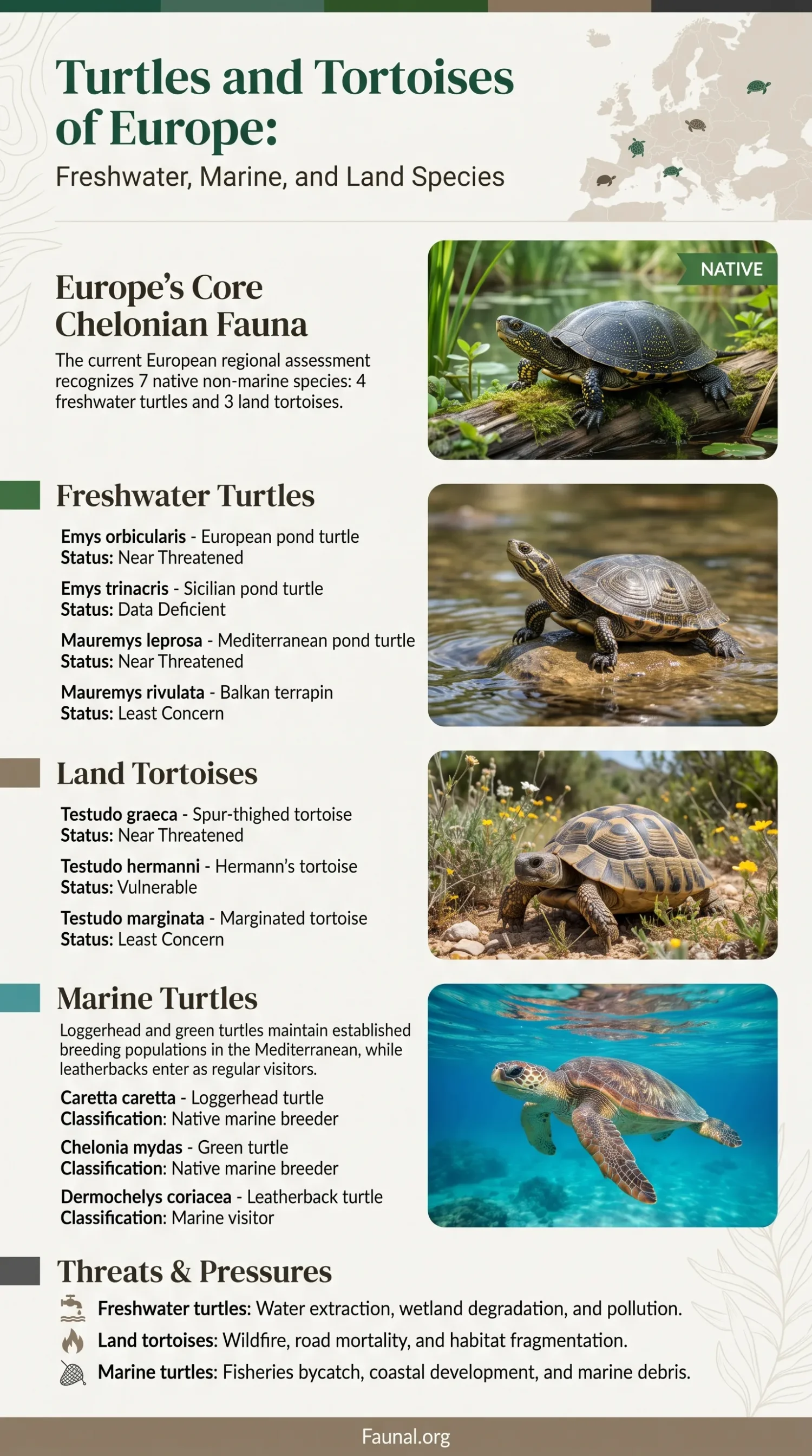
Europe’s native non-marine turtle and tortoise fauna comprises seven species under the current European regional assessment: four freshwater turtles and three land tortoises. Marine turtles require a separate classification. Loggerhead and green turtles maintain breeding populations in the Mediterranean, leatherbacks enter as visitors, and several other oceanic species occur only as occasional records. Introduced turtles and the probably vagrant African softshell turtle should not be added to the seven native freshwater and land species.
This separation follows the taxonomic and geographic treatment used by the European Red List of Reptiles and the current turtle taxonomy summarized by the Turtle Taxonomy Working Group. It prevents a Mediterranean sighting, an introduced pond turtle and a native breeding species from being treated as equivalent records.
Seven Native Freshwater and Land Species Form Europe’s Core Chelonian Fauna
The current European assessment recognizes two native species of Emys, two of Mauremys and three of Testudo. Three of these seven—Emys trinacris, Testudo hermanni and Testudo marginata—are treated as regionally endemic to Europe. Conservation categories below are the current European regional categories rather than global categories or older national assessments.
| Group | Species | Common name | European range pattern | European regional category |
|---|---|---|---|---|
| Freshwater | Emys orbicularis | European pond turtle | Broad but fragmented distribution across much of southern, central and eastern Europe, with extirpated, reintroduced and translocated populations at parts of its range margin | Near Threatened |
| Freshwater | Emys trinacris | Sicilian pond turtle | Restricted to Sicily | Data Deficient |
| Freshwater | Mauremys leprosa | Mediterranean pond turtle | Southwestern Europe, principally the Iberian Peninsula and parts of southern France | Near Threatened |
| Freshwater | Mauremys rivulata | Balkan terrapin | Southeastern Europe, especially the Balkans and Aegean region | Least Concern |
| Land | Testudo graeca | Spur-thighed tortoise | Discontinuous native sectors in the Iberian Peninsula and southeastern Europe | Near Threatened |
| Land | Testudo hermanni | Hermann’s tortoise | Western Mediterranean populations and a wider southeastern European and Balkan distribution | Vulnerable |
| Land | Testudo marginata | Marginated tortoise | Native range centred on Greece and Albania; some other European populations are introduced | Least Concern |
Hermann’s tortoise is the only one of these seven species currently placed in an IUCN threatened category at the European regional level. Near Threatened is not itself one of the threatened categories Vulnerable, Endangered or Critically Endangered, and a Least Concern regional assessment does not imply that every local population is secure.
Europe’s Four Freshwater Turtles Occupy Very Different Geographic Ranges
European Pond Turtle: the Broadest Native Freshwater Distribution
Emys orbicularis has by far the broadest European distribution of the four native freshwater species. Its range extends through large parts of southern, central and eastern Europe, but the distribution is not continuous. The 2025 turtle atlas distinguishes native range from extirpated, reintroduced, translocated, introduced and questionable occurrences, an important distinction for a species that appears in many national datasets.
The species is associated with freshwater wetlands, ponds, marshes and slow-water systems, while reproduction also depends on terrestrial nesting sites. A record from a restored or reintroduced population therefore describes present occurrence but does not necessarily demonstrate uninterrupted historical presence. Its current European assessment remains Near Threatened.
Sicilian Pond Turtle: One Island and an Unresolved Taxonomic Boundary
Emys trinacris is restricted to Sicily and is the only freshwater turtle treated as endemic to Europe in the current regional assessment. Its small geographic scope makes it very different from the widespread E. orbicularis, but its species boundary remains under discussion.
Why Emys trinacris Changes the European Species Count
The European Red List presently retains Emys trinacris as a full species following specialist-group guidance, while some European herpetological treatments have placed it within E. orbicularis. The Reptile Database also records the competing genetic and taxonomic interpretations. The current European checklist used here follows the species-level treatment, but the uncertainty should remain visible whenever the total number of native species is stated.
The Sicilian pond turtle is assessed as Data Deficient in the European Red List. The problem is not simply that the animal is poorly known. Available information is insufficient to establish the population-change metrics required for a firmer regional category, and the assessment also identifies its taxonomic identity as an area requiring confirmation.
Mediterranean Pond Turtle: a Southwestern European Species
Mauremys leprosa belongs to the southwestern part of the European turtle fauna. Its European range is centred on the Iberian Peninsula and extends into southern France, while the species also occurs outside Europe in North Africa. Its European regional assessment is now Near Threatened; older European sources may still display the previous Vulnerable category, so assessment date matters when comparing databases.
Water availability is especially relevant to this species. The European Red List associates the loss of some Spanish subpopulations with drought intensified by climate change, while also noting benefits from habitat restoration and improved water quality elsewhere in Spain. A continent-wide category therefore does not replace local evidence about individual river basins or wetlands.
Balkan Terrapin: the Southeastern Freshwater Counterpart
Mauremys rivulata shifts the centre of freshwater-turtle diversity toward southeastern Europe. It occurs through the Balkans and Aegean region and uses rivers, ponds, marshes and other freshwater habitats. Its European regional category is Least Concern, but freshwater pollution and hydrological alteration remain relevant pressures within its range.
The geographic separation between M. leprosa in southwestern Europe and M. rivulata in southeastern Europe is one of the clearest patterns in the continent’s freshwater chelonian fauna. Treating both merely as “Mediterranean turtles” hides this west–east division.
Three Land Tortoises Are Concentrated in Mediterranean and Southeastern Europe
Hermann’s Tortoise: Western Pockets and a Broad Balkan Sector
Testudo hermanni is regionally endemic to Europe and is commonly divided into two living subspecies. T. h. hermanni represents the western part of the range, including populations around the western Mediterranean, while T. h. boettgeri occupies a much larger southeastern European and Balkan sector. These subspecies are not separate additions to the European species count.
The species is assessed as Vulnerable in Europe. The European Red List links its condition to multiple sources of habitat loss and direct mortality and identifies fire and road mortality as recurrent problems for terrestrial tortoises. Released captive animals can create additional disease and genetic-admixture concerns in native populations.
Spur-Thighed Tortoise: a Discontinuous European Distribution
Testudo graeca is not confined to Europe; its wider distribution extends into North Africa and western Asia. Within Europe, however, its native occurrence is strongly discontinuous, with an Iberian component separated from southeastern European populations. This makes country-level presence particularly easy to misread when native populations, historical translocations and recent introductions are merged.
The 2025 turtle atlas records introduced occurrences in several places outside the accepted indigenous range. Those records are useful evidence of present-day occurrence, but they should not expand the native European range of the species. Its current European category is Near Threatened.
Marginated Tortoise: a Native Range Centred on Greece and Albania
Testudo marginata has the narrowest native geographic pattern among Europe’s three land tortoises. Its indigenous range is centred on Greece and extends into Albania. Populations recorded in parts of Italy, including Sardinia and mainland localities, are treated as introduced rather than evidence that the natural European range extends westward across the central Mediterranean.
Like Hermann’s tortoise, the marginated tortoise is considered regionally endemic to Europe. Its European Red List category is Least Concern, but fire and road mortality affect terrestrial tortoises at local scales regardless of the continent-wide category.
Marine Turtles in European Waters Need Breeding and Visitor Categories
Marine turtles cannot be added to the seven native non-marine species by using the same counting rule. The Mediterranean connects European waters with North Africa and western Asia, while the North-east Atlantic connects European islands and coasts with migratory populations originating far outside Europe. The IUCN SSC Marine Turtle Specialist Group Mediterranean report identifies loggerheads, green turtles and leatherbacks as the three species that regularly use the Mediterranean, but only loggerhead and green turtles maintain established breeding populations there.
| Species | European or Mediterranean occurrence | Breeding treatment | How the record should be classified |
|---|---|---|---|
| Caretta caretta Loggerhead turtle |
Regular across the Mediterranean; Atlantic-origin turtles also enter the basin | Established Mediterranean breeder, including European nesting coasts | Native marine breeder |
| Chelonia mydas Green turtle |
Most strongly associated with the eastern Mediterranean, with newer records farther west | Established Mediterranean breeder; recent nesting outside the traditional core includes Crete | Native marine breeder |
| Dermochelys coriacea Leatherback turtle |
Rare but regular Mediterranean visitor from the Atlantic | No established Mediterranean nesting population | Marine visitor |
| Lepidochelys kempii Kemp’s ridley |
Occasional Mediterranean and North-east Atlantic visitor | No established European or Mediterranean breeding population | Occasional marine record |
| Eretmochelys imbricata Hawksbill turtle |
Rare visitor documented in European Union marine waters and occasional Mediterranean records | No established Mediterranean breeding population | Occasional marine record |
| Lepidochelys olivacea Olive ridley |
Occasional encounters reported at Mediterranean-wide scale | No established Mediterranean breeding population | Exceptional regional record; not a resident European breeder |
A Marine Record Is Not a Breeding Population
A turtle can enter European or Mediterranean waters without establishing a nesting population there. The Biodiversity Information System for Europe identifies loggerhead and green turtles as Mediterranean nesting species and leatherback, Kemp’s ridley and hawksbill as visitors in EU marine waters. The Mediterranean specialist report additionally records occasional olive ridley encounters. Those two geographic scopes should not be converted into a single resident-species total.
Loggerhead Turtle: Europe’s Most Established Marine Breeder
Caretta caretta is the most broadly established nesting sea turtle associated with Mediterranean Europe. Long-standing nesting centres occur in the eastern and central Mediterranean, while foraging and migratory habitat extends much more widely through the basin. Atlantic loggerheads also enter the Mediterranean, so an animal feeding in European waters does not necessarily belong to the Mediterranean breeding unit.
Green Turtle: an Eastern Breeder with New Nesting Evidence Farther West
Chelonia mydas has historically had a much more eastern Mediterranean nesting pattern than the loggerhead. Cyprus and the eastern Mediterranean have been central to its regional breeding distribution. Recent nests outside that long-established core now require the European picture to be described more carefully rather than as a fixed east-only boundary.
Leatherback Turtle: Regular Passage Without Mediterranean Nesting
Dermochelys coriacea enters the Mediterranean from the Atlantic and is recorded as a rare but regular visitor, primarily using marine habitat for feeding and movement. The regional specialist assessment does not identify an established Mediterranean nesting area for the species. It therefore belongs in European marine occurrence data but not beside loggerhead and green turtles as a Mediterranean breeder.
Global and Mediterranean Red List Categories Are Different Scales
The current Marine Turtle Specialist Group assessment summary lists the loggerhead as Vulnerable globally but the Mediterranean subpopulation as Least Concern. The green turtle is Least Concern globally under its 2025 assessment while the Mediterranean subpopulation is Near Threatened. A global category should not replace the Mediterranean category when the biological unit being discussed is the Mediterranean population.
Loggerhead and Green Turtle Nesting Geography Is Changing in the Mediterranean
Western Mediterranean loggerhead nesting was once treated largely as sporadic activity. Genetic evidence now shows that the pattern is more dynamic. A 2024 Scientific Reports study analysed 45 hatchlings from eight Spanish nests laid between 2016 and 2019. The nests showed mixed Mediterranean and Atlantic ancestry, and the sampled clutches were produced by different females except for two nests laid within the same season.
That result matters because the recent rise in nesting was not explained by females born at the new Spanish sites already returning there to reproduce. The researchers instead found evidence for multiple new colonising females. Spain had recorded loggerhead nesting annually from 2014 through the study period, but confirmation of a self-reinforcing resident nesting population requires evidence of later remigration by turtles originating from the new sites.
Green turtles show another developing pattern. A 2025 Molecular Ecology genomic study examined emerging nests and mature-sized turtles outside the species’ traditional Mediterranean core. The new nests sampled on Crete were assigned to the Mediterranean Regional Management Unit, while a nest in Tunisia originated from the South Atlantic unit. The results support an early range-expansion process involving more than one origin population.
New Nests Do Not Yet Equal a New Established Rookery
A nest proves reproduction at a location. It does not by itself demonstrate a persistent breeding population. Repeated nesting, recruitment and the later return of locally produced females provide much stronger evidence that a new rookery has become established.
Alien Turtle Records Add Species to European Datasets Without Adding Native Species
The European reptile assessment separately identifies turtle taxa introduced after 1500 CE and treats them as Not Applicable for the native regional Red List analysis. This group is broader than the familiar red-eared slider. Ten alien turtle species are listed in the assessment, but their inclusion records alien occurrence within the European assessment region; it does not mean that every species has a widespread or self-sustaining European population.
| Alien taxon recorded in the European assessment | Native region reported by the assessment | European treatment |
|---|---|---|
| Chelydra serpentina | North America | Alien; excluded from native regional assessment |
| Macrochelys temminckii | North America | Alien; excluded from native regional assessment |
| Chrysemys picta | North America | Alien; excluded from native regional assessment |
| Pseudemys nelsoni | North America | Alien; excluded from native regional assessment |
| Trachemys scripta | North America | Alien; also regulated in the European Union as an invasive alien species of Union concern |
| Mauremys caspica | Western Asia | Alien within the European assessment scope |
| Mauremys reevesii | Temperate East Asia | Alien; excluded from native regional assessment |
| Mauremys sinensis | East Asia | Alien; excluded from native regional assessment |
| Kinosternon subrubrum | North America | Alien; excluded from native regional assessment |
| Pelodiscus sinensis | China and Vietnam | Alien; excluded from native regional assessment |
The Pond Slider Is the Most Important Species-Level Counting Trap
Trachemys scripta has been transported far beyond its North American native range through the pet trade and is now recorded across many European countries. The species is included in the EU list of invasive alien species of Union concern under the consolidated Commission Implementing Regulation (EU) 2016/1141.
The red-eared slider, Trachemys scripta elegans, is a subspecies of T. scripta, not an additional turtle species. The yellow-bellied slider T. s. scripta and Cumberland slider T. s. troostii likewise belong within the same species. Counting pet-trade subspecies as separate species can therefore inflate a European checklist before the native-versus-alien problem is even considered.
The African Softshell Turtle Sits Outside Both the Native Seven and the Alien List
Trionyx triunguis presents a different problem from introduced pet turtles. The European Red List treats it as probably vagrant in the European assessment region. Its European inclusion rests on a single record from Greece that requires confirmation and reports of animals at sea believed to have originated from Turkish populations.
It should therefore not be presented as an eighth established native freshwater turtle of Europe. Nor should it be merged with the post-1500 alien species table. Its current European status is best described as uncertain or vagrant occurrence pending stronger evidence of a resident population within the assessment region.
Freshwater, Land and Marine Turtles Face Different European Pressures
The major pressures affecting European chelonians depend strongly on habitat. The European Red List links freshwater species to wetland hydrology and water quality, while terrestrial tortoises are particularly exposed to direct mortality from fire and roads. Marine turtles interact with an entirely different set of pressures across nesting beaches, migration routes and fishing grounds.
| Group | Pressures especially relevant in Europe or the Mediterranean | Why the pressure differs |
|---|---|---|
| Freshwater turtles | Water extraction and diversion, wetland degradation, eutrophication, pesticide runoff, drought, invasive fish, crayfish, crabs and turtles | Population persistence depends on functioning freshwater habitats as well as suitable terrestrial nesting areas |
| Land tortoises | Wildfire, road mortality, habitat loss and fragmentation, urban development, collection and release of captive animals | Slow life histories make adult mortality costly, while fires can affect many individuals within a restricted terrestrial population at once |
| Marine turtles | Fisheries bycatch, nesting-beach alteration, artificial lighting and disturbance, marine debris, changing thermal conditions and sea-level effects on nesting habitat | The same individual may depend on nesting beaches, distant feeding grounds and migration corridors across several jurisdictions |
The freshwater and terrestrial pressures are documented in the current European reptile assessment, which notes water extraction and pollution for aquatic turtles and fire and road mortality for the three native land tortoises. The Mediterranean marine assessment records fisheries interaction, coastal nesting pressures and other at-sea and beach-based threats across the region.
For European turtle data, native range, present occurrence, breeding status and conservation category are separate fields. A released slider in a city pond, a leatherback passing through the Mediterranean, a loggerhead nesting on a Spanish beach and a native Emys orbicularis population all document turtles in Europe, but they describe four different biological relationships with the region.
Sources and Verification
- European Red List of Reptiles — Current European taxonomic scope, seven native non-marine chelonians, endemicity, regional conservation categories, alien-taxon treatment and freshwater and terrestrial threat information.
- Turtles of the World: Annotated Checklist and Atlas, 10th Edition — Accepted turtle taxonomy, subspecies treatment, geographic distributions, introduced occurrences and current regional assessment references.
- Reptile Database: Emys trinacris — Species-level treatment, Sicilian distribution and the unresolved taxonomic relationship with Emys orbicularis.
- IUCN SSC Marine Turtle Specialist Group Mediterranean Regional Report — Mediterranean breeding populations, leatherback visitor status, Atlantic contributions and occasional ridley records.
- Biodiversity Information System for Europe: Coasts and Seas — Marine turtle occurrence in EU waters and the distinction between Mediterranean nesting species and marine visitors.
- IUCN SSC Marine Turtle Specialist Group Red List Assessments — Current global and Mediterranean subpopulation categories for loggerhead and green turtles.
- Luna-Ortiz et al., 2024, Scientific Reports — Genomic evidence for multiple new loggerhead colonisers behind emerging nesting on the Spanish Mediterranean coast.
- Marín-Capuz et al., 2025, Molecular Ecology — Genomic evidence from emerging green turtle nests and mature-sized turtles outside the traditional Mediterranean nesting core.
- EUR-Lex: Commission Implementing Regulation (EU) 2016/1141 — Legal listing of Trachemys scripta among invasive alien species of Union concern.
Related Topics
- → Reptiles of Europe: Snakes, Lizards, Turtles, and Tortoises
- → Lizards of Europe: Common Groups, Habitats, and Distribution
- → Snakes of Europe: Venomous and Non-Venomous Species
- → Threats to European Reptiles: Habitat Loss, Roads, and Climate Change
- → Endemic Reptiles of Europe: Islands, Peninsulas, and Restricted Ranges
- → Alpine and Mountain Reptiles of Europe: Cold-Adapted Species