Complete guides: •Regional Fauna Guides•Mammals•Wildlife Habitat Guides•Fauna of Europe
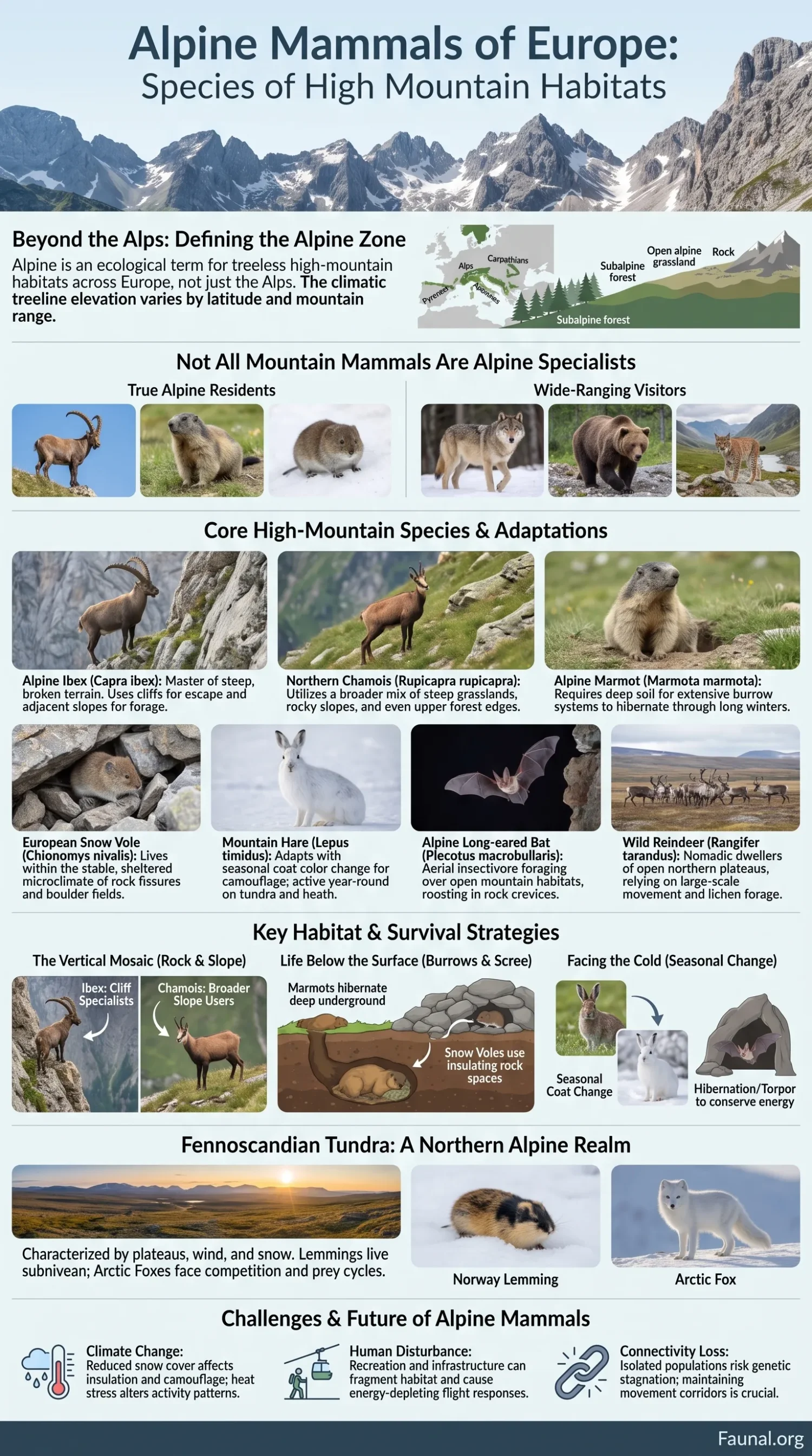
Europe’s alpine mammals include species that depend on treeless high-mountain grasslands, cliffs, scree, snowbeds and tundra, along with several wider-ranging mammals that use these habitats during only part of the year. Alpine ibex, chamois, Alpine marmots and European snow voles form the familiar central European group. Mountain hares, Alpine long-eared bats, wild reindeer, Norway lemmings and Arctic foxes extend the fauna into less visible habitats and the mountain tundra of northern Europe.
The term alpine is ecological as well as geographic. It does not refer only to the European Alps, and it cannot be defined by one elevation that applies across the continent. The climatic treeline occurs at different heights in the Alps, Pyrenees, Carpathians and Scandinavian Mountains. A windswept treeless habitat in northern Fennoscandia may occur far lower than a comparable high-mountain grassland in southern Europe.
Alpine Does Not Mean the Alps Alone
The European Union’s Alpine biogeographical region includes parts of the Alps, Pyrenees, Apennines, northern Fennoscandian mountains, Carpathians, Dinaric Mountains and several Balkan ranges. Treeline ecotones mark the transition where subalpine woodland gives way to alpine heath, scrub or grassland. EU Alpine region EUNIS treeline ecotones
Why Europe Has No Single Alpine Mammal Count
A fixed total would depend on where the lower habitat boundary was drawn and whether seasonal visitors were included. Some mammals spend nearly their entire annual cycle in open mountain terrain. Others descend into forest during winter, feed above the treeline only in summer or cross high passes while moving between larger habitat blocks.
The distinction is especially important for wolves, brown bears, Eurasian lynx and red foxes. These species may occur at high elevations, but their ecology is not confined to alpine habitat. Mountain ranges often provide them with refuge and movement corridors rather than a self-contained year-round habitat. Biodiversity Information System for Europe
A sighting above the treeline does not by itself make a species an alpine specialist. Dependence on the habitat, use across seasons and ability to reproduce there provide stronger evidence than elevation alone.
Mammals Most Closely Associated With European High Mountains
The table uses accepted species-level names from the Mammal Diversity Database. Regional forms remain important in conservation, but a named subspecies is not treated as a separate species unless the selected taxonomic source accepts that split. Mammal Diversity Database
| Common name | Scientific name | Order and family | European mountain association | Core high-mountain habitat | Winter response |
|---|---|---|---|---|---|
| Alpine ibex | Capra ibex | Artiodactyla; Bovidae | Native Alpine lineage restored across much of the Alpine arc after severe historical contraction | Cliffs, rocky ledges, broken slopes and nearby grasslands | Remains active; shifts toward lower, sunnier or more sheltered slopes |
| Northern chamois | Rupicapra rupicapra | Artiodactyla; Bovidae | Alps, Carpathians, Tatras, Dinaric and Balkan mountain systems | Steep grasslands, rocky slopes, scrub and mountain forest edges | Remains active; changes elevation, slope exposure and cover use |
| Southern chamois | Rupicapra pyrenaica | Artiodactyla; Bovidae | Pyrenean, Cantabrian and Apennine populations represented by regional forms | Rocky grasslands, cliffs, subalpine scrub and open mountain slopes | Remains active; makes local and seasonal habitat shifts |
| Alpine marmot | Marmota marmota | Rodentia; Sciuridae | Native in the Alps and parts of the Carpathian–Tatra system; introduced populations occur elsewhere | Open grassland with soil deep enough for durable burrow systems | Long communal hibernation supported by stored body fat |
| European snow vole | Chionomys nivalis | Rodentia; Cricetidae | Scattered mountain systems from Iberia through central and southeastern Europe | Scree, boulder fields, rock fissures and vegetated stone margins | Remains active in sheltered spaces beneath rock and snow |
| Alpine field mouse | Apodemus alpicola | Rodentia; Muridae | Restricted to the northwestern and central Alpine region | Rocky woodland margins, tall-herb vegetation and subalpine transition zones | Remains active and uses protected ground cover |
| Tatra vole | Microtus tatricus | Rodentia; Cricetidae | Carpathian mountain specialist with a restricted and fragmented regional range | Cool rocky forest, subalpine vegetation and humid mountain ground cover | Active beneath vegetation, litter and snow cover |
| Alpine shrew | Sorex alpinus | Eulipotyphla; Soricidae | Central and southeastern European mountain systems | Damp rocky ground, stream margins, mossy cover and cool forested slopes | Active throughout winter with high and continuous food demand |
| Mountain hare | Lepus timidus | Lagomorpha; Leporidae | Fennoscandia, the Alps, Scottish Highlands and other northern or isolated European populations | Mountain heath, tundra, grassland, scrub and treeline mosaics | Seasonal coat change; remains active above or near the snow surface |
| Alpine long-eared bat | Plecotus macrobullaris | Chiroptera; Vespertilionidae | Pyrenees, Alps, Dinaric Mountains, Pindus and adjoining mountain systems | Mountain grasslands, rocky slopes and roost sites in rock or structures | Uses torpor and winter hibernation; seasonal roost use may cross elevation belts |
| Wild reindeer | Rangifer tarandus | Artiodactyla; Cervidae | Mountain and tundra landscapes of Fennoscandia, with wild mountain populations centred in southern Norway | Open plateaus, wind-exposed ridges, snowfields and lichen pasture | Moves among seasonal ranges and digs through snow to reach forage |
| Norway lemming | Lemmus lemmus | Rodentia; Cricetidae | Scandinavian mountains and adjoining northern tundra | Alpine tundra, dwarf-shrub vegetation and subnivean spaces | Breeds and moves beneath winter snow when conditions allow |
| Arctic fox | Vulpes lagopus | Carnivora; Canidae | Fennoscandian mountain tundra and more northerly Arctic landscapes | Open tundra, denning slopes and rodent-rich mountain plateaus | Dense seasonal coat, food caching and flexible use of carrion and small prey |
| Stoat | Mustela erminea | Carnivora; Mustelidae | Broadly distributed; a strong user of alpine and tundra habitats rather than a mountain endemic | Rock piles, meadow edges, rodent burrows and snow-covered ground | Remains active; many northern or mountain populations develop white winter fur |
Cliffs and Open Slopes Separate Ibex From Chamois
Alpine Ibex Depend on Rock but Feed Beyond It
Alpine ibex are closely associated with steep rock faces, ledges and broken terrain. These features provide escape ground and resting sites, while adjacent grasslands and herb-rich slopes supply much of their food. The animals therefore require a connected rock–forage mosaic rather than bare cliff alone.
Seasonal movements commonly follow snow, plant growth, heat and slope exposure. Winter use may concentrate on sunny aspects where snow is shallower or melts sooner. During warmer periods, ibex can move higher, seek shade or transfer activity into cooler hours.
The present distribution also reflects a conservation history rather than uninterrupted survival across the Alps. Reintroductions restored the species from a narrow remnant population, leaving a strong genetic imprint from repeated founder events. Population recovery in numbers therefore does not mean that genetic variation has also returned to its former level. Alpine ibex reintroduction genetics study
Chamois Use a Broader Vertical Habitat Mosaic
Chamois often use cliffs and steep grassland, but many populations also enter forest, dwarf-pine scrub and treeline cover. This wider habitat range distinguishes them from the more rock-centred image associated with Alpine ibex. Habitat use changes with season, weather, sex, age and local predator or human pressure.
Research on Alpine chamois has shown that weather can alter their use of open and forested habitat over short periods. Hot conditions may increase the value of shade and cooler cover, while snow depth can change access to forage and the energetic cost of movement. The response is behavioural and local; it should not be reduced to a simple rule that every population moves upward as temperatures rise. Alpine chamois habitat-use study
Two Accepted Chamois Species
Rupicapra rupicapra is the northern chamois, while Rupicapra pyrenaica is the southern chamois. Names such as Pyrenean chamois, Cantabrian chamois and Apennine chamois refer to geographically distinct populations or forms within the southern species under the taxonomy used here.
The Alpine Marmot’s Annual Cycle Is Set by Hibernation
Alpine marmots need more than open grassland. A colony also needs ground in which deep, stable burrows can be excavated, a growing season that permits sufficient fat storage and winter conditions that allow the underground group to conserve energy. Extremely shallow, waterlogged or continuously unstable ground may be unsuitable even where vegetation appears adequate.
Burrow systems support refuge, reproduction and winter survival. Family members hibernate together, and the thermal benefit of grouping is especially relevant to younger animals with smaller energy reserves. Snow can act as insulation above the soil. A thin or irregular snowpack may expose the burrow zone to colder and more variable air temperatures even when the winter itself appears mild.
A 40-year resurvey published in 2025 found that changes in elevation cannot be assumed to follow one uniform upslope pattern. Marmot distribution reflects interacting effects from terrain, habitat structure, land use and climate. Local persistence may depend on suitable soil and meadow conditions as much as the elevation printed on a map. Forty-year Alpine marmot resurvey
Scree Is a Three-Dimensional Mammal Habitat
High-mountain scree is not simply exposed stone. Spaces between rocks create a sheltered network with lower wind exposure, reduced temperature swings and routes that remain usable beneath snow. Vegetation growing along the edges and within fine sediment pockets supplies food while the rock matrix provides cover.
European Snow Voles Live Within the Rock Layer
The European snow vole is one of the clearest examples of a mammal tied to broken rock. It moves through fissures and cavities rather than relying only on the exposed surface. Suitable sites combine sheltering rock structure with reachable vegetation, making both the stone field and its margins part of the habitat.
Resurveys of Alpine small-rodent communities have confirmed the species’ strong rock-dwelling association. They also show why changes in small-mammal communities cannot be inferred from large-herbivore surveys. Voles and mice respond to vegetation height, ground structure and fine-scale microclimate that may vary over only a few metres. Alpine small-rodent resurvey
Other Small Mammals Occupy Different Mountain Layers
The Alpine field mouse is associated with the Alpine region but often uses rocky vegetation and woodland transitions below the most exposed high-alpine belt. The Tatra vole occupies cool and fragmented Carpathian habitats. The Alpine shrew depends more strongly on moist ground, stream margins, moss and dense cover because its insect-based diet and high metabolism differ from those of seed- and plant-eating rodents.
Treating all small mammals above the treeline as interchangeable “mountain mice” hides these differences. Rock geometry, soil moisture, vegetation cover and invertebrate supply can separate neighbouring species even when they occur within the same elevation band.
Mountain Hares Carry a Seasonal Snow Schedule in Their Fur
Mountain hares occur across northern landscapes as well as isolated mountain regions farther south. Their habitat can include open tundra, heath, grassland, scrub and treeline mosaics. They are therefore cold-adapted mammals with a strong alpine presence, but not every European population is restricted to high elevation.
Many populations replace a brown or grey summer coat with white winter fur. The timing of this change is controlled partly by seasonal biological cues and cannot adjust instantly to every early snowfall or rapid thaw. When snow duration falls faster than coat timing changes, a white hare can remain exposed against dark ground.
A 2025 analysis found that coat-colour patterns remain closely associated with historical climate conditions and that mismatch was greatest where snow-cover duration had declined most over the previous six decades. The result does not mean that every mountain-hare population faces the same mismatch. Local snow history, coat variation and habitat cover still matter. Mountain hare coat-colour study
The Alpine Long-Eared Bat Uses High Mountains After Dark
The Alpine long-eared bat adds an aerial insect predator to the high-mountain mammal community. Its distribution follows several European mountain systems, including the Pyrenees, Alps, Dinaric Mountains and Pindus. The species was historically confused with other long-eared bats, and older names such as Plecotus alpinus occur in the literature.
Diet research in the Pyrenees found strong use of moths associated with open mountain environments. This feeding pattern links the bat to grasslands and other treeless habitats even though individual roosts may occur in buildings, rock cavities or sites outside the highest feeding zone. Pyrenean foraging study
Topographic ruggedness helps explain the species’ wider distribution, but elevation alone does not. Suitable feeding habitat, roost availability and connected movement routes all influence where it can persist. Alpine long-eared bat distribution study
Acoustic Records May Not Resolve the Species
Long-eared bats can produce similar echolocation calls. High-mountain acoustic detections may require capture measurements, genetic testing or other supporting evidence before they can be assigned confidently to Plecotus macrobullaris.
Fennoscandian Mountains Support a Tundra Mammal Community
The mammal community of the Scandinavian Mountains differs from the cliff-and-meadow assemblage most closely associated with the Alps. Broad plateaus, dwarf-shrub tundra, wind-exposed ridges, snowfields and long winter conditions favour species linked to open northern landscapes.
Wild Reindeer Need Seasonal Landscapes, Not Isolated Patches
Wild reindeer use different areas for winter forage, calving, summer feeding and movement. Roads, reservoirs, cabins, power infrastructure and concentrated recreation can separate these functions even where large areas of apparently open mountain terrain remain.
Norway assesses 24 designated wild-reindeer areas using indicators related to population condition, genetics, health, lichen resources, seasonal habitat and connectivity. A 2024 assessment reported only one area in good ecological condition, with the remaining areas placed in medium or poor condition. The categories describe the condition of managed areas rather than the global extinction status of Rangifer tarandus. Norwegian wild-reindeer assessment
Norway Lemmings Reshape the Food Web During Population Peaks
Norway lemmings occupy Scandinavian mountain tundra and use spaces beneath winter snow. Their populations fluctuate, but the familiar story of purposeful mass migration is misleading. High-density movements occur when animals disperse from crowded or deteriorating habitat; they are not coordinated journeys toward water.
Lemming abundance affects predators as well as vegetation. Productive rodent years can improve breeding opportunities for Arctic foxes and several birds of prey, while weak or irregular peaks reduce the amount of small prey available across the tundra food web.
Arctic Foxes Persist Through Active Management
The Fennoscandian Arctic fox is a mountain-tundra population within a species that also occupies wider Arctic regions. Its mainland European recovery has depended on long-term monitoring, captive breeding and release, supplementary feeding and management of competing red foxes in selected areas.
Recent conservation analysis from northern Norway describes a population that has responded to sustained intervention but remains dependent on ecological conditions and continued management. Rodent cycles, red-fox competition, genetic variation and movement between subpopulations all affect persistence. Northern Norway Arctic fox conservation analysis
Winter Survival Is Not One Adaptation
| Winter strategy | Representative mammals | Ecological trade-off |
|---|---|---|
| Long hibernation | Alpine marmot | Reduces winter energy use but requires large autumn fat reserves, secure burrows and suitable thermal conditions. |
| Seasonal coat replacement | Mountain hare, stoat, Arctic fox | Improves camouflage or insulation under expected winter conditions but may produce mismatch when snow timing changes. |
| Vertical habitat shifts | Alpine ibex, northern chamois, southern chamois | Allows use of lower snow depth, sun exposure or shelter, but movement can be blocked by infrastructure and disturbance. |
| Movement among seasonal ranges | Wild reindeer | Provides access to different forage and calving areas but depends on broad landscape connectivity. |
| Subnivean activity | Norway lemming and other small rodents | Snow creates shelter and feeding space, while ice layers or unstable snow can restrict movement and food access. |
| Rock-cavity shelter | European snow vole | Buffers exposure and permits hidden movement, but suitable scree structure is spatially fragmented. |
| Torpor and hibernation | Alpine long-eared bat | Reduces energy use during low insect availability but depends on undisturbed roosts with suitable temperature and humidity. |
| Continuous winter foraging | Alpine shrew | Maintains activity without large fat storage but requires frequent access to invertebrate prey and sheltered microhabitats. |
Large Carnivores Use Mountains Without Being Confined to Them
Grey wolves, brown bears and Eurasian lynx can cross alpine grassland, hunt near the treeline or use mountain passes. Wolverines occupy northern mountain and tundra landscapes, while red foxes range from lowlands into high elevations. None of these patterns means that the animals can complete all parts of their life cycle within a narrow belt of treeless terrain.
- Grey wolf: a wide-ranging predator whose territories may connect valleys, forest and open mountain ground.
- Brown bear: strongly dependent on seasonal food and cover that commonly extend below the alpine belt.
- Eurasian lynx: primarily linked to wooded landscapes, although individuals may cross open high terrain.
- Wolverine: closely associated with cold northern mountains and tundra but not restricted to one vegetation belt.
- Red fox: an adaptable generalist whose movement into mountain tundra can increase competition with Arctic foxes.
For these carnivores, the mountain should be treated as part of a larger connected range rather than as an isolated habitat island.
Changing Snow and Summer Heat Affect Species Through Different Pathways
Loss of alpine habitat is not limited to the physical retreat of snow or ice. Treeline movement, shrub expansion, altered plant timing, changing moisture and more frequent heat exposure can modify the location and seasonal value of habitat. European modelling identifies alpine tundra as sensitive to warming and projected habitat contraction, although the amount and pattern of change vary among mountain systems. European alpine-tundra habitat assessment
Less Snow Can Remove Insulation
Snow is both a barrier and a shelter. It can restrict access to vegetation for ungulates, yet it also insulates marmot burrows and creates subnivean space for lemmings and voles. A shorter snow season may improve access to early vegetation in one setting while exposing underground or under-snow mammals to colder temperature swings in another.
Heat Changes Daily Activity Before It Changes Range
Ibex and chamois can respond to hot conditions by using shade, cooler slopes or different hours of the day. Such behavioural changes may occur before a lasting geographic range shift becomes detectable. Reduced feeding time, greater nocturnal activity or crowding into limited cool refuges may matter even when the animals remain within the same mapped area.
Upward Movement Eventually Meets the Summit
Cold-associated mammals on isolated massifs cannot move upward indefinitely. Available land area often contracts near summits, and neighbouring habitat patches may be separated by valleys, roads or unsuitable low-elevation conditions. A small shift in climate can therefore produce a much larger change in usable and connected habitat.
Human Pressure Changes With Season and Species
Winter Disturbance Spends Stored Energy
Repeated flight from skiers, snowshoe users, dogs or off-trail visitors can force active mammals to use energy during a period when forage is limited. The effect depends on distance, predictability, refuge availability and whether animals can return quickly to suitable feeding or resting ground.
Infrastructure Can Divide Seasonal Habitat
Roads, ski facilities, service tracks, reservoirs, cabins, power lines and dense trail networks may affect species differently. A marmot colony can be altered by direct ground disturbance around burrows. Reindeer may lose access to a movement corridor. Bats may be affected through roost loss or lighting. Ibex and chamois may retain habitat but avoid it during busy periods.
Grazing Effects Depend on Intensity and Site History
Heavy livestock pressure can reduce vegetation cover, compact soil and disturb wildlife. Complete abandonment can also allow shrub or tree expansion into formerly open grassland. The result depends on the original habitat, stocking level, grazing season and the mammal being considered. No single grazing rule applies to all European mountain systems.
Population Size Does Not Replace Genetic Connectivity
Reintroduced or isolated populations may contain many animals while retaining low genetic diversity or limited exchange with neighbouring groups. Alpine ibex and Norwegian wild reindeer show why abundance, ancestry, inbreeding and movement between populations must be evaluated separately.
Feeding Changes Natural Behaviour
Feeding marmots, ibex or other mountain mammals can concentrate animals near people, alter normal foraging and increase close contact among individuals. Conservation feeding programmes for Arctic foxes are controlled interventions and are not comparable to visitors offering food to wildlife.
Visible Mammals and Hidden Mammals Require Different Monitoring
Daylight counts work best for large, visible mammals in open terrain. The same method cannot measure a snow vole moving beneath boulders, a shrew in dense ground cover or a bat feeding after dark. Monitoring design must follow the animal’s scale, season and detectability.
- Ibex and chamois: repeated visual counts, demographic classification, camera traps and GPS tracking.
- Alpine marmots: colony mapping, active-burrow checks, direct observation and long-term occupancy surveys.
- Snow voles, mice and shrews: live trapping, genetic identification, mark–recapture work and microhabitat measurement.
- Mountain hares: camera traps, pellet surveys, tracks, genetic samples and coat-colour records linked to snow conditions.
- Alpine long-eared bats: acoustic detectors supported by capture, morphology, genetics and roost surveys when species identification is uncertain.
- Wild reindeer: GPS movement data, population surveys, genetic sampling, health surveillance and landscape-connectivity models.
- Arctic foxes: den monitoring, genetic pedigrees, camera traps, reproduction records and tracking of released animals.
The 2025 AlpsLife expert assessment placed mountain hare, Alpine marmot, European snow vole, northern chamois and Alpine ibex at the top of its proposed mammal indicators for the European Alps. The report also found that mammal monitoring remains less harmonised than bird monitoring, with particular gaps for small mammals and bats. Its species order is an expert recommendation for monitoring, not a ranking of rarity, ecological value or extinction risk. AlpsLife mammal indicator assessment
The best-known alpine mammals are not necessarily the best-measured parts of the community. Large herbivores are easier to count, while the status of rock-dwelling rodents, insectivores and high-mountain bats may depend on smaller and less evenly distributed datasets.
Sources and Verification
- Mammal Diversity Database taxon list — Taxonomic backbone used for accepted mammal names and species-level treatment.
- European Union Alpine biogeographical region decision — Defines the mountain systems included within the EU Alpine biogeographical region.
- EUNIS treeline ecotones habitat factsheet — Supports the ecological boundary between subalpine woodland and alpine heath, scrub or grassland.
- AlpsLife dataset of taxa-based indicators and aggregated indices — Used for the 2025 European Alps mammal-indicator selection and identified monitoring gaps.
- A strong genetic footprint of the re-introduction history of Alpine ibex — Documents founder effects and genetic consequences of Alpine ibex restoration.
- Weather-dependent changes in habitat use by Alpine chamois — Supports short-term changes in chamois habitat use under different weather conditions.
- Shifting Heights? A 40-Year Resurvey of Alpine Marmot Distribution — Used for recent evidence on elevation, habitat and local variation in Alpine marmot occurrence.
- A Comparison of Small Rodent Assemblages after a 20-Year Interval in the Italian Alps — Supports the European snow vole’s rock-dwelling habitat association and fine-scale small-mammal monitoring.
- Mountain Hares Are Adapted to Historical Climates — Used for the 2025 findings on coat-colour mismatch and reduced snow-cover duration.
- The Foraging Ecology of the Mountain Long-Eared Bat in the Pyrenees — Supports the species’ feeding relationship with moths and open mountain habitat.
- Factors Shaping the Distribution of the Alpine Long-Eared Bat — Used for the role of terrain, climate and topographic ruggedness in the bat’s distribution.
- Code Red and Yellow for Norway’s Wild Reindeer — Reports the ecological classification of Norway’s 24 designated wild-reindeer areas.
- Arctic Fox Conservation in Northern Norway as an Example of Adaptive Management — Used for current Fennoscandian Arctic fox management, monitoring and ecological constraints.
- Alpine Tundra Habitat Loss and Treeline Shifts Under Future Climate Scenarios — Supports the discussion of projected habitat contraction and changing treeline conditions.
- Mountains — Biodiversity Information System for Europe — Used to distinguish specialist mountain mammals from large carnivores using mountains as refuge and movement corridors.
Related Topics
- → Mammals of Europe: Native Species, Habitats, and Distribution
- → Forest Mammals of Europe: Woodland Species and Habitat Use
- → Small Mammals of Europe: Rodents, Shrews, Hedgehogs, and Dormice
- → Wild Ungulates of Europe: Deer, Bison, Boar, Goats, and Sheep
- → Large Carnivores of Europe: Wolves, Bears, Lynx, and Wolverines