Complete guides: •Regional Fauna Guides•Mammals•Fauna of Europe
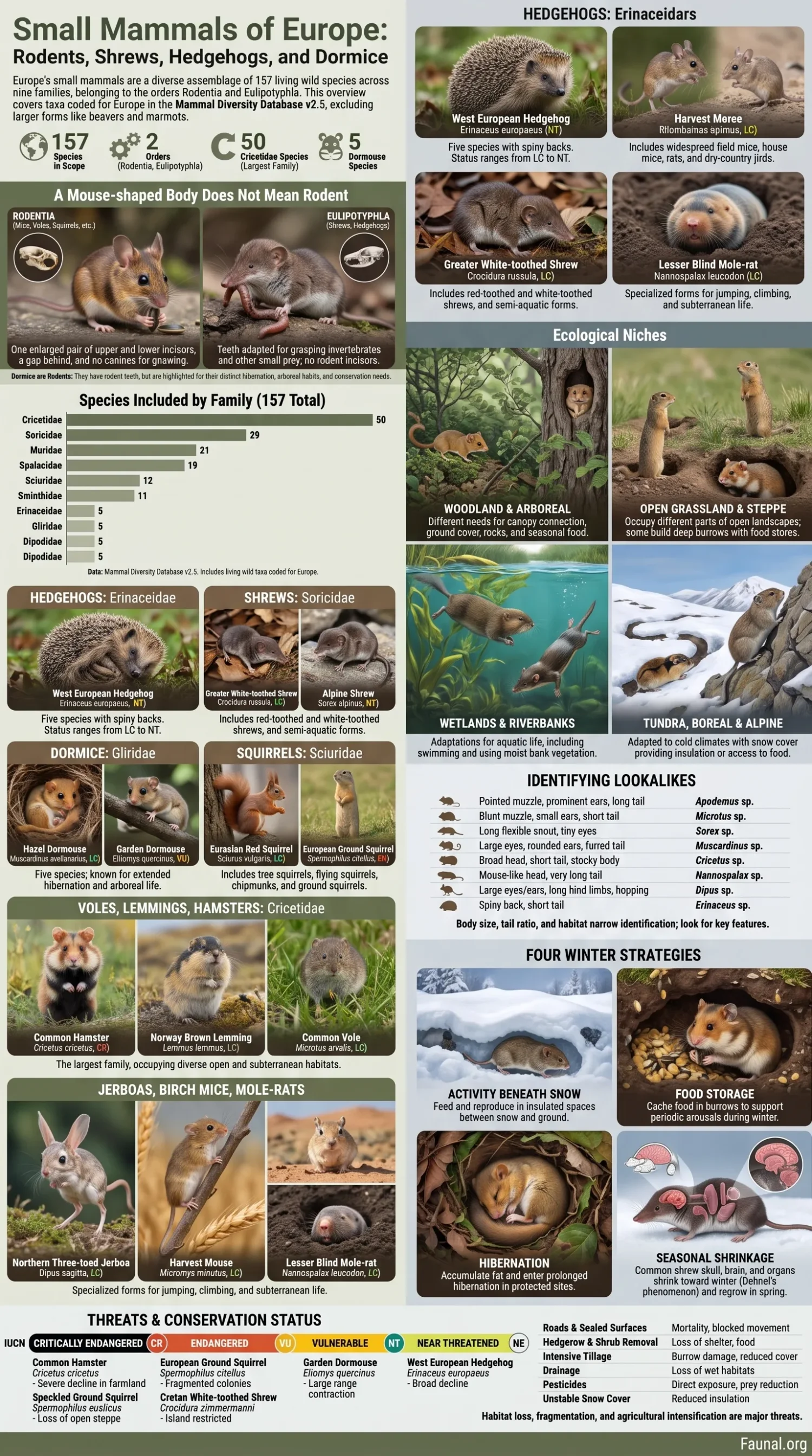
Europe’s small mammals are not one taxonomic group. Under the scope used here, they comprise 157 living wild species in nine families: rodents in Rodentia, plus shrews and hedgehogs in Eulipotyphla. The count follows Mammal Diversity Database v2.5 continent coding. It covers living wild taxa coded for Europe, does not add every alien population whose native MDD continent lies elsewhere, and excludes beavers, porcupines, and marmots because their adult size places them outside the usual small-mammal survey category.[a]
Species in this scope
157
Living, wild, Europe-coded taxa after the stated size exclusions.
Taxonomic orders
2
Rodentia and Eulipotyphla.
Largest family
Cricetidae
50 voles, lemmings, hamsters, and related forms.
Dormouse species
5
All are rodents in family Gliridae.
A Mouse-shaped Body Does Not Mean Rodent
Mice, voles, rats, hamsters, squirrels, jerboas, birch mice, blind mole-rats, and dormice are rodents. They share the rodent tooth plan: one enlarged pair of upper and lower incisors, a gap behind the incisors, and no canine teeth. Shrews and hedgehogs belong to Eulipotyphla. Their teeth are adapted for grasping and processing invertebrates and other food rather than for the same gnawing action.
| Group | Taxonomic position | Field shape | Feeding pattern | Winter response |
|---|---|---|---|---|
| Mice and rats | Rodentia | Usually pointed muzzle, visible ears, long tail | Seeds, plant matter, invertebrates, or human food depending on species | Mostly active; some use food stores or short torpor |
| Voles and lemmings | Rodentia | Compact body, short tail, small ears | Green vegetation, roots, bark, seeds | Many remain active beneath snow or inside tunnel systems |
| Dormice | Rodentia, Gliridae | Large eyes and usually a furred tail | Fruit, seeds, flowers, buds, and invertebrates in varying proportions | Extended hibernation is common in European species |
| Shrews | Eulipotyphla, Soricidae | Long mobile snout, small eyes, no rodent incisors | Invertebrates and other small animal prey | Most remain active; some show seasonal body and organ shrinkage |
| Hedgehogs | Eulipotyphla, Erinaceidae | Spiny back, short tail, strong limbs | Invertebrates with opportunistic use of other foods | Hibernation or deep torpor where climate and body condition allow |
Dormice belong inside Rodentia
Dormice receive their own section because their hibernation, arboreal behaviour, and conservation needs differ from many mice and voles. The separation is ecological, not a claim that dormice form an order beside rodents.
The 157-species European Working Checklist
The checklist uses accepted species names and Europe coding from Mammal Diversity Database v2.5, released on 28 July 2026. “Europe-coded” is deliberately broader than “present throughout Europe.” It includes narrow island endemics, Caucasus and steppe-edge taxa, and species associated with the European part of transcontinental states. It does not add every alien population recorded outside its native MDD continent. Country fields in a global database may not separate the European and Asian sectors of Russia, Türkiye, Kazakhstan, Georgia, or Azerbaijan.
A taxonomic checklist is not a distribution map
Inclusion documents a species coded for Europe in the checked taxonomic dataset. It does not establish continuous range, present occupancy at every historical locality, or occurrence in every part of a listed country. Local atlases, voucher specimens, recent surveys, and national Red Lists are needed for finer geographic claims.
Species Included by Family
Family totals within the 157-species scope used for this page.
Data: Mammal Diversity Database v2.5. Living wild taxa coded for Europe; beavers, porcupines, and marmots excluded.
Hedgehogs: Erinaceidae
Five hedgehog species fall within the European-coded scope. Their spines make the family easy to recognize, but white breast markings, ear length, colour, and geography must be considered together when separating species.
| Accepted species | English name | MDD-linked IUCN category |
|---|---|---|
| Atelerix algirus | North African Hedgehog | LC |
| Erinaceus concolor | Southern White-breasted Hedgehog | LC |
| Erinaceus europaeus | West European Hedgehog | NT |
| Erinaceus roumanicus | Northern White-breasted Hedgehog | LC |
| Hemiechinus auritus | Common Long-eared Hedgehog | LC |
Shrews: Soricidae
The shrew list contains red-toothed Sorex, white-toothed Crocidura, semi-aquatic Neomys, and two more specialised lineages. External appearance alone is unreliable for several neighbouring species.
| Accepted species | English name | MDD-linked IUCN category |
|---|---|---|
| Crocidura fimbriata | South European White-toothed Shrew | NE |
| Crocidura gueldenstaedtii | Güldenstädt's White-toothed Shrew | LC |
| Crocidura iculisma | Iberian White-toothed Shrew | NE |
| Crocidura leucodon | Bicolored White-toothed Shrew | LC |
| Crocidura pachyura | North African White-toothed Shrew | LC |
| Crocidura russula | Greater White-toothed Shrew | LC |
| Crocidura sicula | Sicilian White-toothed Shrew | LC |
| Crocidura suaveolens | Lesser White-toothed Shrew | LC |
| Crocidura zimmermanni | Cretan White-toothed Shrew | EN |
| Diplomesodon pulchellus | Piebald Shrew | LC |
| Neomys anomalus | Iberian Water Shrew | LC |
| Neomys fodiens | Eurasian Water Shrew | LC |
| Neomys milleri | Mediterranean Water Shrew | LC |
| Neomys teres | Transcaucasian Water Shrew | LC |
| Sorex alpinus | Alpine Shrew | NT |
| Sorex antinorii | Valais Shrew | LC |
| Sorex araneus | Common Shrew | LC |
| Sorex caecutiens | Laxmann's Shrew | LC |
| Sorex coronatus | Crowned Shrew | LC |
| Sorex granarius | Iberian Shrew | LC |
| Sorex isodon | Taiga Shrew | LC |
| Sorex minutissimus | Eurasian Least Shrew | LC |
| Sorex minutus | Eurasian Pygmy Shrew | LC |
| Sorex raddei | Radde's Shrew | LC |
| Sorex samniticus | Apennine Shrew | LC |
| Sorex satunini | Caucasian Shrew | LC |
| Sorex tundrensis | Tundra Shrew | LC |
| Sorex volnuchini | Caucasian Pygmy Shrew | LC |
| Suncus etruscus | Etruscan Shrew | LC |
Dormice: Gliridae
Europe has five dormouse species in this scope. Dormice are rodents, not a separate order, and they differ sharply in habitat use: some are strongly arboreal, while the garden and mouse-tailed dormice often use rocks, scree, walls, or ground-level shelter.
| Accepted species | English name | MDD-linked IUCN category |
|---|---|---|
| Dryomys nitedula | Eurasian Forest Dormouse | LC |
| Eliomys quercinus | European Garden Dormouse | VU |
| Glis glis | European Fat Dormouse | LC |
| Muscardinus avellanarius | Hazel Dormouse | LC |
| Myomimus roachi | Roach's Mouse-tailed Dormouse | VU |
Squirrels and Ground Squirrels: Sciuridae
This table retains tree squirrels, the flying squirrel, the Siberian chipmunk, and ground squirrels, while excluding marmots because they are normally treated as medium-sized burrowing mammals rather than small mammals.
| Accepted species | English name | MDD-linked IUCN category |
|---|---|---|
| Eutamias sibiricus | Siberian Chipmunk | LC |
| Pteromys volans | Siberian Flying Squirrel | LC |
| Sciurus anomalus | Caucasian Squirrel | LC |
| Sciurus meridionalis | Calabrian Black Squirrel | NT |
| Sciurus vulgaris | Eurasian Red Squirrel | LC |
| Spermophilus citellus | European Ground Squirrel | EN |
| Spermophilus fulvus | Yellow Ground Squirrel | LC |
| Spermophilus major | Russet Ground Squirrel | NT |
| Spermophilus musicus | Caucasian Mountain Ground Squirrel | LC |
| Spermophilus odessanus | Podolian Ground Squirrel | NE |
| Spermophilus pygmaeus | Little Ground Squirrel | LC |
| Spermophilus suslicus | Speckled Ground Squirrel | CR |
Voles, Lemmings, and Hamsters: Cricetidae
Cricetidae is the largest family in the checklist. It includes short-tailed voles, lemmings, water voles, hamsters, snow voles, and burrowing forms whose ranges extend from Atlantic Europe to the Caucasus, tundra, and steppe.
| Accepted species | English name | MDD-linked IUCN category |
|---|---|---|
| Alexandromys middendorffii | Middendorff's Vole | LC |
| Alexandromys oeconomus | Root Vole | LC |
| Allocricetulus eversmanni | Eversmann's Hamster | LC |
| Arvicola amphibius | Eurasian Water Vole | LC |
| Arvicola destructor | Italian Water Vole | NT |
| Arvicola sapidus | Southwestern Water Vole | NT |
| Chionomys gud | Gudaur Snow Vole | LC |
| Chionomys nivalis | European Snow Vole | LC |
| Chionomys roberti | Robert's Snow Vole | LC |
| Clethrionomys glareolus | Bank Vole | LC |
| Clethrionomys rutilus | Northern Red-backed Vole | LC |
| Craseomys rufocanus | Gray Red-backed Vole | LC |
| Cricetus cricetus | Common Hamster | CR |
| Dicrostonyx torquatus | Palearctic Collared Lemming | LC |
| Dinaromys bogdanovi | Martino's Dinaric Vole | VU |
| Dinaromys longipedis | Western Dinaric Vole | NE |
| Ellobius talpinus | Northern Mole Vole | LC |
| Lagurus lagurus | Steppe Vole | LC |
| Lemmus lemmus | Norway Brown Lemming | LC |
| Lemmus sibiricus | West Siberian Brown Lemming | LC |
| Mesocricetus brandti | Brandt's Golden Hamster | NT |
| Mesocricetus newtoni | Romanian Golden Hamster | VU |
| Mesocricetus raddei | Radde's Golden Hamster | LC |
| Microtus agrestis | Short-tailed Field Vole | LC |
| Microtus arvalis | Common Vole | LC |
| Microtus brachycercus | Calabria Pine Vole | LC |
| Microtus cabrerae | Cabrera's Vole | NT |
| Microtus daghestanicus | Caucasian Pine Vole | LC |
| Microtus duodecimcostatus | Mediterranean Pine Vole | LC |
| Microtus felteni | Balkan Pine Vole | LC |
| Microtus hartingi | Harting's Vole | NE |
| Microtus lavernedii | Mediterranean Field Vole | LC |
| Microtus liechtensteini | Liechtenstein's Pine Vole | LC |
| Microtus lusitanicus | Lusitanian Pine Vole | LC |
| Microtus majori | Major's Pine Vole | LC |
| Microtus multiplex | Alpine Pine Vole | LC |
| Microtus nebrodensis | Sicilian Pine Vole | LC |
| Microtus obscurus | Altai Vole | LC |
| Microtus pyrenaicus | Pyrenean Pine Vole | LC |
| Microtus rossiaemeridionalis | East European Gray Vole | LC |
| Microtus rozianus | Portuguese Field Vole | LC |
| Microtus savii | Savi's Pine Vole | LC |
| Microtus socialis | Social Vole | LC |
| Microtus subterraneus | Common Pine Vole | LC |
| Microtus tatricus | Tatra Pine Vole | LC |
| Microtus thomasi | Thomas's Pine Vole | LC |
| Myopus schisticolor | Wood Lemming | LC |
| Nothocricetulus migratorius | Gray Hamster | LC |
| Prometheomys schaposchnikowi | Long-clawed Mole Vole | LC |
| Stenocranius gregalis | Narrow-headed Vole | LC |
Mice, Rats, Jirds, and Gerbils: Muridae
Muridae contains the familiar long-tailed field mice, the house mouse, rats, the harvest mouse, and dry-country jirds and gerbils. The presence of Mus musculus, Rattus norvegicus, or Rattus rattus often reflects close association with buildings, farms, ports, and stored food.
| Accepted species | English name | MDD-linked IUCN category |
|---|---|---|
| Acomys cahirinus | Northeast African Spiny Mouse | LC |
| Apodemus agrarius | Striped Field Mouse | LC |
| Apodemus alpicola | Alpine Field Mouse | LC |
| Apodemus epimelas | Western Broad-toothed Field Mouse | LC |
| Apodemus flavicollis | Yellow-necked Field Mouse | LC |
| Apodemus mystacinus | Eastern Broad-toothed Field Mouse | LC |
| Apodemus ponticus | Caucasus Field Mouse | LC |
| Apodemus sylvaticus | Long-tailed Field Mouse | LC |
| Apodemus uralensis | Herb Field Mouse | LC |
| Apodemus witherbyi | Steppe Field Mouse | LC |
| Meriones dahli | Dahl's Jird | CR |
| Meriones meridianus | Central Midday Jird | LC |
| Meriones tamariscinus | Tamarisk Jird | LC |
| Micromys minutus | Eurasian Harvest Mouse | LC |
| Mus macedonicus | Macedonian Mouse | LC |
| Mus musculus | House Mouse | LC |
| Mus spicilegus | Mound-building Mouse | LC |
| Mus spretus | Western Mediterranean Mouse | LC |
| Rattus norvegicus | Brown Rat | LC |
| Rattus rattus | Roof Rat | LC |
| Rhombomys opimus | Great Gerbil | LC |
Jerboas: Dipodidae
Jerboas are concentrated toward the eastern European and transcontinental steppe edge. Long hind limbs and hopping locomotion separate them from mice and voles, although country-level database fields do not always show which side of a transcontinental state contains the European records.
| Accepted species | English name | MDD-linked IUCN category |
|---|---|---|
| Allactaga major | Great Jerboa | LC |
| Dipus sagitta | Northern Three-toed Jerboa | LC |
| Pygeretmus pumilio | Dwarf Fat-tailed Jerboa | LC |
| Scarturus elater | Northern Small Five-toed Jerboa | LC |
| Stylodipus telum | Thick-tailed Three-toed Jerboa | LC |
Birch Mice: Sminthidae
Birch mice are small, long-tailed rodents with several narrow-range species in eastern Europe and the Caucasus. Modern taxonomy recognizes them as family Sminthidae rather than placing them among true mice.
| Accepted species | English name | MDD-linked IUCN category |
|---|---|---|
| Sicista betulina | Northern Birch Mouse | LC |
| Sicista caucasica | Caucasian Birch Mouse | NT |
| Sicista caudata | Long-tailed Birch Mouse | LC |
| Sicista cimlanica | Tsimlyansk Birch Mouse | NT |
| Sicista kazbegica | Kazbeg Birch Mouse | VU |
| Sicista kluchorica | Kluchor Birch Mouse | LC |
| Sicista loriger | Nordmann's Birch Mouse | CR |
| Sicista severtzovi | Severtzov's Birch Mouse | CR |
| Sicista strandi | Strand's Birch Mouse | LC |
| Sicista subtilis | Southern Birch Mouse | LC |
| Sicista trizona | Hungarian Birch Mouse | EN |
Blind Mole-rats: Spalacidae
Blind mole-rats are subterranean rodents with reduced eyes, powerful incisors, and highly fragmented ranges. Recent species splitting has left many Nannospalax taxa without a completed IUCN assessment, so NE in this table often marks a taxonomic and assessment lag rather than proof of low risk.
| Accepted species | English name | MDD-linked IUCN category |
|---|---|---|
| Nannospalax bulgaricus | Bulgarian Blind Mole-rat | NE |
| Nannospalax hellenicus | Hellenic Blind Mole-rat | NE |
| Nannospalax hungaricus | Hungarian Blind Mole-rat | NE |
| Nannospalax insularis | Limnos Blind Mole-rat | NE |
| Nannospalax leucodon | Lesser Blind Mole-rat | LC |
| Nannospalax montanoserbicus | Central Serbian Blind Mole-rat | NE |
| Nannospalax montanosyrmiensis | North Serbian Blind Mole-rat | NE |
| Nannospalax monticola | Montane Blind Mole-rat | NE |
| Nannospalax serbicus | South Serbian Blind Mole-rat | NE |
| Nannospalax turcicus | Thracean Blind Mole-rat | NE |
| Nannospalax xanthodon | Western Anatolian Blind Mole-rat | LC |
| Spalax antiquus | Mehely's Blind Mole-rat | EN |
| Spalax arenarius | Sandy Blind Mole-rat | EN |
| Spalax giganteus | Giant Blind Mole-rat | LC |
| Spalax graecus | Bukovina Blind Mole-rat | VU |
| Spalax istricus | Oltenia Blind Mole-rat | CR |
| Spalax lyapunovae | Lyapunova’s Blind Mole-rat | NE |
| Spalax microphthalmus | Greater Blind Mole-rat | LC |
| Spalax zemni | Podolsk Blind Mole-rat | EN |
Status codes: LC, Least Concern; NT, Near Threatened; VU, Vulnerable; EN, Endangered; CR, Critically Endangered; NE, Not Evaluated. The status column reproduces the IUCN category linked in MDD v2.5. National assessments may differ, and newly separated species may remain NE while their former broader taxon has an older assessment.
Where Europe’s Small Mammal Lineages Separate Ecologically
Woodland Canopies, Shrub Layers, and Leaf Litter
Apodemus field mice forage on the ground and climb readily, bank voles use dense ground cover, and dormice divide the woody habitat vertically. Hazel dormice depend heavily on connected shrubs and branch networks. Fat dormice make greater use of mature trees and cavities. Forest dormice occupy woodland and scrub across eastern and south-eastern Europe, while garden dormice can occur in forest, scree, vineyards, orchards, buildings, and urban edges. A woodland label therefore hides different needs for canopy connection, ground cover, rocks, cavities, and seasonal food.
Grassland, Farmland, and Steppe Burrow Systems
Common voles, field voles, hamsters, ground squirrels, blind mole-rats, mole voles, and birch mice occupy different parts of open landscapes. Some feed above ground and retreat into shallow tunnel systems. Blind mole-rats spend nearly their entire lives underground. Common hamsters build deeper burrows with nesting and food-storage chambers. Ground squirrels require open vegetation that allows visibility around burrow entrances. Intensive cultivation can favour a few short-lived generalists for a time while removing the field margins, crop diversity, undisturbed soil, and perennial cover needed by narrower-range species.
Riverbanks, Marshes, and Cold Streams
Water voles are rodents that feed mainly on plants and dig bank burrows or use dense wetland vegetation. Water shrews are predators. Neomys species take aquatic and riparian invertebrates and can swim underwater. Similar use of a river margin does not imply the same diet, field signs, or response to bank engineering. A large blunt-headed water vole, a rat, and a much smaller pointed-snouted water shrew require separate identification.
Tundra, Boreal Forest, and Alpine Rock
Lemmings and northern voles can remain active in the subnivean space beneath snow. Snow voles use rocky slopes and crevices. Alpine and taiga shrews persist through cold periods without the long hibernation used by dormice. At high elevation and latitude, snow depth, snow duration, ground insulation, moisture, and access to unfrozen prey can matter as much as air temperature.
Mediterranean Islands and Peninsulas
The Mediterranean portion of the checklist includes island and peninsula taxa such as the Sicilian, Cretan, and Iberian white-toothed shrews, the Sicilian pine vole, the Calabrian black squirrel, and several western Mediterranean mice. Island populations may be endemic species, old human introductions, or members of wider species with local genetic structure. A name on an island checklist should not be treated as proof of natural colonisation without archaeological, genetic, or museum evidence.
Separating Mice, Voles, Shrews, Dormice, and Other Lookalikes
| Likely group | Head and ears | Tail | Body and movement | Caution |
|---|---|---|---|---|
| Field mouse | Pointed muzzle, eyes and ears usually obvious | Often near body length | Light build; runs and jumps; many climb | Apodemus species can overlap strongly in appearance |
| Vole | Blunter muzzle, small ears partly hidden by fur | Usually much shorter than body | Rounded body; ground-level runs and burrows | Pine voles and field voles may need teeth, skull, or genetics |
| Shrew | Long flexible snout, tiny eyes, small ears | Variable, usually thin | Rapid searching movement through litter or vegetation | Several Sorex and Crocidura species are not safely identified from a distant photograph |
| Dormouse | Large eyes; rounded ears | Furred, often bushy | Climbing is common; garden and mouse-tailed dormice also use rocks and ground cover | A juvenile squirrel or long-haired mouse can cause confusion |
| Hamster | Broad head, small rounded ears | Short | Stocky body; cheek pouches; strong digging | Wild European hamsters are not pet-hamster breeds |
| Birch mouse | Mouse-like head, small ears | Very long and often semi-prehensile | Deliberate climbing and bounding; long hind feet | Species separation often depends on geography, genetics, or detailed morphology |
| Blind mole-rat | Eyes reduced and covered; no external ear pinnae | Very short | Cylindrical body; subterranean; soil mounds | External characters rarely resolve the newer Nannospalax species |
| Jerboa | Large eyes and ears in many species | Long, often tufted | Elongated hind limbs; hopping locomotion | European occurrence lies mainly at the eastern steppe margin |
| Hedgehog | Long face, small ears except in long-eared hedgehogs | Very short | Spiny back; rolling defence | Breast colour alone does not separate every Erinaceus population |
Body size, tail ratio, and habitat narrow an identification; they do not always settle it. Many European small mammals belong to species complexes shaped by recent splitting, chromosome variation, or narrow contact zones.
Four Winter Strategies in the Same Landscape
Activity Beneath Snow
Voles and lemmings can feed and reproduce in insulated spaces between snow and ground. Snow cover reduces exposure to wind and some predators, but unstable freeze-thaw cycles can collapse tunnels, seal vegetation under ice, or remove insulation.
Food Storage and Periodic Torpor
Hamsters carry seeds and other food into burrows. Some mice also cache food. Stored food allows activity to continue when surface access is poor, and it can support periodic arousals during torpor or hibernation. The exact pattern differs among species and climates.
Extended Hibernation
Dormice accumulate fat and enter prolonged hibernation in protected sites. Hedgehogs also rely on fat reserves and insulated nests, although winter activity and hibernation timing vary with latitude, weather, sex, age, and body condition. A mild interval can produce temporary arousal without marking the end of the hibernation season.
Seasonal Shrinkage in the Common Shrew
Sorex araneus remains active through winter but undergoes Dehnel’s phenomenon: the skull, brain, and several organs shrink toward winter and regrow before the breeding season. A 2026 genomic and transcriptomic study linked this plasticity to pathways involved in neurogenesis and metabolic regulation, while also examining the species’ many chromosomal races.[b]
Dehnel’s phenomenon is not ordinary weight loss
The seasonal change includes reversible alteration of the braincase and energy-demanding organs. It is best documented in the common shrew and occurs in only a limited set of other mammals.
Threat Categories Reveal Uneven Risk
Most species in the MDD-linked status field are listed as Least Concern, but that pattern should not be mistaken for uniform security. Narrow-range blind mole-rats, birch mice, hamsters, ground squirrels, island shrews, dormice, and water voles carry many of the higher-risk categories. Fifteen species are Not Evaluated in the checked dataset; many are recently recognised or taxonomically rearranged.
| Species | Category in checked data | European concern represented |
|---|---|---|
| Cricetus cricetus | CR | Severe decline in a formerly widespread farmland hamster |
| Spermophilus suslicus | CR | Loss and isolation of open steppe and grassland populations |
| Sicista loriger | CR | Narrow-range birch mouse with sparse modern evidence |
| Spalax istricus | CR | Extremely restricted blind mole-rat lineage |
| Spermophilus citellus | EN | Fragmented colonies in managed grassland and steppe |
| Crocidura zimmermanni | EN | Island-restricted Cretan shrew |
| Eliomys quercinus | VU | Large contraction across central and eastern Europe |
| Myomimus roachi | VU | Restricted mouse-tailed dormouse of the south-eastern European edge |
| Erinaceus europaeus | NT | Broad decline despite continued presence across many countries |
| Microtus cabrerae | NT | Patchy Iberian wet grassland and Mediterranean habitat |
The Common Hamster Is No Longer a Routine Farmland Rodent
The common hamster is listed as Critically Endangered. The IUCN assessment cites rapid decline in reproductive rate and projects severe future reduction across its range. Its survival depends on more than leaving isolated burrows untouched; crop sequence, harvest timing, cover, soil, food availability, and population connection all shape whether farmland remains usable.[c]
The Garden Dormouse Has Lost Much of Its Eastern Range
The garden dormouse moved from Near Threatened to Vulnerable in the 2024 IUCN assessment. A 2026 country-by-country review reports regional extinction in Estonia, Finland, Latvia, Lithuania, and Slovakia, and argues that the species may also be extinct in Belarus, Poland, and Ukraine. Western populations remain uneven: some urban or mountain populations persist, while other former localities have lost the species.[d]
A Familiar Hedgehog Can Still Move Toward Threat
The West European hedgehog moved from Least Concern to Near Threatened in 2024. IUCN reported shrinking numbers in more than half of the countries in its range and linked the decline to rural habitat degradation, roads, and urban development. Visibility in gardens does not measure the condition of populations across the wider landscape.[e]
Fragmentation Acts Differently on Each Group
A road can directly kill a hedgehog, divide ground-squirrel colonies, separate dormouse habitat, or block the moist bank vegetation used by water voles and shrews. In the EU-27 plus the United Kingdom, the European Environment Agency classifies 27% of land as highly fragmented, with average habitat patches below 0.02 km² in that category. The indicator measures structural fragmentation rather than the movement ability of each species, but it describes the barrier-rich setting in which many small populations persist.[f]
Pesticides create a second set of pathways. Direct exposure can affect mammals, while reduced insects and other invertebrates alter food supply for shrews, hedgehogs, and the more animal-feeding dormice. The EEA reports direct and indirect biodiversity effects across many non-target groups and notes broad reductions in European insect abundance, diversity, and biomass.[g]
| Pressure | Groups most directly exposed | Mechanism |
|---|---|---|
| Roads and sealed surfaces | Hedgehogs, dormice, ground squirrels, water voles | Mortality, blocked movement, loss of verge and bank cover |
| Hedgerow and shrub removal | Dormice, field mice, shrews, hedgehogs | Loss of connected shelter, nesting sites, and seasonal food |
| Intensive tillage and harvest | Hamsters, voles, blind mole-rats, birch mice | Burrow damage, reduced cover, abrupt food loss |
| Drainage and bank engineering | Water voles and water shrews | Loss of burrowing banks, wet vegetation, and aquatic prey |
| Pesticides and rodenticides | Shrews, hedgehogs, dormice, rodents, their predators | Direct exposure, secondary poisoning, and prey reduction |
| Unstable snow cover | Lemmings, northern voles, alpine and boreal shrews | Reduced insulation, ice layers, altered winter access to food |
Taxonomy Changes Fastest in the Hardest Animals to Identify
Blind mole-rats, pine voles, white-toothed shrews, water voles, birch mice, and field mice contain many recently separated or disputed lineages. Subterranean species may show little external variation while carrying deep chromosomal or genetic divisions. Conversely, visibly different populations may not meet the evidence threshold for species rank. This is why the checklist states a database version rather than presenting its 157 names as a permanent total.
The common shrew adds another layer: more than 75 chromosomal races have been described within Sorex araneus, yet those races are not automatically separate species. House mice also contain subspecies and hybrid zones, while several Microtus and Nannospalax identifications can require chromosomes or DNA. A photograph can support a record at genus or species-group level without proving the finest taxonomic identification.
Sources and Verification
- [a] Mammal Diversity Database v2.5 — Used for accepted taxonomy, family placement, Europe coding, common names, and the MDD-linked IUCN categories in the 157-species working checklist.
- [b] Genomic comparisons in the common shrew — Used for the 2026 findings on Dehnel’s phenomenon, seasonal brain plasticity, and chromosomal evolution in Sorex araneus.
- [c] IUCN Red List assessment for Cricetus cricetus — Used for the Critically Endangered category and the assessment rationale concerning reproductive decline.
- [d] The updated status of the threatened garden dormouse Eliomys quercinus — Used for the 2024 Vulnerable category and the 2026 country-level review of regional extinction, remaining populations, and unresolved causes of decline.
- [e] IUCN Red List update for the West European hedgehog — Used for the 2024 move to Near Threatened and the reported pressures across the species’ range.
- [f] EEA landscape fragmentation pressure in Europe — Used for the EU-27 plus United Kingdom fragmentation figure and its structural-connectivity limits.
- [g] EEA briefing on pesticide effects on ecosystems — Used for direct and indirect effects on non-target organisms and evidence of reduced insect abundance, diversity, and biomass.
Related Topics
- → Mammals of Europe: Native Species, Habitats, and Distribution
- → Wild Ungulates of Europe: Deer, Bison, Boar, Goats, and Sheep
- → Large Carnivores of Europe: Wolves, Bears, Lynx, and Wolverines
- → Alpine Mammals of Europe: Species of High Mountain Habitats
- → Forest Mammals of Europe: Woodland Species and Habitat Use