Complete guides: •Regional Fauna Guides•Mammals•Wildlife Habitat Guides•Fauna of Europe
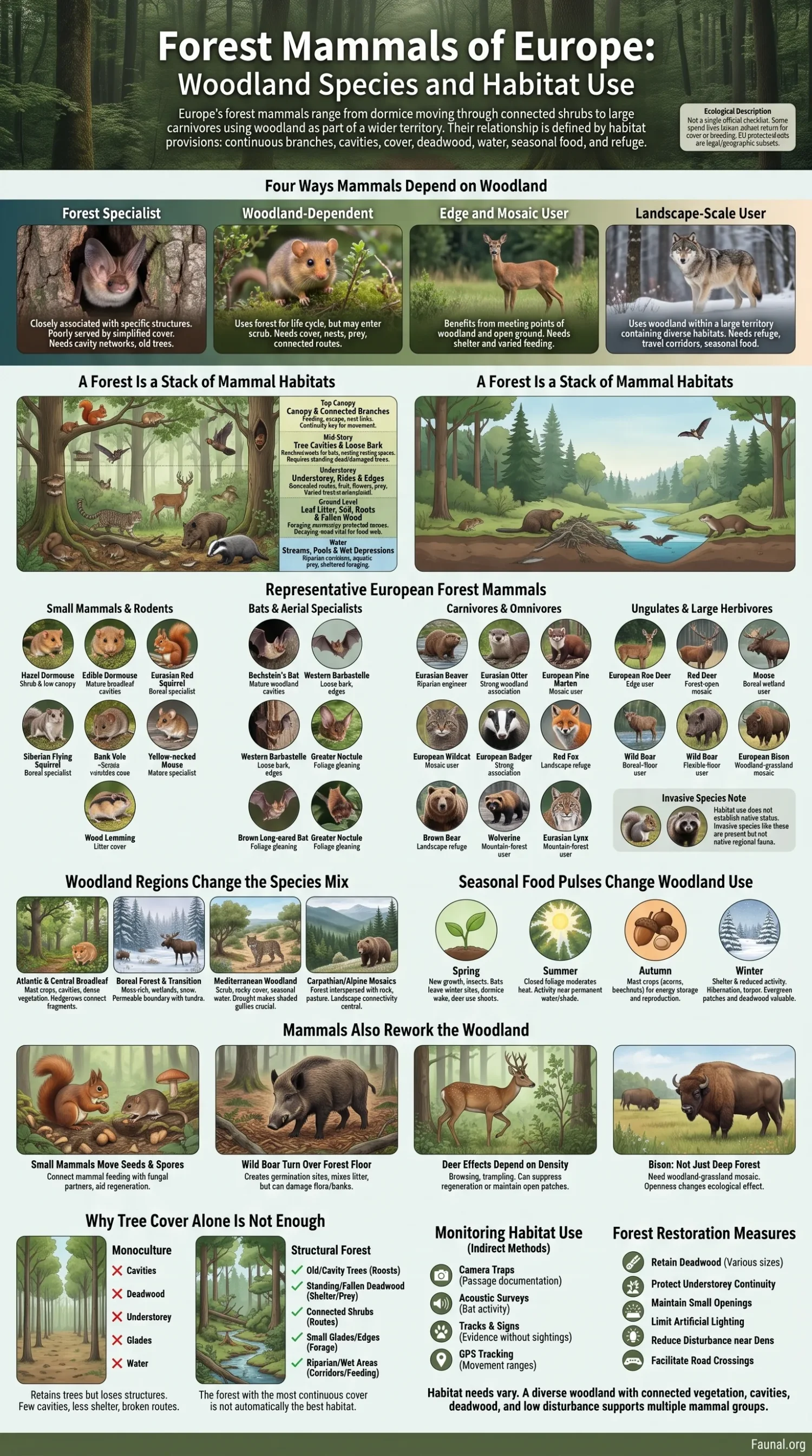
Europe’s forest mammals range from dormice moving through connected shrubs and bats roosting inside old trees to deer, bison and large carnivores that use woodland as one part of a wider territory. Their relationship with forest is defined by what the habitat provides: continuous branches, cavities, dense cover, leaf litter, deadwood, water, seasonal food and refuge from disturbance.
Forest Mammal Is an Ecological Description
There is no single official checklist covering every mammal that may use woodland across geographic Europe. Some species spend most of their lives inside forest, while others feed in open ground and return to woodland for concealment, resting or breeding. European Union figures referring to protected mammals dependent on forest ecosystems describe a legal and geographic subset, not the total number of European forest mammals.[c]
Four Ways Mammals Depend on Woodland
A species seen among trees is not automatically a forest specialist. Woodland relationships form a continuum based on where an animal feeds, rests, reproduces, moves and survives periods of heat, cold or human activity.
| Woodland relationship | Meaning | Representative mammals | Main dependency |
|---|---|---|---|
| Forest specialist | Closely associated with particular forest structures and poorly served by simplified or isolated tree cover. | Bechstein’s bat, wood lemming, Siberian flying squirrel | Cavity networks, old trees, continuous canopy or specialised forest-floor conditions |
| Woodland-dependent | Uses forest for much of its life cycle but may enter scrub, hedgerows, orchards or nearby open ground. | Hazel dormouse, Eurasian red squirrel, European pine marten, European wildcat | Cover, nests, dens, prey and connected movement routes |
| Edge and mosaic user | Benefits from the meeting point between woodland and grassland, scrub, wetland or young regrowth. | Roe deer, red deer, European badger, Iberian lynx | Forest shelter combined with feeding habitat outside closed canopy |
| Landscape-scale user | Uses woodland within a territory that also contains mountains, meadows, farmland, wetlands or open scrub. | Grey wolf, brown bear, Eurasian lynx, European bison | Refuge, travel corridors, seasonal food and quiet resting areas |
A Forest Is a Stack of Mammal Habitats
Canopy and Connected Branches
Squirrels and dormice use branches as feeding surfaces, escape routes and links between nest sites. Eurasian red squirrels move through both coniferous and broadleaf woodland, while edible dormice are closely associated with trees that provide cavities and seasonal seed crops. Hazel dormice often travel through dense shrubs and low canopy rather than crossing exposed ground. Their recorded habitat associations include woodland as well as connected scrub and heath vegetation.[e]
Canopy continuity does not require every part of a forest to be fully closed. Small gaps can produce flowers, fruit and insect-rich edges. Problems arise when wide roads, cleared strips or repeatedly cut boundaries divide the vegetation into gaps that an arboreal animal is reluctant or unable to cross.
Tree Cavities and Loose Bark
Holes created by decay, broken limbs and woodpecker excavation provide roosts for bats and nesting or resting spaces for dormice, squirrels and pine martens. Bechstein’s bat has a strong woodland association and uses tree cavities within mature forest.[f]
A single retained cavity tree cannot replace a network of alternative roosts. Forest bats may change trees as temperature, breeding stage and weather conditions change. Standing dead trees, damaged living trees and trunks with loose bark therefore have different values at different times of year. EUROBATS guidance also identifies small glades, forest tracks, water edges and connected linear vegetation as feeding and commuting habitat around those roosts.[h]
Understorey, Rides and Woodland Edges
The understorey includes saplings, bramble, hazel, bilberry, tall herbs and low branches. It gives small mammals concealed routes and supplies fruit, flowers and invertebrate prey. Roe deer use young growth for browsing and cover. Wildcats can rest inside dense vegetation before hunting along grassland or field margins.
Pine martens can use tree cavities and elevated resting sites, but they also hunt on the ground and move through structurally varied woodland. EUNIS records woodland and forest among the species’ main habitat categories.[g] Their presence should not be reduced to a requirement for uninterrupted closed canopy; prey, secure den sites and low disturbance also matter.
Leaf Litter, Soil, Roots and Fallen Wood
Bank voles, yellow-necked mice, wood mice and shrews forage beneath herbs, leaves and fallen branches. Seeds, fungi and invertebrates concentrate on the forest floor, while roots and decaying logs create protected spaces. Badgers need ground suitable for excavation, and their setts may occupy wooded slopes for many generations. Wild boar turn over litter and soil while searching for acorns, roots, larvae and other food.
Deadwood affects mammals indirectly as well as directly. Decaying timber supports fungi and invertebrates, creates moist refuges and changes the structure of the ground layer. Removing every fallen trunk produces a tidier site but removes feeding and shelter conditions used throughout the woodland food web.
Streams, Pools and Wet Depressions
Riparian woodland joins aquatic and terrestrial habitat. Eurasian beavers cut trees, excavate banks and alter water flow. Eurasian otters use vegetated banks for concealment and movement, although their feeding habitat extends well beyond forest. Moose browse wet woodland and lakeside vegetation in northern Europe, while bats often hunt where insects gather above slow water and sheltered channels.
Representative European Forest Mammals by Habitat Use
The accepted names below follow the current Mammal Diversity Database taxonomic baseline.[a] Continental scope was cross-checked against the second Atlas of European Mammals species list.[b] The table is a source-based ecological reference rather than a claim that every mammal occasionally recorded near trees belongs to one fixed forest category.
| Group and species | Scientific name | Woodland relationship | Main woodland use | Other habitats used |
|---|---|---|---|---|
| Hazel dormouse | Muscardinus avellanarius | Strong woodland and scrub dependence | Connected shrubs, low canopy, nesting and seasonal feeding | Hedgerows, heath and dense scrub |
| Edible dormouse | Glis glis | Mature broadleaf association | Tree cavities, canopy movement and mast feeding | Orchards and buildings in some regions |
| Eurasian forest dormouse | Dryomys nitedula | Broadleaf and mixed forest association | Shrub cover, tree holes, nesting and foraging | Woodland margins and rocky scrub |
| Garden dormouse | Eliomys quercinus | Woodland-edge and rocky mosaic user | Cavities, ground cover and edge feeding | Hedges, orchards, scrub and rocky ground |
| Eurasian red squirrel | Sciurus vulgaris | Woodland-dependent | Canopy travel, dreys, seeds, fungi and buds | Parks and wooded gardens |
| Calabrian black squirrel | Sciurus meridionalis | Southern Italian forest association | Canopy movement, nesting and seed feeding | Connected wooded landscapes |
| Siberian flying squirrel | Pteromys volans | Boreal and old mixed-forest specialist | Cavity roosting and gliding between trees | Forested wetlands |
| Bank vole | Clethrionomys glareolus | Common woodland-floor user | Litter cover, ground vegetation and seed feeding | Hedgerows, scrub and rough grassland |
| Northern red-backed vole | Clethrionomys rutilus | Boreal forest association | Moss, litter and low vegetation | Forest-tundra transition |
| Yellow-necked mouse | Apodemus flavicollis | Broadleaf and mixed-woodland association | Seeds, invertebrates, cavities and ground cover | Hedgerows and wooded farmland |
| Wood mouse | Apodemus sylvaticus | Generalist woodland user | Forest-floor feeding and burrows | Grassland, farmland, dunes and gardens |
| Wood lemming | Myopus schisticolor | Boreal forest specialist | Moss-rich conifer forest floor | Wet taiga and forest margins |
| Common shrew | Sorex araneus | Generalist woodland-floor user | Invertebrate hunting in litter and dense herbs | Grassland, wet ground and hedgerows |
| Bechstein’s bat | Myotis bechsteinii | Mature woodland specialist | Tree-cavity networks and close-range hunting | Small glades and wooded water edges |
| Western barbastelle | Barbastella barbastellus | Woodland-dependent | Loose bark, tree crevices, edges and moth hunting | Riparian corridors and wooded farmland |
| Brown long-eared bat | Plecotus auritus | Wooded-landscape association | Foliage gleaning and cavity roosting | Buildings, orchards and gardens |
| Greater noctule | Nyctalus lasiopterus | Forest-associated aerial hunter | High tree cavities and canopy airspace | Open airspace around wooded landscapes |
| Leisler’s bat | Nyctalus leisleri | Tree-roosting forest association | Cavities, woodland edges and aerial feeding | Parks, reservoirs and wooded settlements |
| Alcathoe bat | Myotis alcathoe | Humid mature-woodland association | Riparian trees, cavities and sheltered foraging | Wooded valleys and stream corridors |
| Eurasian beaver | Castor fiber | Riparian woodland engineer | Bank shelter, woody food and tree cutting | Rivers, lakes, canals and wetlands |
| Eurasian otter | Lutra lutra | Riparian corridor user | Vegetated banks, resting cover and travel | Rivers, lakes, marshes and coasts |
| European pine marten | Martes martes | Strong woodland association | Cavities, elevated resting sites, cover and prey | Rocky woodland and dense scrub |
| European wildcat | Felis silvestris | Woodland-dependent mosaic user | Quiet cover, den sites and concealed movement | Meadows, scrub and field margins |
| European badger | Meles meles | Woodland-associated generalist | Sett construction, shelter and edge feeding | Grassland, farmland and suburban greenspace |
| European polecat | Mustela putorius | Wet woodland and edge user | Dense cover, resting sites and hunting | Wetlands, farmland and riparian vegetation |
| Red fox | Vulpes vulpes | Generalist using woodland | Resting cover, dens and prey-rich edges | Open country, farmland and settlements |
| Eurasian lynx | Lynx lynx | Connected forest and mountain-landscape user | Hunting cover, resting sites and secluded breeding areas | Rocky slopes and mountain mosaics |
| Iberian lynx | Lynx pardinus | Mediterranean scrub and open-woodland specialist | Dense cover beside rabbit feeding habitat | Dehesa, shrubland and grassland mosaics |
| Grey wolf | Canis lupus | Landscape generalist using woodland refuge | Resting, travel cover and access to prey | Mountains, open country and farmed landscapes |
| Brown bear | Ursus arctos | Landscape-scale omnivore | Refuge, denning and seasonal food patches | Mountain meadows, scrub and open slopes |
| Wolverine | Gulo gulo | Boreal and mountain-landscape user | Forest travel, scavenging cover and denning areas | Tundra and high mountain terrain |
| European roe deer | Capreolus capreolus | Edge and young-woodland user | Browsing, concealment and resting cover | Fields, scrub and meadow margins |
| Red deer | Cervus elaphus | Forest–open habitat mosaic user | Daytime cover, browsing and seasonal shelter | Grassland, moorland and mountain slopes |
| Moose | Alces alces | Boreal woodland and wetland user | Browsing, shade and winter cover | Marshes, lakesides and forest-tundra |
| Wild boar | Sus scrofa | Flexible woodland-floor user | Rooting, mast feeding and dense resting cover | Farmland, reedbeds and scrub |
| European bison | Bison bonasus | Woodland–grassland mosaic user | Browsing, shelter and movement between openings | Meadows and open woodland |
Habitat Use Does Not Establish Native Status
Some alien mammals now use European woodland. The eastern grey squirrel and raccoon dog are included on the European Union list of invasive alien species of Union concern. Their occurrence in forests does not make them native members of the regional fauna.[s]
Woodland Regions Change the Species Mix
Atlantic and Central European Broadleaf Forests
Oak, beech and mixed deciduous forests can provide mast crops, cavities, dense spring vegetation and varied edge habitat. Hazel dormice, edible dormice, yellow-necked mice, roe deer, wild boar and several tree-roosting bats use different parts of the same woodland. In heavily settled regions, hedgerows, riparian strips and small copses may determine whether populations can move between larger forest blocks.
Boreal Forest and the Forest–Tundra Transition
Northern coniferous and mixed forests contain moss-rich ground layers, wetlands and long periods of snow cover. Wood lemmings, Siberian flying squirrels, northern red-backed voles, moose, brown bears, Eurasian lynx and wolverines occupy different parts of this system. Some range into open tundra, peatlands or lakeshores, so the forest boundary is permeable rather than fixed.
Mediterranean Woodland and Scrub
Mediterranean mammals often use open oak woodland, scrub, rocky cover and seasonal watercourses together. Iberian lynx habitat depends on dense shelter near open areas where rabbits can be hunted. Wild boar and red deer move between tree cover and feeding grounds. Summer drought makes shaded gullies, permanent water and fire history more influential than canopy cover alone.
Carpathian, Balkan and Alpine Mosaics
Mountain forests are interspersed with rock, pasture, avalanche corridors and high-elevation shrub. Brown bears, wolves and Eurasian lynx may rest or breed inside wooded areas while travelling and feeding across a much wider landscape. European assessments of large carnivores therefore treat connectivity, coexistence and movement beyond individual forest stands as central parts of their ecology.[i]
Floodplain and Riparian Woodland
Floodplain forests provide soft banks, woody food, fish-bearing channels and sheltered travel routes. Beavers alter these conditions directly through tree cutting and water retention. Otters use the same corridors mainly for movement and access to aquatic prey. Bats feed over open water, while small mammals occupy reed margins, fallen timber and periodically flooded vegetation.
Seasonal Food Pulses Change Woodland Use
Spring Growth and Breeding Cover
New leaves, flowers and emerging insects change where mammals feed. Bats leave winter sites and establish summer roost networks. Dormice become active as shrubs produce flowers and invertebrate prey. Deer use young shoots, while dense vegetation gives newborn mammals concealment that was absent during winter.
Summer Shade, Water and Invertebrates
Closed foliage moderates daytime temperature and retains humidity near streams and shaded hollows. These conditions affect resting sites for large mammals and feeding areas for insectivorous bats and shrews. During dry periods, activity may become concentrated near permanent water, moist valley woodland and north-facing slopes.
Autumn Mast
Acorns, beechnuts, hazelnuts and other tree seeds can produce short periods of concentrated food. Edible dormouse reproduction and pre-hibernation energy storage are closely linked to the seasonal timing and year-to-year variation of seed production in deciduous forest.[j]
Wild boar also respond to acorn availability. Oak stands may attract rooting and feeding activity, but the area disturbed depends on soil moisture, alternative food, local animal density and woodland conditions rather than tree species alone.[k]
Winter Shelter and Reduced Activity
Dormice hibernate, while many bats use torpor or move to winter sites with stable temperature and humidity. Snow changes access to ground food and alters predator–prey movement. Leaf fall reduces concealment in deciduous forest, making dense evergreen patches, fallen timber, cavities and sheltered terrain more valuable.
Mammals Also Rework the Woodland
Small Mammals Move Seeds and Fungal Spores
Mice, voles, squirrels and other small mammals consume fruiting fungi and may carry spores through the forest. This connects mammal feeding with the underground fungal partners of trees. Research on mammal mycophagy shows that animals can contribute to fungal dispersal and forest regeneration processes, although the strength of the relationship differs among mammal, fungus and forest types.[l]
Wild Boar Turn Over the Forest Floor
Rooting exposes soil, mixes litter and changes small patches of vegetation. This can create germination sites, but repeated or concentrated rooting can consume tree seed, damage sensitive ground flora and disturb wet banks. A recent forest study found that rooting was unevenly distributed and was associated with stand conditions and water-influenced habitat.[m]
Deer Effects Depend on Density and Site Conditions
Red deer browse plants, disperse seeds, trample soil and return nutrients through dung and urine. These actions may maintain open patches or alter plant composition. High browsing pressure can suppress tree regeneration and remove preferred plants. A European research review found both positive and negative effects, with outcomes influenced by animal density, vegetation, soil, productivity and management.[n]
European Bison Are Not Restricted to Deep Forest
European bison use woodland for shelter and browsing but also depend on grass, herbs and openings. Treating the species as an animal of dense, closed forest alone hides its need for a varied woodland–grassland mosaic. An eight-year forest study found that bison activity was associated with higher plant species richness in the studied oak forest, while the same response was not detected beneath closed beech canopy. The result is site-specific, but it illustrates how canopy openness and grazing can change the ecological effect of a large herbivore.[o]
Why Tree Cover Alone Is Not Enough
A mapped forest can retain trees while losing the structures mammals use. Even-aged stands may contain few cavities. Removal of deadwood reduces shelter and prey. Cleared understorey breaks dormouse routes. Roads divide territories, and artificial light can alter bat movement along edges and watercourses.
European Environment Agency forest indicators report that about 85% of protected forest habitats assessed under the Habitats Directive have an unfavourable condition. The same evidence base describes only a small share of European forest as undisturbed and notes the limited extent of uneven-aged structure. These figures refer to assessed European Union forest conditions rather than every forest across geographic Europe.[d]
| Forest feature | Mammals that use it | Likely effect when it is lost |
|---|---|---|
| Old and cavity-bearing trees | Forest bats, dormice, squirrels, pine martens | Fewer roosts, nests and protected resting sites |
| Standing and fallen deadwood | Small mammals, shrews, bats and ground-hunting carnivores | Reduced shelter, fungal food and invertebrate prey |
| Connected shrubs and low branches | Hazel dormice, wildcats, roe deer and small rodents | Exposed movement routes and reduced nesting cover |
| Small glades and graded edges | Bats, deer, wild boar and hunting carnivores | Less flowering vegetation, browse and edge-associated prey |
| Riparian trees and wet depressions | Beavers, otters, bats, moose and small mammals | Broken water corridors and fewer humid feeding areas |
| Dark commuting routes | Light-sensitive forest bats | Avoidance of otherwise suitable feeding and roosting habitat |
| Quiet connected core areas | Wildcats, lynx, wolves, bears and large ungulates | Displacement, fragmented movement and reduced breeding refuge |
The forest with the most continuous tree cover is not automatically the forest with the best mammal habitat. Tree age, cavities, deadwood, understorey, openings, water, darkness, connectivity and disturbance must be considered together.
Monitoring Habitat Use Without Direct Sightings
Camera Traps
Camera traps can document when terrestrial mammals pass a location, whether several species use the same route and how activity changes around roads, settlements or recreation areas. Snapshot Europe applies standardised camera-trap methods across multiple countries to improve comparisons of terrestrial mammal communities.[p] A photograph confirms recorded use of the camera site during the sampling period; it does not establish the animal’s complete range.
Acoustic Surveys
Bat detectors record echolocation along forest rides, edges, streams and canopy gaps. Repeated surveys can compare activity among woodland structures and seasons. Some calls can be assigned confidently to species, while overlapping call characteristics may support identification only to a species group. Current EUROBATS monitoring guidance combines acoustic methods with roost, emergence and habitat surveys rather than treating detector records as complete population counts.[q]
Tracks, Feeding Signs and Genetic Material
Footprints, droppings, hair, dens, gnawed nuts, bark damage and rooting provide evidence even when animals remain unseen. Genetic analysis of hair or faeces can help separate similar species and identify individuals. Field signs require suitable survey timing and careful identification because weather, substrate and other animals can produce incomplete or misleading traces.
GPS Tracking
Tracking collars reveal movement between feeding grounds, resting sites and seasonal ranges. They are especially useful for mammals whose territories extend beyond a single woodland block. Results still represent the tagged animals and study period, not every member of the regional population.
Forest Restoration Measures With Direct Mammal Relevance
Restoration for mammals involves more than increasing wooded area. Retaining standing and fallen deadwood, allowing uneven-aged stands, protecting riparian strips, reconnecting isolated woods and maintaining native shrub cover address the structures used for shelter, feeding and movement. European Union forest restoration indicators include deadwood, uneven-aged structure and forest connectivity, all of which have direct ecological links to woodland mammals.[r]
- Retain groups of old, damaged and cavity-bearing trees rather than relying on one isolated habitat tree.
- Keep standing and fallen deadwood in different sizes and stages of decay where safety allows.
- Protect understorey continuity along forest edges, streams and links between woodland blocks.
- Maintain small openings without replacing varied woodland with broad cleared areas.
- Limit new lighting along bat routes, watercourses and woodland margins.
- Reduce disturbance around known dens, maternity roosts and breeding refuges.
- Place road crossings and fencing measures where monitoring identifies repeated mammal movement.
- Assess deer and wild boar effects from local vegetation response and animal density rather than from presence alone.
The habitat needs of a dormouse, bat, badger and brown bear cannot be met by one uniform stand design. A woodland capable of supporting several mammal groups usually contains connected vegetation at several heights, secure cavities, living and dead trees, moist and dry ground, feeding openings and areas where human activity remains low.
Sources and Verification
- [a] Mammal Diversity Database — Taxonomic baseline used to check accepted mammal names.
- [b] Atlas of European Mammals, Second Edition Species List — Used to cross-check the continental species scope.
- [c] Biodiversity Information System for Europe: Forests — Supports the distinction between European forest fauna and the mammals covered by European Union nature legislation.
- [d] European Forest Biodiversity Indicators — Provides forest condition, structure, deadwood and uneven-aged stand evidence.
- [e] EUNIS Record for Muscardinus avellanarius — Checked for the hazel dormouse’s woodland and scrub habitat associations.
- [f] EUNIS Record for Myotis bechsteinii — Used for the species’ strong association with woodland habitat.
- [g] EUNIS Record for Martes martes — Confirms woodland and forest within the pine marten’s recorded habitat categories.
- [h] EUROBATS Guidance on Bats and Forest Management — Used for cavity-tree networks, deadwood, glades, forest tracks and riparian feeding habitat.
- [i] European Commission: Large Carnivores — Supports the landscape-scale treatment of wolves, bears and lynx.
- [j] Seasonal Life History of the Edible Dormouse — Used for the relationship between deciduous forest seed production, reproduction and energy storage.
- [k] Wild Boar Acorn Use and Rooting in Oak Forests — Supports the discussion of mast availability and woodland feeding activity.
- [l] Mammal Mycophagy and Fungal Spore Dispersal — Used for links between small-mammal feeding, fungal movement and forest regeneration.
- [m] Factors Influencing Wild Boar Rooting in Forest — Provides recent evidence on the uneven distribution of rooting and its association with stand and wet-ground conditions.
- [n] Review of Red Deer as an Ecosystem Service Provider Across Europe — Used to describe density-dependent and site-dependent effects of feeding, trampling and seed movement.
- [o] European Bison Effects on Forest Plant Richness — Supports the study-specific comparison between oak forest and closed-canopy beech forest.
- [p] Snapshot Europe — Used for standardised continent-wide camera-trap monitoring of terrestrial mammals.
- [q] EUROBATS Monitoring Guidelines — Supports the combined use and limitations of acoustic, roost and habitat surveys.
- [r] European Union Nature Restoration Regulation — Checked for forest indicators covering deadwood, uneven-aged structure and connectivity.
- [s] European Union List of Invasive Alien Species of Union Concern — Used to verify the listed status of the eastern grey squirrel and raccoon dog.
Related Topics
- → Mammals of Europe: Native Species, Habitats, and Distribution
- → Alpine Mammals of Europe: Species of High Mountain Habitats
- → Small Mammals of Europe: Rodents, Shrews, Hedgehogs, and Dormice
- → Wild Ungulates of Europe: Deer, Bison, Boar, Goats, and Sheep
- → Large Carnivores of Europe: Wolves, Bears, Lynx, and Wolverines