Complete guides: Regional Fauna Guides•Fauna of Europe
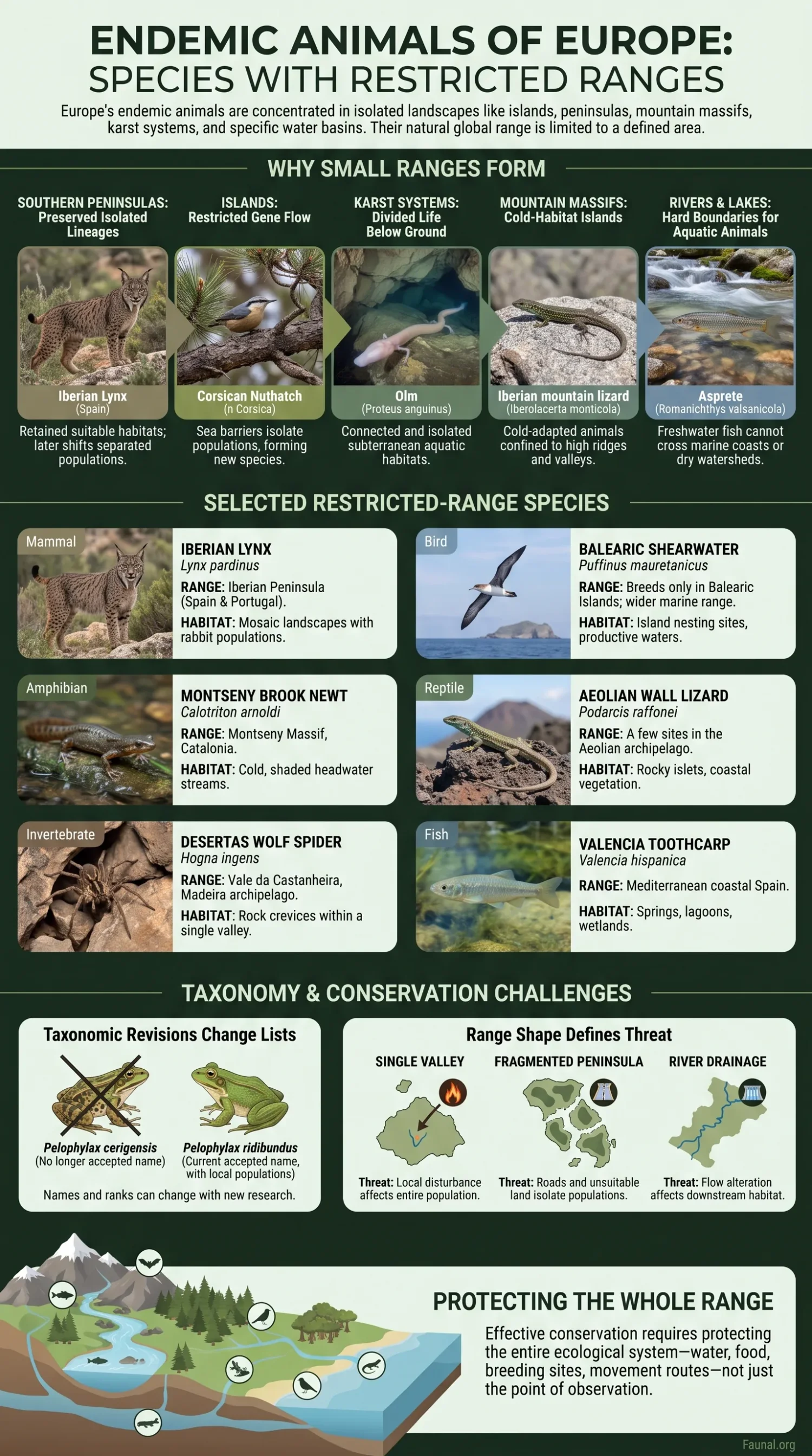
Europe’s endemic animals are concentrated in geographically isolated places rather than spread evenly across the continent. The strongest concentrations occur on Mediterranean and Atlantic islands, in the Iberian and Balkan peninsulas, inside separate mountain massifs, within Dinaric cave systems, and in short rivers or old lake basins. An endemic animal has a natural global range limited to a defined area; a restricted-range animal may occupy a small area without being confined entirely to Europe.
Geographic Scope Used Here
The main continental scope includes geographic Europe and its Mediterranean islands. Madeira, the Azores and the Canary Islands are presented as Macaronesian endemics because they are politically connected to European states but form a separate Atlantic biogeographic region. Species whose natural ranges extend into North Africa, most of Anatolia or Asia are not treated as strict European endemics.
Endemicity Describes a Range, Not a Threat Category
The word endemic answers a geographic question: where does the animal occur naturally across the planet? It does not state how many individuals remain, whether the population is declining or whether the species is legally protected. A species can be endemic and assessed as Least Concern, while a widespread species can be threatened across much of its range.
| Range Term | Meaning in This Page | European Example |
|---|---|---|
| Strict species endemic | The complete natural global range of an accepted species lies inside the stated European area. | Iberian lynx on the Iberian Peninsula |
| Regional endemic | A strict endemic tied to a named island, mountain system, peninsula, lake or drainage basin. | Corsican nuthatch on Corsica |
| Breeding endemic | The species breeds only in the stated area but uses a wider range outside the breeding season. | Balearic shearwater |
| Restricted-range species | The known natural range is small, but it may cross the geographic boundary used for Europe. | A species shared by the Balkans and western Anatolia |
| Endemic subspecies | A locally restricted population is recognized below species rank. | Milos viper under the current Reptile Database treatment |
| Macaronesian endemic | An accepted species is confined to an Atlantic island or island group administered by a European state. | Madeira firecrest |
Endemic, Rare and Endangered Are Not Synonyms
Endemic refers to geographic restriction. Rare may refer to low abundance, sparse occurrence or limited detectability. Threatened refers to an assessed extinction risk under defined criteria. These labels can overlap, but one does not automatically establish the others.
Why Small European Ranges Form in Particular Landscapes
Southern Peninsulas Preserved Isolated Lineages
The Iberian, Italian and Balkan peninsulas retained suitable habitats for many lineages during cold climatic periods. Later warming and habitat shifts separated surviving populations among mountain ranges, river systems and climatic zones. This history helps explain why southwestern Europe contains animals such as the Iberian lynx, Pyrenean desman, broom hare and several mountain lizards with no natural populations elsewhere.
Islands Restricted Gene Flow
Sea barriers can isolate populations long enough for separate species to form. Corsica, Sardinia, Mallorca, the Aeolian Islands, Crete, Cyprus and the smaller Aegean islands support endemics produced or retained by this separation. The same process is even more visible in Macaronesia, where different Atlantic islands hold distinct birds, reptiles and invertebrates.
Karst Divided Life Below Ground
The Dinaric Karst contains caves, fissures, underground rivers and aquifers that are connected in some places and isolated in others. Surface distance alone does not describe these habitats. Two caves located near each other can belong to different groundwater systems, while a contamination source far from a recorded locality may enter the same aquifer used by a cave animal.
Mountain Massifs Function as Cold-Habitat Islands
Cold-adapted animals can become confined to high ridges, shaded valleys or cool headwater streams after suitable lowland habitat disappears. Valleys and warmer slopes then separate populations. The Montseny brook newt and Iberian mountain lizard show two versions of this pattern: one tied closely to cool flowing water, the other divided among mountain areas in northwestern Iberia.
Rivers and Lakes Create Hard Boundaries for Aquatic Animals
A terrestrial animal may move between neighboring valleys, but a freshwater fish cannot normally cross a marine coast or a dry watershed. Old lakes and separate drainage basins therefore contain many narrow-range fishes, molluscs and crustaceans. Dam construction, water extraction or the introduction of another fish can affect a large part of a freshwater endemic’s global habitat at once.
Mammals and Birds with Restricted European Ranges
The following selection uses accepted species-level names where possible. Mammal taxonomy was checked against the Mammal Diversity Database, whose current v2.5 release was issued on 28 July 2026. [a] The table is not presented as a complete inventory of every endemic mammal or bird associated with Europe.
| Animal | Accepted Scientific Name | Natural Range Core | Range Form | Main Habitat Dependence |
|---|---|---|---|---|
| Iberian lynx | Lynx pardinus | Iberian Peninsula; surviving and restored populations in Spain and Portugal | Strict peninsula endemic | Mosaic landscapes supporting European rabbit populations |
| Pyrenean desman | Galemys pyrenaicus | Mountain streams of the Pyrenees and northern and central Iberian ranges [c] | Strict peninsula endemic | Cool, oxygenated streams and intact riparian structure |
| Cypriot mouse | Mus cypriacus | Cyprus [d] | Island endemic within the page’s boundary-sensitive Cyprus scope | Natural and agricultural mosaics on the island |
| Broom hare | Lepus castroviejoi | Cantabrian Mountains of northern Spain [e] | Mountain-range endemic | Upland heath, shrub and grassland mosaics |
| Corsican nuthatch | Sitta whiteheadi | Corsica [f] | Strict island endemic | Mature Corsican pine forest |
| Scottish crossbill | Loxia scotica | Scotland, mainly the eastern Highlands [g] | Restricted resident endemic under the cited bird taxonomy | Conifer woodland and variable cone crops |
| Balearic shearwater | Puffinus mauretanicus | Breeds only in the Balearic Islands; ranges more widely at sea outside breeding [h] | Breeding endemic | Island nesting sites and productive western Mediterranean and Atlantic waters |
| Madeira firecrest | Regulus madeirensis | Madeira [i] | Macaronesian island endemic | Native and secondary woodland across Madeira |
| Azores bullfinch | Pyrrhula murina | Eastern São Miguel in the Azores [j] | Macaronesian micro-endemic | Native laurel-forest vegetation and associated food plants |
Amphibians and Reptiles Confined by Water, Rock and Sea
European amphibian endemism is especially visible in cool island streams, mountain headwaters and subterranean water. Reptile endemism is strongest on islands and in separated mountain systems. Accepted names require regular checking because genetic work can divide one species into regional units or place a familiar local name into synonymy.
| Animal | Accepted or Current Name | Natural Range Core | Range Form | Habitat Dependence |
|---|---|---|---|---|
| Montseny brook newt | Calotriton arnoldi | Montseny Massif in Catalonia, Spain [k] | Mountain micro-endemic | Cold, shaded headwater streams |
| Mallorcan midwife toad | Alytes muletensis | Mallorca [m] | Strict island endemic | Rocky ravines, seasonal water and protected breeding pools |
| Sardinian brook newt | Euproctus platycephalus | Sardinia [n] | Strict island endemic | Mountain streams, springs and pools |
| Olm | Proteus anguinus | Underground waters of the Dinaric Karst [o] | Karst-system endemic | Permanent subterranean aquatic habitat |
| Aeolian wall lizard | Podarcis raffonei | A few sites in the Aeolian archipelago north of Sicily [q] | Archipelago micro-endemic | Rocky islets, coastal vegetation and remaining suitable habitat on Vulcano |
| Iberian mountain lizard | Iberolacerta monticola | Serra da Estrela in Portugal and separated areas of northwestern Spain [s] | Fragmented mountain endemic | Cool rocky habitats, upland vegetation and some low-elevation refuges |
| El Hierro giant lizard | Gallotia simonyi | El Hierro, Canary Islands [t] | Macaronesian island endemic | Rocky dry habitats and managed refuge sites |
| Milos viper | Macrovipera lebetinus schweizeri under the current Reptile Database treatment | Milos, Kimolos, Polyaigos and Sifnos in the western Cyclades [u] | Endemic subspecies under this treatment | Rocky island terrain, scrub and seasonal water-associated prey concentrations |
Freshwater and Subterranean Endemics Can Occupy the Smallest Ranges
Large mammals dominate public discussion, but some of Europe’s narrowest animal ranges belong to freshwater fish, cave beetles, spiders and butterflies. Their distributions may follow a single river reach, one cave region, one island valley or a host plant restricted to a small island.
| Animal | Scientific Name | Documented Range Core | Range Form | Habitat Dependence |
|---|---|---|---|---|
| Asprete | Romanichthys valsanicola | Romanian mountain drainage; formerly reported from the upper Argeș system and now associated chiefly with the Vâlsan [v] | Short-drainage endemic | Cold, clear, fast-flowing water with coarse stone substrate |
| Valencia toothcarp | Valencia hispanica | Mediterranean coastal Spain between the Tortosa area and Cape San Antonio; the cited source also records historical occurrence near Perpignan, where it is extirpated [w] | Restricted western Mediterranean coastal endemic | Springs, lagoons, wetlands and slow freshwater habitats |
| Cretan festoon | Zerynthia cretica | Crete [x] | Strict island endemic | Habitats containing the larval host plants used by the butterfly |
| Narrow-necked cave beetle | Leptodirus hochenwartii | Northern Dinaric Karst in parts of Slovenia, Croatia and Italy [y] | Regional subterranean endemic | Stable cave temperature, humidity and subterranean food webs |
| Desertas wolf spider | Hogna ingens | Vale da Castanheira on Deserta Grande in the Madeira archipelago [z] | Single-island, single-valley micro-endemic | Rock crevices and burrowing habitat within the valley |
The tables are a source-based representative selection, not a claim that Europe has only these endemic animals. Invertebrate diversity is much larger, and the accepted boundaries of several species continue to change as taxonomic research develops.
Six Ranges That Show Why Geographic Scale Matters
Iberian Lynx: Recovery Across a Fragmented Peninsula Range
The Iberian lynx is a true species endemic of the Iberian Peninsula. Its distribution is broader than that of a single-island reptile, yet it remains dependent on separated landscapes with adequate rabbit prey, cover and safe movement routes. Roads, unsuitable land between population centers and local prey loss can divide an apparently large peninsula range into smaller functional units.
In June 2024, the IUCN Red List category for Lynx pardinus improved from Endangered to Vulnerable following long-term conservation work. The change records a lower assessed extinction risk; it does not mean that habitat connectivity, rabbit availability or continued management have become unnecessary. [b]
Montseny Brook Newt: Separate Streams Within One Massif
The Montseny brook newt is confined to a small mountain system, but even that description can hide internal separation. Headwater populations occupy different drainage branches, and movement between them is limited by dry ground, warmer water and unsuitable downstream habitat. Protecting a point where the animal was recorded is therefore weaker than protecting the stream, its shaded banks, groundwater inputs and upstream catchment.
Genomic and geographic research published in 2024 recognized eastern and western population structure and named two subspecies, Calotriton arnoldi arnoldi and Calotriton arnoldi laietanus. The species remains accepted, but its internal taxonomy now records geographic divisions that can matter for captive breeding and translocation decisions. [l]
Balearic Shearwater: One Breeding Range, Several Marine Ranges
The Balearic shearwater is endemic as a breeder, not as a year-round resident of one archipelago. Nesting colonies are restricted to the Balearic Islands, while birds move through wider marine areas after breeding. Land-based action must address nesting habitat, introduced mammals, disturbance and artificial light. Sea-based action must address mortality and food conditions across waters beyond the islands.
This distinction prevents a common range error: a breeding map is not automatically the complete annual distribution of a migratory seabird.
Aeolian Wall Lizard: Four Known Populations in an Archipelago
The Aeolian wall lizard survives in geographically separated populations on tiny islets and one part of Vulcano. In a range this small, introduced competitors, rats, vegetation change, fire or development can affect a large share of the species within one event. The European Union LIFE EOLIZARD project describes four known surviving populations and combines habitat work, invasive-species control, breeding and planned range expansion. [r]
Olm: The Catchment Extends Beyond the Cave Entrance
An olm record identifies a point inside a much larger underground water system. Surface farming, wastewater, quarrying or water extraction can alter the animal’s habitat without taking place near the cave entrance where the species is observed. The appropriate conservation unit is therefore the connected aquifer and recharge area, not only the accessible cave chamber.
Asprete: A River Intervention Can Become a Global Event
The asprete illustrates the exposure created by a short freshwater range. Changes to flow, stone extraction, sediment, bank structure or upstream water quality can affect much of the remaining habitat. A reserve boundary beside one occupied reach cannot replace management of the water regime and connected drainage.
Taxonomic Revisions Can Add or Remove an Endemic Name
Endemic species lists are not permanent. Researchers may divide a geographically variable species, merge two names, change genus placement or conclude that a population is better treated as a subspecies. The animals and their habitats do not change when the name changes, but checklist totals, legal names and conservation units may be affected.
The Karpathos Frog Name Is No Longer Accepted in One Major Register
Pelophylax cerigensis has often appeared in lists as a Critically Endangered frog endemic to Karpathos. Amphibian Species of the World recorded a 2024 change placing that name in the synonymy of Pelophylax ridibundus. It is therefore excluded from the accepted-species tables on this page, while the local frog population can still retain biological and conservation interest. [p]
The Milos Viper Appears Under Two Ranks
Many publications and conservation texts use Macrovipera schweizeri as a full species. The current Reptile Database page used here places the island population under Macrovipera lebetinus schweizeri. A responsible checklist should state which taxonomy it follows rather than silently mixing both forms.
The Bavarian Pine Vole Is Also Taxonomy-Sensitive
Older and alternative treatments recognize Microtus bavaricus as a narrowly distributed species. The current Mammal Diversity Database includes bavaricus within Microtus liechtensteini. Counting it as a separate European endemic without naming the taxonomic authority would produce a checklist conflict.
Accepted Name and Conservation Unit Are Different Questions
A population may lose separate species rank and still require local protection because it carries distinct genes, occupies a unique island or depends on a habitat used nowhere else by that lineage. Taxonomic rank should not be used as the only measure of conservation value.
Range Shape Changes the Main Conservation Pressure
| Range Pattern | Representative Animal | Why the Range Is Exposed | Most Direct Response |
|---|---|---|---|
| Single valley on one island | Desertas wolf spider | Vegetation change or one local disturbance can affect nearly all known habitat. | Protect the valley’s substrate, native vegetation and microclimate. |
| Several tiny islets | Aeolian wall lizard | Each population is small and separated; invasive animals can spread through human transport. | Island biosecurity, invasive-species control and genetically planned population management. |
| Mountain headwater branches | Montseny brook newt | Warm or dry stream sections block movement between nearby populations. | Protect whole catchments, shade, spring flow and separate genetic units. |
| Fragmented peninsula habitat | Iberian lynx | Roads and unsuitable land isolate breeding areas and increase mortality. | Restore connections, reduce road deaths and maintain prey populations. |
| Underground aquifer | Olm | Pollution can enter far from the recorded cave locality. | Manage the full recharge zone and connected groundwater system. |
| Short river drainage | Asprete | Flow alteration or channel work can affect most remaining habitat. | Maintain natural flow, substrate and upstream water quality. |
| Breeding islands plus open sea | Balearic shearwater | Threats occur both at colonies and across distant feeding or migration areas. | Combine colony protection with marine bycatch and movement-area measures. |
| Small native-forest patch | Azores bullfinch | Habitat quality depends on the survival and recovery of local plant communities. | Restore native forest and control invasive plants at occupied sites. |
Animals Commonly Mistaken for European Endemics
A European common name, a strong cultural association with Europe or a very small surviving European population does not establish species-level endemism.
| Animal | Why It Should Not Be Listed as a Strict European Species Endemic |
|---|---|
| European bison | The species is closely associated with European conservation, but its historical and taxonomic range context is not equivalent to a small natural range found nowhere outside Europe. |
| Eurasian lynx | Its natural range extends widely across northern and central Asia. |
| Brown bear | European populations form part of a species distributed across Eurasia and North America. |
| European wildcat | The name contains “European,” but the taxon is not an island or peninsula species confined to a small European range. |
| Mediterranean monk seal | Its range includes non-European shores of the Mediterranean and the eastern Atlantic. |
| Greek tortoise | The species occurs outside Greece and beyond geographic Europe, including parts of North Africa and Asia. |
| Alpine ibex | Its present association with the Alps does not make every named population a separate endemic species. |
| Scottish wildcat | It is a geographically restricted population of the European wildcat rather than an uncontested animal species found only in Scotland. |
Protecting an Endemic Requires the Whole Ecological Range
A protected point is often smaller than the system an endemic animal needs. Stream species depend on upstream water and riparian shade. Cave species depend on aquifer recharge areas. island endemics depend on transport biosecurity as well as reserve boundaries. Seabirds depend on both nesting land and marine feeding areas. Fragmented mammals require movement routes between occupied landscapes.
The EU Habitats Directive covers more than one thousand animal and plant species and about 230 habitat types, providing a legal basis for habitat and species protection across member states. Its conservation categories should not be confused with the global IUCN Red List category assigned to an individual species. [aa]
The EU Nature Restoration Regulation entered into force on 18 August 2024. It adds binding restoration obligations that can affect the habitat networks used by restricted-range animals, including rivers, forests, wetlands and other degraded ecosystems. [ab]
The European Environment Agency’s 2025 presentation of Habitats Directive reporting shows that 27.5% of the covered species assessments were classed as good, 41.8% as poor, 20.6% as bad and 10.2% as unknown. These percentages refer to assessments of protected animal and plant species under the directive, not to every animal species in Europe and not only to endemics. [ac]
For a narrow-range animal, the most useful conservation boundary is the area that maintains water, food, breeding sites, movement and genetic separation. That boundary may be a watershed, aquifer, island group, forest zone or connected landscape rather than the place where the animal was last observed.
Sources and Verification
- [a] Mammal Diversity Database — Used for the current mammal taxonomy release and version date.
- [b] IUCN: Iberian lynx rebounding thanks to conservation action — Used for the June 2024 change from Endangered to Vulnerable.
- [c] Mammal Diversity Database: Galemys pyrenaicus — Used for the accepted mammal name and Iberian mountain-stream distribution.
- [d] Mammal Diversity Database: Mus cypriacus — Used for accepted taxonomy, Cyprus distribution and current species treatment.
- [e] Mammal Diversity Database: Lepus castroviejoi — Used for the broom hare’s accepted name and Spanish endemic range.
- [f] BirdLife DataZone: Corsican nuthatch — Used for the Corsican range, forest association and global assessment context.
- [g] BirdLife DataZone: Scottish crossbill — Used for the accepted bird treatment and eastern Highland range.
- [h] BirdLife DataZone: Balearic shearwater — Used to distinguish the restricted breeding range from the wider marine distribution.
- [i] BirdLife DataZone: Madeira firecrest — Used for Madeira endemism and species-level treatment.
- [j] BirdLife DataZone: Azores bullfinch — Used for the restricted range in eastern São Miguel.
- [k] Amphibian Species of the World: Calotriton arnoldi — Used for accepted taxonomy and the current subspecies record.
- [l] Genomic insights into the Montseny brook newt — Used for the 2024 genomic findings and east-west population structure.
- [m] Amphibian Species of the World: Alytes muletensis — Used for accepted taxonomy, Mallorca type locality and Spanish endemism.
- [n] Population genetic structure of the endemic Sardinian newt — Used for the Sardinian range and internal population separation.
- [o] Amphibian Species of the World: Proteus anguinus — Used for accepted olm taxonomy.
- [p] Amphibian Species of the World: 2024 additions and changes — Used for the placement of Pelophylax cerigensis in the synonymy of Pelophylax ridibundus.
- [q] The Reptile Database: Podarcis raffonei — Used for accepted taxonomy, synonyms and Aeolian distribution.
- [r] European Commission LIFE EOLIZARD project — Used for the four known populations and current conservation actions.
- [s] The Reptile Database: Iberolacerta monticola — Used for accepted taxonomy and the separated Portuguese and Spanish range.
- [t] The Reptile Database: Gallotia simonyi — Used for the current El Hierro range and synonym information.
- [u] The Reptile Database: Macrovipera lebetinus — Used for the current subspecies treatment and western Cyclades distribution of schweizeri.
- [v] FishBase: Romanichthys valsanicola — Used for drainage history, stream habitat and reported pressures on the asprete.
- [w] FishBase: Valencia hispanica — Used for the Spanish Mediterranean range and historical French record.
- [x] GBIF taxon record: Zerynthia cretica — Used for the accepted species name, synonym and linked Catalogue of Life treatment.
- [y] Genome sequence of the cave beetle Leptodirus hochenwartii — Used for the northern Dinaric Karst distribution and subterranean specialization.
- [z] IUCN conservation plan for the Desertas wolf spider — Used for the species’ single-valley range and habitat conservation context.
- [aa] European Commission: Habitats Directive — Used for the directive’s species and habitat scope.
- [ab] European Commission: Nature Restoration Regulation — Used for the entry-into-force date and restoration obligations.
- [ac] European Environment Agency: conservation status of protected habitats and species — Used for the 2025 presentation of Habitats Directive species-assessment percentages.
Related Topics
- → Wildlife of Western Europe: Landscapes, Species, and Conservation
- → Wildlife of Eastern Europe: Forests, Wetlands, and Steppe Species
- → Wildlife of Northern Europe: Boreal Forests, Tundra, and Coasts
- → Birds of Europe: Species Diversity, Habitats, and Biogeographic Regions
- → Mammals of Europe: Native Species, Habitats, and Distribution