Complete guides: Regional Fauna Guides•Fauna of Europe
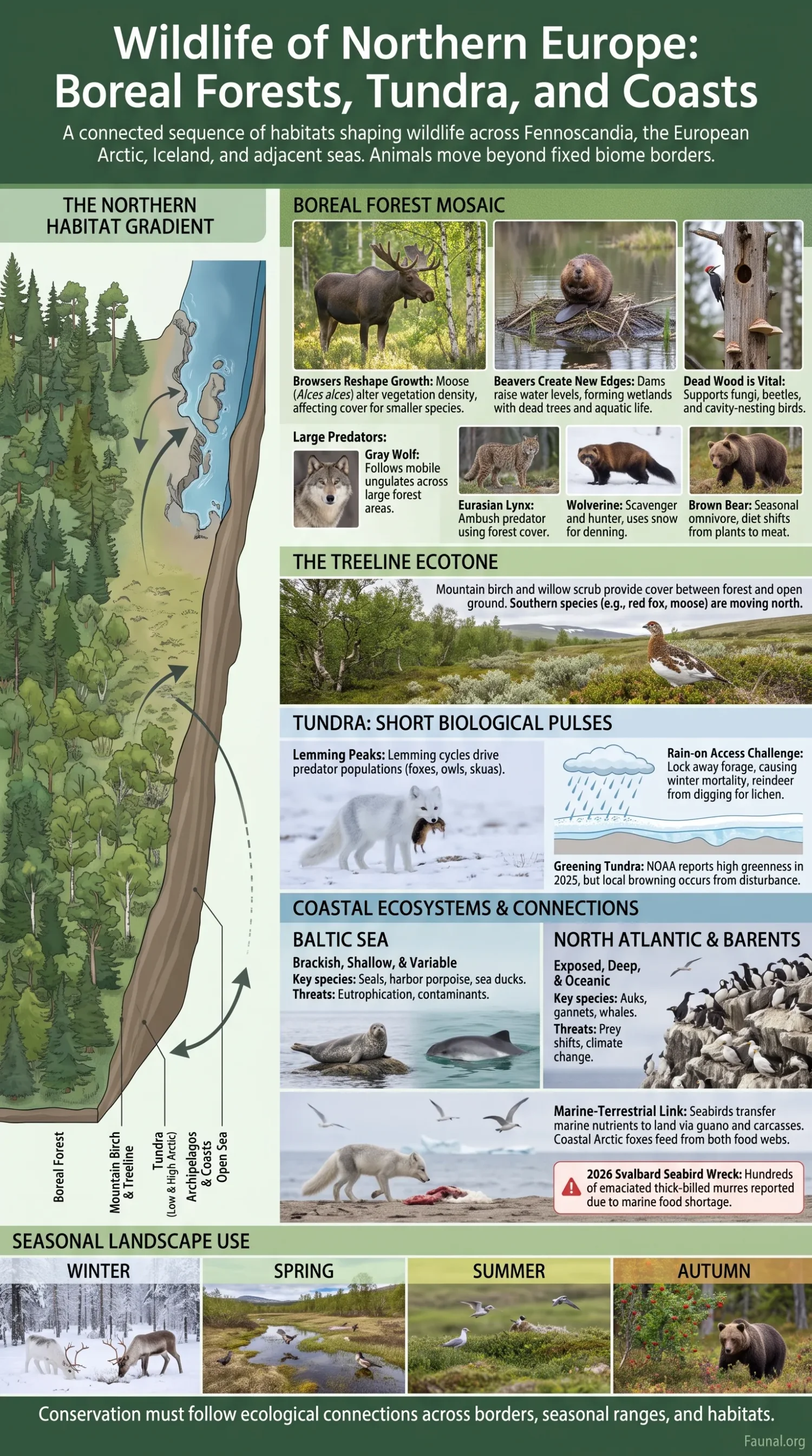
Wildlife in Northern Europe is shaped by a connected sequence of boreal forest, peatland, freshwater, mountain birch, tundra, archipelago, fjord, and open sea. Animals do not remain inside fixed biome borders: reindeer move between seasonal pastures, salmon carry marine nutrients into rivers, seabirds transfer ocean-derived material onto coastal tundra, and predators follow prey across forest edges and snow-covered uplands.
Northern Europe is not a single formal fauna unit. The ecological scope used here includes the boreal and alpine parts of Fennoscandia, the European Arctic and Svalbard, Iceland and the Faroe region, northern Baltic shores, and adjacent North Atlantic and Barents Sea systems. These areas cross several European biogeographical regions, including Boreal, Arctic, Alpine, and Atlantic zones.[a]
Northern Europe Has No Single Wildlife Checklist
A political definition of Northern Europe and a biological definition do not produce the same boundary. A species may be common in the Finnish taiga, restricted to mountain tundra in Norway, absent from Iceland, and present only as a migrant along a Baltic coast. The species matrix on this page is therefore a habitat-based reference rather than a claim to list every animal recorded across every northern country and marine area.
The Northern Habitat Gradient
The transition from forest to tundra is neither straight nor uniform. Latitude, elevation, snow duration, wind exposure, soil moisture, fire history, grazing, and proximity to the sea can move the boundary locally. A sheltered valley may support spruce or pine while an exposed slope at the same latitude carries dwarf shrubs, sedges, lichens, and bare rock.
| Habitat system | Physical structure | Main winter constraint | Characteristic fauna relationships |
|---|---|---|---|
| Boreal forest | Pine, spruce, birch, aspen, forest gaps, dead wood, mires, streams, and lakes | Snow depth, frozen forage, and access to browse or stored food | Large browsers, forest grouse, woodpeckers, beavers, small mammals, and large carnivores |
| Forested peatland and wetland | Bogs, fens, wet woodland, ponds, sedge margins, and slow-flowing water | Ice cover, water-level change, and limited winter vegetation | Beavers, otters, waterbirds, amphibians, fish, aquatic insects, and moose |
| Mountain birch and treeline | Open birch woodland, willow scrub, snowbeds, heaths, and exposed ridges | Wind, icing, uneven snow cover, and short plant-growing periods | Reindeer, mountain hares, ptarmigans, small rodents, foxes, and raptors |
| Low-Arctic and alpine tundra | Dwarf shrubs, sedges, mosses, lichens, wetlands, rock, and treeless slopes | Access to food beneath snow and ice rather than cold alone | Lemmings, Arctic foxes, reindeer, ground-nesting birds, skuas, and falcons |
| Baltic archipelagos and shallow coasts | Brackish water, skerries, lagoons, reedbeds, shallow banks, and seasonal sea ice | Ice conditions, prey access, salinity, and coastal disturbance | Sea ducks, terns, grey seals, ringed seals, harbour seals, otters, and harbour porpoises |
| North Atlantic and Barents coasts | Fjords, exposed cliffs, islands, deep coastal water, tidal shores, and open sea | Storms, changing prey fields, and the energetic cost of offshore feeding | Auks, kittiwakes, gannets, eiders, seals, whales, porpoises, and coastal foxes |
Boreal Forest Is a Mosaic, Not a Continuous Wall of Conifers
Northern boreal forest contains old spruce stands, dry pine woodland, mixed forest, recently burned ground, young post-fire growth, bog woodland, river corridors, and deciduous pockets. EUNIS separates western taiga into multiple forest forms rather than treating it as one uniform habitat.[b] This variation determines which animals can find cover, nesting cavities, forage, prey, and winter shelter.
Browsers Reshape Young Forest Growth
Eurasian elk, or moose (Alces alces), feed heavily on woody vegetation, aquatic plants, and young tree growth. Their browsing can alter the density and height of willow, birch, rowan, pine, and aspen regeneration. These changes affect hiding cover for smaller mammals, the structure used by nesting birds, and the future composition of the tree layer.
Reindeer also use forest habitats, especially where ground and tree lichens remain available. Roe deer become more prominent toward the southern and milder parts of the boreal zone. The resulting herbivore community is not the same across Norway, Sweden, Finland, the Baltic region, and the forest–tundra boundary.
Dead Trees Remain Part of the Living Forest
Standing dead trees, fallen trunks, broken branches, loose bark, root plates, rot holes, and old tree cavities support fungi, lichens, saproxylic beetles, ants, woodpeckers, owls, bats, and cavity-nesting passerines. Removing these structures simplifies the forest even when tree cover remains.
European forest biodiversity research identifies dead wood, old trees, varied stand ages, forest gaps, and wood debris as habitat features that should be retained or restored.[c] A managed stand and an old forest may therefore have similar dominant tree species but very different animal communities.
Beavers Create New Edges Inside the Forest
The Eurasian beaver (Castor fiber) changes streams and forest margins by cutting trees, building dams, retaining sediment, and raising local water levels. Beaver ponds add shallow water, flooded woodland, standing dead trees, muddy margins, and meadow-like openings to a forest landscape.
These changes can create habitat for aquatic invertebrates, amphibians, fish, waterbirds, small mammals, and wetland plants. Beaver engineering can also flood roads, drains, farmland, or commercial trees, so its ecological effects and land-use conflicts must be assessed together.[d]
Large Mammals Divide the Forest by Prey, Cover, and Snow
Northern Europe’s large carnivores share parts of the same landscape but do not use it in the same way. Their prey size, hunting method, dependence on cover, tolerance of open ground, and use of carcasses create different ecological roles.
Gray Wolves Follow Mobile Ungulates
Gray wolves (Canis lupus) can travel across large forest areas and follow prey such as moose, roe deer, red deer, and reindeer. Their social hunting allows them to target prey larger than the animals commonly taken by lynx. Roads, settlements, livestock areas, hunting pressure, and national management rules strongly influence where packs persist.
Eurasian Lynx Hunt from Forest Cover
Eurasian lynx (Lynx lynx) rely more heavily on concealment and short-distance attacks. Roe deer are important prey in many areas, while mountain hares, forest birds, and other mammals contribute according to region. Lynx can cross open land, but connected woodland and broken terrain provide better hunting cover than exposed tundra.
Wolverines Use Snow, Carrion, and Mountain Terrain
Wolverines (Gulo gulo) combine active hunting with extensive scavenging. Carcasses left by wolves, lynx, human hunting, accidents, or winter mortality can become valuable food. Females use snow-covered denning areas, linking the species closely to upland and northern environments where persistent spring snow remains available.
Brown Bears Change Diet Through the Year
Brown bears (Ursus arctos) use animal matter, insects, roots, herbs, berries, and carrion in proportions that change with season and local availability. Spring feeding may include winter-killed ungulates and emerging vegetation. Ants, other invertebrates, and plant material become available later, while berry crops can supply a large part of autumn energy intake.
Forest connectivity matters at several scales. A woodpecker may depend on continuity between old stands and dead trees, while a wolf or wolverine may need movement routes spanning several administrative areas. Northern boreal conservation cannot be reduced to the percentage of land covered by trees.
The northern Barents region contains boreal forest, tundra, freshwater, and national borders within one connected ecological area. Habitat loss, intensive land use, and breaks in landscape continuity can affect species whose ranges extend across those borders.[e]
The Treeline Is an Ecotone, Not a Sharp Border
Conifer forest often gives way to open mountain birch before fully treeless tundra begins. Willow scrub, dwarf birch, heaths, snowbeds, wetlands, and exposed ridges form a patchwork between these zones. The same valley can contain forest birds near its lower slopes, ptarmigans on open ground, reindeer moving through both, and raptors hunting across the boundary.
Mountain Birch Provides Cover Between Forest and Tundra
Mountain birch woodland supplies buds, leaves, insects, concealment, and nesting sites. Willow ptarmigans use shrubby ground, mountain hares browse woody plants, and small mammals occupy the vegetation beneath snow. Where insect outbreaks remove birch foliage across large areas, effects can pass from plants to herbivores, birds, and predators.
Southern Species Are Moving into Northern Food Webs
Longer growing periods and expanding shrubs or trees can benefit some animals while reducing open habitat for tundra specialists. The Arctic Council’s terrestrial biodiversity assessment reports northward range extensions by species such as red fox and moose and warns that local outcomes differ across the Arctic.[f]
Red foxes (Vulpes vulpes) can compete with Arctic foxes and may kill them. Moose entering taller shrub or young woodland can alter browse pressure. New predators, herbivores, parasites, and pathogens do not all move north at the same rate, so changing distributions can assemble combinations of species that did not previously interact as often.
Tundra Wildlife Depends on Short Biological Pulses
Tundra productivity is concentrated into a short snow-free period. Plant growth, insect emergence, bird nesting, egg laying, chick development, and mammal reproduction must occur within narrow seasonal windows. A shift in snowmelt or insect abundance can help one species while leaving another out of step with its food supply.
Lemming Peaks Spread Through the Food Web
Norway lemmings (Lemmus lemmus) and other northern small rodents convert tundra vegetation into prey for Arctic foxes, rough-legged buzzards, snowy owls, stoats, and skuas. During rodent-rich periods, predators may reproduce more successfully and concentrate on small mammals. During poor rodent years, some predators breed less, move elsewhere, or switch more heavily to birds and eggs.
The timing and strength of these fluctuations are not identical throughout Fennoscandia. Snow structure, icing, plant conditions, predator numbers, and local weather can weaken or alter patterns that are sometimes presented as a fixed multi-year cycle.
Winter Access Can Matter More Than Temperature
Many northern animals are insulated against low air temperatures. The harder problem can be reaching food. Reindeer must dig through snow to reach ground vegetation. Ptarmigans need exposed willow or birch. Small mammals depend on the protected space beneath the snow. Rain followed by freezing can seal forage beneath hard ice and collapse the subnivean spaces used by rodents.
Tundra Greening Does Not Mean Every Habitat Is Improving
NOAA’s Arctic Report Card recorded the third-highest circumpolar maximum tundra greenness value in the 26-year MODIS record in 2025. The broad trend reflects greater vegetation productivity across much of the Arctic, but local browning also occurs after fire, drought, extreme weather, or other disturbance.[g]
Greener tundra may contain taller shrubs and more woody growth rather than more of the low lichens, mosses, and open-ground plants used by specialist species. Satellite greenness measures vegetation response; it does not by itself show whether habitat quality improved for Arctic foxes, shorebirds, lemmings, or grazing reindeer.
Reindeer Connect Forest, Tundra, and Human-Managed Pastures
Reindeer (Rangifer tarandus) should not be treated only as open-tundra animals. Mountain and tundra reindeer can move between seasonal ranges, while forest reindeer use woodland habitats much more extensively. Semi-domesticated herds managed within Sámi and other northern herding systems also depend on access to several habitat types during the year.
Seasonal Diet Changes with the Landscape
Summer feeding includes grasses, sedges, herbs, leaves, and other green vegetation. Winter feeding can rely heavily on ground lichens, tree lichens, dwarf shrubs, and plants reached through snow. Mountain reindeer commonly move between seasonal pastures, whereas forest reindeer remain more closely associated with woodland throughout the year.[h]
Wild, Semi-Domesticated, and Island Reindeer Are Not Interchangeable
- Wild mountain and tundra reindeer may undertake seasonal movements across open uplands, valleys, and winter ranges.
- Wild forest reindeer are associated more closely with boreal woodland, mires, and forested winter habitat.
- Semi-domesticated reindeer move within managed herding landscapes whose grazing cycles, calving grounds, and migration routes remain ecologically important.
- Svalbard reindeer form an isolated High-Arctic population with more sedentary movement and adaptations to the archipelago’s sparse vegetation and long winter.
Pasture Fragmentation Acts Across the Whole Annual Cycle
Roads, railways, fences, forestry, mines, wind-energy infrastructure, cabins, and other land uses can affect access to winter grazing, calving areas, summer ranges, or the routes between them. Warmer winters can add another pressure when rain freezes at ground level or forms hard layers inside the snow. NIBIO describes these weather changes and land-use pressures as linked problems for Sámi reindeer husbandry.[i]
The Baltic and North Atlantic Support Different Coastal Faunas
“Northern coast” can refer to ecological systems with very different salinity, depth, ice cover, tides, seabed structure, and exposure. The brackish Baltic Sea cannot be treated as a smaller version of the open North Atlantic.
| Coastal feature | Baltic Sea | North Atlantic, Norwegian Sea, and Barents Sea |
|---|---|---|
| Salinity | Brackish and strongly variable between sub-basins | Oceanic salinity, with local freshwater influence in fjords and estuaries |
| Typical structure | Shallow bays, reedbeds, lagoons, skerries, offshore banks, and archipelagos | Exposed islands, deep fjords, steep cliffs, tidal shores, and open shelf waters |
| Sea ice | Regular winter ice in northern and eastern areas, with strong year-to-year variation | Coastal and fjord ice in Arctic areas, plus pack-ice and ice-edge habitats farther north |
| Characteristic birds | Eiders, scoters, long-tailed ducks, mergansers, terns, gulls, and coastal waders | Puffins, guillemots, little auks, kittiwakes, fulmars, gannets, skuas, and eiders |
| Marine mammals | Grey seal, harbour seal, Baltic ringed seal, harbour porpoise, and coastal otter | Several seal, porpoise, dolphin, and whale species, varying by latitude and season |
| Prominent pressures | Eutrophication, contaminants, bycatch, coastal alteration, underwater noise, and low-oxygen areas | Prey shifts, bycatch, marine heat, storm exposure, disturbance, pollution, and sea-ice loss |
Seabirds Transfer Marine Production onto Land
A seabird cliff is part of both a marine and terrestrial food web. Birds collect fish and zooplankton-derived energy at sea, then bring nutrients ashore through guano, eggs, dropped prey, feathers, carcasses, and uneaten material. Vegetation below colonies can become far more productive than nearby unfertilised tundra.
The Norwegian Polar Institute describes seabirds as agents of large nutrient transfers from sea to land in Svalbard. These marine inputs support plant growth and provide food for geese, ptarmigans, Arctic foxes, invertebrates, and decomposers.[j]
Different Birds Use Different Parts of the Water Column
- Puffins and guillemots pursue small fish underwater and carry prey back to cliff or burrow nests.
- Kittiwakes and terns take prey closer to the surface and can respond quickly to changes in near-surface fish availability.
- Gannets plunge-dive from the air and forage over broad marine areas.
- Eiders and scoters dive for benthic prey such as mussels and other invertebrates in shallower coastal water.
- Skuas and large gulls combine hunting, scavenging, egg predation, and stealing food from other birds.
Coastal Arctic Foxes Feed from Two Food Webs
Where lemmings are absent or scarce, Arctic foxes can depend more heavily on seabirds, eggs, shore-cast material, seal remains, reindeer carcasses, and food cached during summer. The Norwegian Polar Institute distinguishes these coastal generalists from rodent-dependent fox populations and describes how Svalbard foxes link marine and terrestrial food sources.[k]
A Crowded Colony Can Still Be in Decline
A cliff holding thousands of birds can appear healthy even when breeding success is poor or the long-term number of adults is falling. Marine bird condition must be assessed through several measures, including abundance, chick production, adult survival, diet, distribution, and pressure from fisheries or predators.
OSPAR’s 2023 assessment found marine birds in poor condition across much of the North-East Atlantic, with widespread problems in abundance and breeding productivity.[l] Conditions differ among regions and feeding groups, so one trend should not be applied to every seabird colony.
The 2026 Svalbard Seabird Wreck
Hundreds of emaciated thick-billed murres were reported around Bjørnøya and Spitsbergen in early 2026 after harsh marine conditions and food shortage. Such wrecks occur away from breeding ledges, showing why colony protection alone cannot address every stage of a seabird’s annual cycle.[m]
Baltic Seals and Porpoises Have Separate Regional Assessments
Five resident marine mammal species are recognised in the HELCOM Baltic scope: grey seal, harbour seal, ringed seal, harbour porpoise, and Eurasian otter. Their distributions are uneven. Grey seals occur widely, harbour seals are concentrated in the southwest and Kattegat, and ringed seals are restricted mainly to northern and eastern parts of the sea.
The 2024 HELCOM Red List II retained the Baltic Proper harbour porpoise as Critically Endangered, assessed the Belt Sea population as Endangered, classified Baltic ringed seals in the southern management units as Endangered, and retained the Gulf of Bothnia ringed seal assessment as Vulnerable.[n] These are regional population or management-unit assessments and should not be substituted for a species’ global category.
Rising Seal Counts Do Not Resolve Every Health Measure
Grey seals and harbour seals have risen in some Baltic areas, but HELCOM’s broader status assessment found that population growth, reproduction, nutrition, abundance, or distribution did not meet all agreed thresholds. Harbour porpoise status was also assessed as not good across Baltic populations.[o]
Ringed Seals Need Both Ice and Snow
Ringed seals (Pusa hispida) maintain breathing holes and give birth in snow lairs built over sea ice. The lair conceals and insulates a pup during its first weeks. Thin ice, early break-up, rain, or inadequate snow can reduce the availability and stability of these structures.[p]
The Same Landscape Supports Different Wildlife Each Season
| Season | Boreal forest and freshwater | Treeline and tundra | Coasts and open sea |
|---|---|---|---|
| Winter | Carnivore tracks become easier to detect; grouse feed on woody plants; beaver activity continues beneath ice; bears den | Ptarmigans use snow shelters; reindeer dig for forage; rodents occupy spaces beneath snow; icing can block food | Sea ducks gather on feeding grounds; ice-dependent seals use frozen habitat; many seabirds remain offshore |
| Spring | Ungulates shift toward new growth; migrants return to wetlands; thaw reconnects streams and floodplains | Snow-free patches expose early forage; calving and nesting begin; predators respond to rodent availability | Seabirds return to colonies; ringed seals nurse pups; coastal fish and invertebrate activity rises |
| Summer | Insects, leaves, aquatic plants, and berries expand food options; young mammals and birds use dense cover | Plant production, insect emergence, and bird breeding are compressed into a short period; insect harassment affects reindeer | Cliff colonies reach peak activity; adults commute between nests and feeding areas; marine nutrients accumulate on land |
| Autumn | Bears and other mammals build reserves; berries and seeds are widely used; salmon return to river systems | Reindeer move toward later-season and winter ranges; many birds leave; mammals develop winter coats | Colonies empty; juvenile and adult seabirds disperse; migrants stage in Baltic bays and shallow banks |
Climate Change Alters Boundaries, Timing, and Food Access
Northern species respond to climate through habitat structure and seasonal conditions rather than temperature alone. A warmer summer, wetter winter, earlier thaw, later freeze, or stronger marine heat event can each affect different parts of an animal’s life cycle.
Forest and Shrub Growth Changes the Open Tundra
Taller shrubs can trap snow, alter soil temperature, shade low vegetation, and provide cover for animals more typical of wooded environments. Open-ground birds and lichen-rich grazing systems may lose habitat even where total plant biomass rises.
Rain-on-Snow Separates Herbivores from Their Food
Rain falling onto snow can freeze into crusts or ground-level ice. Reindeer may be unable to dig through it, while small rodents lose access to insulated feeding spaces. Winter mortality can then increase the amount of carrion available to Arctic foxes, ravens, gulls, and other scavengers, linking one weather event to several trophic levels.
Earlier Spring Can Break Seasonal Matches
Migratory birds time their return using cues encountered far from their breeding grounds. Plant growth and insects on the northern breeding range respond more directly to local snow and temperature. When these clocks shift at different rates, peak food availability may occur before chicks need it most.
Marine Change Reaches Breeding Cliffs
Ocean temperature, currents, plankton production, fish distribution, and ice cover influence where seabirds and marine mammals find prey. A colony can remain physically protected while adults are forced to travel farther or return with food of lower energy value.
Conservation Has to Follow Ecological Connections
Protecting isolated sites remains valuable, but many northern animals depend on processes that extend outside reserve boundaries. Seasonal ranges, migration corridors, wintering seas, river systems, prey movements, forest age structure, and cross-border populations all require measures operating at more than one scale.
Fennoscandian Arctic Fox Recovery Now Includes Genetic Management
Captive breeding, releases, supplementary feeding, den monitoring, and red fox control have helped Arctic foxes recover in parts of Fennoscandia. Population growth alone has not removed all risk. NINA reported in 2025 that inbreeding and weak genetic connections among subpopulations require targeted releases and measures that reconnect fox groups.[q]
Forest Restoration Must Restore Structure
Retaining old trees, allowing some dead wood to remain, protecting wet forest, reconnecting stands, restoring drained peatland, and permitting natural disturbance can recover habitat features that tree planting alone does not provide. The target is not merely more wooded area but more varied and connected habitat.
Marine Protection Must Extend Beyond Nesting Colonies
Seabird measures may need to address invasive predators on islands, disturbance at breeding sites, prey availability, fisheries bycatch, offshore development, pollution, and wintering grounds outside Northern Europe. Seal and porpoise measures likewise depend on fishing gear, underwater noise, contaminants, ice habitat, and reliable population monitoring.
HELCOM’s Red List II assessed 1,445 Baltic species or assessment units and classified 95 as threatened. The report also warns that a larger threatened total than in the earlier assessment partly reflects better data and revised assessment work, not only biological deterioration.[r] Changes in list totals must therefore be interpreted alongside taxonomy, data coverage, assessment units, and survey methods.
Characteristic Wildlife Across the Forest–Tundra–Coast Gradient
The table below brings together animals that help define the main northern habitat systems. It is not an exhaustive regional inventory. Mammal names were checked against the 2026 Mammal Diversity Database,[s] while wider scientific-name checks used the July 2026 Catalogue of Life release.[t]
| Common name | Scientific name | Main northern habitat | Ecological relationship |
|---|---|---|---|
| Eurasian elk or moose | Alces alces | Boreal forest, wetlands, young woodland | Large browser that alters woody regeneration and supplies prey or carrion to large carnivores and scavengers |
| Brown bear | Ursus arctos | Forest, mire edges, uplands | Seasonal omnivore using vegetation, insects, berries, carrion, and animal prey |
| Gray wolf | Canis lupus | Connected forest and forest–tundra landscapes | Social predator of medium and large ungulates; carcasses feed scavengers |
| Eurasian lynx | Lynx lynx | Forest and broken wooded terrain | Ambush predator associated with cover and medium-sized mammal prey |
| Wolverine | Gulo gulo | Mountains, northern forest, tundra | Hunter and scavenger with snow-dependent denning ecology |
| Red fox | Vulpes vulpes | Forest, farmland edge, coast, and expanding northern range | Generalist predator and competitor with Arctic foxes in some tundra areas |
| Eurasian beaver | Castor fiber | Rivers, streams, lakes, forest wetlands | Creates ponds, flooded woodland, dead wood, and wetland edges |
| Eurasian otter | Lutra lutra | Rivers, lakes, archipelagos, and coasts | Aquatic predator connecting freshwater and coastal food webs |
| Mountain hare | Lepus timidus | Forest edge, birch woodland, heath, tundra | Browser and prey species with seasonal coat change in snowy regions |
| Western capercaillie | Tetrao urogallus | Mature boreal and mixed forest | Large forest grouse dependent on ground vegetation, trees, and lekking habitat |
| Black grouse | Lyrurus tetrix | Forest openings, bog edges, young woodland | Uses transitional habitats and feeds on shoots, buds, berries, and invertebrates |
| Siberian jay | Perisoreus infaustus | Northern conifer forest | Resident omnivorous bird using forest cover and cached food through winter |
| Eurasian three-toed woodpecker | Picoides tridactylus | Conifer forest with dead or dying trees | Feeds on wood-boring insects and excavates cavities later used by other animals |
| Whooper swan | Cygnus cygnus | Boreal lakes, wetlands, and migration staging areas | Large waterbird linking northern breeding wetlands with distant wintering grounds |
| Reindeer | Rangifer tarandus | Forest, mountain birch, tundra, coastal plain | Large herbivore whose seasonal grazing links several vegetation zones |
| Arctic fox | Vulpes lagopus | Alpine and Arctic tundra, coastal Arctic habitats | Predator and scavenger responding to rodents, birds, eggs, and marine-derived carrion |
| Norway lemming | Lemmus lemmus | Fennoscandian mountain tundra and heath | Small herbivore that supplies prey pulses to several birds and mammals |
| Willow ptarmigan | Lagopus lagopus | Willow scrub, birch edge, low tundra | Plant-eating ground bird and prey for foxes, raptors, and mustelids |
| Rock ptarmigan | Lagopus muta | Exposed alpine and Arctic tundra | Cold-adapted ground bird using sparse upland vegetation and seasonal camouflage |
| Rough-legged buzzard | Buteo lagopus | Open tundra and northern uplands | Migratory raptor whose breeding can respond to small-rodent availability |
| Gyrfalcon | Falco rusticolus | Arctic and alpine cliffs, open tundra | Large falcon preying on ptarmigans and other birds |
| European golden plover | Pluvialis apricaria | Heath, bog, moor, and open tundra | Ground-nesting migrant feeding on terrestrial invertebrates |
| Snow bunting | Plectrophenax nivalis | Rocky tundra, Arctic settlements, coastal ground | Northern passerine using seeds and summer invertebrates |
| Atlantic puffin | Fratercula arctica | North Atlantic islands and sea cliffs | Pursuit-diving seabird carrying small fish from offshore feeding areas to burrow nests |
| Common guillemot | Uria aalge | Sea cliffs and open North Atlantic water | Colonial diver nesting on exposed cliff ledges |
| Thick-billed murre | Uria lomvia | High-Arctic cliffs and cold marine waters | Ice-associated auk and major component of several Arctic seabird colonies |
| Black-legged kittiwake | Rissa tridactyla | Sea cliffs, coastal towns, and open water | Surface-feeding gull vulnerable to changes in small fish availability |
| Northern gannet | Morus bassanus | Atlantic islands, cliffs, and offshore feeding grounds | Plunge-diving colonial seabird travelling widely between nest and prey |
| Common eider | Somateria mollissima | Rocky coasts, skerries, islands, and shallow seabeds | Diving sea duck feeding heavily on benthic invertebrates |
| White-tailed eagle | Haliaeetus albicilla | Archipelagos, lakes, estuaries, and coasts | Large predator and scavenger using fish, waterbirds, and carrion |
| Grey seal | Halichoerus grypus | Baltic and North Atlantic coasts | Marine predator using haul-out and breeding sites on islands, shores, or ice |
| Harbour seal | Phoca vitulina | Sheltered coasts, skerries, sandbanks, and estuaries | Coastal fish predator with regionally separated populations |
| Ringed seal | Pusa hispida | Sea-ice and snow-lair habitat | Ice-dependent seal whose pupping ecology requires suitable snow over ice |
| Harbour porpoise | Phocoena phocoena | Baltic, North Sea, fjord, and North Atlantic waters | Small cetacean using echolocation to hunt fish; exposed to gillnet bycatch and underwater noise |
| Killer whale | Orcinus orca | Norwegian and North Atlantic coastal waters | Social marine predator whose diet and movements vary among groups |
| Atlantic salmon | Salmo salar | North Atlantic, estuaries, and connected rivers | Migratory fish carrying marine-derived nutrients into freshwater catchments |
| Arctic char | Salvelinus alpinus | Cold lakes, rivers, estuaries, and Arctic coastal waters | Occurs in resident freshwater and sea-migrating forms, linking inland and coastal food webs |
Sources and Verification
- [a] European Environment Agency — Biogeographical regions in Europe — Used to define the Boreal, Arctic, Alpine, and Atlantic regions crossed by the article’s ecological scope.
- [b] EUNIS — Western Taiga habitat factsheet — Used for the variation among old spruce, pine, mixed, burned, and naturally regenerating boreal forest types.
- [c] Forest Information System for Europe — Sustaining Europe’s forest biodiversity — Used for the roles of dead wood, old trees, forest gaps, wood debris, and varied stand structure.
- [d] NatureScot — Understanding the Ecosystem Engineer — Used for Eurasian beaver effects on wetlands, biodiversity, water storage, and land-use conflicts.
- [e] Nordic Council of Ministers — Improving ecological connectivity in boreal forests of the Barents region — Used for cross-border connectivity among boreal forest, tundra, and freshwater habitats in northern Fennoscandia.
- [f] Arctic Council — Snapshot of an ever-changing Arctic — Used for shrub and tree expansion, northward movement of southern species, and uneven terrestrial biodiversity responses.
- [g] NOAA Arctic Report Card 2025 — Tundra Greenness — Used for the 2025 MODIS greenness result and the distinction between broad greening and local browning.
- [h] International Centre for Reindeer Husbandry — What is Reindeer Husbandry? — Used for seasonal pasture movement, forest and mountain reindeer differences, and winter feeding ecology.
- [i] NIBIO — Climate change and land use threaten Sámi reindeer husbandry — Used for seasonal routes, land encroachment, and ice layers that restrict access to winter forage.
- [j] Norwegian Polar Institute — Fauna in Svalbard — Used for seabird-driven nutrient transfer from marine feeding areas to terrestrial Arctic ecosystems.
- [k] Norwegian Polar Institute — Arctic fox — Used for coastal Arctic fox diets involving seabirds, eggs, seal remains, cached food, and reindeer carcasses.
- [l] OSPAR — Marine Birds Thematic Assessment, Quality Status Report 2023 — Used for North-East Atlantic marine bird abundance, breeding productivity, and regional status.
- [m] Arctic Council — Mass seabird deaths signal trouble for Arctic ecosystems — Used for the early-2026 thick-billed murre wreck around Bjørnøya and Spitsbergen.
- [n] HELCOM — 2024 Red List II of Marine Mammals — Used for resident Baltic marine mammals, their regional distributions, and threatened population assessments.
- [o] HELCOM State of the Baltic Sea — Marine mammals — Used for population, reproduction, nutrition, abundance, and distribution threshold findings.
- [p] Norwegian Polar Institute — Ringed seal — Used for snow-lair pupping and dependence on suitable sea-ice and snow conditions.
- [q] Norwegian Institute for Nature Research — Measures to Save the Arctic Fox from Inbreeding — Used for the 2025 genetic management work within the Fennoscandian Arctic fox recovery programme.
- [r] HELCOM — Red List II of Baltic Sea species in danger of becoming extinct — Used for the number of assessed species or units, threatened results, and cautions about comparison with the 2013 assessment.
- [s] American Society of Mammalogists — Mammal Diversity Database, Version 2.5 — Used to check current mammal names and taxonomic placement.
- [t] Catalogue of Life — July 2026 Extended Release — Used for cross-taxon scientific-name verification in the representative species table.
Related Topics
- → Wildlife of Western Europe: Landscapes, Species, and Conservation
- → Wildlife of Eastern Europe: Forests, Wetlands, and Steppe Species
- → Birds of Europe: Species Diversity, Habitats, and Biogeographic Regions
- → Mammals of Europe: Native Species, Habitats, and Distribution
- → Endemic Animals of Europe: Species with Restricted Ranges