Complete guides: Regional Fauna Guides•Fauna of Europe
Updated: September 11, 2026 What changed?
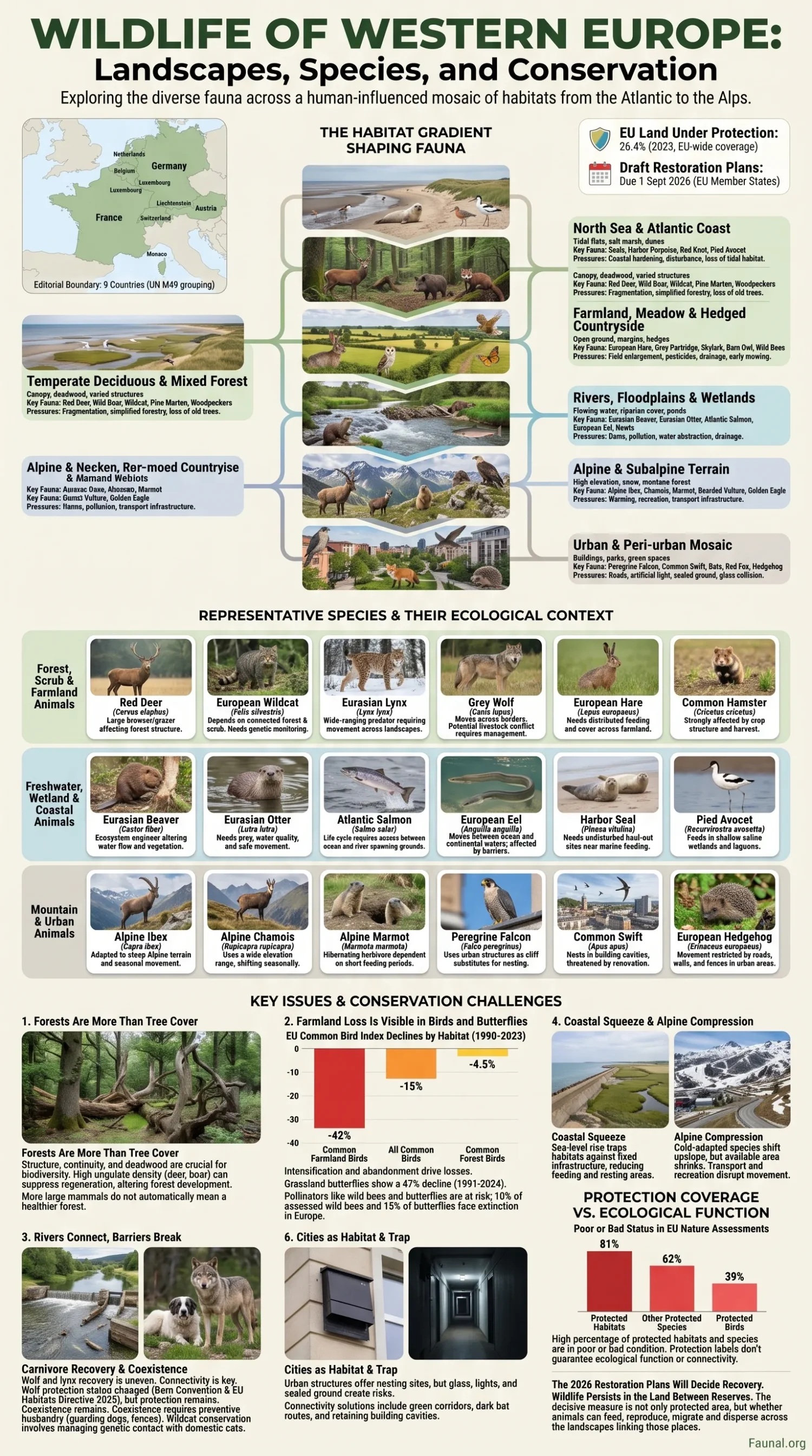
Western Europe supports wolves, lynx, wildcats, deer, beavers, seals, migratory fish, mountain birds, amphibians and thousands of less conspicuous animals across a densely settled mosaic of forests, farmland, rivers, wetlands, Atlantic coasts, Alpine slopes and cities. Much of this fauna does not live in isolated wilderness. Its survival depends on whether managed landscapes still provide breeding sites, food, seasonal refuge and routes between habitat patches.
Editorial Boundary
9 countries
The UN M49 Western Europe grouping includes Austria, Belgium, France, Germany, Liechtenstein, Luxembourg, Monaco, the Netherlands and Switzerland. [a]
EU Land Under Protection
26.4%
EU-wide land coverage at the end of 2023; this is not a Western Europe-only value. [r]
Draft Restoration Plans
Assessment phase underway
The 1 September 2026 draft submission deadline has passed. The Commission, supported by the EEA, is assessing the drafts before final national restoration plans are completed. [t]
Nine Countries, One Ecological Continuum
The geographic label Western Europe is often used loosely. For a reproducible boundary, this page follows the UN M49 regional grouping. The scope therefore differs from everyday cultural definitions: the United Kingdom and Ireland are assigned to Northern Europe, while Spain, Portugal and Italy are assigned to Southern Europe.
The boundary is editorial rather than biological. Wolves may disperse across Germany, France, Switzerland, Austria and neighbouring countries. Migratory fish move between Atlantic waters and inland catchments. Birds using the Wadden Sea may breed or winter far beyond the region. Alpine populations extend across mountain systems that continue into Italy and Slovenia.
A Regional Boundary Is Not a Range Boundary
The inclusion of a species means that it is associated with one or more parts of the defined region. It does not mean that the species occurs in every Western European country or throughout every suitable-looking habitat.
The Habitat Gradient That Organizes the Fauna
Western Europe changes from tidal mudflats and low coastal plains to river valleys, managed farmland, deciduous forest, upland plateaus and high Alpine terrain. Wildlife composition changes along the same gradient. Salinity, water depth, tree age, grazing intensity, snow cover, elevation and landscape connectivity often explain more than national borders.
| Landscape | Defining Conditions | Representative Fauna | Main Pressures |
|---|---|---|---|
| North Sea and Atlantic tidal coast | Intertidal sediment, salt marsh, dunes, shallow channels and exposed resting grounds | Harbour seal, grey seal, harbour porpoise, red knot, pied avocet, common shelduck | Disturbance, coastal hardening, underwater noise, bycatch and loss of tidal habitat |
| Temperate deciduous and mixed forest | Canopy layers, old trees, cavities, deadwood, understory and connected woodland edges | Red deer, roe deer, wild boar, European wildcat, pine marten, forest bats and woodpeckers | Fragmentation, simplified forestry, road mortality and loss of old-tree structures |
| Farmland, meadow and hedged countryside | Open vegetation, field margins, flower-rich grassland, hedgerows and low-intensity grazing | European hare, common hamster, grey partridge, skylark, lapwing, barn owl, butterflies and wild bees | Field enlargement, pesticides, drainage, early mowing and abandonment of semi-natural grassland |
| Rivers, floodplains and wetlands | Flowing water, seasonal inundation, riparian cover, ponds, side channels and wet soils | Eurasian beaver, Eurasian otter, Atlantic salmon, European eel, lampreys, shads, frogs and newts | Dams, weirs, channelisation, nutrient pollution, water abstraction and wetland drainage |
| Alpine and subalpine terrain | Short growing seasons, snow, exposed rock, montane forest and elevation-linked vegetation bands | Alpine ibex, Alpine chamois, Alpine marmot, bearded vulture, golden eagle, black grouse and rock ptarmigan | Warming, recreation, transport infrastructure, habitat compression and isolated populations |
| Urban and peri-urban mosaic | Buildings, gardens, cemeteries, parks, canals, railway edges and remnant woodland | Peregrine falcon, common swift, common pipistrelle, red fox, stone marten and European hedgehog | Roads, artificial light, sealed ground, glass collision, renovation and disconnected green space |
A Source-Based Set of Representative Species
No single verified checklist combines every terrestrial, freshwater and marine animal within the exact M49 boundary. The tables below therefore provide a broad representative fauna set, not a claim that all regional species have been listed. Scientific names were rechecked against the active Catalogue of Life COL26.8 XR release, issued 26 August 2026. [b]
Forest, Scrub and Farmland Animals
| Common Name | Scientific Name | Main Association in Western Europe | Ecological Relevance |
|---|---|---|---|
| Red deer | Cervus elaphus | Large forests, uplands, forest edges and open feeding grounds | Large browser and grazer that affects woodland regeneration and vegetation structure |
| Roe deer | Capreolus capreolus | Woodland edges, farmland mosaics, young forest and scrub | Uses small habitat patches and edge cover more readily than red deer |
| Wild boar | Sus scrofa | Forest, agricultural land, wetlands and peri-urban edges | Disturbs soil while rooting and can reach high local densities where food is abundant |
| European wildcat | Felis silvestris | Connected forest, scrub and structurally varied woodland margins | Depends on cover and landscape continuity; road mortality and contact with domestic cats require local attention |
| Eurasian lynx | Lynx lynx | Large forested landscapes in Alpine, Jura, Vosges and adjoining systems | Wide-ranging predator whose small populations need movement between occupied areas |
| Grey wolf | Canis lupus | Forested, agricultural and mountain mosaics with prey and dispersal routes | Moves across administrative borders and may come into conflict with livestock production |
| Pine marten | Martes martes | Woodland with tree cover, cavities and connected canopy or ground routes | Predator and seed disperser associated mainly with structurally varied woodland |
| European badger | Meles meles | Woodland edges, pasture, hedgerows and mixed rural landscapes | Excavates extensive setts and feeds across both wooded and open habitats |
| European hare | Lepus europaeus | Open farmland, pasture and mixed agricultural landscapes | Needs feeding areas and cover distributed across the farmed landscape |
| Common hamster | Cricetus cricetus | Deep soils in selected arable landscapes, especially in parts of France, Germany, Belgium and neighbouring Central Europe | Strongly affected by crop structure, harvest timing, food supply and habitat isolation |
| Grey partridge | Perdix perdix | Open farmland with field margins and insect-rich breeding habitat | Chicks depend heavily on invertebrate food during early development |
| Eurasian skylark | Alauda arvensis | Arable fields, grassland and other open landscapes | Responds to crop height, nesting opportunities and the timing of farm operations |
| Northern lapwing | Vanellus vanellus | Wet grassland, open farmland, floodplain fields and shallow wet areas | Ground-nesting bird affected by drainage, vegetation height and nest loss during field work |
| Barn owl | Tyto alba | Farmland, rough grassland, field margins and buildings | Links nesting access in structures with the availability of small mammals in open habitat |
| Stag beetle | Lucanus cervus | Old broadleaved woodland, veteran trees, parks and wooded urban areas | Larvae develop for years in decaying wood below or near ground level |
Freshwater, Wetland and Coastal Animals
| Common Name | Scientific Name | Main Association in Western Europe | Ecological Relevance |
|---|---|---|---|
| Eurasian beaver | Castor fiber | Rivers, streams, canals, floodplains and riparian woodland | Changes water flow, vegetation and wetland structure through damming, digging and tree cutting |
| Eurasian otter | Lutra lutra | Rivers, wetlands, lakes, canals and some coastal waters | Needs prey, resting cover, water quality and safe movement along banks and beneath roads |
| Atlantic salmon | Salmo salar | Atlantic-connected rivers with accessible spawning and juvenile habitat | Its life cycle depends on continuity between marine feeding grounds and freshwater spawning reaches |
| European eel | Anguilla anguilla | Rivers, estuaries, lakes, canals and coastal waters | Moves between oceanic spawning areas and continental growth habitats; barriers affect both upstream and downstream passage |
| River lamprey | Lampetra fluviatilis | Estuaries and rivers with accessible spawning substrates and juvenile sediment habitat | Requires connected reaches and suitable riverbed conditions during different life stages |
| Sea lamprey | Petromyzon marinus | Atlantic and North Sea catchments with open migration routes | Large barriers can remove access to spawning habitat far upstream |
| Allis shad | Alosa alosa | Atlantic estuaries and large rivers | Migratory fish whose river access is affected by barriers, altered flow and water quality |
| Great crested newt | Triturus cristatus | Fish-free or low-fish ponds connected to terrestrial shelter and feeding habitat | Needs both aquatic breeding sites and surrounding land with cover |
| Common toad | Bufo bufo | Ponds, lakes, gardens, woodland and farmland | Seasonal breeding movements can cross roads between terrestrial habitat and water |
| Common frog | Rana temporaria | Ponds, wet grassland, woodland, uplands and gardens | Uses a broad range of wet and terrestrial habitats but still depends on accessible breeding water |
| Harbour seal | Phoca vitulina | Wadden Sea, North Sea coast, estuaries and exposed resting banks | Needs undisturbed haul-out and pupping sites near marine feeding grounds |
| Grey seal | Halichoerus grypus | North Sea and Atlantic coastal waters, islands and sandbanks | Uses terrestrial sites for breeding, resting and moulting while feeding at sea |
| Harbour porpoise | Phocoena phocoena | North Sea, English Channel and adjacent Atlantic waters | Small marine cetacean exposed to underwater noise, prey changes and accidental capture |
| Pied avocet | Recurvirostra avosetta | Shallow saline wetlands, lagoons, mudflats and coastal breeding sites | Feeds in shallow water and depends on exposed or sparsely vegetated nesting ground |
| Red knot | Calidris canutus | Intertidal feeding areas used during long-distance migration | Connects Western European coastal habitat with breeding and wintering areas far outside the region |
Mountain and Urban Animals
| Common Name | Scientific Name | Main Association in Western Europe | Ecological Relevance |
|---|---|---|---|
| Alpine ibex | Capra ibex | Rocky Alpine slopes, cliffs and high grassland | Large mountain herbivore adapted to steep terrain and seasonal movement |
| Alpine chamois | Rupicapra rupicapra | Alpine and subalpine grassland, forest edges and rocky slopes | Uses a wider elevation range than ibex and shifts habitat seasonally |
| Alpine marmot | Marmota marmota | Open Alpine meadows with soils deep enough for burrows | Hibernating herbivore dependent on short seasonal feeding periods |
| Bearded vulture | Gypaetus barbatus | High mountains, cliffs and open areas with wild or domestic ungulates | Specialised scavenger that consumes bones and needs safe nesting cliffs |
| Golden eagle | Aquila chrysaetos | Mountain cliffs, open uplands and broad hunting territories | Large raptor requiring both nesting security and prey-rich open habitat |
| Black grouse | Lyrurus tetrix | Subalpine woodland edges, moorland and open scrub | Depends on transitional habitat rather than dense forest or treeless ground alone |
| Rock ptarmigan | Lagopus muta | Cold, open Alpine terrain above or near the tree line | Cold-adapted bird with limited options when suitable climate zones contract upslope |
| Alpine salamander | Salamandra atra | Cool, moist Alpine and subalpine habitat | Unlike many amphibians, it gives birth to developed young and does not require open water for breeding |
| Peregrine falcon | Falco peregrinus | Cliffs, towers, tall buildings and industrial structures | Urban structures can substitute for nesting cliffs where prey and safe ledges are available |
| Common swift | Apus apus | Cavities in buildings, roofs and older urban structures | Building renovation can remove nesting spaces unless cavities are retained or replaced |
| Common pipistrelle | Pipistrellus pipistrellus | Buildings, gardens, waterways, woodland edges and parks | Uses narrow roost spaces and feeding routes that can be altered by renovation and artificial light |
| European hedgehog | Erinaceus europaeus | Gardens, parks, hedgerows, cemeteries and suburban green space | Ground-level movement is restricted by roads, walls and sealed garden boundaries |
| Stone marten | Martes foina | Rocky habitat, farms, villages, roofs and urban edges | Frequently uses human structures and may persist in heavily modified landscapes |
Forests Are More Than Tree Cover
Temperate broadleaved and mixed forests form much of Western Europe’s potential natural vegetation, but present-day woodland varies greatly in ecological condition. A young plantation, an even-aged production stand and an old mixed forest may all be recorded as tree cover while providing very different resources for wildlife.
Old Trees, Cavities and Decaying Wood
Large old trees support cavities, loose bark, rot holes and broken limbs used by bats, owls, woodpeckers, martens and invertebrates. Fallen trunks and decaying roots provide food and developmental sites for wood-dependent beetles, fungi and other decomposers. Removing all deadwood produces a visually tidy stand but removes several stages of the forest life cycle.
Tree species diversity and uneven age structure create differences in canopy height, shade, leaf litter and understory growth. These conditions influence insects, small mammals and birds, which in turn affect predators. Forest quality is therefore better described by structure, continuity and management than by tree count alone.
High Ungulate Density Can Change the Next Forest Generation
Red deer, roe deer and wild boar are native parts of Western European ecosystems, yet high local densities can alter woodland development. Deer browsing may suppress preferred seedlings and shrubs. Wild boar rooting exposes soil, consumes seeds and invertebrates, and creates disturbed patches. The effects vary with food supply, hunting, predator presence, winter conditions and surrounding farmland.
More large mammals do not automatically mean a healthier forest. Their abundance must be considered alongside regeneration, ground vegetation, deadwood fauna and predator–prey relationships.
Farmland Loss Is Visible in Birds and Butterflies
A large share of Western Europe’s wildlife occupies land used for food production. Skylarks nest within open fields. Lapwings use wet grassland and sparsely vegetated ground. Barn owls hunt small mammals along rough margins. Hares require feeding areas and nearby cover. Wild bees and butterflies depend on flowers, host plants, bare ground, stems, hedges and other small habitat features distributed across the farmed landscape.
The EU common bird index shows a sharp difference between habitat groups. From 1990 to 2023, the index for 168 common birds fell by 15%. The common farmland bird index fell by 42%, while the common forest bird index fell by 4.5%. These are EU-wide multi-species indicators rather than counts of individual animals or Western Europe-only estimates. [d]
EU Common Bird Index Declines by Habitat Association
Percentage decrease in multi-species indices between 1990 and 2023.
Source: European Environment Agency, Common Bird Index in Europe. Values represent change in EU multi-species indices, not the percentage of species threatened or the number of birds lost.
Intensification and Abandonment Remove Different Habitats
Agricultural intensification reduces habitat through field enlargement, drainage, repeated mowing, high grazing pressure, herbicide use and the removal of hedges or uncultivated edges. Insecticides can reduce prey for chicks and bats as well as directly affecting target and non-target invertebrates. Dense crops may leave little bare or open ground for nesting birds.
Abandonment can also remove habitat when flower-rich grassland and open scrub mosaics develop into uniform tall vegetation or woodland. Many grassland specialists depend on continued mowing or grazing, but the timing and intensity of that management determine whether eggs, larvae, nests and flowering plants survive.
The EU grassland butterfly index fell by 47% between 1991 and 2024. The indicator combines 17 typical grassland species and is driven mainly by losses among rarer habitat specialists. None of the 17 species showed a statistically supported increase over the monitored period. [e]
Pollinator Risk Extends Beyond Honey Bees
Managed honey bees represent only one part of pollination. Europe also supports solitary bees, bumblebees, hoverflies, butterflies, moths, beetles and other flower-visiting insects with different nesting and feeding requirements.
The 2025 European Red List reassessment estimated that 10% of assessed wild bee species and 15% of assessed butterfly species in Europe face extinction risk. The bee assessment covered 1,928 species, while the butterfly assessment covered 442 species. These European values should not be treated as Western Europe-only rates. [f]
A Flower Strip Cannot Replace the Whole Life Cycle
Adult insects may use planted flowers while their larvae require particular host plants, nesting soils, dead stems, wet depressions or undisturbed grass. Pollinator restoration must retain breeding and overwintering habitat as well as nectar sources.
Rivers Connect Habitats—and Barriers Break the Route
The Rhine, Rhône, Loire, Seine, Meuse and their tributaries connect mountains, lowlands, estuaries and coastal waters. Their wildlife depends on more than water being present. Flow variation, sediment movement, shaded banks, gravel beds, floodplain channels, wetlands and passage between river sections all shape freshwater habitat.
In the latest EU reporting cycle, 39.6% of assessed surface waters reached good or high ecological status in 2021. Artificial barriers and embankments were among the pressures identified alongside agricultural, urban and industrial pollution. Several river-basin districts in Belgium, the Netherlands, Luxembourg and northern Germany were among the areas where more than 90% of surface waters remained below good status. [g]
Migratory Fish Need More Than a Fish Pass
Atlantic salmon, European eel, lampreys and shads move between habitats used at different life stages. A structure that permits some upstream passage may still delay migration, block downstream movement, alter flow, change sediment transport or prevent access to side channels. River restoration must therefore examine the whole barrier and surrounding reach rather than counting fish passes alone.
European rivers and lakes support otters, beavers, fish, amphibians, dragonflies, molluscs and other taxa adapted to flowing or standing water. Ponds and lagoons often support local assemblages that cannot be inferred from the fauna of a nearby river. [h]
Beavers Change the Habitat Rather Than Merely Occupying It
The Eurasian beaver cuts trees, digs channels, stores food and sometimes builds dams. These activities can slow water, raise local water tables, trap sediment, create ponds, open the canopy and produce wet–dry habitat contrasts. The outcome depends on topography, stream size, existing infrastructure and how conflicts are managed.
A European-focused research review describes beavers as ecosystem engineers because their physical modification of waterways can alter hydrology, geomorphology and habitat availability for other organisms. The same activities can also flood crops, block drainage structures or damage valued trees, so ecological benefits do not remove the need for site-specific management. [i]
Amphibians Move Between Water and Land
A breeding pond cannot support amphibians if surrounding terrestrial habitat is sealed, intensively cultivated or cut off by roads. Newts, frogs and toads may spend much of the year away from open water. Pond networks need shaded refuges, rough vegetation, woodland, field margins or gardens between breeding sites.
Temporary ponds can be valuable because seasonal drying may limit fish that consume eggs and larvae. Deep permanent ponds, shallow seasonal pools, marsh edges and wet woodland are not interchangeable habitat units.
North Sea Coasts Depend on Tides and Undisturbed Resting Sites
The Dutch and German Wadden Sea is one of Western Europe’s main tidal systems. Its mudflats, sandbanks, salt marshes, channels and islands support breeding birds, migratory birds, fish nurseries, invertebrates and marine mammals. Birds may use the area for only one stage of a migration linking Arctic breeding grounds with wintering areas farther south.
The Common Wadden Sea Secretariat reports almost one million ground-breeding birds from 31 species and much larger numbers of birds using the system during migration. Such counts describe a transboundary coastal ecosystem rather than the permanent resident fauna of a single country. [j]
Seals Need Land Within a Marine Habitat
Harbour seals and grey seals feed at sea but return to exposed land for resting, breeding or moulting. A sandbank can therefore be biologically necessary even when it is submerged during part of the tidal cycle. Repeated close approach by boats, aircraft, dogs or people can reduce the usable resting period before the tide returns.
Both harbour seals and grey seals occur in the Wadden Sea. Their presence does not remove concerns about disturbance, disease, contaminants, prey conditions or movement between the Wadden Sea and neighbouring marine regions. [k]
Coastal Squeeze Removes the Landward Escape Route
Salt marsh and other intertidal habitats can move landward as sea level changes only where space and suitable elevation remain available. Sea walls, roads and development may trap habitat between rising water and fixed infrastructure. This process, known as coastal squeeze, can reduce feeding, nesting and flood-storage areas even where the visible coastline remains in place.
The Alps Compress Habitats Into Vertical Bands
Austria, Switzerland, Liechtenstein, Germany and France include parts of the Alpine system. Elevation creates a short horizontal distance between valley floors, montane forest, subalpine scrub, Alpine meadow, scree and exposed rock. Each band differs in snow duration, temperature, vegetation and seasonal food.
The Alpine Convention reports more than 30,000 animal species across the Alps as a whole. That total covers the full Alpine Convention area, including countries outside this article’s Western European boundary, and should not be read as a Western Europe species count. [l]
Cold-Adapted Species Cannot Move Upward Indefinitely
Rock ptarmigan, cold-adapted insects and other high-elevation animals may shift upslope as lower zones become warmer. The available area usually becomes smaller toward the summit. Suitable vegetation, snow conditions and rock structure may also fail to occur immediately above the present habitat.
A mountain ridge, ski area, road, reservoir or dense settlement can interrupt movement between apparently nearby habitat patches. Connectivity may require broad landscape routes for lynx or wolves, wooded cover for forest species, and small stepping-stone habitats for invertebrates.
Transport and Recreation Produce Seasonal Effects
Winter disturbance can force grouse, ungulates and other animals to spend energy when food is limited. Summer recreation can affect cliff-nesting birds, open meadows and wet ground. The ecological effect depends on route placement, timing, visitor concentration and whether animals retain undisturbed refuge.
Alpine connectivity studies identify settlements and transport infrastructure among the main artificial barriers to movement. Agricultural land, energy infrastructure and tourism development may add further breaks or narrow passages. [m]
Carnivore Recovery Brings Connectivity and Coexistence Into the Same Question
Wolves and Eurasian lynx have returned to or expanded within parts of Western Europe after long periods of persecution and regional loss. Their recovery is uneven. A dispersing individual, an occupied area and a self-sustaining breeding population are different forms of evidence.
Lynx Populations Remain Unevenly Connected
Eurasian lynx occur in several European populations rather than one continuous population. Within Western Europe, the Alpine, Jura and Vosges areas are especially relevant. Roads, railways, dense settlement and gaps in forest cover may restrict dispersal and gene flow even where prey is available.
The European Commission’s 2023 large-carnivore assessment estimated about 9,400 Eurasian lynx across Europe and recorded lynx presence over about 1.5 million square kilometres. Those continental figures combine populations with different trends and conservation problems; they do not show that every regional population is secure. [n]
Wolf Law Changed, but Protection Was Not Removed
The wolf moved from Appendix II, covering strictly protected fauna, to Appendix III, covering protected fauna, under the Bern Convention on 7 March 2025. The change allows a different management regime but still requires populations to be kept out of danger. [o]
Within the European Union, Directive (EU) 2025/1237 moved the wolf from Annex IV to Annex V of the Habitats Directive, with the amendment entering into force on 14 July 2025. Annex V permits regulated taking or exploitation where national measures remain compatible with maintaining the species at favourable conservation status. National rules may still provide stronger protection. [p]
Livestock guarding dogs, night enclosures, well-maintained electric fencing, shepherding, carcass management and payment systems address different parts of coexistence. Their performance depends on terrain, herd type, labour, maintenance and local predator behaviour. Population management does not replace preventive husbandry, and preventive measures do not remove every loss.
Range Expansion Is Not the Same as Secure Recovery
A species may occupy more territory while still facing road mortality, illegal killing, genetic isolation, disease or conflict. Range, abundance, reproduction and connectivity must be assessed separately.
Wildcat Conservation Includes Genetic Contact With Domestic Cats
European wildcats use forest and scrub but often move through landscapes containing roads, farms, villages and free-ranging domestic cats. Hybridisation rates differ among regions and cannot be inferred from appearance alone. Genetic work in western Central Europe found low but measurable hybridisation, showing why population monitoring requires genetic evidence rather than visual identification only. [q]
Cities Work as Habitat Only When Green and Dark Routes Connect
Western European cities support wildlife because buildings, waterways, parks, rail corridors, cemeteries and gardens create nesting, roosting and feeding opportunities. Peregrine falcons use tall structures as cliff substitutes. Swifts and bats occupy narrow building cavities. Foxes, stone martens and hedgehogs move through gardens and vegetated edges.
Urban habitat can also function as an ecological trap. Birds collide with glass. Hedgehogs enter road networks or become confined by impermeable fencing. Bats lose roosts during renovation and avoid brightly lit commuting routes. Artificial light changes insect activity and can draw insects away from darker habitat.
A Park Is Not Connected Merely Because Another Park Is Nearby
Different animals experience the same city differently. A bat may follow a dark tree line over a canal. A hedgehog needs ground-level gaps. An amphibian may require a route between a breeding pond and winter shelter. A peregrine can cross built-up districts by flight but still needs a secure nesting ledge.
- Rivers and canals can link urban centres with surrounding wetlands.
- Railway and utility corridors may provide linear vegetation but can also create mortality risks.
- Gardens and cemeteries can form small habitat steps where boundaries remain permeable.
- Building cavities can be retained or replaced during renovation.
- Dark routes can preserve bat movement between roosts and feeding areas.
Protection Coverage Does Not Measure Ecological Function
Protected areas are necessary for retaining breeding sites, rare habitats and less disturbed refuges, but the percentage of land designated does not show whether populations can move between sites or whether each site is being managed for its ecological purpose.
At the end of 2023, protected areas covered 26.4% of EU land: 18.6% within Natura 2000 and 7.8% under other national designations. Coverage still remained below the EU target of protecting at least 30% of land by 2030. Switzerland and Liechtenstein are outside the EU, so EU coverage figures cannot be applied to the entire Western Europe boundary.
The wider conservation picture remains poor. The EEA reports that 81% of protected habitats, 39% of protected birds and 62% of other protected species assessed under the EU Nature Directives are in poor or bad conservation status. These values concern EU assessments and do not form a separate Western Europe dataset. [c]
Poor or Bad Status in EU Nature Assessments
Share of assessments reported in poor or bad conservation status under the EU Nature Directives.
Source: European Environment Agency biodiversity assessment. Values are EU-wide shares of assessments, not Western Europe-only results and not percentages of all European species.
A Corridor Must Match the Animal
A generic green line on a planning map does not serve every taxon. Wolves and lynx need broad, low-conflict routes through large landscapes. Forest bats may need dark, tree-lined flight paths. Amphibians may need only a short crossing, but that crossing must connect the correct pond and terrestrial refuge. Fish require passable watercourses. Grassland insects may move through small patches of suitable flowers and host plants.
| Wildlife Group | Connection Required | Common Break in the Route | Useful Biological Response |
|---|---|---|---|
| Large carnivores | Broad landscape permeability between occupied areas | Dense roads, settlement, fencing and conflict zones | Successful dispersal, reproduction and genetic exchange |
| Forest specialists | Continuous or closely spaced woodland with mature structures | Clearance, young uniform stands and isolated old trees | Occupancy of connecting patches and continued breeding |
| Farmland birds | Open nesting habitat linked to insect-rich feeding areas and cover | Large uniform fields, early mowing and margin removal | Nest survival, chick food availability and stable monitored populations |
| Pollinators | Flowering, nesting and larval habitat distributed through the season | Herbicide use, pesticide exposure and loss of semi-natural grassland | Presence of specialist species and successful reproduction |
| Amphibians | Breeding ponds connected to terrestrial shelter | Roads, kerbs, sealed ground and fish introductions | Breeding success and movement between multiple ponds |
| Migratory fish | Continuous upstream and downstream passage | Dams, weirs, turbines and altered flow | Arrival at spawning grounds and successful downstream migration |
| Coastal birds and seals | Undisturbed tidal feeding, breeding and resting sites | Recreation, fixed coastal structures and habitat squeeze | Use of high-tide refuges, nests and haul-out sites |
| Urban bats and ground mammals | Dark aerial routes or permeable ground-level passages | Lighting, roads, walls and sealed garden boundaries | Continued movement between roost, shelter and feeding habitat |
The 2026 Restoration Plans Will Decide Where Recovery Happens
The EU Nature Restoration Regulation requires restoration measures to cover at least 20% of EU land and sea areas by 2030 and, by 2050, all ecosystems that need restoration. It also includes targets for agricultural ecosystems, forests, pollinators, urban ecosystems and the restoration of at least 25,000 kilometres of rivers to a free-flowing state by 2030. [s]
The 1 September 2026 deadline for draft national restoration plans has passed. Over the coming months, the Commission, supported by the European Environment Agency, will assess the drafts and provide observations to Member States. Final national restoration plans are to be completed within one year. [t]
The ecological value of those plans will depend on what is restored, where it occurs and how biological response is measured. Area treated is an implementation measure. Wildlife recovery requires evidence that animals can breed, feed, disperse or complete migration after the work.
Forest Measures Need Structural Targets
- Retain old trees, cavities and standing or fallen deadwood where safety permits.
- Increase variation in tree age, species and canopy structure.
- Reconnect isolated woodland used by wildcats, bats, martens and forest invertebrates.
- Measure browsing pressure where deer affect regeneration.
- Keep selected flight routes dark for bats.
Farmland Measures Must Cover the Full Breeding Season
- Restore hedges, rough margins, wet depressions and flower-rich grassland.
- Adjust mowing dates and retain uncut refuges where appropriate.
- Provide nesting and larval habitat rather than flowers alone.
- Reduce pesticide exposure and retain insect prey for birds and bats.
- Monitor specialist butterflies, wild bees and breeding birds, not only vegetation cover.
River Measures Need to Restore Process and Passage
- Remove obsolete barriers where feasible.
- Reconnect floodplains, side channels and wetlands.
- Restore sediment movement and varied riverbed structure.
- Provide safe upstream and downstream migration.
- Retain riparian cover while allowing natural water-level change.
Coastal and Alpine Measures Need Space for Movement
- Allow salt marsh and other tidal habitat to move landward where geography permits.
- Protect high-tide bird refuges and seal resting areas from repeated disturbance.
- Retain movement routes between Alpine habitat bands.
- Map climate refuges for cold-adapted species.
- Place recreation infrastructure away from sensitive breeding and wintering sites.
Wildlife Persists in the Land Between Reserves
Western Europe’s fauna is shaped by a basic spatial problem: many animals must complete their life cycles across land that is farmed, forested, settled, engineered or used for transport. A protected wetland may fail migratory fish when barriers remain downstream. A forest reserve may fail wildcats or lynx when surrounding roads prevent dispersal. An urban park may fail hedgehogs when every boundary is sealed.
Species recovery must also be separated from ecosystem recovery. The return of beavers may restore wetland processes in one catchment while creating conflicts in another. More wolves or lynx may show reduced persecution without proving that their populations are genetically connected. Rising deer numbers may coexist with poor forest regeneration. Seal recovery may occur while tidal resting habitat remains vulnerable to disturbance.
The decisive measure is not only how much land has a protection label, but whether animals can feed, reproduce, migrate and disperse across the landscapes linking those protected places.
Sources and Verification
- [a] United Nations Standard Country or Area Codes for Statistical Use (M49) — Used to define the nine-country Western Europe boundary applied to the article.
- [b] Catalogue of Life Data Downloads and Releases — Used to recheck accepted scientific-name usage against the active COL26.8 XR release issued 26 August 2026.
- [c] European Environment Agency: Biodiversity—State of Habitats and Species — Used for the EU-wide poor or bad conservation-status shares and their assessment scope.
- [d] European Environment Agency: Common Bird Index in Europe — Used for the 1990–2023 common, farmland and forest bird index changes shown in the article and chart.
- [e] European Environment Agency: Grassland Butterfly Index in Europe — Used for the 1991–2024 EU grassland butterfly trend and indicator-species scope.
- [f] IUCN: European Wild Bee and Butterfly Red List Findings — Used for the 2025 European extinction-risk estimates and numbers of assessed bee and butterfly species.
- [g] European Environment Agency: Ecological Status of Surface Waters — Used for the 2021 surface-water status figure and examples of Western European river-basin pressure.
- [h] Biodiversity Information System for Europe: Rivers and Lakes — Used for freshwater habitat diversity and the animal groups associated with European inland waters.
- [i] Brazier et al.: Beaver—Nature’s Ecosystem Engineers — Used for the physical and ecological effects of Eurasian beaver activity and the need to consider both benefits and conflicts.
- [j] Common Wadden Sea Secretariat: Richly Diverse — Used for the Wadden Sea breeding-bird scope and its function for migratory wildlife.
- [k] Common Wadden Sea Secretariat: Seals — Used to verify harbour seal and grey seal occurrence in the Wadden Sea.
- [l] Alpine Convention: Biodiversity and Nature Conservation — Used for the Alpine-wide animal-species estimate and the geographic limits of that figure.
- [m] Alpine Convention: Ecological Connectivity and Climate Change — Used for the role of corridors, stepping stones, settlements and transport infrastructure in Alpine movement.
- [n] European Commission: Large Carnivore Populations Across Europe — Used for the 2023 Eurasian lynx population and recorded-presence estimates at continental scale.
- [o] Council of Europe: Wolf Protection Change Under the Bern Convention — Used for the Appendix II to Appendix III change that entered into force on 7 March 2025.
- [p] European Commission: Large Carnivores — Used for the wolf’s move from Annex IV to Annex V of the EU Habitats Directive and the date it entered into force.
- [q] Steyer et al.: European Wildcat and Domestic Cat Hybridisation — Used for genetic evidence of low but measurable hybridisation in western Central Europe.
- [r] European Environment Agency: Designated Terrestrial Protected Areas — Used for EU land-protection coverage, Natura 2000 coverage and other national designations at the end of 2023.
- [s] European Commission: Nature Restoration Regulation — Used for the 2030 restoration coverage, ecosystem and free-flowing-river targets.
- [t] European Commission: EU Countries Submit Draft Plans on Restoring Nature — Used for the 1 September 2026 draft-plan submission stage, the Commission and EEA assessment phase, and the timing of final national restoration plans.
Related Topics
- → Wildlife of Eastern Europe: Forests, Wetlands, and Steppe Species
- → Wildlife of Northern Europe: Boreal Forests, Tundra, and Coasts
- → Birds of Europe: Species Diversity, Habitats, and Biogeographic Regions
- → Mammals of Europe: Native Species, Habitats, and Distribution
- → Endemic Animals of Europe: Species with Restricted Ranges