Complete guides: Regional Fauna Guides•Fauna of Europe
Updated: September 11, 2026 What changed?
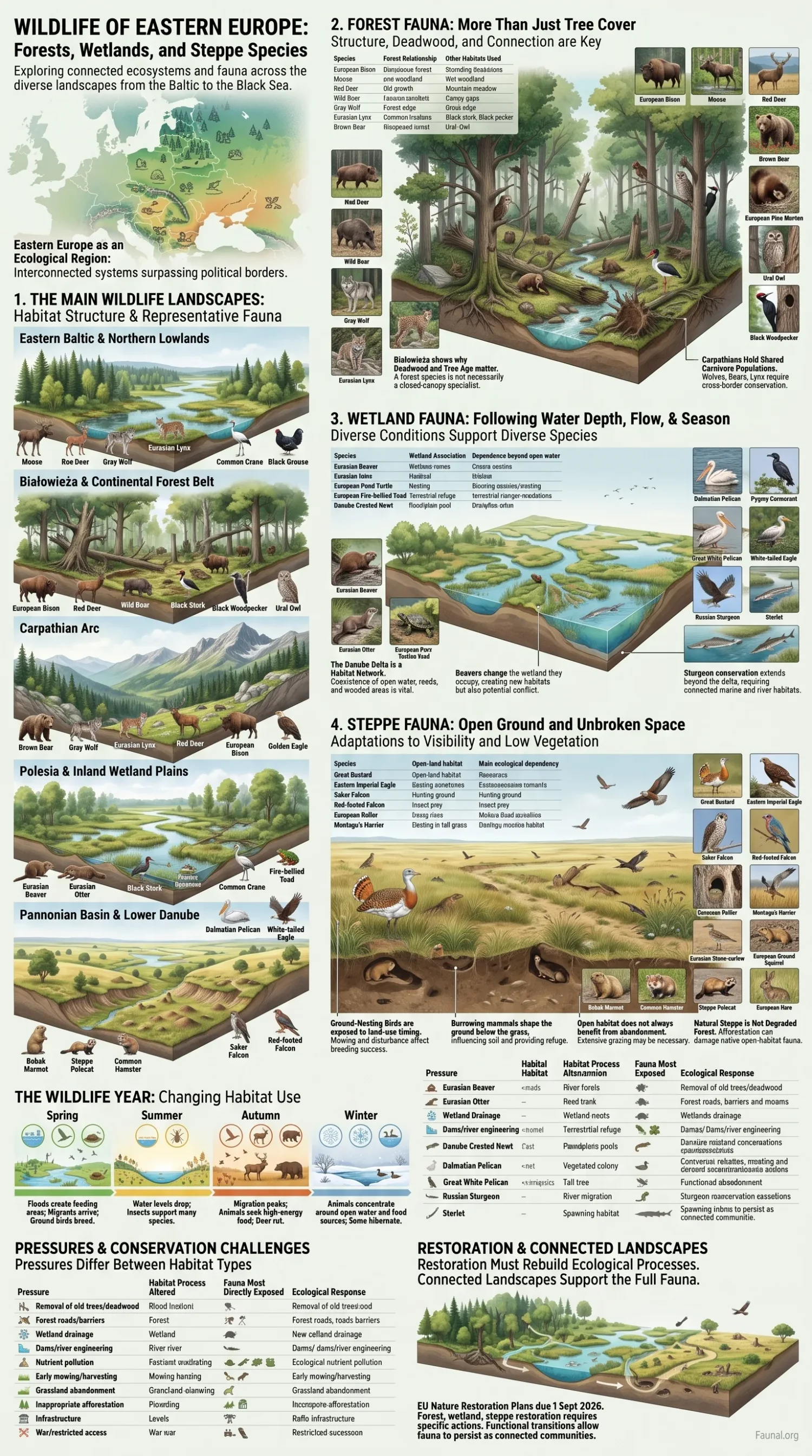
Eastern Europe contains several connected wildlife systems rather than one uniform fauna. Mixed and old-growth forests shelter large herbivores, carnivores, cavity-nesting birds, bats, and deadwood-dependent invertebrates; deltas, peatlands, floodplains, and reed beds support waterbirds, fish, beavers, otters, turtles, and newts; dry grasslands and forest-steppe mosaics hold bustards, eagles, falcons, ground squirrels, marmots, hamsters, and steppe mustelids. Many species depend on more than one of these settings, making the boundaries between forest, wetland, and steppe as biologically important as the habitats themselves.
Eastern Europe as an Ecological Region
“Eastern Europe” has no single ecological border. Political definitions differ, while animal populations and river systems cross national boundaries. For this page, the region is treated as a landscape belt extending from the eastern Baltic and Polesia lowlands through the Białowieża forest zone and Carpathian arc, then south and east through the Pannonian Basin, lower Danube, Black Sea lowlands, forest-steppe, and Pontic steppe. This working scope includes parts of several European biogeographical regions rather than assuming that every species occurs throughout every eastern European country.[a]
Why There Is No Single Eastern Europe Species Total
A regional total would change according to the countries included, whether marine fauna is counted, which taxonomic release is used, and how historical, introduced, migratory, or unverified records are treated. National checklists and occurrence databases also differ in survey effort. The species presented here form a source-based habitat reference, not a claim that every animal of Eastern Europe has been inventoried in one list.
Scientific names in the tables were checked against the active Catalogue of Life release, COL26.8 XR, issued on 26 August 2026. Taxonomic services may revise accepted combinations, authorities, or synonym relationships as specialist datasets are updated.[b]
Białowieża Forest
59 mammal species
UNESCO also reports more than 250 bird species and over 12,000 invertebrate species within the transboundary property.[c]
Danube Delta
300+ bird species
UNESCO reports 45 freshwater fish species in the delta’s lakes and marshes.[f]
Askaniya-Nova
Festuca–Stipa steppe
A surviving southern Black Sea steppe ecosystem surrounded by intensively used lowland landscapes.[i]
The Main Wildlife Landscapes
| Landscape belt | Habitat structure | Representative fauna | Ecological connection |
|---|---|---|---|
| Eastern Baltic and northern lowlands | Mixed forest, conifer stands, lakes, peatlands, wet meadows, and river valleys | Moose, roe deer, gray wolf, Eurasian lynx, Eurasian beaver, common crane, black grouse | Forest mammals regularly encounter wetlands, lake margins, and managed farmland |
| Białowieża and the continental forest belt | Old-growth deciduous and mixed forest, deadwood, tree cavities, small rivers, and forest openings | European bison, red deer, wild boar, black stork, black woodpecker, Ural owl | Open glades, wet depressions, and streams support species not confined to closed canopy |
| Carpathian arc | Montane forest, rocky slopes, river valleys, subalpine grassland, and wooded foothills | Brown bear, gray wolf, Eurasian lynx, red deer, European bison, golden eagle | Altitudinal movement connects forest shelter with meadows and valley feeding areas |
| Polesia and inland wetland plains | Peat bogs, marshes, floodplain forest, wet grassland, slow rivers, and shallow pools | Eurasian beaver, Eurasian otter, black stork, common crane, fire-bellied toad | Water levels determine whether sites function as open marsh, wet meadow, scrub, or woodland |
| Pannonian Basin and lower Danube | Alluvial plains, reed beds, oxbow lakes, salt grassland, agricultural mosaics, and dry steppe remnants | Great bustard, eastern imperial eagle, European ground squirrel, Dalmatian pelican, white-tailed eagle | Wetlands and dry grasslands often occur within the same river-basin landscape |
| Pontic steppe and forest-steppe | Feather-grass steppe, fescue grassland, loess soils, ravines, river valleys, and scattered woodland | Bobak marmot, steppe polecat, common hamster, Saker falcon, red-footed falcon | Wooded gullies, river corridors, and shelterbelts interrupt otherwise open terrain |
Forest Fauna Depends on Structure, Not Tree Cover Alone
Eastern European forests range from wet lowland woods and oak–hornbeam stands to spruce-dominated mountain slopes and mixed boreal forest. Their wildlife value is shaped by tree age, canopy gaps, deadwood, standing snags, root plates, hollow trunks, understory density, streams, and temporary pools. A plantation and an old-growth stand may both appear as forest on a land-cover map while providing very different nesting, feeding, and shelter conditions.
Large mammals also use forests at different spatial scales. Eurasian lynx often depends on cover for stalking and resting. Wolves may travel through forests, farmland, grassland, and settlements within the same range. Brown bears use wooded slopes for shelter but may feed in meadows, orchards, berry-rich openings, river valleys, and other seasonal food patches. European bison graze in openings and grassland as well as browsing within wooded landscapes.
| Species | Scientific name | Forest relationship | Other habitats commonly used |
|---|---|---|---|
| European bison | Bos bonasus | Uses woodland for shelter, browse, and movement between feeding sites | Forest openings, grassland, meadow, and wooded mountain mosaics |
| Moose | Alces alces | Feeds in young forest, willow growth, wet woodland, and regenerating stands | Marsh margins, peatlands, lake edges, and river valleys |
| Red deer | Cervus elaphus | Uses forest for cover and resting | Meadows, clearings, farmland margins, and mountain grassland |
| Roe deer | Capreolus capreolus | Favours woodland edges, understory, and small forest patches | Hedgerows, scrub, field margins, and mixed farmland |
| Wild boar | Sus scrofa | Roots through soil and litter for seeds, roots, fungi, and invertebrates | Reed beds, farmland, wet woodland, and river corridors |
| Gray wolf | Canis lupus | Uses large forest blocks as cover and breeding habitat in many areas | Open uplands, farmland mosaics, steppe margins, and river valleys |
| Eurasian lynx | Lynx lynx | Associated with wooded cover, broken terrain, and prey-rich forest mosaics | Rocky slopes, forest edge, scrub, and subalpine zones |
| Brown bear | Ursus arctos | Uses extensive forest and mountain woodland for shelter and denning | Meadows, berry fields, riverbanks, orchards, and high-elevation grassland |
| European pine marten | Martes martes | Uses trees, cavities, fallen timber, and dense forest cover | Wooded river corridors and connected small forest patches |
| Black stork | Ciconia nigra | Often nests in quiet mature forest | Feeds in streams, marshes, wet meadows, and shallow pools |
| Ural owl | Strix uralensis | Uses mature mixed and coniferous forest with nesting cavities or broken trunks | Forest clearings and meadow edges used for hunting |
| Black woodpecker | Dryocopus martius | Excavates large cavities and feeds on wood-associated insects | Older managed forest where large trees and deadwood remain |
Białowieża Shows Why Deadwood and Tree Age Matter
Białowieża Forest is frequently represented by the European bison, but the bison is only one component of the forest. Large old trees provide nesting and roosting spaces; dead trunks and fallen wood support beetles, fungi, and other decomposers; root plates and depressions create small wet habitats; canopy gaps support herbs and grazing mammals. The resulting fauna includes species linked to closed forest, open glades, wet woodland, streams, and decaying wood.
A forest species is not necessarily a closed-canopy specialist. European bison, red deer, wolves, bears, black storks, and several raptors use resources located at forest edges, clearings, meadows, streams, or wetlands. Protecting tree cover without retaining these internal habitat differences can leave parts of the fauna unsupported.
The Carpathians Hold Shared Carnivore Populations
The Carpathians form a curved mountain system crossing several countries. Bears, wolves, and Eurasian lynx therefore cannot be understood only through national totals. Roads, settlements, border infrastructure, forestry, livestock practices, hunting rules, and monitoring methods vary across the same population range. The Carpathian Convention treats biodiversity and large-carnivore work as cross-border subjects rather than isolated national issues.[d]
The Council of Europe reports that wolves, brown bears, and Eurasian lynx have recovered parts of their former European space, while conflict with livestock and human activity remains a management issue. Recovery at continental scale does not mean that every local population is secure or that monitoring results are directly comparable between countries.[e]
Forest Birds Link Trees to Water and Open Ground
Woodpeckers, owls, capercaillie, black storks, lesser spotted eagles, and cavity-roosting bats occupy different parts of forest structure. Woodpeckers create cavities later used by other animals. Owls require nesting sites and prey-rich hunting areas. Black storks may place nests in mature forest but travel to wetlands and streams for food, making disturbance near the nest and changes in nearby water systems part of the same habitat problem.[o]
Wetland Fauna Follows Water Depth, Flow, and Season
Eastern European wetlands include river deltas, floodplain lakes, reed beds, peatlands, oxbows, wet meadows, fishponds, slow channels, temporary pools, and brackish lagoons. These habitats cannot be treated as interchangeable. A pelican feeding in open shallow water, a bittern concealed in reeds, a newt breeding in a fish-free pool, and a sturgeon migrating through a river channel depend on different water conditions.
Seasonal flooding can connect rivers to side channels and floodplain lakes, opening feeding and nursery areas. Falling summer water levels may expose mud used by waders while reducing breeding water for amphibians. Winter ice concentrates some waterbirds at unfrozen channels. Drainage or rigid water control can remove this variation even where a site still appears blue or green on a map.
| Species | Scientific name | Wetland association | Dependence beyond open water |
|---|---|---|---|
| Eurasian beaver | Castor fiber | Slow rivers, streams, ponds, canals, and wooded banks | Uses riparian trees and can alter water depth, flow, and wetland extent |
| Eurasian otter | Lutra lutra | Rivers, lakes, marshes, deltas, and fishpond systems | Needs bank cover, resting sites, prey, and connected waterways |
| European pond turtle | Emys orbicularis | Still or slow water with aquatic vegetation | Females leave the water to nest on suitable dry ground |
| European fire-bellied toad | Bombina bombina | Shallow, warm, vegetated pools and floodplain waters | Requires nearby terrestrial shelter outside the breeding period |
| Danube crested newt | Triturus dobrogicus | Lowland floodplain pools, ditches, marshes, and slow waters | Uses terrestrial refuges after leaving breeding water |
| Dalmatian pelican | Pelecanus crispus | Large shallow lakes, deltas, marshes, and lagoons | Requires secure breeding sites and productive fish-feeding areas |
| Great white pelican | Pelecanus onocrotalus | Open shallow water in deltas, lakes, and marsh complexes | Moves between nesting colonies and feeding waters |
| Pygmy cormorant | Microcarbo pygmaeus | Reed-fringed lakes, marshes, river channels, and fishponds | Uses trees, bushes, or reed beds for roosting and nesting |
| Common crane | Grus grus | Marshes, bogs, wet meadows, and shallow roosting sites | Feeds in grassland and farmland away from wetland roosts |
| Ferruginous duck | Aythya nyroca | Shallow vegetated lakes, marshes, and slow water | Depends on dense emergent vegetation and nearby feeding areas |
| White-tailed eagle | Haliaeetus albicilla | Large rivers, lakes, deltas, and coastal wetlands | Often nests in tall trees within reach of aquatic feeding sites |
| Beluga sturgeon | Huso huso | Black Sea and connected large rivers | Requires river continuity between marine feeding areas and spawning reaches |
| Russian sturgeon | Acipenser gueldenstaedtii | Marine and estuarine waters with river migration | Depends on accessible spawning habitat and suitable river flow |
| Sterlet | Acipenser ruthenus | Large freshwater rivers | Riverbed condition, flow, and migration barriers influence access to spawning habitat |
The Danube Delta Is a Habitat Network
The Danube Delta is not one continuous reed bed. Open lakes, channels, floating vegetation, reed margins, wet grasslands, dunes, wooded areas, and brackish zones form a changing network. Pelicans and cormorants use fish-rich open water; herons and bitterns use shallows and reeds; raptors may nest in trees and forage across water; amphibians occupy smaller pools and vegetated margins. The value of the delta comes from the coexistence and connection of these settings, not from one habitat type alone.
Dalmatian pelicans breed in parts of eastern and southeastern Europe and use large wetland systems that provide both secure colony sites and feeding waters. A breeding record, migration record, or winter observation does not carry the same biological meaning, so seasonal status must remain attached to distribution evidence.[p]
Beavers Change the Wetland They Occupy
Eurasian beavers cut woody vegetation, dig channels, build lodges, and may dam smaller watercourses. These activities can create ponds, raise local water levels, add deadwood, open the canopy, and produce a wider mixture of aquatic and riparian conditions. Amphibians, aquatic invertebrates, waterbirds, bats, and some fish may use habitats created or altered by beavers.
The same engineering can flood farmland or forestry, weaken banks, obstruct drainage, and affect infrastructure. Beaver presence should therefore be described as an ecological process with site-dependent benefits and conflicts, not as an automatically positive result in every catchment.[g]
Sturgeon Conservation Extends Beyond the Delta
Danube sturgeons demonstrate why river fauna cannot be protected only at a feeding or spawning site. Migratory species require a connected sequence of marine, estuarine, lower-river, and upstream habitats. Dams, altered flow, degraded riverbeds, pollution, and illegal harvest can affect different stages of the same life cycle.
Measures identified within Danube river-basin work include reducing pollution, restoring migration routes, improving habitat, and coordinating conservation across countries. A fish passage at one barrier cannot replace suitable flow and spawning substrate elsewhere in the river system.[h]
Steppe Fauna Requires Open Ground and Unbroken Space
The eastern European steppe is not empty land awaiting forest or cultivation. Natural feather-grass and fescue communities, loess grasslands, salt steppes, dry slopes, and forest-steppe mosaics support animals adapted to visibility, low vegetation, burrows, seasonal drought, and wide hunting or display areas.
Natural steppe should also be separated from arable fields, short urban grass, abandoned farmland, and intensively grazed pasture. Some animals can use agricultural mosaics, but a crop field does not reproduce the plant diversity, soil structure, burrow networks, seasonal cover, and low-disturbance breeding conditions of intact steppe.
| Species | Scientific name | Open-land habitat relationship | Main ecological dependency |
|---|---|---|---|
| Great bustard | Otis tarda | Steppe, open grassland, pasture, and some low-intensity farmland | Large undisturbed display and nesting areas with suitable vegetation height |
| Eastern imperial eagle | Aquila heliaca | Open plains, steppe, pasture, and farmland mosaics | Accessible prey and safe nesting trees or structures |
| Saker falcon | Falco cherrug | Steppe and other open hunting landscapes | Ground-dwelling prey and secure nests on cliffs, trees, or structures |
| Red-footed falcon | Falco vespertinus | Open grassland, steppe, pasture, and agricultural mosaics | Abundant insects and small vertebrates, with access to existing nests |
| European roller | Coracias garrulus | Warm open landscapes with scattered trees | Cavities for nesting and short vegetation for ground-based prey |
| Montagu’s harrier | Circus pygargus | Grassland, marsh edge, steppe, and farmland | Low vegetation for nesting and open feeding terrain |
| Eurasian stone-curlew | Burhinus oedicnemus | Dry open ground, sparse grassland, and stony fields | Bare or lightly vegetated nesting ground with low disturbance |
| European ground squirrel | Spermophilus citellus | Short-grass steppe, pasture, airfield grassland, and open slopes | Low vegetation, diggable soil, and connected colonies |
| Bobak marmot | Marmota bobak | Open steppe and grassland | Deep burrow systems, visibility, and enough continuous habitat for colonies |
| Common hamster | Cricetus cricetus | Steppe-derived soils, field margins, grassland, and farmland | Burrowing soil, seasonal food, and land use that does not destroy nests repeatedly |
| Steppe polecat | Mustela eversmanii | Steppe, dry grassland, pasture, and open agricultural land | Ground-squirrel, hamster, vole, and other small-mammal prey |
| European hare | Lepus europaeus | Grassland, steppe, fallow land, and mixed farmland | Vegetation mosaics that provide both feeding and cover |
Ground-Nesting Birds Are Exposed to Land-Use Timing
Great bustards, harriers, stone-curlews, and other open-country birds place eggs or young close to ground level. Mowing, harvesting, ploughing, grazing pressure, vehicles, dogs, and repeated disturbance can therefore affect breeding even where grassland remains visible. Vegetation height also matters: ground that becomes too dense, too tall, too bare, or heavily fragmented may no longer provide the combination required for display, nesting, and feeding.
Great Bustard records cover resident, breeding, and non-breeding ranges across different parts of Eurasia. Regional presence should therefore be attached to season and evidence type rather than treated as proof of year-round occupation throughout a country.[k]
Saker Falcons illustrate another dependency within the steppe food web. Their presence is linked not only to nesting places but also to open hunting ground and suitable prey. Declines in ground squirrels or other medium-sized prey can reduce habitat value even when nesting structures remain available.[l]
Burrowing Mammals Shape the Ground Below the Grass
Ground squirrels, marmots, hamsters, and other burrowing mammals influence steppe soils by excavating tunnels and moving material between soil layers. Their colonies create bare patches, entrances, mounds, and vegetation differences. Abandoned burrows may be used by insects, reptiles, amphibians, or small mammals, while the burrowers themselves form prey for eagles, falcons, foxes, and steppe polecats.
The loss of a burrowing mammal can therefore remove more than one species from a food web. It may reduce prey availability, change soil disturbance, and eliminate ready-made refuges. Small isolated colonies are also vulnerable when roads, ploughing, development, or tall unmanaged vegetation separate them from neighbouring habitat.
Open Habitat Does Not Always Benefit from Abandonment
Stopping all land use can help some damaged ecosystems, but many semi-natural European grasslands developed under long periods of mowing or low-intensity grazing. When those practices end, shrubs and trees may spread, litter may accumulate, and short-grass habitat can disappear. Heavy grazing can also remove cover, compact soil, and damage nests, so the ecological result depends on timing, intensity, livestock type, and local habitat.
A 2026 European Environment Agency assessment reports that about one in three protected European habitat types depends on extensive grazing. This finding supports targeted grazing where open habitat requires it; it does not support applying the same livestock density or schedule to every grassland.[j]
Natural Steppe Is Not Degraded Forest
Tree planting can damage native open-habitat fauna when it replaces old steppe, salt grassland, species-rich dry grassland, or established ground-squirrel colonies. Afforestation value depends on the previous habitat, not simply on whether the site currently lacks trees.
War Limits What Can Be Verified in the Ukrainian Steppe
Askaniya-Nova and the Black Sea Biosphere Reserve are among the protected landscapes affected by the continuing war and occupation in Ukraine. Direct field access, routine management, long-term surveys, fire assessment, and independent verification may be interrupted. In such conditions, old checklist records cannot automatically confirm current population size, breeding success, or habitat condition.
UNESCO reported in November 2025 that Askaniya-Nova and the Black Sea Biosphere Reserve remained under occupation. Claims about exact wildlife losses should therefore be separated from verified site status, documented physical damage, and areas where current field data are unavailable.[m]
Species Move Across the Forest–Wetland–Steppe Boundaries
Assigning each animal to one habitat is useful for organising a checklist, but it can hide the resources required across a full life cycle. Nesting, feeding, resting, wintering, breeding, and dispersal may occur in different parts of the landscape.
| Species | Forest use | Wetland use | Open-land use |
|---|---|---|---|
| European bison | Shelter, browse, and movement | Wet forest and water access | Grazing in meadow, clearing, and mountain grassland |
| Gray wolf | Cover, denning areas, and travel routes | River valleys and frozen or open wetland crossings | Hunting and dispersal through farmland, grassland, and steppe margins |
| Brown bear | Shelter, denning, and seasonal foods | Riverbanks, wet valleys, and aquatic food sources | Meadows, berry fields, orchards, and high grassland |
| Black stork | Nesting in mature quiet woodland | Feeding in streams, marshes, pools, and wet meadow | Occasional feeding in open damp ground |
| White-tailed eagle | Nesting and roosting in large trees | Fishing and scavenging around rivers, lakes, and deltas | Foraging over grassland and farmland |
| Common crane | Uses secluded woodland wetlands in parts of its range | Breeding or roosting in marshes, bogs, and shallow water | Feeds in grassland, pasture, and agricultural fields |
| Eurasian beaver | Fells and browses riparian trees | Lives and engineers habitat in waterways and ponds | May forage on banks, meadows, and agricultural edges |
Habitat quality can fail outside a protected site. A forest nest may depend on an unprotected feeding marsh. A wetland roost may depend on surrounding grassland. A steppe predator may depend on prey colonies divided by roads or cultivation. Site boundaries rarely contain every resource used by a mobile animal.
The Wildlife Year Changes Habitat Use
Spring Floods, Migration, and Ground Nests
Spring floods reconnect channels and shallow depressions, creating feeding areas for fish, amphibians, and waterbirds. Frogs and newts move toward breeding pools. Migratory birds occupy staging, breeding, or passage sites according to species and population. In grasslands, bustards, harriers, stone-curlews, and other ground-nesting birds become vulnerable to cultivation, mowing, vehicles, and uncontrolled disturbance.
Summer Water Levels and Insect Abundance
Reed-bed colonies, amphibian larvae, aquatic invertebrates, and young fish respond to changing water depth and temperature. Drying pools may complete a natural seasonal cycle, but drainage or prolonged drought can remove breeding habitat before larvae develop. In steppe and meadow systems, insects support rollers, red-footed falcons, harriers, and many smaller birds. Broad insect loss can affect predators that appear unrelated to vegetation management.
Autumn Movement Reconnects Distant Sites
Autumn migration brings waterbirds, cranes, and raptors through staging areas that may be used for only a few weeks. Red deer enter the rut, bears seek high-energy foods before winter, and harvested fields may temporarily attract cranes, geese, raptors, and mammals. A site with few breeding records can still be biologically important as a migration stop or seasonal feeding area.
Winter Concentrates Animals Around Food and Open Water
Snow depth changes movement costs for deer, bison, wolves, and smaller mammals. Frozen lakes and marshes concentrate waterbirds where currents, springs, or human activity keep water open. Burrowing mammals reduce activity or enter hibernation according to species. Artificial winter feeding can alter movement, disease contact, vegetation pressure, and conflict, so it should not be treated as a neutral conservation action.
Pressures Differ Between Forest, Wetland, and Steppe Fauna
| Pressure | Habitat process altered | Fauna most directly exposed | Ecological response |
|---|---|---|---|
| Removal of old trees and deadwood | Loss of cavities, decay stages, fungal habitat, and wood-associated prey | Woodpeckers, owls, bats, saproxylic insects, and cavity users | Retain old trees, standing deadwood, fallen timber, and varied tree ages |
| Forest roads and barriers | Reduced movement and higher access, collision, or disturbance | Large carnivores, bison, deer, amphibians, and forest birds | Protect movement routes and reduce disturbance around breeding areas |
| Wetland drainage | Loss of shallow water, hydroperiod, saturated soils, and floodplain connection | Amphibians, fish, waterbirds, beavers, otters, and aquatic invertebrates | Restore water retention and reconnect rivers with floodplains where feasible |
| Dams and river engineering | Interrupted migration, altered sediment, changed flow, and isolated side channels | Sturgeons, other migratory fish, floodplain breeders, and riverbank fauna | Restore continuity, flow patterns, spawning habitat, and side-channel access |
| Nutrient pollution | Algal growth, oxygen change, and altered aquatic food webs | Fish, aquatic invertebrates, amphibians, and fish-eating birds | Reduce nutrient inputs across the catchment rather than treating one wetland alone |
| Early mowing and harvesting | Direct nest loss and abrupt removal of cover | Great bustards, harriers, corncrakes, hares, and insects | Match timing and cutting pattern to breeding and refuge needs |
| Grassland abandonment | Shrub spread, litter accumulation, and loss of short vegetation | Ground squirrels, bustards, rollers, steppe plants, and open-ground insects | Use locally suitable grazing, mowing, or shrub control |
| Inappropriate afforestation | Replacement and fragmentation of native open habitat | Steppe birds, burrowing mammals, reptiles, and dry-grassland invertebrates | Check existing habitat value before tree planting |
| Power lines, roads, and wind infrastructure | Collision, electrocution, mortality, disturbance, and habitat division | Eagles, falcons, bustards, bats, carnivores, and small-mammal colonies | Route, design, mark, and manage infrastructure using species-specific evidence |
| War and restricted field access | Fire, physical damage, pollution, disturbance, and loss of monitoring continuity | All groups within affected protected areas and migration corridors | Separate verified damage from unconfirmed estimates and rebuild field monitoring when access permits |
Restoration Must Rebuild Ecological Processes
Forest restoration may require retaining old trees, allowing deadwood to remain, reconnecting forest blocks, reducing road disturbance, and restoring streams or wet depressions. Planting trees alone does not recreate old-growth structure, cavity supply, decomposer communities, or the spatial requirements of large mammals.
Wetland restoration depends on hydrology. Rewetting peat, reconnecting floodplains, reopening side channels, restoring shallow margins, improving water quality, and removing selected migration barriers can support different parts of the fauna. A wetland may need seasonal variation rather than a permanently fixed water level.
Steppe and semi-natural grassland restoration may require removing encroaching scrub, retaining native grassland, adjusting mowing dates, maintaining suitable grazing, protecting burrow colonies, and reconnecting isolated open areas. The correct action can be the opposite of forest restoration: keeping the land open rather than adding trees.
The EU Nature Restoration Regulation requires member states to prepare national restoration plans. The 1 September 2026 deadline for draft National Restoration Plans has passed. Draft submissions are now entering the Commission and European Environment Agency assessment phase, and final national restoration plans are to follow after that review.[n] Some Member States continued submitting draft plans in the days immediately after the deadline, including Austria on 2 September, Bulgaria and Luxembourg on 3 September, and Sweden on 4 September.[q] These plans can influence forest, river, wetland, grassland, and species work in EU countries within Eastern Europe, while many shared populations and river systems also extend into non-EU states.
Connected Landscapes Support the Full Fauna
A protected forest cannot support black storks if nearby feeding wetlands are drained. A restored marsh cannot support migratory fish if the river remains blocked. A steppe reserve may lose eagles and falcons if prey colonies disappear outside its boundary. A carnivore population may occupy several countries while depending on a small number of movement corridors between mountain and lowland habitat.
Eastern Europe’s wildlife is therefore best described as a network of forest interiors, canopy gaps, floodplains, peatlands, reed beds, wet meadows, river channels, dry grasslands, burrow colonies, agricultural mosaics, and mountain passes. The animals identified with one habitat often reveal the condition of another. Keeping those transitions functional is what allows forest, wetland, and steppe fauna to persist as connected communities rather than isolated species records.
Sources and Verification
- [a] Biogeographical regions in Europe — European Environment Agency — Used to define the ecological scope through the Continental, Pannonian, Alpine, Black Sea, and Steppic regions rather than a fixed political border.
- [b] Catalogue of Life Active Version Metadata — COL26.8 XR — Used to re-check accepted scientific names against the active 26 August 2026 release. In that release, Bos bonasus is accepted for the European bison, with Bison bonasus treated as a synonym.
- [c] Białowieża Forest — UNESCO World Heritage Centre — Used for the reported mammal, bird, amphibian, reptile, and invertebrate richness of the transboundary forest property.
- [d] Biodiversity — Carpathian Convention — Used for the cross-border treatment of Carpathian biodiversity and large-carnivore conservation work.
- [e] Group of Experts on the Conservation of Large Carnivores — Council of Europe — Used for the European recovery context of wolves, brown bears, and Eurasian lynx and the continuing need for coexistence measures.
- [f] Danube Delta — UNESCO World Heritage Centre — Used for the reported bird and freshwater fish richness of the delta’s lakes and marshes.
- [g] Understanding the Ecosystem Engineer — NatureScot — Used for the habitat-forming effects of beaver activity and the possibility of conflict with infrastructure and farming.
- [h] Danube Watch: A New Plan for the Danube’s Future — ICPDR — Used for Danube sturgeon recovery measures involving pollution reduction, migration routes, and habitat improvement.
- [i] Askaniya-Nova — UNESCO Man and the Biosphere Programme — Used for the reserve’s representation of the southern Black Sea steppe and its conserved Festuca–Stipa ecosystem.
- [j] Extensive Livestock Systems and Nature in Europe — European Environment Agency — Used for the 2026 assessment of protected European habitats that depend on extensive grazing.
- [k] Great Bustard Otis tarda Species Factsheet — BirdLife International — Used for the species’ mapped seasonal range evidence and open-land distribution context.
- [l] Saker Falcon Falco cherrug Species Factsheet — BirdLife International — Used for the species’ taxonomy, distribution, habitat, and open-land hunting context.
- [m] UNESCO Supports Ukrainian Media Professionals to Cover Climate and Biodiversity — Used for the November 2025 status of Askaniya-Nova and the Black Sea Biosphere Reserve under occupation.
- [n] EU Countries Submit Draft Plans on Restoring Nature — European Commission — Used for the 1 September 2026 draft-plan submission stage, the Commission and EEA assessment phase, and the later completion of final national restoration plans.
- [o] Black Stork Ciconia nigra Species Factsheet — BirdLife International — Used for the black stork’s taxonomy, broad distribution, forest dependence, and wetland feeding context.
- [p] Dalmatian Pelican Pelecanus crispus Species Factsheet — BirdLife International — Used for the species’ eastern European breeding distribution and wetland range evidence.
- [q] National Restoration Plan Submissions — Biodiversity Information System for Europe — Used for the recorded draft-plan submission dates after 1 September 2026, including Austria, Bulgaria, Luxembourg, and Sweden.
Related Topics
- → Wildlife of Western Europe: Landscapes, Species, and Conservation
- → Wildlife of Northern Europe: Boreal Forests, Tundra, and Coasts
- → Birds of Europe: Species Diversity, Habitats, and Biogeographic Regions
- → Mammals of Europe: Native Species, Habitats, and Distribution
- → Endemic Animals of Europe: Species with Restricted Ranges