Complete guides: •Regional Fauna Guides•Reptiles•Fauna of Europe
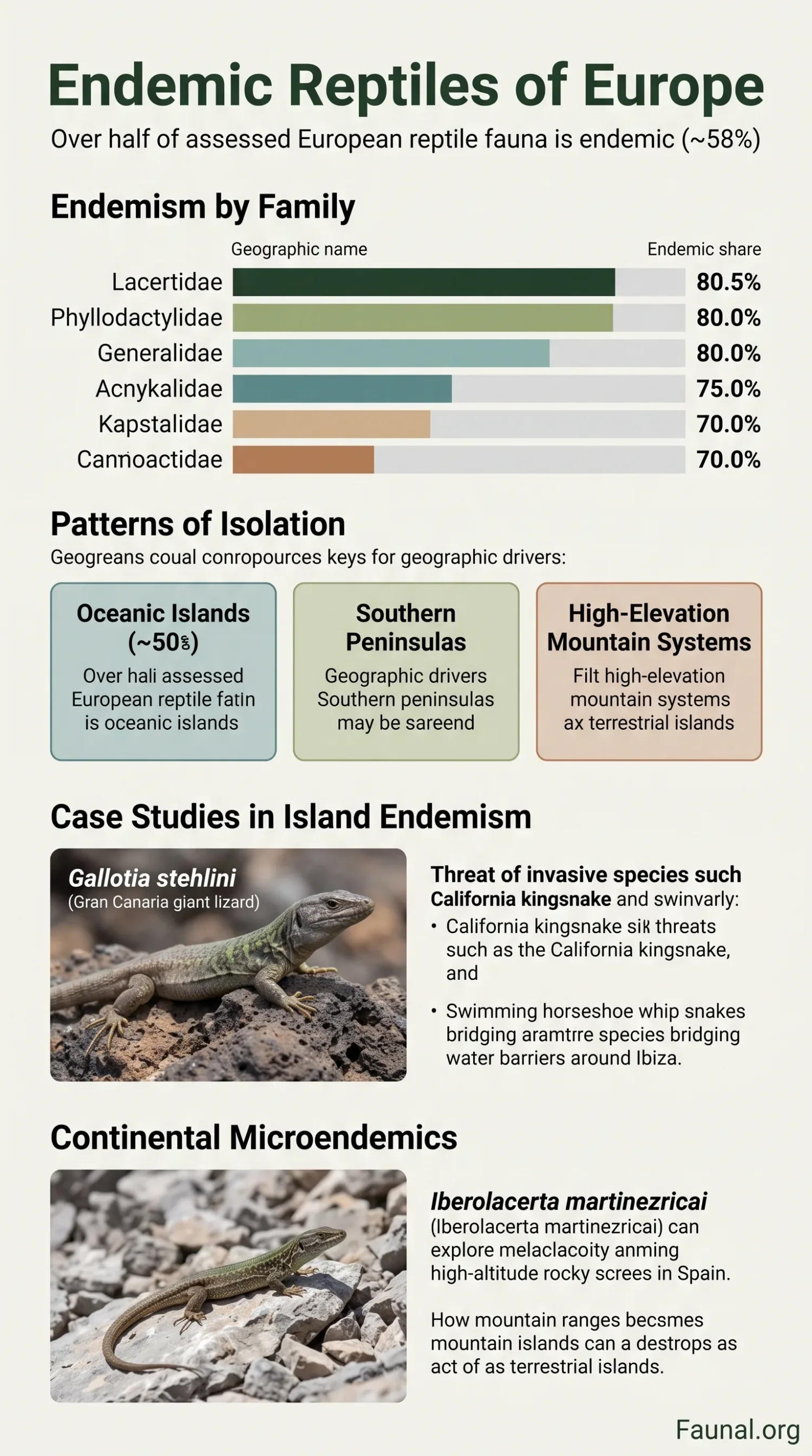
Europe’s endemic reptiles are concentrated rather than evenly distributed. Under the geographic scope used by the 2025 European Red List of Reptiles, the strongest concentrations occur on the Iberian Peninsula, Mediterranean islands and the Canary Islands, with additional narrow-range species on other peninsulas and isolated mountain systems. The same term endemic can therefore describe a reptile distributed across much of a peninsula and another whose entire native range is limited to several islets, a single island or a handful of mountain screes. [a]
The European range used here includes Macaronesia and Cyprus
The European Red List assessment extends west to the Azores, south to the Canary Islands and east to the Urals. It includes Cyprus, the Canary, Madeira and Azores archipelagos, European Türkiye and most European parts of the Russian Federation. This geographic definition is important because some of Europe’s strongest reptile endemism occurs on Macaronesian islands rather than on the continental landmass.
More Than Half of the Assessed European Reptile Fauna Is Endemic
Table 1 of the 2025 European Red List reports 171 reptile species in its Pan-European analysis, of which 99 are endemic to the assessment region, or 57.9%. Endemism is especially concentrated among lizards. Lacertidae contains 77 assessed European species and 62 European endemics, an endemic share of 80.5%. All eight species of Iberolacerta are European endemics, while all seven extant species of Gallotia are endemic to the Canary Islands. Podarcis is represented by 27 European species, most confined to Europe. [a]
| Family | European species assessed | European endemics | Endemic share |
|---|---|---|---|
| Lacertidae | 77 | 62 | 80.5% |
| Phyllodactylidae | 5 | 4 | 80.0% |
| Anguidae | 6 | 4 | 66.7% |
| Blanidae | 3 | 2 | 66.7% |
| Testudinidae | 3 | 2 | 66.7% |
| Viperidae | 11 | 6 | 54.5% |
| Gekkonidae | 6 | 3 | 50.0% |
| Emydidae | 2 | 1 | 50.0% |
| Scincidae | 15 | 7 | 46.7% |
| Colubridae | 25 | 6 | 24.0% |
| Natricidae | 5 | 1 | 20.0% |
| Agamidae | 5 | 1 | 20.0% |
The 2025 report contains two endemic totals
The narrative text of the European Red List states that 100 of 171 assessed reptiles are endemic to Europe, while its family-level Table 1 totals 99 endemic species and gives 57.9%. The family figures on this page follow Table 1 because its individual family counts sum to 99. For the continent-wide proportion, “about 58%” avoids hiding this one-species discrepancy.
High European endemicity does not mean that every endemic has a tiny range. Some species now considered European endemics occupy broad portions of the continent after taxonomic revisions separated formerly wider species complexes. The geographically narrow end of the spectrum is different: an entire species can be confined to one archipelago, one peninsula, several offshore rocks or a small network of high-elevation habitat patches.
Islands, Peninsulas and Mountains Produce Different Kinds of Isolation
European reptile endemism repeatedly follows three geographic patterns. Oceanic and Mediterranean islands restrict terrestrial dispersal with seawater. Southern peninsulas retain lineages within broad but bounded refugial regions. Mountain systems isolate cool-adapted reptiles in high, rocky habitat separated by warmer or otherwise unsuitable lowlands. A biogeographic analysis of Western Palearctic reptiles identified the Canary Islands, Corsica and Sardinia, and the Peloponnese among its consensus areas of reptile endemism. [b]
| Range form | Representative reptile | Geographic pattern | What limits the native range |
|---|---|---|---|
| Oceanic-island endemic | Gallotia stehlini | Gran Canaria | Oceanic isolation and island-specific evolutionary history |
| Archipelago endemic | Podarcis pityusensis | Ibiza, Formentera and surrounding islets | Water barriers among Pityusic island populations |
| Micro-island endemic | Podarcis levendis | Pori and Lagouvardos area | Extremely small Aegean island system |
| Relict islet distribution | Podarcis lilfordi | Islets around Mallorca and Menorca and the Cabrera system | Present populations persist as strongly separated island units |
| Fragmented island endemic | Podarcis raffonei | Aeolian Islands | Survival in a few remaining localities |
| Shared two-island endemic | Archaeolacerta bedriagae | Corsica and Sardinia | Tyrrhenian island history rather than a modern political boundary |
| Peninsula endemic | Hellenolacerta graeca | Peloponnese | Long-term southern isolation within the Greek peninsula |
| Mountain microendemic | Iberolacerta martinezricai | Sierra de Francia | Small, disconnected high-elevation scree habitats |
The Canary Islands Contain an Entire Endemic Reptile Radiation
The Canary Islands occupy an unusual position in European reptile biogeography. The 2025 European assessment recognizes seven extant species of Gallotia, all endemic to the archipelago. The islands also support endemic Chalcides skinks and island-restricted populations and species of Tarentola geckos. Earlier Western Palearctic analysis likewise identified the Canaries as a distinct reptile endemism area and found all native reptile species in the archipelago to be insular endemics within the fauna covered by that study.
Different Canary Islands Hold Different Giant Lizards
Gallotia stehlini is endemic to Gran Canaria, Gallotia intermedia to Tenerife, Gallotia simonyi to El Hierro, and Gallotia bravoana to La Gomera. These are not simply populations of one widespread island lizard. They are distinct evolutionary lineages whose global native distributions are tied to individual islands or parts of individual islands.
La Gomera provides an extreme example. G. bravoana was thought extinct before a living population was rediscovered in 1999 in the western part of the island. Tenerife’s G. intermedia also has a restricted distribution. In the latest European regional assessment both species are Endangered, while G. simonyi is Vulnerable. These labels describe regional extinction risk under that assessment cycle; they do not define endemicity itself.
Gran Canaria Shows How an Island-Wide Endemic Can Become Threatened Quickly
The California kingsnake, Lampropeltis californiae, was first recorded in the wild on Gran Canaria in 1998 and began expanding rapidly after 2007. The European Red List reports that it occupied about half of the island by 2020. Native reptile declines followed in invaded areas. The Gran Canaria giant lizard, Gallotia stehlini, moved from Least Concern in the 2009 European assessment to Critically Endangered in the current regional assessment; the endemic Gran Canaria skink, Chalcides sexlineatus, is now Endangered. [a]
An island does not have to be tiny for range restriction to matter. When a species’ entire native distribution lies on one island, the spread of a new predator across that island can progressively overlap most or all of its global range.
Balearic Lizards Show Two Very Different Forms of Island Endemism
Podarcis lilfordi: Islets Preserve Deeply Separated Populations
Lilford’s wall lizard, Podarcis lilfordi, survives in numerous insular populations around Mallorca and Menorca and within the Cabrera system. Its distribution is especially informative because the surrounding water has not merely separated the species from mainland reptiles; it has also separated populations of the same species from one another.
A 2024 genome-wide study combined data from 191 lizards representing 16 island populations. Every sampled population was genetically differentiated, with a mean pairwise differentiation value of FST = 0.247. The analysis found no recent immigration or translocation among the sampled populations. Menorcan populations and the Mallorca/Cabrera populations formed two major lineages, while some individual islets were even more distinct. Genetic diversity tended to fall with decreasing islet area, but substantial diversity persisted even on very small islets. [c]
This changes the biological meaning of losing a small offshore population. An islet containing only a fraction of the species’ total individuals may still preserve a differentiated lineage that is not interchangeable with populations on neighboring islands.
Podarcis pityusensis: The Sea Is No Longer a Reliable Predator Barrier
The Ibiza wall lizard, Podarcis pityusensis, is native to Ibiza, Formentera and their surrounding Pityusic islets. A 2026 study describes the species across the two main islands and 39 surrounding islets. Its native distribution is therefore naturally fragmented by seawater, but that isolation historically helped preserve distinctive islet populations.
That protection has weakened because the introduced horseshoe whip snake, Hemorrhois hippocrepis, can disperse through seawater. Researchers directly observed a snake swimming approximately 430 m from Ibiza toward the Santa Eulària islet. Fifty-eight snakes were captured there over 13 visits through May 2025, and repeated lizard surveys after October 2023 found no surviving wall lizards. The study treats the Santa Eulària population as locally extirpated and documents other open-water swimming observations around Ibiza. [d]
A water barrier can fail after an invasive predator arrives
Small offshore islands are often treated as natural refuges from terrestrial predators. Around Ibiza, active swimming by invasive horseshoe whip snakes means that even nearby islets cannot automatically be assumed to remain predator-free.
Management has expanded accordingly. The Balearic Government reported 3,604 invasive snakes captured on Ibiza and 893 on Formentera during the 2025 campaign, more than 4,400 captures across the Pityusic Islands. The 2026 programme also expanded year-round trapping, coastal surveillance and snake-free refuge areas. [e]
The LIFE Reptiles programme adds captive and protected-population measures to direct snake control. The Balearic Government announced €2.18 million in project funding for endemic Balearic lizards over six years, alongside a network of secure refuges for P. pityusensis. The first refuge was presented in June 2026, with additional refuges planned. [f]
The Aeolian Wall Lizard Has Been Compressed into a Few Surviving Fragments
The Aeolian wall lizard, Podarcis raffonei, represents a narrower form of island endemism than a species occupying an entire large island. Surviving populations are associated with a small part of Vulcano and offshore rocks within the Aeolian archipelago. The 2025 European Red List classifies the species as Endangered at the European regional scale.
Research on its decline has focused on contact with the Italian wall lizard, Podarcis siculus. A 2024 experimental study found a competitive advantage for invasive P. siculus males during interspecific encounters: Aeolian wall lizards received more attacks and escaped more often. Genomic identification found only one hybrid among tested animals, supporting direct interference competition as a plausible mechanism alongside, rather than merely assuming, widespread hybrid replacement. [g]
This distinction matters. A narrow native range can be reduced by several mechanisms, but they should not be treated as interchangeable. Competition, predation, hybridization, habitat loss and stochastic events require different evidence and different management responses.
Aegean Islands Divide Wall Lizard Ranges at Archipelago Scale
The Aegean contains several Podarcis species whose global distributions can be described more accurately by naming island systems than countries. Political boundaries contribute little to understanding these ranges; island identity and the water gaps between populations are the biologically relevant features.
Milos Wall Lizard — Podarcis milensis
Podarcis milensis is associated with the western Cyclades, including Milos and Kimolos and additional islands and islets such as the Ananes group, Falkonera and Velopoula. Its distribution illustrates an archipelago endemic whose global native range consists of several separated land units rather than one continuous island. [j]
Pori Wall Lizard — Podarcis levendis
The Pori wall lizard has one of the clearest micro-island distributions in the region. The Reptile Database records it from Pori, north of Antikythira between Crete and the Peloponnese, with Lagouvardos or Poreti immediately west-southwest of Pori included in its type-locality account. The 2025 European assessment lists P. levendis as Vulnerable. [k]
Cretan Wall Lizard — Podarcis cretensis
Podarcis cretensis is recorded from Crete and satellite islands. Its nomenclatural history also shows why older distribution literature should not automatically be merged under current names: populations now treated as P. cretensis have historically appeared under forms of Podarcis erhardii and older Lacerta combinations. [l]
The Cyclades also contain a non-lizard example of narrow European reptile endemism. The Cyclades blunt-nosed viper, Macrovipera schweizeri, is listed as Endangered in the current European regional assessment. This helps separate the geographic phenomenon of endemism from the especially species-rich radiation of Mediterranean wall lizards.
Corsica and Sardinia Share Endemics Across a Two-Island System
Not every island endemic belongs to only one island. Corsica and Sardinia form a paired Tyrrhenian endemism system with reptiles shared between the two large islands. Bedriaga’s rock lizard, Archaeolacerta bedriagae, occurs on Corsica and Sardinia, including Sardinian mountain populations. Algyroides fitzingeri and Podarcis tiliguerta provide additional examples of lineages associated with the Corsica-Sardinia system. [m]
This pattern differs from both a single-island endemic and a species spread across many unrelated Mediterranean islands. The relevant unit is a biogeographically connected island history: modern seawater separates Corsica and Sardinia, but their reptile fauna retains shared endemic lineages.
The Maltese Wall Lizard Shows Why Native Range and Political Borders Should Be Kept Separate
The Maltese wall lizard, Podarcis filfolensis, occurs across the Maltese archipelago and on the Italian Pelagian islands of Linosa and Lampione. Its range therefore crosses a modern national boundary while remaining confined to a small central Mediterranean island system. The Reptile Database records populations on Malta, Gozo, Comino, Filfla, Fungus Rock, Selmunett and the Pelagian islands. [i]
Its global IUCN assessment published in 2024 reports Least Concern. That combination is useful: a geographically restricted native range does not automatically place a species in a threatened Red List category. Endemicity describes where a species occurs naturally; threat categories assess extinction risk under defined criteria. [p]
Madeira Demonstrates That Introduced Populations Do Not Rewrite Native Endemism
The Madeiran wall lizard, Teira dugesii, is native to the Madeira archipelago, including Madeira, Porto Santo, the Desertas and Selvagens island groups in the distribution treatment used by the Reptile Database. Introduced populations have also been reported outside that native system, including the Azores and mainland Portugal. [o]
An introduced population outside the native range does not cancel endemic origin. Endemicity is based on the species’ natural geographic distribution. Human-mediated populations need to be recorded separately from that native range.
The Iberian Peninsula Produces Endemics Without Complete Oceanic Isolation
The Iberian Peninsula is one of the main centres of European reptile endemism even though it is connected to the rest of the continent. Its isolation is less absolute than that of an island. Instead, the Pyrenees, climatic history, Atlantic-Mediterranean environmental contrasts and long-term separation among mountain systems create multiple opportunities for lineages to persist and diverge.
Examples include Bedriaga’s skink, Chalcides bedriagai, several Iberian wall lizards, the Spanish algyroides Algyroides marchi, and the mountain radiation of Iberolacerta. The geographic scale is important. An Iberian endemic may occupy a far larger area than an Aeolian or Pori endemic while still occurring nowhere naturally outside its regional range.
Peninsular refugia are also relevant to the broader distribution of European reptiles. Southern European peninsulas retained lineages through Quaternary climatic oscillations, after which mountains, valleys and climatic gradients could maintain regional differentiation. The result is not a single “Iberian endemic pattern” but a set of ranges extending from peninsula-wide taxa to individual mountain endemics.
The Peloponnese Functions as a Distinct Southern Reptile Endemism Area
The Peloponnese was identified as a reptile endemism area in the Western Palearctic analysis and remains visible in the 2025 European endemic-richness pattern. Several reptiles are centred on this southern Greek peninsula rather than distributed uniformly across Greece.
The Greek rock lizard, Hellenolacerta graeca, is recorded from the Peloponnese. Other regional endemics associated with the peninsula include the Greek keeled lizard Algyroides moreoticus, the Peloponnese wall lizard Podarcis peloponnesiacus and the Peloponnese slow worm Anguis cephallonicus. [n]
The Peloponnese therefore represents a middle position between oceanic-island endemism and broad continental endemism. It is geographically attached to the Balkan region, yet its southern position and historical isolation have allowed several reptile lineages to maintain ranges centred on the peninsula.
Mountain Lizards Turn High Ground into Continental Islands
Mountain endemics do not require seawater to become isolated. A cool, rocky population at high elevation can be surrounded by lower terrain that is warmer, drier, more vegetated or otherwise unsuitable. Gene flow can then be restricted between peaks and mountain blocks in a pattern analogous to islands separated by water.
Iberolacerta martinezricai: A Mainland Range Measured in Scree Patches
The Peña de Francia rock lizard, Iberolacerta martinezricai, is an extreme mainland example. A 2025 habitat study describes it as the reptile with the most restricted distribution in continental Europe, confined to rocky screes in Spain’s Sierra de Francia. Researchers surveyed 67 localities during 2018 and confirmed the species at 30. Occupied sites tended to be larger screes at roughly 1,300–1,700 m elevation, with larger stones, more moisture, lichens and mosses, and stronger connectivity to other screes. [h]
The distinction between potential habitat and confirmed presence is especially important for a microendemic of this kind. Distribution modelling identified additional screes with high predicted suitability, but predicted habitat should not be treated as confirmed occupancy until field evidence is obtained.
The 2025 European Red List places I. martinezricai in Endangered at the European regional level. Other Iberolacerta species occupy separate Iberian and Pyrenean mountain systems, including I. aurelioi, I. bonnali, I. cyreni, I. galani and I. monticola. The genus contains eight European species, all endemic to Europe.
A mountain can isolate reptiles without a coastline
For a cold-adapted or rock-specialist lizard, unsuitable lowland habitat can function as a dispersal barrier. Separate mountain blocks may therefore behave as biological islands even though they are connected by continuous land.
Europe’s Restricted Endemics Include Snakes and Turtles as Well as Lizards
Lizards dominate the numbers, especially Lacertidae, but European reptile endemism is not confined to them. Six of the 11 viper species in the 2025 European family table are endemic to the region. The Cyclades blunt-nosed viper, Macrovipera schweizeri, and Greek meadow viper, Vipera graeca, are both Endangered in the current European regional assessment.
Turtles add another geographic pattern. The European assessment treats the Sicilian pond turtle, Emys trinacris, Hermann’s tortoise, Testudo hermanni, and the marginated tortoise, Testudo marginata, as regionally endemic. Their distributions are broader than the smallest island lizards but remain confined to the European assessment region.
The snake fauna also illustrates how taxonomy changes the apparent geography of endemism. All European snake genera have representatives outside the region except Hierophis, which the 2025 assessment treats as an endemic European genus containing three species. Range and endemicity figures therefore depend on the taxonomic concepts used by the assessment, not only on newly collected locality records.
Restricted Range and Red List Category Measure Different Things
Endemicity is a statement about natural geographic restriction. A Red List category is an assessment of extinction risk using criteria that can include range size, fragmentation, population change and other evidence. A reptile can therefore be endemic and Least Concern, or endemic and Critically Endangered.
| Species | Range pattern | European regional category | What the comparison shows |
|---|---|---|---|
| Gallotia stehlini | Gran Canaria endemic | CR | A single-island endemic can face island-wide invasive-predator pressure. |
| Podarcis pityusensis | Pityusic archipelago endemic | EN | Several island populations do not guarantee protection when an invasive predator can cross water. |
| Podarcis raffonei | Aeolian fragmented endemic | EN | Survival in only a few fragments creates exposure to local pressures across much of the remaining range. |
| Iberolacerta martinezricai | Sierra de Francia mountain microendemic | EN | Extreme restriction can occur on continental land without marine isolation. |
| Podarcis levendis | Pori-area micro-island endemic | VU | A species-level range can consist of a very small island system. |
| Gallotia simonyi | El Hierro endemic | VU | Island endemicity alone does not determine the category assigned under Red List criteria. |
These categories come from the European regional assessment published in 2025. The underlying reassessment work was completed using the assessment cycle reported for 2022, so the publication year and assessment dataset year should not be treated as the same field. The report also notes that changes from the 2009 categories were not evidence of a continent-wide improvement: many category changes resulted from better information, revised taxonomy or revised application of assessment criteria. [a]
Small Ranges Fail in Different Ways
The conservation problem created by a restricted range depends on the geometry of that range. A species spread among many independent islands does not face exactly the same exposure as a species occupying one island. A mountain reptile confined to discontinuous screes has different dispersal constraints from a coastal lizard separated by open water.
- Predator expansion across most of a native range: Gran Canaria’s endemic reptiles are exposed as the California kingsnake spreads through the island.
- Predator movement between formerly isolated patches: horseshoe whip snakes around Ibiza can swim to offshore islets occupied by genetically distinctive Podarcis pityusensis populations.
- Competition at the edge of a remnant range: interactions with Podarcis siculus are a documented pressure on the surviving P. raffonei system.
- Habitat islands on land: Iberolacerta martinezricai depends on a small network of suitable rocky screes rather than a continuous mountain landscape.
- Population isolation within a species: Podarcis lilfordi populations can remain strongly differentiated even when their islands are geographically close.
A very small range also magnifies the proportional effect of a local loss. The disappearance of one population from a widespread continental species may remove a small fraction of its total distribution. The loss of one of only a few occupied rocks, islets or scree networks can remove a much larger share of a microendemic’s global distribution or erase a differentiated island lineage.
Range Geometry Is More Informative Than the Word “Endemic” Alone
Europe’s endemic reptiles occupy ranges that differ by several geographic orders: much of a peninsula, a paired island system, one archipelago, one island, a cluster of offshore rocks or a small network of mountain habitat. Calling all of them endemic is taxonomically and biogeographically correct, but it does not describe how their populations are arranged.
For restricted-range reptiles, the more informative questions are whether the native range is continuous or fragmented, whether populations can exchange individuals, whether separate patches retain distinct genetic lineages, and whether the barrier that produced isolation still protects the species. In the Balearics, water created evolutionary separation but no longer guarantees protection from an invasive snake. In Iberian mountains, unsuitable lowlands maintain isolation without any sea at all. In the Aeolian Islands, a species-level range has contracted to a few remnants. These geographic differences determine what “restricted” actually means for each endemic reptile.
Sources and Verification
- [a] European Red List of Reptiles, European Commission, 2025 — Used for the European assessment boundary, family-level endemicity, endemic-richness pattern, regional Red List categories and invasive-species case studies.
- [b] Ficetola et al. — Biogeographical structure and endemism pattern in reptiles of the Western Palearctic — Used for broad reptile areas of endemism, including the Canary Islands, Corsica-Sardinia and Peloponnese.
- [c] Otalora et al. — Population genetics and phylogeographic history of Podarcis lilfordi — Used for the 16-population genomic dataset, population differentiation, island lineages and genetic-diversity findings.
- [d] Casbas et al. — Swimming snakes wipe out endemic lizards from Mediterranean islets — Used for open-water dispersal by invasive horseshoe whip snakes, Santa Eulària captures and loss of the local Ibiza wall lizard population.
- [e] Government of the Balearic Islands — 2025 invasive snake control results — Used for Ibiza and Formentera capture totals and the expansion of snake-control and refuge measures.
- [f] Government of the Balearic Islands — LIFE Reptiles conservation programme — Used for the 2026 funding level, programme duration and protected-refuge network for endemic Balearic lizards.
- [g] Ficetola et al. — Interference competition in the Aeolian wall lizard — Used for experimentally observed interactions between Podarcis raffonei and invasive Podarcis siculus.
- [h] Colino-Rabanal et al. — Habitat characterization for Iberolacerta martinezricai — Used for the Sierra de Francia survey, confirmed localities and habitat characteristics of this mainland microendemic.
- [i] The Reptile Database — Podarcis filfolensis — Used for the Maltese and Pelagian island distribution of the Maltese wall lizard.
- [j] The Reptile Database — Podarcis milensis — Used for the western Cyclades distribution of the Milos wall lizard.
- [k] The Reptile Database — Podarcis levendis — Used for the Pori and Lagouvardos locality information of the Pori wall lizard.
- [l] The Reptile Database — Podarcis cretensis — Used for the Crete and satellite-island distribution and current synonymy of the Cretan wall lizard.
- [m] The Reptile Database — Archaeolacerta bedriagae — Used for the Corsica-Sardinia distribution of Bedriaga’s rock lizard.
- [n] The Reptile Database — Hellenolacerta graeca — Used for the Peloponnese distribution of the Greek rock lizard.
- [o] The Reptile Database — Teira dugesii — Used to distinguish the native Madeiran range from introduced populations outside that island system.
- [p] IUCN Red List assessment of Podarcis filfolensis, University of Malta repository — Used for the published global Least Concern assessment of the Maltese wall lizard.
Related Topics
- → Reptiles of Europe: Snakes, Lizards, Turtles, and Tortoises
- → Threats to European Reptiles: Habitat Loss, Roads, and Climate Change
- → Alpine and Mountain Reptiles of Europe: Cold-Adapted Species
- → Turtles and Tortoises of Europe: Freshwater, Marine, and Land Species
- → Lizards of Europe: Common Groups, Habitats, and Distribution
- → Snakes of Europe: Venomous and Non-Venomous Species