Complete guides: •Regional Fauna Guides•Reptiles•Fauna of Europe
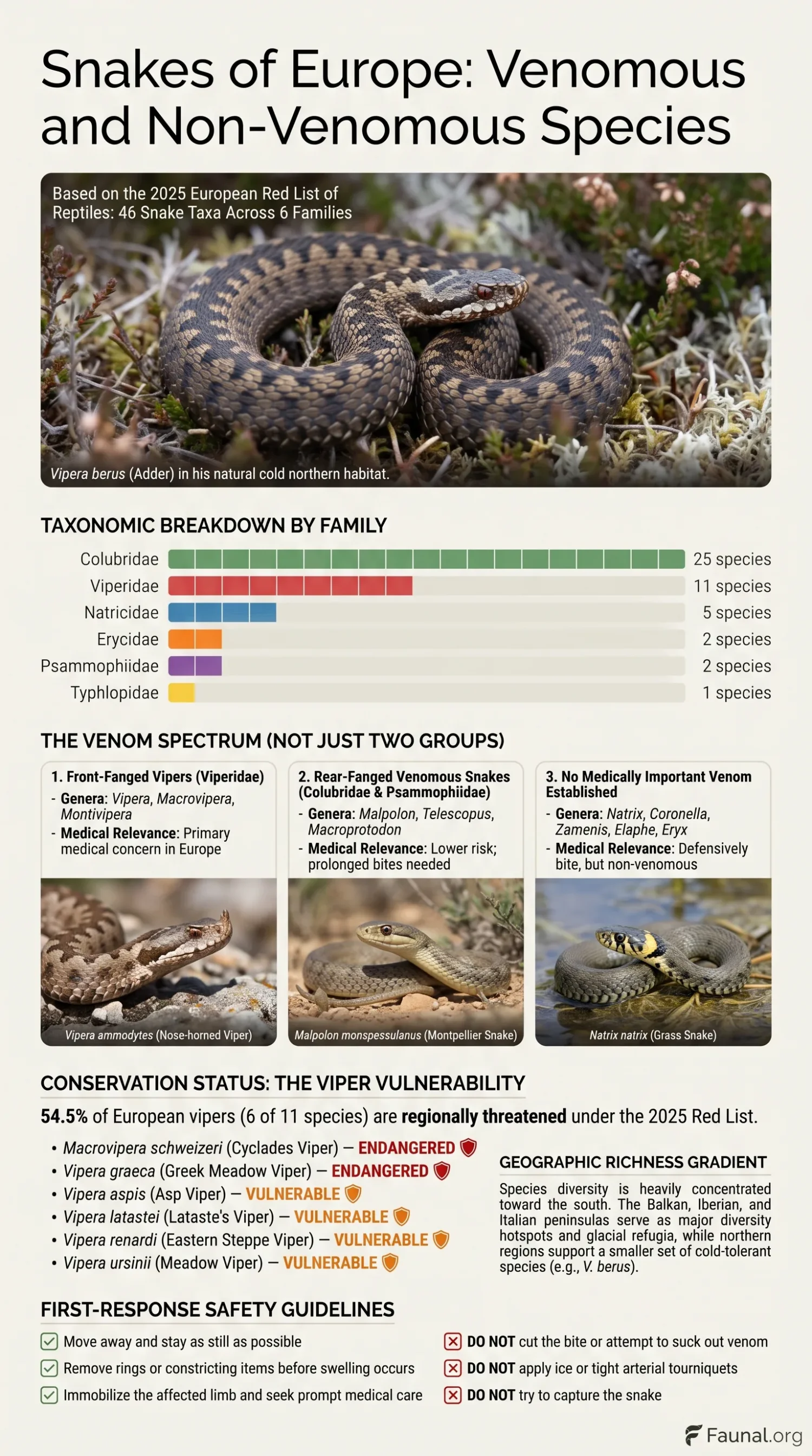
Europe supports a compact but taxonomically varied snake fauna that includes front-fanged vipers, rear-fanged venomous snakes and many species without a medically important venom system. Under the geographic and taxonomic scope used by the 2025 European Red List of Reptiles, the European diversity table contains 46 snake taxa in six families, including 11 Viperidae. The number is not universal: a broader 2022 identification key covered 57 species plus one unresolved taxon because it used different geographic and occurrence boundaries.
Why European Snake Counts Do Not Always Match
A species total for “Europe” depends on more than taxonomy. The southeastern boundary of Europe, treatment of the Caucasus, European Türkiye, Mediterranean islands, introduced populations and records of uncertain origin can all change the total. The 2025 European Red List defines a specific European assessment region and excludes species classified as Not Applicable because they were introduced or possibly introduced after 1500 CE. Its diversity table counts 46 snake taxa across Erycidae, Colubridae, Psammophiidae, Natricidae, Typhlopidae and Viperidae. European Red List of Reptiles (2025)
The 2022 dichotomous key to European snakes used a broader reference set and included 58 taxa: 57 named species and one unnamed taxon. Its authors incorporated taxonomic revisions and newly documented allochthonous populations as well as morphology, measurements and distribution in the identification key. Di Nicola, Faraone and Zabbia (2022)
Forty-six taxa in the diversity table, forty-five regional snake assessments
The 2025 diversity table gives Colubridae 25 taxa and 46 snakes in total, but the regional Red List status table assesses 24 colubrids and 45 snakes. The difference is Rhynchocalamus melanocephalus, first reported from Cyprus in 2020. The report states that its European origin remains unresolved: the population could reflect human-mediated arrival or a previously undetected, longer-established population.
Snake Taxa by Family in the 2025 European Diversity Table
Colubridae account for more than half of the taxa counted in the report, while Viperidae contains 11 species.
European Red List of Reptiles, 2025, Table 1. The 46-taxon diversity table includes the Cyprus record of Rhynchocalamus melanocephalus, whose origin is unresolved.
Venom in European Snakes Is Not a Two-Group System
Calling every European snake either “venomous” or “non-venomous” hides an important biological distinction. Europe has front-fanged vipers capable of medically important envenomation, but it also has rear-fanged species with venom-delivery systems that usually pose a much lower risk to people. A third group contains species for which no medically important venom system is established.
| Practical category | European examples | Venom delivery and human relevance |
|---|---|---|
| Front-fanged vipers | Vipera, Macrovipera, Montivipera | Long front fangs connected to venom glands. These are the European snakes of primary medical concern. |
| Rear-fanged venomous snakes | Malpolon insignitus, M. monspessulanus, Telescopus fallax, Macroprotodon brevis, M. cucullatus | Venom delivery occurs from posterior maxillary teeth. Human effects are generally more limited than viper envenomation, although prolonged Malpolon bites can produce more than superficial local effects. |
| No medically important venom established | Natrix, Coronella, Zamenis, Elaphe, Hierophis, Eryx and most other European snakes | These species should not be treated as medically important venomous snakes. They can still bite defensively, and field identification should not be based on this category alone. |
Clinical reviews of European vertebrate envenomation describe Malpolon as rear-fanged and usually of limited medical relevance, but prolonged bites have produced pain, swelling and occasional systemic neurological effects. Telescopus and Macroprotodon bites are much less often associated with human envenomation and are mainly reported with mild local effects. Clinical review of European venomous vertebrates
Europe’s 11 Vipers
Viperidae is the part of the European snake fauna most relevant to human envenomation and also the snake family carrying the highest concentration of current European conservation concern. The 2025 European assessment recognises 11 species within its regional boundary.
| Species | Common English name | European distribution pattern | 2025 Europe threat category |
|---|---|---|---|
| Macrovipera lebetinus | Blunt-nosed Viper | Cyprus within the core European assessment; the species extends far beyond Europe through western and central Asia | Not listed as CR, EN or VU |
| Macrovipera schweizeri | Cyclades Blunt-nosed Viper / Milos Viper | Restricted to islands of the western Cyclades | EN |
| Montivipera xanthina | Ottoman Viper | Extreme southeastern Europe, with a much larger range in Anatolia | Not listed as CR, EN or VU |
| Vipera ammodytes | Nose-horned Viper | Northeastern Italy and the Balkan region, extending into European Türkiye | Not listed as CR, EN or VU |
| Vipera aspis | Asp Viper | Southwestern and western-central Europe, especially France, Italy, Switzerland and adjacent areas | VU |
| Vipera berus | Adder | The broadest northern distribution among European vipers, extending into Scandinavia and far across northern Eurasia | Not listed as CR, EN or VU |
| Vipera graeca | Greek Meadow Viper | High-elevation Pindos mountains of Greece and Albania | EN |
| Vipera latastei | Lataste’s Viper | Iberian Peninsula | VU |
| Vipera renardi | Eastern Steppe Viper | Eastern European steppe zone within the assessment boundary | VU |
| Vipera seoanei | Seoane’s Viper | Northern and northwestern Iberian Peninsula and adjacent southwestern France | Not listed as CR, EN or VU |
| Vipera ursinii | Meadow Viper | Highly fragmented grassland and montane populations in central and southeastern Europe | VU |
The familiar European adder, Vipera berus, differs biogeographically from most of the family. It reaches far into northern Europe and occupies colder environments than the Mediterranean and steppe-associated vipers. At the other extreme, species such as V. graeca and Macrovipera schweizeri have very restricted European ranges. The 2022 European snake key also illustrates why location belongs in identification: V. aspis, V. ammodytes and V. latastei have geographically structured ranges even when some external features appear superficially similar.
The Cyclades viper changes rank between current taxonomic sources
The 2025 European Red List and the 2020 SEH European herpetofauna list treat the Cyclades form as the species Macrovipera schweizeri. The Reptile Database currently places it at subspecies rank as Macrovipera lebetinus schweizeri. A 2025 review of Macrovipera discusses the unresolved rank and retains M. schweizeri as a species. The checklist below follows the species treatment used by the current European assessment rather than presenting the alternative rank as an error.
Rear-Fanged Venomous Snakes Outside Viperidae
Western and Eastern Montpellier Snakes
Malpolon monspessulanus and Malpolon insignitus are large, active psammophiid snakes with posterior venom-delivery teeth. The western species is associated mainly with the Iberian Peninsula, southern France and nearby western Mediterranean areas, while M. insignitus occupies southeastern European and eastern Mediterranean parts of the range. Their venom system is biologically real, but their normal human risk profile should not be equated with European vipers. Effective venom delivery generally requires a prolonged bite in which the rear teeth remain engaged.
Cat Snake
Telescopus fallax occurs in southeastern Europe and parts of the Mediterranean, including Balkan and island populations. It is rear-fanged. Clinical literature treats it as much less medically important than the European vipers, with human effects rarely reported and generally local. Its vertical pupil is useful within a full identification assessment, but pupil shape is not a safe stand-alone test for venom.
False Smooth Snakes
Macroprotodon brevis and Macroprotodon cucullatus are small rear-fanged snakes represented in southwestern European and Mediterranean populations. Their inclusion is one reason that a strict “viper versus non-venomous snake” classification is biologically incomplete. Published European clinical reviews describe effects from this group as uncommon and generally mild.
The 46-Taxon European Snake Checklist
The checklist follows the geographic logic and family composition of the 2025 European Red List diversity table, with scientific names aligned to the current European assessment and its underlying SEH taxonomy. It is a regional working checklist rather than a claim that every publication uses the same boundary. The unresolved Cyprus origin of Rhynchocalamus melanocephalus is retained explicitly rather than silently counting it as certainly native.
| Family | Common English name | Scientific name | Venom grouping |
|---|---|---|---|
| Erycidae | Javelin Sand Boa | Eryx jaculus | No medically important venom established |
| Erycidae | Dwarf Sand Boa | Eryx miliaris | No medically important venom established |
| Colubridae | Smooth Snake | Coronella austriaca | No medically important venom established |
| Colubridae | Southern Smooth Snake | Coronella girondica | No medically important venom established |
| Colubridae | Caspian Whip Snake | Dolichophis caspius | No medically important venom established |
| Colubridae | Black Whip Snake | Dolichophis jugularis | No medically important venom established |
| Colubridae | Levant Dwarf Snake | Eirenis levantinus | No medically important venom established |
| Colubridae | Masked Dwarf Snake | Eirenis modestus | No medically important venom established |
| Colubridae | Steppe Snake | Elaphe dione | No medically important venom established |
| Colubridae | Four-lined Snake | Elaphe quatuorlineata | No medically important venom established |
| Colubridae | Blotched Snake | Elaphe sauromates | No medically important venom established |
| Colubridae | Horseshoe Whip Snake | Hemorrhois hippocrepis | No medically important venom established |
| Colubridae | Coin-marked Snake | Hemorrhois nummifer | No medically important venom established |
| Colubridae | Cyprus Whip Snake | Hierophis cypriensis | No medically important venom established |
| Colubridae | Balkan Whip Snake | Hierophis gemonensis | No medically important venom established |
| Colubridae | Western Whip Snake | Hierophis viridiflavus | No medically important venom established |
| Colubridae | Iberian False Smooth Snake | Macroprotodon brevis | Rear-fanged venomous |
| Colubridae | Algerian False Smooth Snake | Macroprotodon cucullatus | Rear-fanged venomous |
| Colubridae | Reddish Whip Snake | Platyceps collaris | No medically important venom established |
| Colubridae | Dahl’s Whip Snake | Platyceps najadum | No medically important venom established |
| Colubridae | Black-headed Ground Snake | Rhynchocalamus melanocephalus | No medically important venom established; European origin unresolved |
| Colubridae | Cat Snake | Telescopus fallax | Rear-fanged venomous |
| Colubridae | Transcaucasian Rat Snake | Zamenis hohenackeri | No medically important venom established |
| Colubridae | Italian Aesculapian Snake | Zamenis lineatus | No medically important venom established |
| Colubridae | Aesculapian Snake | Zamenis longissimus | No medically important venom established |
| Colubridae | Ladder Snake | Zamenis scalaris | No medically important venom established |
| Colubridae | Leopard Snake | Zamenis situla | No medically important venom established |
| Psammophiidae | Eastern Montpellier Snake | Malpolon insignitus | Rear-fanged venomous |
| Psammophiidae | Western Montpellier Snake | Malpolon monspessulanus | Rear-fanged venomous |
| Natricidae | Iberian Grass Snake | Natrix astreptophora | No medically important venom established |
| Natricidae | Barred Grass Snake | Natrix helvetica | No medically important venom established |
| Natricidae | Viperine Snake | Natrix maura | No medically important venom established |
| Natricidae | Grass Snake | Natrix natrix | No medically important venom established |
| Natricidae | Dice Snake | Natrix tessellata | No medically important venom established |
| Typhlopidae | Worm Snake | Xerotyphlops vermicularis | No medically important venom established |
| Viperidae | Blunt-nosed Viper | Macrovipera lebetinus | Front-fanged viper |
| Viperidae | Cyclades Blunt-nosed Viper / Milos Viper | Macrovipera schweizeri | Front-fanged viper |
| Viperidae | Ottoman Viper | Montivipera xanthina | Front-fanged viper |
| Viperidae | Nose-horned Viper | Vipera ammodytes | Front-fanged viper |
| Viperidae | Asp Viper | Vipera aspis | Front-fanged viper |
| Viperidae | Adder | Vipera berus | Front-fanged viper |
| Viperidae | Greek Meadow Viper | Vipera graeca | Front-fanged viper |
| Viperidae | Lataste’s Viper | Vipera latastei | Front-fanged viper |
| Viperidae | Eastern Steppe Viper | Vipera renardi | Front-fanged viper |
| Viperidae | Seoane’s Viper | Vipera seoanei | Front-fanged viper |
| Viperidae | Meadow Viper | Vipera ursinii | Front-fanged viper |
Five European Natrix Species, Not One “Grass Snake”
Older field literature can give the impression that the European grass snake is a single species spread across most of the continent. Current European taxonomy recognises five Natrix species. Two of the most important changes were the recognition of Natrix helvetica and Natrix astreptophora as species separate from N. natrix. This makes geography especially useful when distinguishing grass snakes.
| Species | European range pattern | Ecological association |
|---|---|---|
| Natrix astreptophora | Iberian Peninsula and southwestern France | Grass-snake lineage associated with terrestrial and wet habitats of southwestern Europe |
| Natrix helvetica | Western Europe, including Great Britain, France, parts of central Europe and Italy | Often associated with ponds, wetlands and amphibian-rich landscapes but not confined to water |
| Natrix natrix | Central and eastern European range continuing far into Eurasia | Wetlands, ponds, river margins and surrounding terrestrial habitat |
| Natrix maura | Iberia, France and parts of the western Mediterranean | Strongly associated with aquatic habitats; its markings and defensive behaviour can produce a viper-like appearance |
| Natrix tessellata | Central, southern and eastern Europe, including Balkan and eastern Mediterranean populations | Highly aquatic compared with the grass snakes and frequently associated with fish-rich water bodies |
Geography Is Part of European Snake Identification
European snakes cannot be divided safely by a single visible feature. A broad or triangular head can be produced by defensive flattening. Vertical pupils occur in some species outside Viperidae. A zigzag is useful on many vipers but varies between species and individuals, and dark melanistic snakes may obscure dorsal patterning. The European identification key therefore combines scale characters, proportions, pattern and geographic distribution rather than reducing identification to one field mark.
| Common confusion | Why confusion occurs | More useful evidence |
|---|---|---|
| Vipera berus vs Coronella austriaca | Both can be small, patterned, ground-dwelling snakes with overlapping parts of their European ranges. | Body proportions, head scalation, eye and facial pattern, dorsal markings and locality should be considered together. |
| Natrix maura vs Iberian vipers | The Viperine Snake can show a zigzag-like dorsal pattern and may broaden its head defensively. | Scale arrangement, body form, aquatic context and regional species range are more reliable than head shape alone. |
| Vipera ammodytes vs Vipera latastei | Both have an elevated nasal projection. | Their core European ranges are widely separated: V. ammodytes is mainly Balkan and southeastern, while V. latastei is Iberian. |
| Natrix natrix vs Natrix helvetica vs Natrix astreptophora | All belong to the grass-snake complex historically treated more broadly. | Geographic range, lateral barring, head and neck pattern and current taxonomy should be combined. |
| Melanistic adder vs other dark snakes | Very dark Vipera berus can lose much of the visible dorsal zigzag. | A missing zigzag cannot by itself rule out an adder; structure, scalation and locality remain necessary. |
No single field mark proves that a European snake is safe to handle
Head shape, pupil shape, colour and dorsal pattern all have exceptions. Identification from a safe distance should use several characters together with locality. An unidentified wild snake should not be picked up for closer examination.
European Snake Diversity Is Concentrated Toward the South
The European reptile fauna shows a strong north-to-south richness gradient, with the Balkan Peninsula standing out as the richest part of the current European assessment. The Iberian, Italian and Balkan peninsulas also acted as major glacial refugia, while Mediterranean islands add isolated lineages and narrowly distributed taxa. These patterns are visible in the snake fauna rather than being a simple consequence of modern political borders.
Iberian Peninsula
Iberia contains a distinctive western assemblage that includes Vipera latastei, Vipera seoanei, Natrix astreptophora, Natrix maura, Malpolon monspessulanus, Macroprotodon brevis and several large colubrids. Some northern species overlap only part of the peninsula, producing sharp regional changes in local snake communities.
Italy and the Western-Central Transition
Italy sits between western European, Alpine and Mediterranean faunal elements. Vipera aspis, Hierophis viridiflavus, Natrix helvetica, Zamenis longissimus and the southern Italian Zamenis lineatus illustrate how continental and Mediterranean distributions meet within one peninsula.
Balkans and the Southeastern European Fauna
The Balkans combine Mediterranean scrub, river systems, open karst, forests, steppe-like habitats and high mountains. The regional fauna includes Vipera ammodytes, Hierophis gemonensis, Dolichophis caspius, Elaphe quatuorlineata, Zamenis situla, Natrix tessellata and Telescopus fallax, while mountain systems retain restricted meadow-viper populations.
Northern Europe
Species richness drops toward the north. A smaller set of cold-tolerant species reaches high latitudes, particularly Vipera berus. Depending on longitude and latitude, Coronella austriaca, grass snakes and a limited number of other species extend northward, while most Mediterranean and Balkan taxa disappear from the assemblage.
Introduced and Uncertain Records Need Separate Treatment
A snake recorded in Europe is not automatically part of the native European fauna. The 2025 assessment separates post-1500 introductions classified as Not Applicable from species included in its main European diversity table. This distinction prevents established exotic populations, isolated releases and ancient naturalised populations from being combined without context.
| Taxon | 2025 European treatment | Reason the record matters |
|---|---|---|
| Elaphe schrenckii | Introduced / Not Applicable | Amur Rat Snake populations do not represent native European snake diversity. |
| Hemorrhois algirus | Introduced / Not Applicable | European occurrence originates outside the native European assessment set. |
| Lampropeltis californiae | Introduced / Not Applicable | California Kingsnake is an established exotic reptile rather than a native European snake. |
| Indotyphlops braminus | Introduced / Not Applicable | The Flowerpot Snake has a strongly human-assisted global distribution. |
| Rhynchocalamus melanocephalus | Included in the diversity table; origin unresolved | The first Cyprus report was published in 2020. Genetic similarity to an eastern Mediterranean specimen could fit either human-mediated dispersal or natural colonisation. |
| Hemorrhois ravergieri | Not included in the current European fauna | An earlier Greek record is now considered a misidentification in the 2025 European assessment. |
| Zamenis hohenackeri | Retained but poorly documented in the European assessment | The report notes that its Cyprus occurrence remains based on an old museum specimen, leaving the European evidence unusually sparse. |
The Cyprus record of Rhynchocalamus melanocephalus is supported by morphological and mitochondrial evidence from two specimens reported in 2020. The original study explicitly left open whether the occurrence reflects natural colonisation or human transport. Cyprus Rhynchocalamus study
Current European Conservation Risk Is Concentrated in Vipers
The 2025 European assessment finds that six of the 11 European Viperidae species, or 54.5%, are regionally threatened. No other European snake family has species listed as threatened at the European regional level in that assessment. Vipers represent a small share of the assessed reptile fauna but a much larger share of its threatened species.
| Species | 2025 European category | Conservation context |
|---|---|---|
| Macrovipera schweizeri | Endangered (EN) | Island-restricted Cyclades taxon exposed to habitat loss, road mortality, persecution and illegal collection. |
| Vipera graeca | Endangered (EN) | Restricted to isolated high-elevation meadow systems in the Pindos range. |
| Vipera aspis | Vulnerable (VU) | The 2025 assessment reports a genuine deterioration from its earlier European category, supported by long-term decline evidence. |
| Vipera latastei | Vulnerable (VU) | Iberian viper with fragmented habitat and regional conservation pressure. |
| Vipera renardi | Vulnerable (VU) | Steppe-associated eastern species affected by the condition and fragmentation of open habitats. |
| Vipera ursinii | Vulnerable (VU) | Occurs in fragmented meadow and steppe populations; abandonment or alteration of suitable open habitat is a recurring concern. |
The Greek Meadow Viper shows how narrow ecological requirements can magnify risk. Research on Vipera graeca documented 17 known populations in alpine and subalpine meadows above 1,600 m in Greece and Albania, with a diet strongly centred on orthopteran insects. Its distribution is therefore tied to a small set of cold, open mountain habitats rather than to mountains in general. Greek Meadow Viper mountain study
Threats also differ among species. The European Red List identifies habitat loss, fragmentation and degradation as major pressures on reptiles, with agricultural change, development and infrastructure among the drivers. Persecution remains a recurring pressure on European snakes. Road mortality can become especially important for range-restricted populations; the current assessment cites the Cyclades Blunt-nosed Viper as a case where roadkill represented a measurable population burden before traffic restrictions were introduced during peak activity.
European Red List categories are regional assessments. A species classified as Endangered or Vulnerable in Europe should not automatically be assigned the same category at global or national scale without checking the corresponding assessment.
Snakebite Response Should Not Depend on Field Identification
A person bitten by an unidentified European snake should not spend time trying to capture it. Move away from the animal, keep the bitten person as still as practical, remove rings or other constricting items before swelling develops, immobilise the affected limb and obtain medical care promptly. A photograph may help identification only when it can be taken from a safe distance without delaying treatment.
Avoid damaging snakebite first-aid methods
Do not cut the bite, attempt to suck out venom, apply ice, use a tight arterial tourniquet or try to catch the snake. These measures do not replace medical assessment and can cause additional injury. World Health Organization snakebite guidance
Sources and Verification
- European Commission — European Red List of Reptiles (2025) — Current European geographic scope, snake family totals, regional conservation categories, introduced taxa and changes since the earlier assessment.
- Di Nicola, Faraone & Zabbia — An updated dichotomous key to the snakes of Europe (2022) — European snake identification characters, broader species coverage and geographic distribution used to distinguish similar taxa.
- Speybroeck et al. — Species list of the European herpetofauna, 2020 update — SEH Taxonomic Committee treatment, accepted European species names and English common names forming the basis of later European assessments.
- Di Nicola et al. — Venomous Bites, Stings and Poisoning by European Vertebrates (2023) — Clinical distinction between European front-fanged vipers and rear-fanged venomous snakes including Malpolon, Macroprotodon and Telescopus.
- A Guide to the Clinical Management of Vipera Snakebite in Italy (2024) — Medical relevance of European vipers and context for rear-fanged species occurring within European snake assemblages.
- Avella et al. — The biology and toxinology of blunt-nosed vipers (2025) — Distribution and current discussion of the taxonomic rank of the Cyclades/Milos viper.
- The Reptile Database — Macrovipera lebetinus — Alternative current treatment of schweizeri at subspecies rank and associated synonymy.
- Tamar et al. — Discovery of Rhynchocalamus melanocephalus in Cyprus (2020) — First documented Cyprus records and evidence behind the unresolved natural-versus-human-mediated origin.
- Mizsei et al. — Greek Meadow Viper conservation study — High-elevation distribution, known population structure and specialised ecology of Vipera graeca.
- World Health Organization — Snakebite Envenoming Treatment — First-response measures and harmful snakebite practices to avoid.
Related Topics
- → Reptiles of Europe: Snakes, Lizards, Turtles, and Tortoises
- → Turtles and Tortoises of Europe: Freshwater, Marine, and Land Species
- → Lizards of Europe: Common Groups, Habitats, and Distribution
- → Threats to European Reptiles: Habitat Loss, Roads, and Climate Change
- → Endemic Reptiles of Europe: Islands, Peninsulas, and Restricted Ranges
- → Alpine and Mountain Reptiles of Europe: Cold-Adapted Species