Complete guides: •Regional Fauna Guides•Reptiles•Fauna of Europe
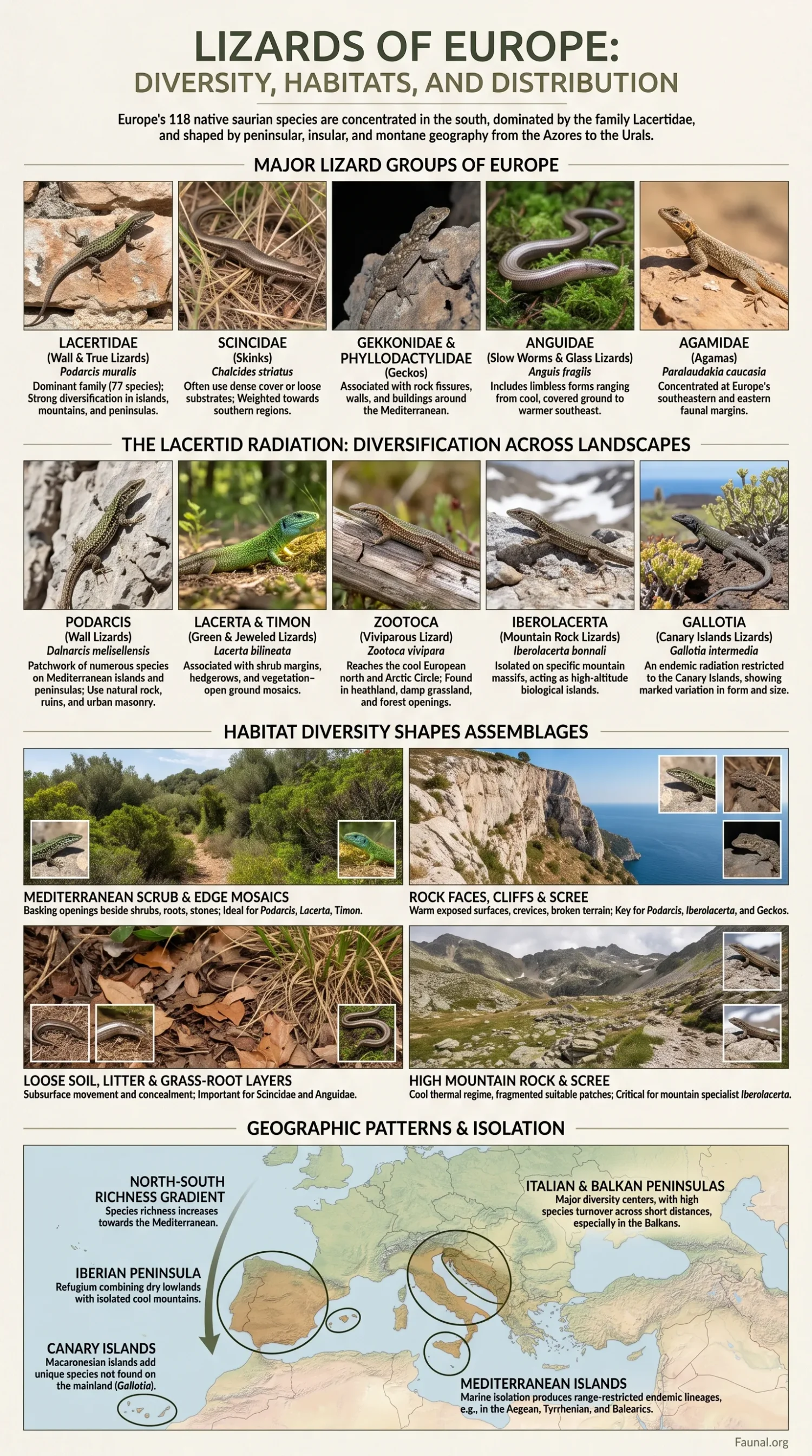
Europe’s lizard fauna is concentrated toward the south, but it is not a single Mediterranean assemblage. Wall lizards diversify across peninsulas and islands, skinks are weighted toward warmer southern regions, geckos occupy rock and built surfaces around much of the Mediterranean, slow worms extend into cooler and more humid landscapes, and a small set of cold-adapted lacertids persists on isolated mountain systems. Under the geographic and taxonomic scope used by the 2025 European Red List of Reptiles, 118 native European species are placed in Sauria, with 77 of them in Lacertidae.[a]
The European Count Depends on Where Europe Ends and What Is Counted as a Lizard
The geographic boundary matters before any species total is used. The 2025 European Red List extends from the Azores to the Urals and from the Arctic islands to the Canary Islands. It includes Cyprus, Madeira, the Canary and Azores archipelagos, and Türkiye-in-Europe, while excluding the North Caucasus from its European assessment region. Species present only as recent introductions, species confined within this assessment to Spanish North African territories, and several taxa with only marginal European occurrence are handled separately from the main native assessment.
Why the 118-species total includes worm lizards
The 2025 European Red List places three Blanidae species inside its Sauria diversity table. Other modern faunal treatments separate worm lizards as Amphisbaenia. The family chart below reproduces the Red List’s stated scope rather than silently changing its total; Blanidae is treated separately in the biological discussion.
Native European Sauria by Family in the 2025 Assessment
Lacertidae accounts for 77 of the 118 species in the report's native European Sauria total.
Data: European Commission, European Red List of Reptiles, 2025, Table 1. Blanidae is retained because it is included in the report's Sauria total.
| Family in the 2025 European scope | Native species | Representative European taxa | Broad European pattern |
|---|---|---|---|
| Lacertidae | 77 | Podarcis, Lacerta, Timon, Zootoca, Iberolacerta, Gallotia | Dominant lizard family; strong southern, island and montane diversification, with several species extending into central and northern Europe. |
| Scincidae | 15 | Chalcides, Ablepharus | Weighted toward southern Europe, Mediterranean islands and the southeast; many species use dense ground cover, loose substrate or grass-root layers. |
| Anguidae | 6 | Anguis, Pseudopus | Includes legless lizards ranging from cool, covered ground used by slow worms to warmer southeastern landscapes occupied by the European glass lizard. |
| Gekkonidae | 6 | Hemidactylus, Mediodactylus | Mainly Mediterranean and southeastern; rock fissures, walls, buildings and other crevice-rich surfaces are important habitats. |
| Agamidae | 5 | Laudakia, Phrynocephalus | Concentrated toward Europe’s southeastern and eastern faunal margins rather than spread across the continent. |
| Phyllodactylidae | 5 | Tarentola | Warm Mediterranean and Macaronesian geckos associated with rock, cliffs, walls and other structured surfaces. |
| Blanidae | 3 | Blanus | Burrowing worm lizards of southwestern and Mediterranean Europe; often treated under Amphisbaenia rather than conventional lizard checklists. |
| Sphaerodactylidae | 1 | Euleptes europaea | A geographically restricted European gecko lineage associated especially with western Mediterranean islands and nearby coastal areas. |
Lacertidae Forms the Main European Lizard Radiation
Lacertidae is not merely the largest European lizard family. The 2025 assessment records 62 of its 77 native European species as endemic to the European region, an endemism rate of 80.5%. Much of the visible geographic structure of Europe’s lizard fauna therefore comes from repeated diversification within this one family: wall lizards on islands and peninsulas, green lizards in scrub and edge habitats, sand and grassland species on open ground, high-mountain rock lizards, and the endemic Gallotia radiation of the Canary Islands.
Podarcis Wall Lizards Produce a Patchwork Rather Than One Continental Range
Wall lizards are among the most characteristic reptiles of southern Europe, but the common name hides strong geographic turnover. The 2025 European assessment recognizes 27 Podarcis species in its regional treatment. Many have restricted Mediterranean distributions, while the common wall lizard Podarcis muralis has a much broader native distribution across central and southern Europe.[b]
Stone walls are only one part of the habitat picture. Podarcis species use natural rock, scree, cliffs, open woodland edges, field margins, ruins, quarries and urban masonry. A wall can function as a human-made analogue of a sun-exposed rock face when it provides warm surfaces and retreat crevices. That ecological flexibility should not be confused with uniform distribution: neighbouring islands, coastal districts or mountain blocks may contain different wall-lizard species.
The Balkans show this especially well. Genomic work on Balkan Podarcis separates several closely related species groups within a relatively small geographic area, including island and mainland forms. The result is high species turnover across the southern Balkans and Aegean rather than one wall-lizard species occupying every apparently suitable rocky site.
Green Lizards and Timon Use Vegetation–Open Ground Mosaics
Large lacertids such as Lacerta and Timon are more strongly associated with structurally mixed ground than the phrase “green lizard habitat” suggests. Shrub margins, hedgerows, forest-steppe, vineyards, rough grass, open woodland, field boundaries and rocky patches can place basking sites next to dense escape cover. The exact combination changes with latitude, elevation and species.
Names can also conceal geographic replacement. European green lizards are not one continent-wide species. Closely related Lacerta species occupy different parts of western, central, southeastern and Mediterranean Europe, while Timon is particularly associated with southwestern European and western Mediterranean faunas. Identification therefore needs locality as well as colour.
Zootoca vivipara Reaches the Cool European North
Zootoca vivipara, the viviparous or European common lizard, breaks the simple association between European lizards and dry Mediterranean heat. Its recorded distribution extends through much of northern and central Europe and beyond the Arctic Circle, while populations also occur farther south in cooler landscapes. Heathland, peatland, damp grassland, forest openings and montane sites can provide the combination of cover and basking opportunities used by this species.[c]
Northern European lizard diversity is low compared with the Mediterranean region, but low diversity does not mean absence. A small number of cold-tolerant or habitat-flexible species occupy climatic space that most southern European lizards do not.
Iberolacerta Turns Separate Mountain Massifs into Biological Islands
The eight recognized Iberolacerta species illustrate a different European pattern. Most occupy isolated highland systems in the Iberian Peninsula and Pyrenees, while Iberolacerta horvathi occurs farther east in the Alpine–Dinaric region. Their ranges are fragmented because a suitable cool, rocky mountain habitat can be separated from the next suitable massif by warmer lowlands that are difficult to cross.
A 2026 genomic study covering the genus found genomic evidence relevant to high-altitude adaptation, including a shift associated with oxygen affinity, while also resolving relationships among the isolated mountain lineages.[d] The biological unit is therefore not simply “rocky habitat.” Altitude, temperature, isolation and the history of each mountain block all matter.
Gallotia Is a Canary Islands Radiation
The Canary Islands add a lizard radiation that has no mainland European equivalent. The 2025 European assessment recognizes seven extant Gallotia species, all endemic to the Canary Islands. Research on the genus shows marked variation in body form, colour and behaviour among species and populations, while island history has produced both restricted modern ranges and extinct giant forms.[e]
Geckos, Skinks, Anguids and Agamas Occupy Different Parts of the European Habitat Spectrum
European Geckos Belong to Three Families
“European gecko” is an ecological description rather than one family. The 2025 regional table includes six Gekkonidae, five Phyllodactylidae and one Sphaerodactylidae. Familiar Mediterranean examples therefore belong to different evolutionary lineages: Hemidactylus turcicus is a gekkonid, Tarentola mauritanica is a phyllodactylid, and Euleptes europaea is the sole sphaerodactylid counted in the native European table.
Tarentola mauritanica, the common wall or Moorish gecko, is recorded across several Mediterranean European countries and islands. Rock faces, crevices and masonry provide the vertical surfaces and shelters that make the species conspicuous around settlements, but its association with buildings does not make buildings its only habitat.[f]
Skinks Use the Ground Layer More Than the Open Rock Surface
Europe’s 15 native Scincidae are concentrated mainly in its warmer southern and southeastern regions and on Mediterranean or Macaronesian islands. Chalcides includes forms with elongated bodies and reduced limbs that move through grasses, loose soil, litter or low vegetation rather than spending most of their activity time exposed on walls or boulders. The western three-toed skink Chalcides striatus, for example, is recorded from Portugal, Spain, France and northwestern Italy, whereas several other Chalcides species have much more insular distributions.
Low detectability is important here. A skink moving below dense grass or through surface litter can be present without producing the visual encounter rates expected from a basking wall lizard. Apparent scarcity in casual observations is therefore not a direct measure of population size.
Slow Worms and the European Glass Lizard Are Legless Lizards
Anguidae adds another body plan. Anguis slow worms are limbless lizards represented by several European species, and modern taxonomy has divided populations once broadly assigned to Anguis fragilis among species including A. fragilis, A. colchica, A. graeca, A. cephallonica and A. veronensis. This is one reason older maps labelled entirely as A. fragilis cannot automatically be treated as current species maps.
The European glass lizard Pseudopus apodus represents a warmer southeastern pattern. The Reptile Database records it from Greece, coastal parts of the western Balkans, Bulgaria, Türkiye and farther east outside the European assessment region.[g] Its large, elongated body can resemble a snake at first sight, but taxonomically it is an anguid lizard.
Agamas Mark the Southeastern and Eastern Edge of the Fauna
Only five Agamidae are included in the 2025 native European table. Their importance is therefore geographic rather than numerical. Rock agamas and toad-headed agamas connect southeastern and eastern European reptile assemblages with much larger agamid radiations in western and central Asia. Exposed rock, dry steppe, sparsely vegetated ground and other high-insolation habitats dominate this European edge of the family.
European Lizard Richness Rises Southward, but the Pattern Breaks into Peninsulas, Islands and Mountains
The 2025 European assessment finds an evident north-to-south increase in reptile species richness, with the greatest richness in the Balkan Peninsula. The Iberian, Italian and Balkan peninsulas are major diversity centres associated with former glacial refugia, while Mediterranean islands add many range-restricted endemic reptiles. Endemic richness is especially concentrated around Mediterranean islands, the Peloponnese, the Balkan coast and parts of the Iberian Peninsula.
Iberia Combines Dry Lowlands with Isolated Cool Mountains
The Iberian Peninsula supports dry-ground lacertids, large Timon, several Podarcis lineages, skinks and a separate set of mountain specialists. This means that “Iberian lizard habitat” can refer to coastal dunes, Mediterranean scrub, open rocky slopes, oak mosaics, agricultural margins or high mountain scree. Climate and elevation can replace one assemblage with another over a relatively short horizontal distance.
Italy and the Tyrrhenian Islands Preserve Their Own Mixtures
The Italian Peninsula, Sicily, Sardinia, Corsica and the smaller Tyrrhenian islands should not be treated as one repeated fauna. Island separation, past sea-level changes and multiple colonization histories have produced genetic and taxonomic structure within otherwise familiar groups. Work on Podarcis siculus in the Tuscan Archipelago, for example, has identified old insular lineages that are not evident from the species name alone.
The Balkans and Aegean Have the Highest Regional Richness
The Balkan Peninsula combines continental grasslands, limestone mountains, Adriatic and Aegean coasts, forest margins, warm valleys and a dense network of islands. Those habitats intersect with repeated geographic isolation. The result is high richness and short-distance replacement among wall lizards, rock lizards, green lizards, skinks and geckos. An Aegean island only a short distance from another island or mainland coast may support a different endemic or regional Podarcis lineage.
Central and Northern Europe Have Fewer Species but Large-Ranging Survivors
Moving north generally reduces the number of lizard species, yet several lineages extend far beyond Mediterranean climates. Zootoca vivipara reaches very high latitudes. Lacerta agilis, the sand lizard, has a broad Eurasian range and reaches northwestern Europe where suitable heathland, dunes and other warm open habitat remain. Slow worms extend even more of the legless-lizard component into temperate landscapes.
Macaronesia Adds European Species That Never Occur on the Mainland
Including Macaronesia materially changes the meaning of “European lizards.” The Canary Islands contribute endemic Gallotia, several island skinks and geckos. These taxa cannot be inferred from a mainland Europe map. The European Red List includes the Canary, Madeira and Azores archipelagos within its geographic assessment boundary, so any total copied from that assessment carries the same geographic decision with it.
Lizard Habitat Is Defined by Shelter, Substrate and Microclimate as Much as Vegetation
Broad land-cover labels hide many of the features that separate European lizard assemblages. Two places mapped as “grassland” can differ in soil looseness, rock exposure, vegetation height, moisture, aspect, crevice availability and daily surface temperature. Those differences can determine whether the site favours an open-ground lacertid, a slow worm under dense cover or a skink moving through the root layer.
| Habitat structure | Features that matter to lizards | Representative European taxa | European context |
|---|---|---|---|
| Rock faces, cliffs and scree | Warm exposed surfaces, cracks, deep refuges and broken terrain | Podarcis, Iberolacerta, several geckos | Mediterranean coasts, islands, limestone landscapes and mountain systems |
| Mediterranean scrub and edge mosaics | Basking openings beside shrubs, roots, stones and dense escape cover | Lacerta, Timon, Podarcis | Iberia, southern France, Italy, Balkans and Mediterranean islands |
| Heath, meadow and cool grassland | Low vegetation, local moisture, solar exposure and dense ground refuge | Zootoca vivipara, Lacerta agilis, Anguis | Central, western, northern and montane Europe |
| Loose soil, litter and grass-root layers | Subsurface movement, concealment and friable substrate | Chalcides, Ablepharus | Especially southern Europe, Mediterranean islands and the southeast |
| Open dry steppe and gravel | High solar exposure, sparse plants and open ground | Several eastern lacertids and Agamidae | Southeastern and eastern European margins |
| High mountain rock and scree | Cool thermal regime, exposed basking surfaces and fragmented suitable patches | Iberolacerta | Pyrenees, Iberian massifs and the Alpine–Dinaric region |
| Dry-stone walls, ruins and quarries | Heat-storing surfaces and abundant retreat crevices | Podarcis, Tarentola, Hemidactylus | Especially Mediterranean Europe, but locally farther north |
Islands and Mountain Massifs Produce Small Ranges for Different Reasons
Mediterranean islands isolate lizard populations with seawater. Mountains can create a similar pattern without an ocean. A cool rocky summit or high plateau may be separated from another suitable massif by warm valleys, dense forest or extensive lowland habitat. For a temperature-limited mountain lizard, that intervening landscape can function as a dispersal barrier.
This is why European endemism is not distributed like simple continental area. The Balearics, Tyrrhenian islands, Adriatic islands, Aegean archipelagos and Canary Islands support restricted lizard lineages, while the Pyrenees and Iberian mountain systems hold separate Iberolacerta species. Very small geographic ranges can therefore arise from both marine isolation and altitudinal isolation.
Human-Made Stone Can Add Habitat Without Changing a Species’ Native Origin
Walls, castles, terraces, cemeteries, railway embankments, road cuttings and quarries can create warm surfaces and crevices resembling natural rocky habitat. Wall lizards and geckos often use these structures, and some populations persist deep inside urban landscapes. Recent behavioural research on Podarcis siculus has compared urban wall-lizard populations with non-urban populations precisely because the genus can occupy both human structures and natural settings.
Three situations still need to be separated: a native population using a building, a native population expanding along newly created habitat, and a population established after human transport. The presence of a lizard on masonry says something about habitat use; it does not by itself establish whether the population is native to that region.
A locality record is not a continental range
A documented observation confirms evidence at a locality. It does not establish continuous occupation between records, abundance across the region, native origin, or presence in every nearby habitat that appears suitable. This distinction is especially important for introduced wall-lizard populations, island records and taxa near their geographic limits.
Taxonomic Revision Can Change a European Lizard Map Without Any Animal Moving
European lizard totals have risen partly because species concepts have changed. Older literature placed many lacertids inside Lacerta; current classifications distribute them among genera such as Podarcis, Iberolacerta, Dinarolacerta, Hellenolacerta, Dalmatolacerta, Zootoca and others. Species complexes have also been divided after genetic, morphological and geographic work.
Slow worms demonstrate the same problem outside Lacertidae. The broad historical use of Anguis fragilis covered populations now assigned to several accepted species. A museum specimen or old field record can therefore retain biological value while carrying a name that no longer matches the modern taxonomic treatment of its locality.
This also explains why an older European lizard total should not be compared directly with the 2025 count unless geographic scope and taxonomy are matched. The 2025 European Red List explicitly incorporated taxonomic changes since the earlier 2009 assessment.
Climate Risk Is Concentrated in Some Lizards That Already Occupy the Coldest Available Habitat
A warmer climate does not produce the same response in every European lizard. Some adaptable lowland taxa may gain locally suitable thermal conditions farther north or at higher elevations. Cold-adapted mountain specialists face a different geometry: suitable conditions can shift uphill while the physical area of the mountain becomes smaller.
The 2025 European Red List uses Iberolacerta as a case study. Seven of the eight species are considered threatened by human-induced climate change. The assessment identifies both direct warming and vegetation change as mechanisms: denser vegetation can reduce basking opportunities and overgrow the open rock and gravel habitat used by these mountain lizards.[h]
The same assessment shows why high species richness and extinction risk should not be treated as the same map. Twelve lacertids fall in threatened European categories: one Critically Endangered, seven Endangered and four Vulnerable. The list includes island-restricted Gallotia and Podarcis, mountain Iberolacerta, and other lacertids with very different ecological histories. The Gran Canaria skink Chalcides sexlineatus is also assessed as Endangered, while the agamid Phrynocephalus helioscopus is assessed as Vulnerable at the European regional level.
European lizard distribution is therefore shaped by more than latitude. Peninsula history, island isolation, mountain barriers, substrate, vegetation structure, microclimate, human transport and taxonomic boundaries all change the pattern visible on a map.
Sources and Verification
- [a] European Commission — European Red List of Reptiles, 2025 — Used for the geographic assessment boundary, native Sauria total, family totals, endemism, regional richness pattern and European conservation categories.
- [b] The Reptile Database — Podarcis muralis — Used to verify the accepted taxon and broad native and introduced distribution of the common wall lizard.
- [c] The Reptile Database — Zootoca vivipara — Used for the accepted name and broad European distribution of the viviparous lizard, including its far-northern occurrence.
- [d] Morales et al. — Lizards on a Sky Archipelago: Genomic Approaches to the Evolution of the Mountain Genus Iberolacerta, 2026 — Used for the eight-species mountain radiation, fragmented massif distribution and genomic evidence related to high-altitude adaptation.
- [e] Molina-Borja and Bohórquez-Alonso — Morphology, Behaviour and Evolution of Gallotia Lizards from the Canary Islands, 2023 — Used for the Canary Islands radiation and documented variation among Gallotia species and populations.
- [f] The Reptile Database — Tarentola mauritanica — Used for the accepted family placement and Mediterranean distribution of the common wall gecko.
- [g] The Reptile Database — Pseudopus apodus — Used for the accepted Anguidae placement, limbless morphology and southeastern European distribution of the European glass lizard.
- [h] European Red List of Reptiles — Climate Change and Montane Lizards: Iberolacerta Case Study — Used for the finding that seven of eight Iberolacerta species are considered threatened by human-induced climate change and for the associated thermal and habitat mechanisms.
Related Topics
- → Reptiles of Europe: Snakes, Lizards, Turtles, and Tortoises
- → Turtles and Tortoises of Europe: Freshwater, Marine, and Land Species
- → Snakes of Europe: Venomous and Non-Venomous Species
- → Threats to European Reptiles: Habitat Loss, Roads, and Climate Change
- → Endemic Reptiles of Europe: Islands, Peninsulas, and Restricted Ranges
- → Alpine and Mountain Reptiles of Europe: Cold-Adapted Species