Complete guides: •Regional Fauna Guides•Reptiles•Fauna of Europe
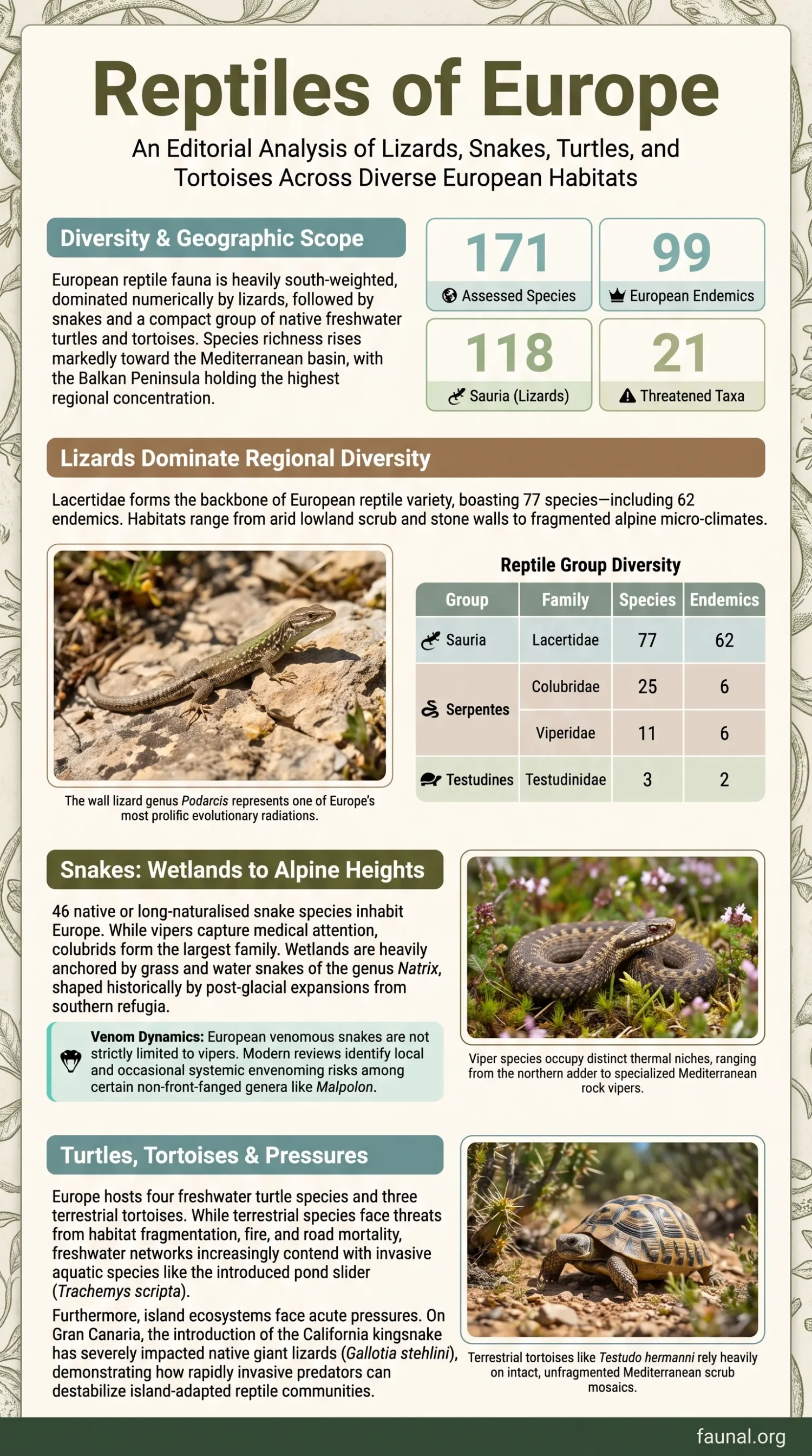
Europe supports a strongly south-weighted reptile fauna dominated by lizards, followed by snakes and a much smaller native assemblage of freshwater turtles and tortoises. Under the geographic and taxonomic scope used by the 2025 European Red List of Reptiles, 171 native or long-naturalised terrestrial and freshwater reptile species were assessed. The report recognises 118 species in its Sauria grouping, 46 snakes and seven non-marine turtles and tortoises. Reptile richness rises markedly toward southern Europe, with the Balkan Peninsula holding the highest regional species richness and Mediterranean peninsulas and islands supporting many narrow-range endemics.
The 171-Species Count Uses a Defined European Boundary
A European reptile total depends on what is meant by Europe. The 2025 regional assessment extends from Iceland, Svalbard and Franz Josef Land in the north to the Canary Islands in the south, and from the Azores in the west to the Urals in the east. It includes Cyprus, the European Macaronesian islands, European Türkiye and most of European Russia. The North Caucasus portions of Russia and the European portion of Kazakhstan fall outside this assessment boundary.
The 171 assessed species are native or were naturalised before 1500 CE. Recent introductions, species with only marginal European occurrence and several uncertain records are treated separately rather than being added to the core total. This distinction matters for reptiles because escaped pets, introduced turtles and translocated snakes now reproduce in parts of Europe without becoming part of the native regional fauna.
Marine turtles are outside the 171-species total
The European Red List assessment used here covers terrestrial and freshwater reptiles. Marine turtles require a separate marine scope. The European Environment Agency identifies the Mediterranean as the main European sea for turtles and recognises indigenous nesting populations of loggerhead turtles Caretta caretta and green turtles Chelonia mydas.
Terrestrial and freshwater reptiles assessed
171 species
2025 European regional assessment.
Main taxonomic composition
118 + 46 + 7
Sauria grouping, snakes, and non-marine turtles or tortoises.
Threatened at European level
21 species
CR, EN or VU among species with sufficient assessment data.
Highest regional richness
Balkan Peninsula
Species richness rises strongly from northern toward southern Europe.
Lizards Account for Most of Europe’s Reptile Diversity
The numerical centre of European reptile diversity lies among lizards and related saurian lineages. Lacertidae alone accounts for 77 species in the family-level diversity table of the 2025 assessment, including 62 European endemics. This family contains wall lizards, rock lizards, green lizards, racerunners and several mountain lineages whose ranges may be limited to a peninsula, mountain system or island group.
| Assessment grouping | Family | Species | European endemics |
|---|---|---|---|
| Sauria | Agamidae | 5 | 1 |
| Sauria | Anguidae | 6 | 4 |
| Sauria | Blanidae | 3 | 2 |
| Sauria | Chamaeleonidae | 0 | 0 |
| Sauria | Gekkonidae | 6 | 3 |
| Sauria | Lacertidae | 77 | 62 |
| Sauria | Phyllodactylidae | 5 | 4 |
| Sauria | Scincidae | 15 | 7 |
| Sauria | Sphaerodactylidae | 1 | 0 |
| Serpentes | Erycidae | 2 | 0 |
| Serpentes | Colubridae | 25 | 6 |
| Serpentes | Psammophiidae | 2 | 0 |
| Serpentes | Natricidae | 5 | 1 |
| Serpentes | Typhlopidae | 1 | 0 |
| Serpentes | Viperidae | 11 | 6 |
| Testudines | Emydidae | 2 | 1 |
| Testudines | Geoemydidae | 2 | 0 |
| Testudines | Testudinidae | 3 | 2 |
| Total | 18 family rows | 171 | 99 |
These figures follow Table 1 of the 2025 assessment, which counts species confirmed within the assessment region and native or naturalised before 1500 CE. A family can therefore show zero in the core table even when a related species has been reported near or within the broader geographic boundary; marginal taxa classified as Not Applicable are excluded from these totals.
The published endemic total contains a small internal discrepancy
The family rows in Table 1 sum to 99 European endemics, or 57.9% of the 171 species, while nearby narrative text in the same report states 100 of 171. The structured family table yields the 99-species total used here.
Wall lizards form one of Europe’s main evolutionary radiations
The genus Podarcis is especially characteristic of European rocky landscapes, stone walls, scrub, islands and open woodland margins. The 2025 assessment recognises 27 Podarcis species occurring in Europe, most confined to the region. Familiar widespread forms such as the common wall lizard Podarcis muralis occur alongside far narrower island taxa such as the Ibiza wall lizard Podarcis pityusensis and Aeolian wall lizard Podarcis raffonei.
Mountain isolation has produced another pattern. The eight recognised Iberolacerta species are European endemics, with several tied to restricted mountain systems in the Iberian Peninsula. The Canary Island genus Gallotia represents a separate island radiation: the 2025 assessment recognises seven extant species, all endemic to the archipelago. The current Reptile Database provides the taxonomic catalogue needed to track accepted species names as these lineages continue to be revised.
Green lizards, racerunners and mountain specialists occupy different thermal settings
Large lacertids such as the ocellated lizard Timon lepidus and green lizards of Lacerta occupy warmer open habitats, woodland edges, scrub and agricultural mosaics in different parts of southern and central Europe. Sandier or steppe-like environments support racerunners such as Eremias. At the opposite end of the topographic gradient, several Iberolacerta and Dinarolacerta species are associated with rocky mountain terrain and fragmented high-elevation habitat.
Geckos and skinks extend the fauna into nocturnal and ground-level niches
Mediterranean Europe also supports geckos including Tarentola, Hemidactylus, Mediodactylus and the European leaf-toed gecko Euleptes europaea. Many use cliffs, rock fissures, dry stone structures and buildings, with several active mainly after dusk. Skinks occupy a different structural niche close to or beneath the ground. European representatives include Chalcides, Ablepharus and other lineages with varying degrees of limb reduction and strong associations with loose soil, grass, leaf litter or rocky cover.
Europe’s Snakes Range from Wetland Hunters to Alpine and Steppe Vipers
The 2025 assessment includes 46 native or long-naturalised snakes in its core European scope. The fauna is not dominated by vipers. Colubrids form the largest snake family in the family-level diversity table, while natricines, sand boas, psammophiids, a blind snake and vipers add very different feeding strategies and habitat associations.
Grass snakes and water snakes connect reptiles with wetlands
Species of Natrix make wetlands a major part of the European snake landscape. The common grass snake Natrix natrix, barred grass snake Natrix helvetica and Iberian grass snake Natrix astreptophora represent separate lineages once treated more broadly under the grass-snake complex. Dice snakes Natrix tessellata and viperine snakes Natrix maura are even more closely tied to aquatic feeding in much of their range.
Genetic work on Natrix also shows why modern European distributions cannot be explained solely by present climate. Populations persisted through glacial periods in several refugia and later expanded into central and northern Europe. Research on Natrix helvetica and Natrix natrix has identified both classical southern refugia and evidence for survival outside the three large Mediterranean peninsulas. Phylogeographic evidence from grass snakes supports this more complex history.
Whipsnakes and rat snakes are prominent in warmer regions
Southern and southeastern Europe support a varied assemblage of active colubrids. The Caspian whipsnake Dolichophis caspius, western whip snake Hierophis viridiflavus, four-lined snake Elaphe quatuorlineata, Aesculapian snake Zamenis longissimus, smooth snake Coronella austriaca and horseshoe whipsnake Hemorrhois hippocrepis illustrate how the group spans dry scrub, open woodland, rocky slopes, field margins and other structurally varied habitats.
Vipers occupy northern heath, Mediterranean rock and mountain grassland
Europe has 11 viper species in the 2025 assessment. Their habitats are not uniform. The adder Vipera berus extends into cool northern environments; the asp viper Vipera aspis is centred farther southwest; the nose-horned viper Vipera ammodytes is strongly associated with southeastern Europe; and meadow or steppe vipers such as Vipera ursinii, Vipera graeca and related taxa occupy much more localised open habitats. The Cyclades blunt-nosed viper Macrovipera schweizeri is restricted to Greek islands in the Cyclades.
European venomous snakes are not limited to vipers
Vipers are the main front-fanged venomous snakes in Europe, but describing every non-viper as non-venomous is inaccurate. A 2024 review of European non-front-fanged snakes found the clearest evidence of local and occasional systemic envenoming in Malpolon. Bites involving several other genera are reported mainly with local effects, while the medical evidence remains limited. Any snakebite should receive appropriate medical assessment rather than being judged from family identity alone.
The distinction is supported by a 2024 review of bites by European non-front-fanged snakes, which examined Malpolon, Hemorrhois, Hierophis, Natrix, Platyceps, Telescopus and Zamenis. This is why a simple “viper versus harmless snake” division does not accurately represent European snake biology.
Slow Worms and Worm Lizards Break the Simple Snake–Lizard Divide
A long, limbless body is not enough to identify an animal as a snake. Europe contains several limbless or strongly limb-reduced reptiles that belong to other squamate lineages. Slow worms in the genus Anguis are lizards in the family Anguidae. The current Reptile Database recognises five Anguis species: A. cephallonica, A. colchica, A. fragilis, A. graeca and A. veronensis.
The European glass lizard Pseudopus apodus provides another example of limb reduction within lizards. Mediterranean worm lizards of Blanus go further in a different direction: they are specialised fossorial squamates with compact heads and annulated bodies adapted to moving through soil. Their subterranean ecology means they can be overlooked even in areas where surface-active lizards are well documented.
Body shape and taxonomy are not interchangeable: snakes, slow worms, glass lizards and worm lizards can all have elongated bodies, but they represent different evolutionary branches and ecological strategies.
The Seven Native Non-Marine Turtles and Tortoises Occupy Two Very Different Systems
Europe’s core 2025 assessment contains four freshwater turtle species and three terrestrial tortoises. Treating all seven simply as “European turtles” hides an important ecological split. Freshwater species depend on wetland quality, hydrology and connections between aquatic and nesting habitat, while tortoises are terrestrial animals exposed to pressures such as fire, road mortality, land conversion and collection.
| Family | Species | Primary European setting |
|---|---|---|
| Emydidae | Emys orbicularis | Ponds, marshes, slow waters and connected wetlands |
| Emydidae | Emys trinacris | Sicilian freshwater habitats |
| Geoemydidae | Mauremys leprosa | Iberian and western Mediterranean freshwater systems |
| Geoemydidae | Mauremys rivulata | Southeastern European and eastern Mediterranean fresh waters |
| Testudinidae | Testudo graeca | Dry scrub, grassland and open Mediterranean landscapes |
| Testudinidae | Testudo hermanni | Mediterranean scrub, open woodland and habitat mosaics |
| Testudinidae | Testudo marginata | Dry rocky landscapes of southeastern Europe |
The 2025 assessment lists Hermann’s tortoise Testudo hermanni as Vulnerable at the European level. The report identifies fire and road mortality among pressures that can cause direct mortality in tortoises. Freshwater turtles face a different set of pressures: water extraction, diversion, wetland degradation, pollution and introduced aquatic animals can alter habitat quality or survival.
Released pet turtles have added an introduced layer to Europe’s wetlands
The pond slider Trachemys scripta is not part of the native seven-species assemblage. It originated in the Americas and became widespread in Europe through the pet trade and subsequent releases or escapes. European Environment Agency reporting identifies it as one of the most widespread invasive alien species in the EU environment, with records reported by 26 Member States.
Presence of an introduced turtle does not by itself establish the same status everywhere. Records may represent isolated releases, persistent populations or successful breeding populations. Native, introduced, naturalised and invasive are therefore separate biological and management categories rather than interchangeable labels.
Why Reptile Diversity Is Concentrated in Southern Europe
Temperature influences reptile activity, but the modern north–south pattern cannot be reduced to a simple warm-versus-cold explanation. Europe’s present fauna also carries the effects of repeated glacial cycles, mountain barriers, sea-level changes, postglacial expansion and long periods of isolation.
The Iberian, Italian and Balkan peninsulas acted as major refugial regions for many temperate and warmth-associated lineages during cold periods. Populations isolated within and among these southern regions accumulated genetic differences, while later range expansion repopulated parts of central and northern Europe. Reptile studies also show that some lineages survived outside the classic southern refugia, so present distributions preserve multiple histories rather than one universal recolonisation route.
The Balkans combine high richness with strong topographic variation
The 2025 European assessment identifies the Balkan Peninsula as the area of greatest reptile species richness. The region combines Mediterranean coastlines, karst, river valleys, open dry habitats, forest edges, mountains and steppe-influenced landscapes. Its position between central Europe, the Mediterranean and western Asia also brings together lineages with different geographic histories.
Iberia combines widespread Mediterranean reptiles with mountain endemics
The Iberian Peninsula contains dryland reptiles such as the ocellated lizard Timon lepidus, Lataste’s viper Vipera latastei and several Psammodromus species, while isolated mountain systems support narrow-range Iberolacerta. Atlantic influence, Mediterranean climate, high plateaus and mountain chains create sharp ecological transitions over relatively short distances.
Mediterranean and Macaronesian islands generate narrow ranges
Island isolation is one reason European reptile endemism is not distributed evenly. The Balearic Islands, Aeolian Islands, Cyclades, Canary Islands and other Mediterranean archipelagos support reptile lineages with distributions far smaller than those of widespread continental species. Podarcis raffonei is restricted to the Aeolian Islands, while several Gallotia species occur on individual Canary Islands or subsets of the archipelago.
Small geographic ranges also change the scale of risk. A new predator, fire, development project or habitat change that affects a limited portion of a widespread continental species can overlap a far larger share of the global population of an island endemic.
Habitat Structure Determines Which Reptiles Can Persist Locally
European reptiles depend on mosaics of thermal and structural conditions rather than temperature alone. A sun-exposed stone, shaded shrub, burrow, grass tussock, pond margin and rock fissure can provide different conditions within the same habitat patch. This small-scale variation allows animals to regulate body temperature, avoid predators, forage and shelter through weather extremes.
- Mediterranean scrub and open woodland: wall lizards, green lizards, tortoises, whipsnakes and several vipers use mosaics of cover and exposed basking sites.
- Rock faces, scree and dry stone structures: Podarcis, mountain lacertids, geckos and some vipers can depend heavily on crevices and warm surfaces.
- Heathland, meadow and woodland edge: species such as Lacerta agilis, Anguis and Vipera berus use structurally varied temperate landscapes.
- Steppe and dry grassland: racerunners and steppe-associated vipers occupy open habitats where vegetation succession or agricultural conversion can alter suitability.
- Ponds, marshes and river systems: Emys, Mauremys and aquatic Natrix species depend directly or indirectly on freshwater habitat.
- Mountain and subalpine grassland: several rock lizards and meadow vipers occur in fragmented high-elevation environments with short seasonal activity windows.
Cold Winters Restrict Activity Without Excluding Reptiles from Northern Europe
Northern Europe supports fewer reptile species, but several lineages tolerate long cold seasons. Seasonal inactivity in protected refuges reduces exposure during winter, while basking and behavioural thermoregulation allow activity during suitable periods. The adder Vipera berus and viviparous lizard Zootoca vivipara extend much farther north than most Mediterranean reptiles.
Reproductive strategy also matters. Live-bearing allows embryos to develop within females that can move among warmer and cooler microsites, a useful trait in climates where soil temperatures may be unsuitable for eggs during much of the year. This does not make cold climates cost-free: northern populations still operate within shorter annual activity and feeding periods.
The 2025 Red List Places 21 European Reptiles in Threatened Categories
Of the 171 reptiles assessed at the European level, eight were Data Deficient. Among the 163 species with sufficient data, 21 were classified as Critically Endangered, Endangered or Vulnerable, equal to 12.9%. The threatened set consists of one Critically Endangered species, ten Endangered species and ten Vulnerable species. All but two of the 21 are endemic to Europe.
Threatened European reptiles by Red List category
The 21 species assessed as threatened at the European regional level in the 2025 assessment.
European Red List of Reptiles, 2025. European regional assessment; Data Deficient and non-threatened categories are not plotted.
Vipers carry an unusually high share of the assessed risk
Six of the 11 European viper species are in threatened categories, equal to 54.5% of the family in the assessment. The threatened set includes the Greek meadow viper Vipera graeca, asp viper Vipera aspis, Lataste’s viper Vipera latastei, eastern steppe viper Vipera renardi, meadow viper Vipera ursinii and Cyclades blunt-nosed viper Macrovipera schweizeri. Several have restricted or fragmented habitat requirements, making local habitat change more consequential than it is for widespread generalists.
Habitat loss, development and agriculture affect the widest range of species
The 2025 assessment identifies habitat loss, fragmentation and degradation from human land use as the main pressure on European reptiles. Agricultural intensification, residential and commercial development, energy development and transport infrastructure can remove habitat directly or divide populations. Roads add a second mechanism through direct mortality. For the Cyclades blunt-nosed viper, the assessment cites research estimating annual road mortality at about 10% of the studied population between 1993 and 2006 before traffic restrictions were introduced during peak activity periods.
Loss of traditional open habitat can also occur through abandonment
Land abandonment does not automatically improve reptile habitat. In landscapes where grazing or low-intensity agriculture maintained open grassland and patchy vegetation, succession toward dense woody cover can reduce habitat for open-ground reptiles. Meadow vipers and other grassland specialists illustrate why both intensive land use and complete abandonment can create problems in different settings.
Warmer conditions do not automatically improve reptile habitat
Reptiles are ectotherms, but this does not mean every temperature increase benefits them. The 2025 assessment identifies direct climate-change effects—including habitat alteration, drought, temperature extremes and storms—as ongoing or future threats to 44 European reptile species. Climate change can also interact with wildfire and facilitate the expansion of competitors or predators. Mountain species may lose suitable climatic space as conditions shift upslope, while drought can alter wetland availability and prey resources.
Gran Canaria Shows How Fast an Introduced Snake Can Alter an Island Reptile Community
The California kingsnake Lampropeltis californiae, a species commonly kept as a pet, was first recorded in the wild on Gran Canaria in 1998. Rapid range expansion began in 2007, and by 2020 it had been found across approximately half of the island. Gran Canaria evolved without native snakes, leaving its endemic lizards exposed to a predator with which they had no local evolutionary history.
The most severe documented effect concerns the Gran Canaria giant lizard Gallotia stehlini. The European Red List assessment reports a decline greater than 50% since 2007 and projects a decline above 80% over the next three generations if the invasion continues. Juvenile mortality in invaded areas is described as almost complete. The species, assessed as Least Concern in the earlier European assessment, is now Critically Endangered at the European regional level.
The Gran Canaria skink Chalcides sexlineatus and Boettger’s wall gecko Tarentola boettgeri also occur at less than half their density in invaded areas compared with uninvaded sites. The skink is now assessed as Endangered. The case demonstrates why an invasive predator can have a different effect on an island fauna than on a continental assemblage containing a longer history of snake–lizard interactions.
European Reptile Names and Species Totals Are Still Changing
Older European reptile lists should not be treated as permanently fixed inventories. Genetic research and renewed morphological work have split former species complexes, elevated subspecies and clarified relationships among geographically isolated populations. The 2025 European assessment incorporates many taxonomic changes that accumulated after the first regional Red List, while the Reptile Database continues to publish revised global checklists.
Grass snakes provide a clear example. Animals once placed broadly under Natrix natrix are now represented in western and southwestern Europe by recognised species including Natrix helvetica and Natrix astreptophora. Slow worms provide another: the current taxonomy recognises multiple European Anguis species where older field literature often used Anguis fragilis much more broadly.
Regional species counts therefore need a date, a geographic boundary and a taxonomic standard. A museum record, an introduced population, a marginal occurrence and a species with an established native range do not represent the same type of evidence. Likewise, an occurrence point documents a record at a place and time; it does not establish continuous presence throughout the surrounding country or range polygon.
Sources and Verification
- European Commission, European Red List of Reptiles (2025) — Regional boundary, assessed species totals, family composition, endemicity, conservation categories, spatial richness and major threats.
- The Reptile Database — Current accepted reptile taxonomy, scientific names, synonyms and taxonomic revisions.
- The Reptile Database data downloads — Dated 2026 reptile species checklists and taxonomic dataset structure.
- Kindler, Graciá & Fritz, Scientific Reports: Extra-Mediterranean glacial refuges in barred and common grass snakes — Phylogeographic evidence for European grass-snake refugia and postglacial history.
- A review of bites by non-front-fanged snakes of Europe, Toxicon (2024) — Evidence on venom and reported bite effects in European non-viper snakes.
- European Environment Agency, Marine Turtles — European marine-turtle scope and indigenous Mediterranean nesting populations of loggerhead and green turtles.
- European Environment Agency, EU invasive alien species reporting — Current Member State reporting for the introduced pond slider Trachemys scripta.
Related Topics
- → Turtles and Tortoises of Europe: Freshwater, Marine, and Land Species
- → Lizards of Europe: Common Groups, Habitats, and Distribution
- → Snakes of Europe: Venomous and Non-Venomous Species
- → Threats to European Reptiles: Habitat Loss, Roads, and Climate Change
- → Endemic Reptiles of Europe: Islands, Peninsulas, and Restricted Ranges
- → Alpine and Mountain Reptiles of Europe: Cold-Adapted Species