Complete guides: •Regional Fauna Guides•Reptiles•Fauna of Europe
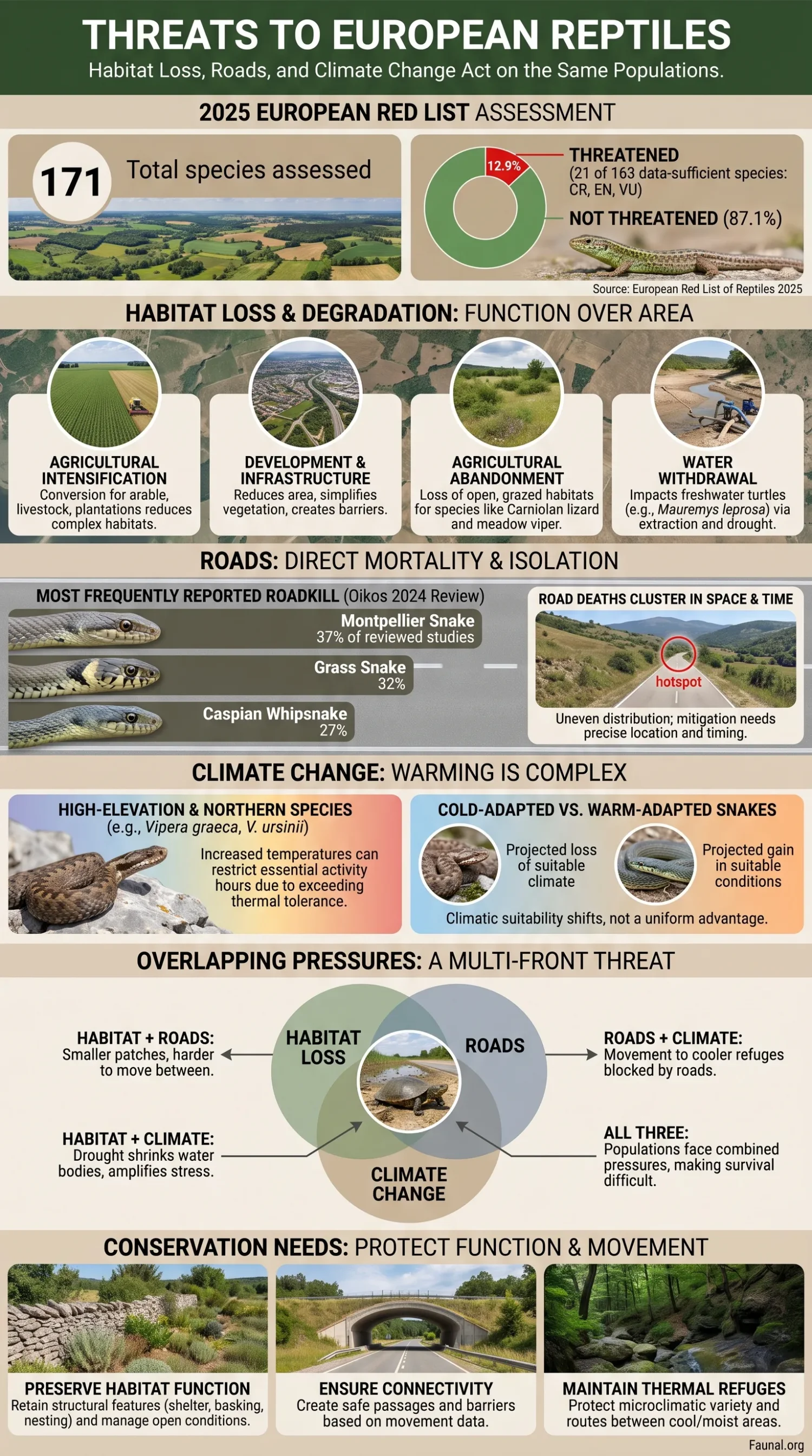
European reptiles face three pressures that often act on the same populations: habitat is removed, simplified or cut into smaller patches; roads add direct mortality and interrupt movement; and climate change alters the thermal and hydrological conditions that make those patches usable. The 2025 European Red List assessed 171 species. After eight Data Deficient species were excluded from the threatened-species calculation, 21 of 163 data-sufficient species—12.9%—were classified as Critically Endangered, Endangered or Vulnerable at the European scale. Habitat loss, fragmentation and degradation remain the main threat group, while direct climate-related impacts were recorded as an ongoing or future threat to 44 European species.
European Red List scope
171 species
Species evaluated in the 2025 European reptile assessment.
Threatened among data-sufficient species
21 of 163 · 12.9%
Critically Endangered, Endangered or Vulnerable at the European scale.
Direct climate-related threat
44 species
Habitat change, drought, temperature extremes or storms recorded as ongoing or future threats.
European roadkill evidence base
300 sources · 33 countries
The 2024 Oikos review assembled 1,688 reptile roadkill records and 125 taxa.
The 2025 Red List resets the conservation baseline
The 2025 European Red List of Reptiles is a fully revised second assessment rather than a simple update of the 2009 list. It incorporates taxonomic changes, newly described or elevated species, and roughly 15 years of additional field and assessment evidence. The companion IUCN European reptile dataset records the 171-species assessment scope.
The regional threatened proportion is 12.9% among species with enough information for assessment, and the EU27 figure is 13.7%. The highest numbers of threatened species occur in southern and southwestern Europe, including the Mediterranean and Macaronesian islands. These percentages describe regional extinction risk under the IUCN system; they do not mean that the remaining species are free from local road mortality, habitat deterioration or climate exposure.
The lower percentage does not show a Europe-wide recovery
The 2025 report explicitly warns against reading the lower threatened percentage as an improvement since 2009. The assessed taxonomic set is larger and contains more species classified as Least Concern, while the number of threatened species has remained similar. The report found no European reptile species with a genuine Red List status improvement since the first assessment.
Habitat can remain on a map after it stops functioning for reptiles
For reptiles, habitat loss includes more than the conversion of natural land into buildings or fields. A site can retain vegetation while losing the structures that provide shelter, basking sites, nesting places, prey, moisture and safe movement. Dry-stone walls, rock piles, open patches, scrub edges, dead wood, wet depressions and small water bodies can determine whether an apparently intact landscape still supports a reptile population.
The 2025 European assessment identifies agricultural intensification as the leading land-use pathway behind habitat loss and degradation, especially conversion or management for arable production, with livestock and plantations also involved. Residential and commercial development and energy production add further pressure. These processes can reduce habitat area, simplify vegetation and remove connections between patches.
Agricultural abandonment can also close reptile habitat
More intensive agriculture is not the only agricultural pathway. Some European reptiles depend on open or semi-open habitats maintained by low-intensity grazing or other traditional land use. When those practices stop, shrubs and trees can encroach into grassland, meadow and wetland margins. The European Red List identifies this process in formerly grazed prealpine wetlands used by the Carniolan lizard Zootoca carniolica and in montane meadows used by the meadow viper Vipera ursinii.
For these reptiles, “less human activity” is not automatically equivalent to better habitat. The ecological outcome depends on whether management maintains or removes the open, structurally varied conditions a population uses.
Mountain development compresses already narrow habitat bands
Tourism and infrastructure can be especially damaging where reptiles occupy narrow elevational zones. The European Red List points to alpine ski development as a pressure on montane snakes and lizards. Roads, buildings, cleared slopes and energy infrastructure may remove habitat directly while also creating barriers through the remaining terrain. This matters when a species cannot simply shift downslope or across developed valleys as temperature conditions change.
Freshwater turtles lose habitat through water withdrawal as well as land conversion
Europe’s freshwater turtles experience a different form of habitat loss. The 2025 assessment links much of their habitat degradation from agricultural and urban development to water extraction and diversion. Eutrophication and pesticide runoff can further alter aquatic habitat. It also reports that climate-amplified drought has contributed to the loss of some Spanish subpopulations of the Mediterranean stripe-necked terrapin Mauremys leprosa, while habitat restoration and improved water quality have benefited the species elsewhere in Spain.
Roads combine direct mortality with landscape isolation
A road affects reptiles in at least two biologically different ways. Vehicles can kill animals moving, dispersing, foraging or using warm road surfaces. At the same time, the road corridor can divide habitat and reduce movement between feeding, breeding, overwintering and refuge sites. A population can therefore be affected even where carcass counts appear modest, because the barrier changes which parts of the landscape remain connected.
The European Environment Agency landscape indicator classifies 27% of land in the EU27 plus the United Kingdom as highly fragmented in the 2018 dataset, with average habitat patches below 0.02 km² in that class. Transport infrastructure and sealed surfaces are among the barriers used in the indicator. This provides continental context for structural fragmentation, but it is not a reptile roadkill statistic and cannot be converted into a reptile population-loss rate.
Landscape fragmentation is not the same metric as reptile mortality
The EEA value describes landscape structure. Roadkill studies count or model animal deaths. A fragmented landscape may increase isolation even without a measured collision rate, while a roadkill hotspot can occur inside a landscape that appears connected at a broader mapping scale.
European roadkill studies repeatedly record large snakes
A 2024 Oikos review examined 300 data sources from 33 European countries and assembled 1,688 reptile roadkill records covering 125 taxa. The three species most frequently reported across the reviewed literature were the Montpellier snake Malpolon monspessulanus, grass snake Natrix natrix and Caspian whipsnake Dolichophis caspius. Across species, greater body mass was associated with higher relative roadkill frequency, while crepuscular species were reported less often.
Reptiles Most Frequently Reported in European Roadkill Studies
Relative roadkill frequency is the percentage of reviewed studies in which each species was recorded.
Data: Morelli et al. (2024), Oikos; 300 reviewed data sources from 33 European countries. Percentages describe reporting frequency across studies, not the share of a species population killed on roads.
Roadkill frequency is not a population mortality rate
A species appearing in 37% of reviewed studies does not mean that 37% of its population is killed on roads. The metric measures how often the species occurred in the literature dataset. Detectability, carcass persistence, research effort, road access and geographic coverage can all affect reporting.
Road deaths cluster in places and seasons
Road mortality is rarely distributed evenly along a road network. A Romanian study of the Caspian whipsnake compiled 270 road-killed individuals from 251 events recorded between 2003 and 2022. The analysis detected high-risk road sections and “hot moments” in time; road density, terrain ruggedness and habitat configuration were among the main predictors. Most recorded deaths were adults.
This pattern changes the mitigation question. Treating every kilometre of road as equally risky can miss the sites and periods where mortality is concentrated. Survey timing, age class, seasonal movement and road type matter when deciding where traffic restrictions, crossing structures, guiding barriers or other measures are most likely to intercept the actual mortality process.
The Cyclades blunt-nosed viper shows how roadkill can reach population scale
The Cyclades blunt-nosed viper Macrovipera schweizeri provides an unusually clear European case. The 2025 Red List reports that roadkill between 1993 and 2006 produced an estimated mean annual mortality of about 10% of the total population before an agreement limited traffic during peak activity periods. The same assessment notes that road mortality can also have an important local effect on some Hermann’s tortoise Testudo hermanni subpopulations.
Continental Red List category and local road risk answer different questions. A species can have a broad European range while a road network still removes enough adults from one local population to alter its prospects.
Warming does not create a uniform advantage for reptiles
Reptiles are ectotherms, but “warmer is better” is biologically incomplete. Environmental temperature determines when an animal can move, forage, digest, court, reproduce and avoid predators. Warming can lengthen usable activity periods in cool settings, yet extreme heat and drought can close daytime activity windows, increase dehydration risk and shrink the cool refuges available during hot periods.
The 2025 European Red List records direct climate-related impacts—habitat change, drought, temperature extremes and storms—as ongoing or future threats to 44 European reptile species. Climate can also act indirectly by changing fire regimes or helping competitors and predators expand into new areas. The threat therefore depends on species ecology, elevation, water dependence, microhabitat and the possibility of moving to suitable conditions.
High-elevation vipers can lose usable hours even as average temperatures rise
A 2025 mechanistic study of 20 grassland viper taxa modelled hours when environmental temperatures exceed the animals’ thermal tolerance and are unavailable for essential activity. The cross-taxon median was 1,168 restricted hours under current climatic conditions. It was projected to rise to 1,413 hours under SSP1-2.6 and 1,776 hours under SSP5-8.5—about 21% and 52.1% above the current median, respectively. High-elevation and northern populations showed the greatest projected increases, with Vipera graeca and Vipera ursinii moldavica among the most exposed taxa in the model.
These are modelled future restriction hours, not observed future population losses. Their biological value is that they quantify a mechanism: a warming climate can reduce the time available for essential activity when temperatures cross upper thermal limits, even though some cooler hours become more favourable.
Cold-adapted and warm-adapted snakes can move in opposite directions
A separate 2025 modelling study of 31 European snake species projected broad declines in ecological suitability for several cold-tolerant taxa. Under SSP5-8.5, the meadow viper Vipera ursinii was projected to lose nearly half of its climatic suitability across its modelled range, with Seoane’s viper Vipera seoanei showing a comparable reduction. The authors note that many obscured records could not be included for these two species, which adds uncertainty to the projections.
The same study projected gains in suitable conditions for several snakes associated with dry environments and long warm summers, including the Caspian whipsnake Dolichophis caspius, Balkan whipsnake Hierophis gemonensis and eastern Montpellier snake Malpolon insignitus. A warmer Europe can therefore produce contraction for some reptiles and climatic opportunity for others.
Climatic suitability is not a population forecast
A projected gain in suitable climate does not prove that a species will expand or become more abundant. The snake models evaluate environmental suitability within defined range boundaries and do not reproduce every biological interaction, dispersal barrier or road-fragmented landscape. A species may gain suitable climate on a map while remaining unable to reach or occupy that habitat.
The three pressures become more damaging when they overlap
Habitat loss, roads and climate change are often measured separately, but a reptile experiences the landscape as one connected problem. Habitat conversion can leave smaller patches. Roads can make movement between those patches more dangerous or less frequent. Climate change can then shift the location of suitable temperatures, moisture or water, making movement more necessary at the same time that the landscape has become harder to cross.
| Reptile setting | Habitat pathway | Road pathway | Climate pathway | European examples |
|---|---|---|---|---|
| Montane grasslands and open highlands | Development, intensive land use or woody encroachment can reduce open habitat and structural variety. | Mountain roads and tourism infrastructure can divide narrow elevational habitat bands. | Heat can reduce usable activity time while suitable cooler space contracts upslope. | Vipera ursinii, Vipera graeca, Zootoca carniolica |
| Mediterranean islands | Development can remove habitat from already restricted island ranges. | Even short road networks can create repeated mortality where animals cross or thermoregulate. | Limited island area can restrict movement toward alternative climates or refuges. | Macrovipera schweizeri |
| Freshwater systems | Water extraction, diversion, shoreline change and pollution reduce usable aquatic habitat. | Roads may add barriers where turtles move between water, nesting areas and terrestrial refuges. | Drought can shrink or eliminate water bodies and amplify existing water stress. | Mauremys leprosa, Mauremys rivulata |
| Mobile lowland snakes | Agricultural simplification and development can break continuous habitat into smaller units. | Large, mobile snakes recur frequently in European roadkill literature. | Projected suitability differs by thermal ecology; some warm-adapted species may gain suitable climate. | Malpolon monspessulanus, Dolichophis caspius, Hierophis gemonensis |
| Tortoise landscapes | Land conversion, fire and habitat degradation can remove shelter and feeding areas. | Adult mortality on roads can matter locally because long-lived tortoises recover slowly from repeated losses. | Hotter, drier conditions can alter vegetation, fire exposure and seasonal activity. | Testudo hermanni |
Climate-driven movement requires connected habitat
A climate model can identify a cooler slope, higher valley or newly suitable region, but a reptile still has to reach it. Small home ranges, low dispersal, isolated populations, dense road networks and developed valleys can turn potential climate space into inaccessible habitat. Connectivity therefore becomes a climate adaptation issue as well as a habitat issue.
Water extraction and drought can push the same wetland from two directions
Freshwater turtles illustrate a different interaction. Water abstraction can reduce depth or persistence under present-day conditions; drought can then reduce inflow and increase drying pressure. The combined result may be a much larger change in usable aquatic habitat than either pressure suggests in isolation. Protecting a shoreline while losing the water regime that sustains the wetland does not preserve the same reptile habitat.
Conservation has to protect habitat function, movement and thermal refuge
The 2025 assessment places habitat conservation and restoration at the centre of European reptile management. For open-land species, that can mean retaining meadows, grasslands, heath, peat habitat, forest edges and the structural features reptiles actually use, including stone walls, stone piles and dead wood. In some sites, maintaining open conditions requires active vegetation or grazing management rather than simple abandonment.
Road mitigation needs the same ecological precision. The Cyclades blunt-nosed viper case shows why traffic timing can matter, while the Romanian Caspian whipsnake study shows why spatial hotspots matter. Crossing structures or barriers are most defensible when monitoring shows where animals attempt to cross, which life stages are affected, and when seasonal mortality peaks occur. A measure placed outside the actual movement corridor may add infrastructure without removing the mortality process.
Climate adaptation adds a third requirement: preserve microclimatic variety and routes between refuges. Rocks, burrows, shaded edges, vegetation mosaics, wet depressions and topographic variation can create cooler or moister conditions within a broader warming landscape. At larger scales, populations need connected routes among those refuges if suitable climate shifts across elevation or geography.
Monitoring should keep the evidence scales separate. A European Red List category describes regional extinction risk. A roadkill survey measures deaths along a defined road and period. A thermal model estimates future activity constraints. A climatic-suitability model estimates where environmental conditions may become more or less favourable. None of these measurements substitutes for a local population trend, but together they show why protecting area alone is not enough when the remaining habitat is fragmented, difficult to cross or thermally unusable.
Sources and Verification
- Bowles et al. (2025), European Red List of Reptiles, European Commission — Used for the current European assessment, threat pathways, regional patterns, freshwater turtle pressures and species-level road mortality examples.
- IUCN Red List Data Repository, European Reptile Dataset — Used to verify the 171-species scope of the 2025 European reptile assessment and the associated dataset.
- Morelli et al. (2024), Oikos — Used for the 33-country roadkill review, 1,688 records, 125 taxa and species-level relative roadkill frequency.
- Sahlean et al. (2024), Journal for Nature Conservation — Used for the Romanian Caspian whipsnake roadkill dataset, hotspot timing and landscape predictors.
- European Environment Agency, Landscape Fragmentation Pressure in Europe — Used for the 2018 EU27 plus UK fragmentation context and the definition of the landscape indicator.
- Mizsei et al. (2025), Frontiers in Zoology — Used for modelled activity-restriction hours across 20 grassland viper taxa under current and future climate scenarios.
- Deschepper (2025), Biological Diversity — Used for projected ecological-suitability changes across 31 European snake species and the contrast between cold- and warm-adapted taxa.
Related Topics
- → Reptiles of Europe: Snakes, Lizards, Turtles, and Tortoises
- → Endemic Reptiles of Europe: Islands, Peninsulas, and Restricted Ranges
- → Alpine and Mountain Reptiles of Europe: Cold-Adapted Species
- → Turtles and Tortoises of Europe: Freshwater, Marine, and Land Species
- → Lizards of Europe: Common Groups, Habitats, and Distribution
- → Snakes of Europe: Venomous and Non-Venomous Species