Complete guides: •Regional Fauna Guides•Reptiles•Wildlife Habitat Guides•Fauna of Europe
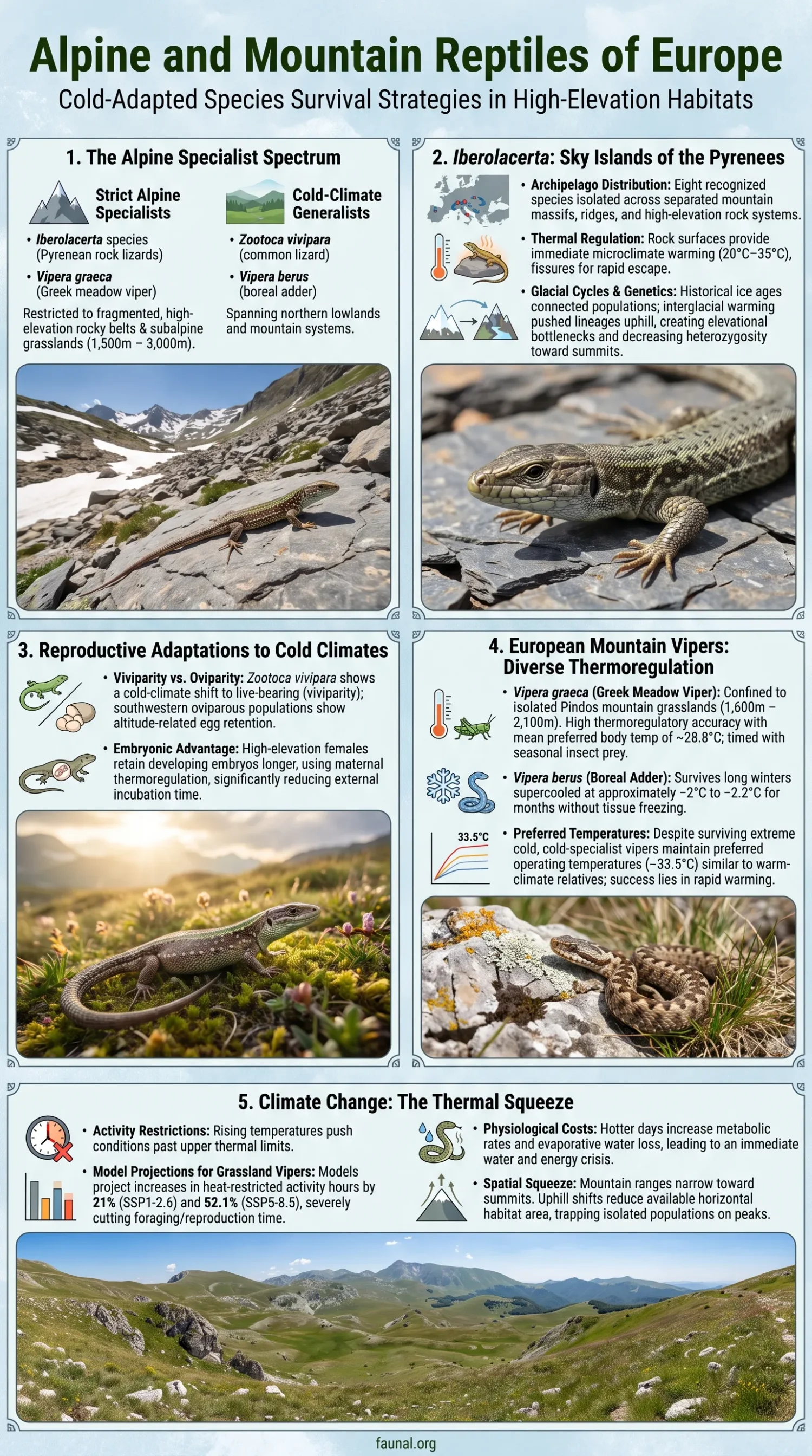
Europe’s cold-adapted mountain reptiles are a small ecological subset of its reptile fauna. The clearest examples include the high-elevation rock lizards of Iberolacerta, the cold-climate lizard Zootoca vivipara, the alpine Greek meadow viper Vipera graeca, high-mountain populations of Vipera ursinii, and the boreal adder Vipera berus. Their success in cold landscapes depends less on remaining active at low body temperatures than on finding short periods of usable heat, selecting protected microhabitats, completing reproduction within constrained seasons, and surviving long winters in suitable refuges.
High elevation is not the same as cold specialization
A reptile recorded on a mountain is not automatically an alpine specialist. Species with broad ecological ranges may reach high elevations while maintaining large populations in warmer lowlands. The species emphasized here either have ranges strongly concentrated in montane, subalpine or alpine environments, or show well-documented biological traits associated with cold climates.
Europe’s Mountain Reptiles Fall Into More Than One Cold-Climate Category
The strongest alpine specialists occupy fragmented high-elevation habitat and have little opportunity to move into continuous lowland landscapes. The three Pyrenean rock lizards Iberolacerta aranica, I. aurelioi and I. bonnali are examples. Vipera graeca is similarly concentrated in subalpine and alpine grasslands of the Pindos Mountains.
Other species are better described as cold-climate generalists. Vipera berus is not restricted to the Alps or any single mountain system; its range extends across much of northern Eurasia. Zootoca vivipara also occupies both northern lowlands and mountain habitats. Their presence in European mountains reflects broad adaptation to cool climates rather than dependence on an alpine belt.
| Taxon or group | Main European mountain context | Relationship with cold mountain habitat | Biological feature emphasized here |
|---|---|---|---|
| I. aranica, I. aurelioi, I. bonnali | Central Pyrenees | Alpine specialists | High-elevation rocky habitat, fragmented ranges and long seasonal snow cover |
| Other Iberolacerta | Iberian mountain systems and the eastern Alpine-Dinaric region | Mostly montane lineages with varying elevational specialization | Mountain isolation, rock dependence and genomic evidence of elevational bottlenecks |
| Zootoca vivipara | Northern Europe and many European mountain systems | Cold-climate generalist | Live-bearing across much of its range and altitude-related egg retention in oviparous populations |
| Zootoca carniolica | Slovenia, northeastern Italy, southern Austria and northwestern Croatia | Regional montane species | Now treated separately from Z. vivipara; reproductive findings from Z. vivipara should not be transferred automatically |
| Vipera graeca | Pindos Mountains | Subalpine and alpine specialist | Precise thermoregulation within isolated high-mountain grasslands |
| Vipera ursinii | Apennine and other European grassland populations | Grassland specialist; some populations are strongly montane | High-elevation meadow dependence in the Italian range |
| Vipera berus | Alps, northern European mountains and boreal regions | Boreal cold-climate specialist | Long overwintering, live-bearing and prolonged supercooling capacity |
Iberolacerta Forms Europe’s Clearest Radiation of Mountain Lizards
The Reptile Database currently recognizes eight species in Iberolacerta. Most are associated with separated mountain systems in southwestern Europe, while I. horvathi occurs farther east in the Alpine-Dinaric region. Their geography resembles an archipelago: suitable habitat is divided among massifs, ridges and high-elevation rock systems rather than connected across a continuous climatic zone. Reptile Database
| Accepted species | Main documented range | Mountain pattern |
|---|---|---|
| Iberolacerta aranica | Central Pyrenees, Spain and France | Fragmented alpine range |
| Iberolacerta aurelioi | Central-eastern Pyrenees, including Spain, Andorra and adjoining French alpine terrain | Restricted alpine range |
| Iberolacerta bonnali | Central Pyrenees, France and Spain | High-elevation alpine rock specialist |
| Iberolacerta cyreni | Sierra de Guadarrama and Sierra de Gredos, central Spain | Separated central Iberian mountain populations |
| Iberolacerta galani | Montes de León, northwestern Spain | Montane distribution documented from roughly 1,000–2,000 m |
| Iberolacerta horvathi | Northwestern Croatia, Slovenia, northeastern Italy and southern Austria | Disjunct Alpine-Dinaric mountain distribution |
| Iberolacerta martinezricai | Sierra de Francia, western-central Spain | Extremely restricted mountain range |
| Iberolacerta monticola | Serra da Estrela, Galicia and the Cantabrian region | Northwestern Iberian montane distribution with broader elevational variation than the Pyrenean alpine trio |
Three Pyrenean Species Live Mainly in the Alpine Belt
Iberolacerta aranica, I. aurelioi and I. bonnali are endemic to the central Pyrenees and are strongly associated with the alpine belt. French environmental authorities report that the great majority of their localities lie between about 2,000 and 3,000 m, with the group not known below 1,500 m in the cited regional account. Their habitat includes scree, moraines, stone accumulations, fractured bedrock and scattered large blocks. Tree cover is absent or sparse, and snow commonly covers the alpine environment from autumn into spring. DREAL Occitanie
Rock is not simply shelter. Its surface can provide a usable thermal environment when surrounding air remains cool, while fissures offer rapid retreat from wind, predators and unfavorable temperatures. Monitoring information for I. bonnali from the French Pyrenees reports activity associated with rock temperatures of about 20–35°C, illustrating why an alpine reptile experiences a very different thermal landscape from the air temperature measured above the ground. Parc national des Pyrénées
Glacial Cycles Repeatedly Connected and Re-Isolated Mountain Populations
Genomic work published in 2026 provides a deeper explanation for the fragmented distribution. Paleoclimatic reconstructions indicate that suitable Iberolacerta ranges were generally broader during the last glacial maximum than during warmer interglacial and present conditions. Colder periods could connect populations through lower terrain; warmer periods pushed suitable conditions uphill and separated lineages among mountain systems. Dufresnes et al., 2026
A second 2026 genomic study assembled the first reference genome for the genus and found evidence consistent with adaptation to high-elevation hypoxia through shifts in gene expression. Its demographic analyses also supported past ecological exclusion involving Podarcis, adding another reason why apparently suitable warmer terrain below an alpine population cannot be treated as equivalent habitat. Talavera et al., 2026
The Lower Edge of a Mountain Range Can Hold More Genetic Diversity Than the Summit
The 2026 phylogeographic analysis found that heterozygosity generally decreased with elevation in the sampled high-elevation Iberolacerta data. The relationship was clear in I. cyreni and also emerged when the three Pyrenean species were analyzed together. The same study identified populations near lower range edges as some of the genetically richest populations examined.
Moving uphill does not preserve every part of a mountain species’ biological diversity. The lowest surviving populations may contain genetic variation that is poorly represented near the summit, while also being the populations most directly exposed to warming and competition from lower-elevation reptiles.
Zootoca vivipara Links Cold Climate to Reproductive Strategy
Zootoca vivipara is not an alpine endemic. It extends across a vast Eurasian range and reaches north of the Arctic Circle as well as European mountain systems. Its value as a cold-adaptation example lies in reproduction. Much of the species is live-bearing, while some southwestern populations are oviparous. Reptile Database
A study of oviparous populations in northern Spain compared lowland sites averaging about 235 m with highland sites averaging about 1,895 m. Females from the high-elevation populations laid eggs containing embryos at more advanced developmental stages, and the eggs required less time to complete incubation. The pattern fits the cold-climate model of viviparity: retaining developing embryos inside the female allows maternal thermoregulation to influence their thermal environment before eggs are laid. Rodríguez-Díaz and Braña
Elevation did not simply cause the lizards in that experiment to select colder active temperatures. The adaptation involved developmental timing and egg retention rather than a requirement for chronically low body temperature. This distinction recurs across cold-adapted reptiles: successful life in a cold climate often depends on obtaining preferred temperatures efficiently during limited opportunities.
Zootoca carniolica is now treated separately
Older literature may refer to the Carniolan form as Zootoca vivipara carniolica. The current Reptile Database recognizes Zootoca carniolica as a separate species distributed in Slovenia, northeastern Italy, southern Austria and northwestern Croatia. Physiological or reproductive results measured in Z. vivipara should therefore not be assumed to describe Z. carniolica.
European Mountain Vipers Use Different Routes to the Same Seasonal Problem
Vipera graeca Is Confined to High Pindos Grasslands
The Greek meadow viper Vipera graeca is one of Europe’s clearest alpine snake specialists. It occurs in Greece and Albania in the Pindos mountain system, normally in subalpine and alpine grasslands around 1,600–2,100 m. A 2024 thermal-ecology study described 17 known isolated mountaintop populations and measured 74 snakes from five populations spanning the species’ geographic range. Mizsei et al., 2024
The mean preferred body temperature measured in the laboratory was 28.77 ± 0.43°C. Field data showed high thermoregulatory accuracy and strong use of the available thermal landscape. These snakes are therefore not passive occupants of cold meadows. They actively select conditions that bring body temperature into a preferred range.
The species’ mountain habitat also ties its annual cycle to food seasonality. The Reptile Database account describes a diet dominated by Orthoptera and notes that grasshoppers and related insects are abundant during the warmer part of the alpine season. Feeding opportunities, surface temperatures and reproduction are therefore compressed into the same limited period. Reptile Database
Italian Vipera ursinii Populations Occupy High Mountain Grassland
Vipera ursinii should not be described as if every population across its wider range occupied identical alpine habitat. In Italy, however, the species occurs as isolated relict populations in central Apennine mountain systems. The Italian IUCN account places these populations at about 1,350–2,300 m and associates them with stony high-mountain grasslands and pastures, often with low shrubs. IUCN Italia
This is an example of why the ecological unit matters more than the species name alone. A meadow-viper lineage can include populations separated by geography, elevation and grassland structure. Statements about one alpine population should not automatically be generalized to all populations assigned to the species or species complex.
Vipera berus Survives Cold Without Being an Alpine Endemic
Vipera berus occupies a much larger climatic range. It is a boreal species extending across northern Eurasia and also occurs in Alpine and other European mountain environments. Its cold adaptation is especially visible during overwintering.
Experiments on adults from Kizhi Island in northern Russia found that adders could remain supercooled at approximately −2 to −2.2°C for 23–121 days. Complete freezing was not tolerated, although short partial freezing occurred in experiments. The distinction matters: remaining liquid below 0°C is physiologically different from allowing body tissues to freeze. Biology Bulletin cold-resistance study
Supercooled does not mean freeze-proof
Vipera berus can tolerate long periods slightly below the freezing point while remaining supercooled. The available experimental evidence does not support describing the species as routinely capable of surviving complete body freezing.
Cold Specialists Do Not Necessarily Prefer Colder Body Temperatures
A comparison of pregnant Vipera berus and the more southern Vipera aspis found almost identical selected thermal ranges in a laboratory gradient. Mean selected temperatures were about 33.47°C in V. berus and 33.21°C in V. aspis. The cold specialist differed more in thermoregulatory efficiency and metabolic physiology than in its preferred body temperature. Lourdais et al., 2013
Cold adaptation in a reptile does not mean seeking a cold body temperature. It can mean reaching a relatively warm operating temperature quickly, holding it accurately, reproducing despite a short season, and retreating before environmental conditions move outside the usable range.
The Walser Viper Remains a Taxonomic Boundary Case
The Walser viper of the northwestern Italian Alps was described as Vipera walser in 2016. Its taxonomic rank remains unsettled. A 2024 phylogenomic study found that its nuclear genome falls within Alpine Vipera berus diversity even though its mitochondrial genome is associated with a different Caucasian viper lineage. The authors interpreted this as a striking case of mito-nuclear discordance. Dufresnes et al., 2024
The current Reptile Database treatment lists the taxon as Vipera berus walser, while also documenting the competing species-level interpretation. For a current reference page, presenting Vipera walser as an undisputed standalone species would hide an active taxonomic problem. Reptile Database
A Cold Mountain Is a Mosaic of Usable and Unusable Temperatures
Air temperature alone does not describe the conditions experienced by an alpine reptile. Direct solar radiation can warm exposed stone rapidly. Grass and low shrubs create shaded surfaces. Crevices buffer wind and temperature change. Slope orientation alters the timing and duration of sunlight. Two sites at the same elevation can therefore offer very different opportunities for basking, feeding and refuge.
The Pyrenean Iberolacerta account illustrates this fine-scale dependence. These lizards are associated with fractured rock and well-exposed alpine terrain, while some slope orientations are used less frequently. Vipera graeca likewise occurs in a mosaic of grass, shrubs and stone, with many field observations concentrated near shrubs or stone piles in favorable patches.
The biological year is therefore governed by thermal opportunity rather than by a fixed calendar. Emergence, feeding, digestion, mating, pregnancy or egg development, juvenile growth and preparation for winter all have to fit within the portion of the year when appropriate body temperatures can be reached without excessive exposure to cold, heat or predators.
Warming Can Close Activity Windows Instead of Simply Extending Summer
A warmer climate can initially create more hours when a cold-site reptile can reach its preferred body temperature. That benefit has an upper boundary. Once operative environmental temperatures exceed the upper end of the preferred thermal range, exposed habitat becomes unavailable until conditions cool again.
The 2024 study of Vipera graeca estimated about 1,278 hours per year when environmental temperatures already exceed the species’ preferred upper thermal limit under the modeled current conditions. The study projects greater restriction under warmer climates, reducing time available for thermoregulation, foraging and reproduction.
A broader 2025 mechanistic model covering 20 grassland-viper taxa reached the same directional result. Relative to current modeled conditions, future activity-restriction hours were projected to rise by 21% under SSP1-2.6 and by 52.1% under SSP5-8.5. High-elevation and northern populations showed some of the strongest modeled changes. Mizsei et al., 2025
Projected Increase in Heat-Restricted Activity Time for Grassland Vipers
Modeled change in hours when environmental temperatures exceed the usable upper thermal range across 20 grassland-viper taxa.
Source: Mizsei et al. (2025), Frontiers in Zoology. Values are projected increases in activity-restriction hours for 20 grassland-viper taxa under SSP1-2.6 and SSP5-8.5.
The viper model cannot be applied to every European mountain reptile
The 21% and 52.1% values come from a mechanistic model of 20 grassland-viper taxa. They describe that modeled taxonomic group and its assumptions, not a continent-wide percentage for Iberolacerta, Zootoca or all alpine reptiles.
Heat Also Changes Water and Energy Budgets
Overheating is only one part of the warming problem. A 2025 study comparing European vipers found that species associated with colder and wetter climates had higher metabolic rates and higher evaporative water loss than warm- and dry-adapted species under the experimental conditions. Simulated summer heat events raised both energy expenditure and water loss across the tested species, with stronger responses in the cold- and wet-adapted group. Lucchini et al., 2025
For a mountain reptile, a hotter day can therefore impose several costs at once: less safe surface time, more dependence on shaded refuges, greater water loss and a higher metabolic burden. A longer nominal summer does not necessarily produce a longer usable season.
Uphill Range Shifts Can Shrink Habitat Before a Summit Is Reached
Mountain ranges narrow toward their upper elevations. When suitable climate shifts uphill, the same vertical movement can lead to less horizontal habitat area. Valleys and low passes can also prevent an isolated reptile from reaching another cool massif. This geometry is especially restrictive for species already divided among separate summits.
The recent Iberolacerta genomic results show that this isolation is not only a present-day distribution issue. Warmer interglacial periods repeatedly produced altitudinal bottlenecks, whereas colder glacial periods allowed broader ranges and renewed contact through lower elevations. Modern warming can push the process toward isolation again, but within a landscape now also altered by roads, ski infrastructure, grazing changes, mining and other land uses that differ among mountain systems.
Vipera graeca illustrates the same spatial constraint from another lineage. Its known populations already occupy isolated mountaintops above the Pindos tree line. The 2024 thermal study identifies climate warming together with habitat degradation, mining, tourism and skiing as pressures on an already fragmented alpine range.
The most cold-associated European reptiles are not protected simply by living higher. Their survival depends on retaining enough alpine area, suitable rock or grassland structure, local thermal refuges, viable lower range margins and connections that prevent each mountain population from becoming an isolated endpoint.
Sources and Verification
- Reptile Database — Iberolacerta — Used for the current eight-species treatment of the genus.
- DREAL Occitanie — Pyrenean lizards — Used for the alpine distribution, elevation and habitat of I. aranica, I. aurelioi and I. bonnali.
- Parc national des Pyrénées — Iberolacerta bonnali — Used for documented elevation and rock-temperature activity information.
- Dufresnes et al. — Slippery slopes — Used for 2026 genomic phylogeography, glacial range expansion, elevational bottlenecks and genetic-diversity patterns.
- Talavera et al. — Lizards on a sky archipelago — Used for the 2026 reference genome, phylogenomics, altitudinal hypoxia findings and historical ecological exclusion.
- Reptile Database — Zootoca vivipara — Used for current taxonomy and broad geographic distribution.
- Reptile Database — Zootoca carniolica — Used for its current species-level treatment and Alpine-Dinaric distribution.
- Rodríguez-Díaz and Braña — egg retention in Zootoca vivipara — Used for the comparison of highland and lowland oviparous populations and embryonic development.
- Mizsei et al. — Alpine viper in changing climate — Used for Vipera graeca elevation, population fragmentation, preferred temperature, thermoregulation and modeled activity restriction.
- Reptile Database — Vipera graeca — Used for current taxonomy, habitat and diet information.
- IUCN Italia — Vipera ursinii — Used for the Italian elevational range and high-mountain grassland habitat.
- Biology Bulletin — cold resistance of Vipera berus — Used for experimental supercooling duration and freezing limits.
- Lourdais et al. — cold-climate specialization in vipers — Used for the comparison of preferred temperatures and thermoregulation in V. berus and V. aspis.
- Dufresnes et al. — Palearctic viper phylogenomics — Used for the nuclear placement and mito-nuclear discordance of the Walser viper lineage.
- Reptile Database — Vipera berus — Used for the current treatment of Vipera berus walser and broader adder taxonomy.
- Mizsei et al. — Restriction times on the rise — Used for the 2025 model of 20 grassland-viper taxa and the SSP1-2.6 and SSP5-8.5 activity-restriction projections.
- Lucchini et al. — hydrothermal physiology of European vipers — Used for metabolic-rate, evaporative-water-loss and simulated heat-event responses.
Related Topics
- → Reptiles of Europe: Snakes, Lizards, Turtles, and Tortoises
- → Threats to European Reptiles: Habitat Loss, Roads, and Climate Change
- → Endemic Reptiles of Europe: Islands, Peninsulas, and Restricted Ranges
- → Turtles and Tortoises of Europe: Freshwater, Marine, and Land Species
- → Lizards of Europe: Common Groups, Habitats, and Distribution
- → Snakes of Europe: Venomous and Non-Venomous Species