Complete guides: •Fauna of the Mediterranean Basin•Regional Fauna Guides•Mammals
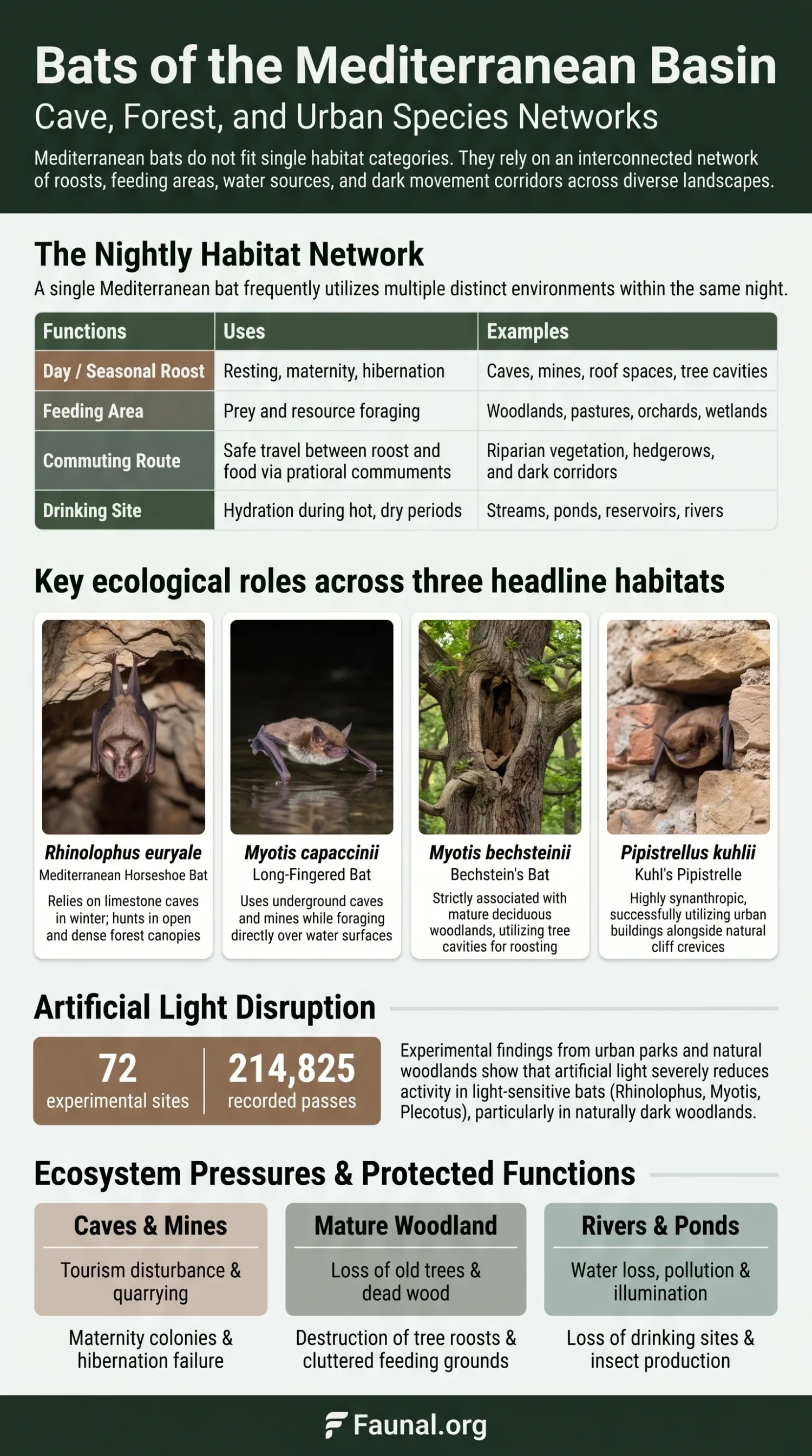
Bats of the Mediterranean Basin do not separate neatly into cave, forest, and urban species. A bat may spend the day in a limestone cave, feed over woodland or water after sunset, and reach those feeding grounds along dark tree lines or river corridors. Others roost in tree cavities or buildings but still depend on habitats well outside the roost itself. The most useful way to describe Mediterranean bats is therefore by the network of roosts, feeding areas, water sources, and movement routes they use across the landscape.
Why a Single Mediterranean Species Total Is Not Used
The geographic meaning of “Mediterranean Basin” changes among datasets and conservation programs. EUROBATS lists 55 bat species for its wider Agreement area, but that area extends beyond the Mediterranean and its total should not be presented as a Basin-wide species count. This page therefore concentrates on well-documented Mediterranean habitat relationships rather than assigning an unsupported total to the region. [a]
A Mediterranean Bat Can Use Several Habitats in the Same Night
Calling a species a “cave bat” usually describes an important roost relationship, not the full habitat used by that animal. The distinction matters because Mediterranean landscapes often place limestone caves, oak or pine woodland, pasture, orchards, reservoirs, villages, coastal cliffs, and riparian vegetation within a relatively short flight distance of one another.
| Habitat function | What the bat uses it for | Mediterranean examples |
|---|---|---|
| Day or seasonal roost | Resting, maternity colonies, mating, hibernation, or seasonal shelter | Caves, mines, cellars, roof spaces, wall gaps, bridges, tree cavities, loose bark, and cliff fissures |
| Feeding area | Finding insects, fruit, or other prey and food resources | Woodland interiors, forest edges, pasture, orchards, rivers, reservoirs, wetlands, parks, and open airspace |
| Commuting route | Moving between the roost and feeding habitat while retaining cover or darkness | Riparian vegetation, hedgerows, tree lines, valley bottoms, woodland edges, and dark urban corridors |
| Drinking site | Access to free water, especially during dry and hot periods | Streams, ponds, reservoirs, irrigation water, wetlands, and sheltered river reaches |
A protected roost is only one part of a bat’s habitat. The feeding ground and the route connecting it to the roost may lie in a different habitat category altogether.
Karst Caves Support Some of the Basin’s Most Cave-Dependent Bats
Limestone landscapes are widespread around parts of the Mediterranean, especially across the Iberian Peninsula, Italy, the Dinaric and Balkan regions, Greece, Anatolia, the Levant, and parts of North Africa. Their caves, fissures, mines, and other underground spaces provide a range of temperatures and humidity conditions that can be used for maternity colonies, hibernation, transitional roosts, or year-round occupation.
Horseshoe Bats Link Underground Roosts with Vegetated Feeding Grounds
Rhinolophus euryale, the Mediterranean horseshoe bat, is strongly associated with the Mediterranean Basin and limestone areas. EUROBATS reports underground sites, with occasional use of cellars and roofs, as summer roosts and caves with stable microclimates as winter roosts. Its feeding habitat is different: the species can hunt in both open forest and dense vegetation. [b]
Rhinolophus mehelyi, Mehely’s horseshoe bat, shows an even stronger cave association in the EUROBATS account, which describes it as using caves in both summer and winter. Its feeding habitat includes meadows, pastures, and steppe. Its distribution is scattered around parts of North Africa, southern Europe, the Balkans, Cyprus, and the eastern Mediterranean rather than forming a continuous ring around the sea. [c]
The Long-Fingered Bat Connects Caves Directly to Water
Myotis capaccinii, the long-fingered bat, is one of the clearest examples of why a roost label cannot describe the whole ecology of a species. It uses caves and mines through the year, yet feeds over water. It is a trawling bat, taking prey from or immediately above the water surface with its feet and tail membrane. Changes in water quality and loss of water bodies therefore affect a species that might otherwise be described simply as a cave bat. [d]
Large Cave Colonies Can Depend on Habitat Far Beyond the Cave Entrance
Miniopterus schreibersii, Schreibers’ bent-winged bat, forms colonies in karst caves, mines, and cellars and is also associated with landscapes rich in woodland. EUROBATS reports seasonal movements between summer and winter roosts commonly averaging about 40–100 km, with longer movements also recorded. One colony can therefore depend on feeding habitat and additional roosts spread across a much larger landscape than the cave itself. [e]
The Egyptian Fruit Bat Marks an Eastern Mediterranean Faunal Shift
Most bats discussed in European Mediterranean accounts are insectivorous, but the eastern and southeastern Basin also contains the Egyptian fruit bat, Rousettus aegyptiacus. EUROBATS records it from Cyprus, Egypt, the southern coast of Türkiye, and the Near East. It forms cave colonies and feeds in orchards on fruits including dates, figs, and peaches, as well as flowers and leaves. Its presence is therefore an important reminder that the bat fauna of the Levant and eastern Mediterranean is not simply an eastern extension of the western European fauna. [f]
Forest Bats Depend on Trees as Roost Structures, Not Just Green Cover
Mediterranean woodland ranges from oak and mixed deciduous forest to pine-dominated woodland, riparian trees, montane forest, and open wooded landscapes. For bats, the biological value of a forest cannot be described only by the area covered by trees. Tree age, cavities, cracks, dead and dying wood, loose bark, canopy structure, understory density, nearby water, and connections to open feeding grounds can all alter which species can use it.
Myotis bechsteinii is closely associated with mature deciduous woodland, particularly beech and oak forest, and uses tree holes and trunks as roosts. Its feeding style is suited to cluttered vegetation, where prey can be taken from foliage or the ground. This makes the availability of mature trees and internal forest structure more relevant than a simple measure of tree cover. [g]
Barbastella barbastellus, the western barbastelle, commonly uses loose bark and cracks in trees during summer. In colder periods it can shift to caves, mines, and rock crevices. The same species can therefore appear in both “forest bat” and “underground bat” datasets depending on season and survey method. [h]
Nyctalus lasiopterus, the greater noctule, represents another forest relationship. EUROBATS describes it as dependent on mature forest and using holes in deciduous trees throughout the year. Its fast, high flight differs from the maneuvering flight of bats that hunt among dense foliage, showing that “forest bat” includes several very different uses of forest structure. [i]
Island research adds a geographic dimension. A 2025 analysis of Mediterranean islands found that tree cover and distance to the nearest coast were the best-performing predictors of bat species richness in the studied Greek island system. The result does not establish a universal rule for every Mediterranean island, but it shows that forest availability and isolation can shape island bat assemblages together. [q]
Urban Mediterranean Bats Use Buildings Without Becoming Independent of Natural Habitat
Mediterranean towns and cities contain many artificial equivalents of natural crevices: roof gaps, wall cavities, bridge joints, shutters, cellars, and spaces behind building materials. Some bats use these readily. Urban occupation, however, does not mean that the animal completes its entire life cycle inside the built environment. Parks, trees, water, low-intensity farmland, cliffs, and dark routes between feeding areas can remain part of the same nightly habitat network.
Pipistrellus kuhlii, Kuhl’s pipistrelle, is one of the strongest examples of a Mediterranean synanthropic bat. EUROBATS describes it as widespread in the Basin and comfortable in both agricultural and urban habitats. Roosts include gaps in buildings and cellars as well as natural tree and cliff crevices. [j]
Hypsugo savii, Savi’s pipistrelle, occurs in Mediterranean coastal and mountain habitats, including sparsely vegetated landscapes. Summer roosts include tree holes and cliff crevices, while underground sites can be used in winter. Building renovation is also listed among its pressures, reflecting its ability to use human structures in parts of its range. [k]
Tadarida teniotis, the European free-tailed bat, occupies another urban niche. CMS describes it from both mountainous and urban settings, with roosts in rock crevices, cliffs, caves, and bridges. Its fast flight in open airspace separates its feeding ecology from slower bats working close to vegetation. [l]
A 2025 acoustic study in the metropolitan area of Naples recorded seven identified species plus one Myotis group. The assemblage was dominated by urban-associated Pipistrellus kuhlii, Hypsugo savii, and Pipistrellus pipistrellus. The study also found that landscape composition and season affected bat activity and richness, illustrating that Mediterranean city bat communities are filtered by more than the availability of buildings alone. [r]
Artificial Light Creates Different Outcomes for Different Bats
Street lighting can concentrate some flying insects, but that does not make illuminated habitat equally suitable for all bats. Species differ in flight behavior, exposure to predators, preferred vegetation structure, and willingness to cross illuminated space.
Experimental sites
72
Urban parks and natural woodlands in Italy and Montenegro.
Recorded bat passes
214,825
Paired dark and experimentally lit survey nights.
Taxa or species groups
9
Used to compare responses to artificial light.
The 2026 Italy–Montenegro experiment found that artificial light reduced activity of light-sensitive Rhinolophus ferrumequinum, R. hipposideros, and Myotis bats much more strongly in naturally dark woodland than in urban parks. Plecotus and nyctaloid activity was also reduced, while pipistrelles and Tadarida teniotis did not show the same response. Species richness declined under lighting in both landscape contexts. [s]
Urban-Tolerant Does Not Mean Light-Dependent
A bat may tolerate buildings and dense settlement while still feeding more effectively in dark patches. Urban adaptation, use of artificial roosts, and response to artificial light are separate ecological traits.
Focal Species Show How Cave, Forest, and Urban Categories Overlap
| Species | Important roost relationship | Feeding or landscape relationship | Mediterranean pattern |
|---|---|---|---|
| Rhinolophus euryale | Underground sites; caves especially important in winter | Open and dense woodland vegetation | Strong Mediterranean and limestone association |
| Rhinolophus mehelyi | Caves in summer and winter | Meadows, pastures, steppe | Scattered southern Mediterranean distribution |
| Myotis capaccinii | Caves and mines | Feeds directly over water surfaces | Patchy Mediterranean coastal and eastern distribution |
| Miniopterus schreibersii | Karst caves, mines, cellars | Woodland-rich landscapes and aerial insect prey | Southern European and eastern Mediterranean colonies |
| Rousettus aegyptiacus | Large cave colonies | Orchards; fruit, flowers, and leaves | Eastern and southeastern Mediterranean |
| Myotis bechsteinii | Tree holes and trunks | Mature deciduous woodland and cluttered vegetation | Patchy southern European forest distribution |
| Barbastella barbastellus | Loose bark and tree cracks in summer; underground sites in winter | Forested landscapes, especially moth-rich feeding areas | Fragmented European distribution reaching parts of the Mediterranean |
| Nyctalus lasiopterus | Tree holes throughout the year | Mature forest plus high open-air foraging space | Patchy Iberian-to-Balkan and Mediterranean-island records |
| Pipistrellus kuhlii | Buildings, cellars, tree and cliff crevices | Urban and agricultural landscapes | Widely associated with Mediterranean settlements |
| Hypsugo savii | Tree holes, cliff crevices, winter underground sites | Coastal, mountain, rocky, and built landscapes | Widespread through Mediterranean Europe and eastward |
| Tadarida teniotis | Cliffs, rock fissures, caves, bridges | Fast flight in open airspace, including cities | Broad Mediterranean distribution |
Water Links Cave Roosts, Woodland, Farmland, and Cities
Water is a separate ecological layer running through all three headline habitats. A bat roosting in a cave may forage along a river. A tree-roosting bat may drink from a pond or reservoir. An urban bat may leave a building and follow a vegetated stream through the city. In dry Mediterranean summers, the location and permanence of freshwater can alter the value of the surrounding landscape.
The dependence is especially direct in Myotis capaccinii, which takes prey from water surfaces. For other species, riparian woodland can combine insect production, drinking opportunities, sheltered flight paths, and feeding habitat. Removing riverbank vegetation or illuminating an otherwise dark water corridor can therefore affect more than one habitat function at once.
The Mediterranean Bat Fauna Changes from West to East
The Mediterranean should not be treated as one uniform bat community. Species ranges overlap differently around Iberia, North Africa, Italy, the Balkans, the Aegean, Anatolia, Cyprus, and the Levant. Several widespread European bats reach the Mediterranean from the north, while other species are concentrated in southern or eastern parts of the Basin.
| Geographic signal | Species example | What it shows |
|---|---|---|
| Western and central Mediterranean horseshoe-bat zone | Rhinolophus euryale | A broad Mediterranean association extending from northwest Africa and Iberia through southern Europe, the Balkans, and western Asia Minor. |
| Patchier southern Mediterranean range | Rhinolophus mehelyi | Scattered populations in North Africa, Iberia, Italy, the Balkans, and parts of the eastern range rather than continuous occupation of the Basin. |
| Mediterranean aquatic specialization | Myotis capaccinii | Cave-rich regions must be connected to suitable water habitat; the species is not distributed continuously around every Mediterranean coast. |
| Eastern fruit-bat element | Rousettus aegyptiacus | Cyprus, Egypt, southern Türkiye, and the Levant add a fruit-eating cave bat absent from western Mediterranean Europe. |
| Broad settlement-associated element | Pipistrellus kuhlii | A species well suited to agricultural and urban landscapes across a large part of the Mediterranean region. |
Island faunas add another layer. Distance from source populations, island area, woodland cover, cave availability, elevation, and survey effort can all change the list recorded on individual islands. A species present on Sicily, Crete, Cyprus, Sardinia, or a large Aegean island should not automatically be expected on smaller nearby islands with superficially similar climate.
Summer and Winter Can Place the Same Species in Different Habitat Categories
Seasonal roost switching is another reason fixed habitat labels fail. The greater horseshoe bat, Rhinolophus ferrumequinum, can use warm attics and underground sites in summer and larger caves, tunnels, and mines in winter. Its feeding habitat includes woodland, riparian forest, and pasture. [m]
Myotis myotis, the greater mouse-eared bat, provides a similar contrast. It uses deciduous and mixed woodland and also hunts over pasture and meadow, while winter roosts include caves, mines, and cellars. Roof spaces and bridge structures can also be used. A winter cave survey and a summer feeding survey can therefore describe very different pieces of the ecology of the same species. [n]
Warm Mediterranean Winters Do Not Produce Complete Seasonal Inactivity
A 2025 study in organic olive groves in Tuscany recorded early-winter bat activity at temperatures from about 7°C, with an overall median activity threshold around 15°C. The researchers also reported a December warming trend of about 0.6°C per decade in their study region since 1990. These measurements apply to the Tuscany study system rather than the entire Basin, but they show why Mediterranean winter ecology should not be reduced to a simple assumption that every local bat remains continuously inactive inside a hibernation site. [t]
Habitat Loss Affects Different Mediterranean Bats in Different Ways
The same landscape change does not create the same problem for every species. Cave disturbance directly affects bats that form underground maternity or winter colonies. Removal of old trees affects cavity and bark-roosting forest bats. Building renovation can close roost entrances used by urban-tolerant species. Water pollution or drying can damage a feeding resource even when the roost itself remains intact.
| Habitat system | Main pressure | Ecological function at risk | Examples particularly exposed |
|---|---|---|---|
| Caves and mines | Tourism disturbance, uncontrolled entry, quarrying, structural alteration | Maternity colonies, hibernation, transitional roosts | Rhinolophus euryale, R. mehelyi, Miniopterus schreibersii, Myotis capaccinii |
| Mature woodland | Loss of old trees, cavities, dead wood, and structurally varied forest | Tree roosts, cluttered feeding habitat, forest connectivity | Myotis bechsteinii, Barbastella barbastellus, Nyctalus lasiopterus |
| Buildings and bridges | Renovation, sealing of gaps, demolition, altered access points | Summer roosts, maternity sites, crevice shelter | Pipistrellus kuhlii, Hypsugo savii, Tadarida teniotis |
| Rivers, ponds, and reservoirs | Water loss, pollution, removal of bank vegetation, excessive illumination | Drinking, insect production, trawling, commuting | Myotis capaccinii and other bats feeding or drinking near water |
| Night landscape | Bright linear lighting and loss of dark corridors | Movement between roost and feeding habitat; access to dark feeding areas | Horseshoe bats, Myotis, Plecotus, and other light-sensitive groups |
The EUROBATS underground-sites database illustrates why cave records require particular care. It contains internationally important underground sites reported across the wider Agreement area and includes caves, mines and quarries, cellars, fortifications, tunnels, and other structures. The database itself notes that the amount of species and count information differs among sites and that some locations are deliberately generalized or withheld because disturbance can threaten sensitive colonies. [u]
Cave Counts, Acoustic Surveys, and Range Maps Measure Different Things
A large count inside a cave records bats using that particular underground site at the time of survey. It does not map every feeding area used by those animals. An acoustic detector placed in a city park or forest records flight activity near the microphone but does not normally identify the roost. A range map summarizes known geographic occurrence at a much broader scale and cannot establish local occupancy of every suitable-looking habitat.
Survey methods also favor different species. Cave monitoring readily detects large underground colonies. Tree-roosting bats may be spread among many small cavities. Fast open-air species can pass high above a detector, while quiet-calling bats inside dense vegetation may have shorter acoustic detection distances. Urban surveys can overrepresent species tolerant of buildings and artificial landscapes. Record density therefore reflects survey design and access as well as actual bat activity.
The functional habitat of a Mediterranean bat population may include a cave or tree used for shelter, woodland or water used for feeding, and several kilometers of landscape needed to connect them. Protecting only the place where the bats are found during daylight can leave the rest of that network exposed.
Sources and Verification
- [a] EUROBATS — Protected Bat Species — Used to distinguish the 55 species listed for the wider EUROBATS Agreement area from a Mediterranean Basin species total.
- [b] EUROBATS — Rhinolophus euryale — Used for Mediterranean and limestone association, underground roost use, forest feeding habitat, range, and listed pressures.
- [c] EUROBATS — Rhinolophus mehelyi — Used for year-round cave use, open feeding habitats, and the species’ scattered Mediterranean geographic pattern.
- [d] EUROBATS — Myotis capaccinii — Used for cave and mine roosting, water-surface trawling, Mediterranean distribution, seasonal movement, and water-related pressures.
- [e] EUROBATS — Miniopterus schreibersii — Used for underground colony sites, woodland association, and reported summer-to-winter movement distances.
- [f] EUROBATS — Rousettus aegyptiacus — Used for eastern Mediterranean range, cave colonies, orchard use, and fruit and flower feeding.
- [g] EUROBATS — Myotis bechsteinii — Used for mature deciduous woodland association, tree roosts, and clutter-adapted feeding behavior.
- [h] EUROBATS — Barbastella barbastellus — Used for summer bark and tree-crack roosts, winter underground use, woodland association, and geographic range.
- [i] EUROBATS — Nyctalus lasiopterus — Used for mature-forest dependence, deciduous-tree roosting, high open-air flight, and Mediterranean range records.
- [j] EUROBATS — Pipistrellus kuhlii — Used for Mediterranean abundance, agricultural and urban habitat use, and natural and building roosts.
- [k] EUROBATS — Hypsugo savii — Used for Mediterranean coastal and mountain habitat, seasonal roost use, and building-related pressure.
- [l] Convention on Migratory Species — Tadarida teniotis — Used for Mediterranean range, urban and mountain occurrence, roost structures, and open-air feeding behavior.
- [m] EUROBATS — Rhinolophus ferrumequinum — Used for seasonal shifts between summer and winter roosts and feeding habitat in woodland, riparian forest, and pasture.
- [n] EUROBATS — Myotis myotis — Used for woodland and pasture feeding habitat, caves and mines, building roosts, and seasonal movements.
- [q] Forest and Isolation Determine Bat Species Richness on Mediterranean Islands — Used for the 2025 Greek-island analysis linking bat species richness with tree cover and island isolation.
- [r] Landscape and Season Influence Bat Activity and Richness in a Mediterranean Metropolitan Area — Used for the 2025 Naples metropolitan acoustic survey, recorded assemblage, and dominance of urban-associated taxa.
- [s] Context-dependent Responses of Bats to Artificial Light at Night in Urban and Natural Woodlands — Used for the 2026 Italy–Montenegro experiment on artificial light, bat activity, and species richness.
- [t] Warming Winters Disrupt Bat Activity and Hibernation in Mediterranean Olive Agroecosystems — Used for Tuscany early-winter activity temperatures and the reported regional December warming trend.
- [u] EUROBATS — Conservation of Key Underground Sites Database — Used for underground-site types, variation in submitted site information, and sensitivity restrictions on cave-location data.
Related Topics
- → Mammals of the Mediterranean Basin: Native Species and Habitats
- → Marine Mammals of the Mediterranean Sea
- → Island Mammals of the Mediterranean: Native and Introduced Species
- → Small Mammals of the Mediterranean: Rodents, Hedgehogs, and Shrews
- → Large Carnivores of the Mediterranean: Wolves, Bears, Lynx, and Wild Cats
- → Mediterranean Ungulates: Deer, Goats, Sheep, and Wild Boar