Complete guides: •Fauna of the Mediterranean Basin•Regional Fauna Guides•Mammals
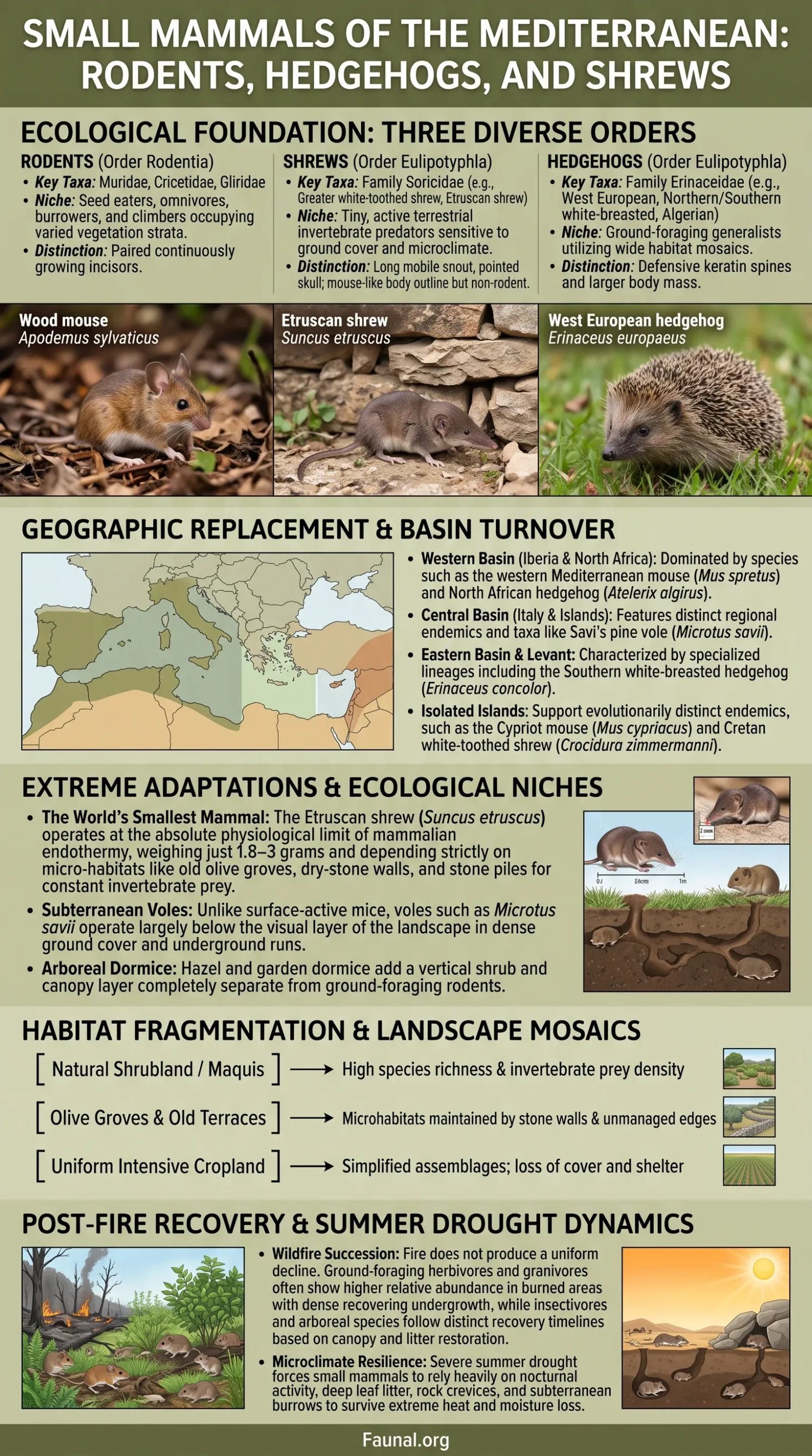
Mediterranean small mammals include rodents adapted to woodland, scrub, farmland and dry ground, tiny shrews that depend heavily on invertebrate-rich microhabitats, and several hedgehog species whose ranges replace or overlap with one another around the basin. There is no single Mediterranean small-mammal community: Iberia, North Africa, Italy, the Balkans, Mediterranean islands and the eastern basin support different combinations of species.
The Mediterranean Basin Biodiversity Hotspot contains almost 300 mammal species according to the Critical Ecosystem Partnership Fund, with rodents and shrews forming much of its mammalian diversity and Muridae reported as its largest mammal family. [a] The term small mammal, however, is an ecological and field-survey grouping rather than a formal taxonomic rank. Rodents belong to Rodentia, while true shrews and hedgehogs belong to Eulipotyphla. Current names and higher classification used here follow the American Society of Mammalogists’ Mammal Diversity Database, whose current release is version 2.5. [b]
| Group | Current taxonomic position | Mediterranean ecological pattern | Useful distinction |
|---|---|---|---|
| Rodents | Order Rodentia; Mediterranean representatives include Muridae, Cricetidae and Gliridae | Seed eaters, omnivores, herbivores, burrowers, ground foragers and climbing species occupy many habitat layers | Paired continuously growing incisors distinguish rodents from shrews |
| Shrews | Order Eulipotyphla; family Soricidae | Mostly small, active predators of terrestrial invertebrates; many respond strongly to ground cover and microclimate | Long mobile snout and pointed skull; not rodents despite a mouse-like body outline |
| Hedgehogs | Order Eulipotyphla; family Erinaceidae | Ground-foraging mammals using wider habitat mosaics than the smallest shrews and mice | Defensive spines and larger body size separate them immediately from other groups on this page |
The Mediterranean Boundary Changes the Species List
A species occurring somewhere in Spain, Türkiye, Morocco or another Mediterranean country is not automatically part of Mediterranean fauna throughout that country. Coastal Mediterranean climates, mountain systems, interior steppes, deserts, humid northern forests and islands form different biological regions. This page therefore treats Mediterranean small mammals as animals documented from Mediterranean and immediately adjoining landscapes, not as a complete mammal checklist for every country touching the sea.
Mediterranean Small-Mammal Fauna Changes Across the Basin
The western basin contains a strong Iberian–North African element. The western Mediterranean mouse Mus spretus, also known as the Algerian mouse, occurs in southern France, Spain and Portugal and across Morocco, Algeria, Tunisia and Libya. The Mammal Diversity Database specifically associates it with natural grasslands and agricultural fields in the western Mediterranean climatic zone. [c]
The wood mouse Apodemus sylvaticus has a much broader geographic pattern. Its range spans much of Europe, reaches northwestern Türkiye, crosses the Atlas region of Morocco, Algeria and Tunisia, and includes numerous Mediterranean islands. Its presence illustrates why a widespread European species and a characteristically western Mediterranean species can occur in the same landscape without having the same biogeographic history. [d]
Italy adds another rodent pattern. Savi’s pine vole, Microtus savii, is currently recognized by the Mammal Diversity Database from Italy and Switzerland, and its taxonomic history includes the removal of Microtus nebrodensis from the broader concept formerly applied to M. savii. This is a useful example of why older Mediterranean mammal lists cannot always be copied into a current regional account without checking species limits. [e]
The eastern basin and Mediterranean islands add still more turnover. Cyprus supports the Cypriot mouse Mus cypriacus, a distinct species described from the island rather than a local form of a mainland mouse. Crete supports the Cretan white-toothed shrew Crocidura zimmermanni. These restricted island mammals make Mediterranean small-mammal geography fundamentally different from a simple continental checklist.
| Species | Group | Mediterranean geographic signal | Current taxonomic or status point |
|---|---|---|---|
| Mus spretus | Rodent | Western Mediterranean Europe and North Africa | Accepted species; strongly associated with the western basin |
| Apodemus sylvaticus | Rodent | Broad European and North African range, including many Mediterranean islands | Far broader than a Mediterranean endemic |
| Microtus savii | Rodent | Italian-centered Mediterranean example | Current concept excludes some populations formerly grouped under this name |
| Mus cypriacus | Rodent | Cyprus | Island endemic species [f] |
| Crocidura russula | Shrew | Southern and western Europe plus northwestern Africa | Greater white-toothed shrew; a major western Mediterranean study species [g] |
| Suncus etruscus | Shrew | Southern Europe and North Africa, with a much wider range continuing eastward | Etruscan shrew; one of the smallest living mammals by mass |
| Crocidura zimmermanni | Shrew | Crete, Greece | Accepted Cretan endemic; current MDD-linked IUCN category Endangered [h] |
| Atelerix algirus | Hedgehog | North African Mediterranean zone, with introduced populations north of the sea | Native distribution extends from coastal Western Sahara through northern Libya; introduced in several European and island areas [i] |
| Erinaceus europaeus | Hedgehog | Western and central European side of the basin, including Italy and several islands | Current global IUCN category Near Threatened [j] |
| Erinaceus roumanicus | Hedgehog | Balkans, Greece and parts of the northern eastern Mediterranean | Accepted separately from E. europaeus; current MDD-linked category Least Concern [k] |
| Erinaceus concolor | Hedgehog | Anatolia and the Levantine/eastern Mediterranean region | Southern white-breasted hedgehog; accepted as a separate species [l] |
A Mediterranean small mammal is therefore better understood through where in the basin it occurs, which habitat it uses and how its taxon is currently defined than through the broad label “Mediterranean species” alone.
Rodents Occupy Very Different Mediterranean Niches
Mediterranean rodents are not one ecological type. Mice in the genera Mus and Apodemus, voles such as Microtus, dormice in Gliridae, rats and several dryland rodent lineages differ in diet, locomotion, shelter and vegetation use. A field margin holding Mus spretus is not equivalent to woodland used by Apodemus, and neither resembles the partly subterranean habitat use of many voles.
Open Ground Favors a Different Mouse Community from Woodland
Mus spretus is particularly useful for understanding the western Mediterranean. Its distribution connects Iberian and North African landscapes, and it is associated with open natural grassland and agricultural ground rather than being simply another house mouse. By contrast, Apodemus sylvaticus occurs across woodland, scrub, hedgerows and other structurally covered habitats over a far larger geographic range.
These differences matter in agricultural mosaics. Removing shrub strips, field margins or uncultivated patches does not affect every rodent in the same direction. Species able to exploit open or disturbed land can persist where animals needing denser vegetation, woody cover or tree-connected habitat become less frequent.
Voles Work Mostly Below the Visual Layer of the Landscape
Voles differ from the long-tailed mice that dominate many public images of small mammals. Their compact bodies, shorter tails and stronger association with dense low vegetation or underground runways reflect a different way of using Mediterranean ground cover. In Italy, Microtus savii belongs to this ecological layer and occurs alongside mice and shrews without using the landscape in the same way.
Dormice Add an Arboreal and Shrubby Rodent Layer
Mediterranean Rodentia also includes dormice. Hazel dormice, garden dormice and edible dormice occur in parts of southern Europe, but their dependence on shrubs, trees, cavities or rocky shelter separates them from ground-foraging mice and voles. A woodland can therefore contain several rodent niches at once: ground feeding, burrowing, shrub movement and canopy-linked activity.
Shrews Depend on the Mediterranean Ground Layer
Shrews resemble mice superficially, but their ecology is different. They are Eulipotyphlan mammals with pointed snouts and diets dominated by animal prey, especially terrestrial invertebrates. For small Mediterranean shrews, conditions within a few centimetres of the soil surface can matter as much as the broad vegetation category visible from above.
The Etruscan Shrew Operates at an Extreme Body Size
The Etruscan shrew, Suncus etruscus, is the smallest living mammal by mass in the cited zoological study. Most adults weigh about 1.8–3 g and measure roughly 35–48 mm in body length. Mediterranean records are associated with habitats such as abandoned olive groves, vineyards, old dry-stone walls, stone piles, maquis and Mediterranean oak or pine woodland. Its minute size also makes it difficult to survey with conventional small-mammal traps. [m]
Those habitat descriptions show why small structures matter. An olive grove with bare, repeatedly disturbed soil is not ecologically equivalent to an old grove containing terraces, vegetation, stone crevices and unmanaged edges. The same distinction applies to vineyards and scrub: broad land-cover labels can hide large differences in shelter, humidity and prey availability at ground level.
Crocidura russula Responds to Mediterranean Vegetation Change
A ten-year study in Mediterranean habitats of Catalonia found that greater white-toothed shrew abundance, occupancy and colonization were consistently higher in shrublands than in woodlands within the study system. A later landscape analysis using protected areas in the same western Mediterranean region found that local vegetation change could alter predicted occupancy over relatively small spatial scales. [n]
This makes the common assumption that “more forest means better small-mammal habitat” unreliable. Afforestation can benefit some woodland rodents while reducing open Mediterranean shrub habitat used by another species. The biological response depends on the animal being measured.
Mediterranean Hedgehogs Form a Geographic Replacement Pattern
There is no single species called the Mediterranean hedgehog. Several Erinaceidae occur around the basin, and their geographic pattern changes from west to east and from the European shore to North Africa.
The West European hedgehog Erinaceus europaeus occupies the western European side of the basin. Erinaceus roumanicus extends through much of the Balkans and Greece, while Erinaceus concolor represents another white-breasted hedgehog lineage farther east, including Türkiye and the Levant. North Africa adds Atelerix algirus. Its presence in parts of Mediterranean Europe and on islands should not automatically be interpreted as natural colonization because current mammal taxonomy records several of those populations as introduced.
The West European Hedgehog Now Carries a Near Threatened Assessment
The IUCN Red List moved Erinaceus europaeus from Least Concern to Near Threatened in its October 2024 update. IUCN reported reductions in more than half of the countries in its range for which decline information was available and identified agricultural intensification, roads and urban development among the pressures associated with the reassessment. [o]
That category should not be transferred to every Mediterranean hedgehog. A 2025 review of European Erinaceidae found broad monitoring gaps and recurring pressures such as roads and habitat loss or degradation, while also emphasizing that available population evidence differs among species and regions. [p]
Mediterranean Islands Separate Endemism from Human-Mediated Arrival
Island records are among the most informative parts of Mediterranean small-mammal biogeography, but presence alone does not explain origin. A mammal on an island may represent an endemic lineage that evolved in isolation, a naturally established population, an old human-mediated introduction or a more recent arrival.
Cyprus Retains Its Own Wild Mouse Lineage
Mus cypriacus was described as an endemic Cypriot species after genetic, cytogenetic and morphological evidence separated the island’s non-commensal mouse from surrounding Eurasian Mus species. The original study recorded it mainly in the Troodos region in abandoned cultivation terraces, grassy areas and shrub vegetation, while noting stronger dominance of the house mouse in heavily human-modified lowland settings. [q]
Crete Preserves a Restricted Shrew
The Cretan white-toothed shrew Crocidura zimmermanni is currently accepted as a species in Soricidae and is documented from Greece with its type locality on Crete. Its restricted island distribution is very different from the much broader ranges of shrews such as Crocidura russula and Suncus etruscus.
Some Tiny Mammals Moved with People
The present range of the Etruscan shrew also contains a historical dispersal signal. A review of dated fossil evidence found an east-to-west pattern across the Mediterranean and inferred human-facilitated translocation as the main process behind part of its ancient westward dispersal. [r] This does not make every current population introduced, but it shows why island and coastal occurrence cannot always be interpreted from present-day geography alone.
Island Presence Does Not Establish Native Origin
Endemic, native and introduced describe different histories. An endemic species is restricted to a defined area; a native species need not be endemic; and a long-established island population can still descend from animals transported by people. These labels should be assigned from taxonomic, palaeontological, archaeological or historical evidence rather than from modern occurrence alone.
Shrubland, Woodland Edge and Traditional Farmland Form Different Small-Mammal Habitat
Mediterranean vegetation is highly seasonal, and small mammals experience it at ground level. Shade beneath shrubs, leaf litter, rock crevices, burrows, grass cover, tree cavities, stone terraces and moist drainage lines can create local conditions that differ sharply from exposed soil only a short distance away.
| Mediterranean habitat feature | Rodent relationship | Shrew relationship | Hedgehog relationship |
|---|---|---|---|
| Maquis and garrigue | Ground mice can use seeds, fruit, cover and dense low vegetation; species composition varies by region | Shrub litter and invertebrate prey can support white-toothed shrews | Provides cover beside open feeding ground |
| Open woodland and woodland edge | Apodemus and dormice may use different vertical layers | Leaf litter and sheltered ground can provide prey, though not every shrew favors closed woodland | Edge structure can combine resting cover and foraging space |
| Olive groves and vineyards | Suitability depends heavily on ground vegetation, margins and management intensity | Old terraces, stone structures and unmanaged vegetation can provide microhabitat for species such as Suncus etruscus | Can form part of a wider agricultural foraging mosaic |
| Dry-stone walls and rock piles | Crevices provide refuge for several small rodents | Ground-level crevices can retain shelter and hunting space for tiny shrews | Larger cavities and nearby vegetation can provide local cover |
| Uniform intensive cropland | Some adaptable species persist while assemblages can become simpler | Reduced ground complexity and invertebrate prey can remove suitable microhabitat | Large open areas may lack safe daytime shelter and connected movement routes |
| Riparian and wet patches | Local rodent assemblages differ from surrounding dry ground | Moisture can maintain invertebrate-rich ground conditions | Can provide feeding habitat and movement cover within dry landscapes |
Landscape Composition Alters the Whole Assemblage
A 2022 analysis of 21 small-mammal species from 86 georeferenced barn-owl pellet sites in central Italy found that taxonomic and functional composition changed with landscape composition and configuration. Assemblages became simpler along gradients with greater human pressure and lower cover of seminatural land. [s]
A 2026 study in northeastern Portugal reached a more detailed result rather than a simple “farmland versus nature” division. Using small mammals identified from barn-owl pellets at 40 nest sites, researchers found species richness declining with greater olive-grove cover while increasing with shrubland cover and chestnut-woodland patch density. Measures weighted toward common or dominant species responded differently from raw richness. [t]
The biological issue is therefore not whether a landscape contains agriculture. It is which land-cover types remain, how they are arranged, and whether low vegetation, woodland patches, field margins and other refuges persist between intensively managed areas.
Summer Drought Makes Microhabitat Structure More Important
Mediterranean summers combine high daytime temperatures with long dry periods. Small mammals reduce exposure through nocturnal activity, underground refuges, dense vegetation, rock crevices and other sheltered microhabitats. These responses operate at a scale much finer than a vegetation map. Two sites both classified as shrubland can differ in litter depth, shade, soil moisture, stone cover and prey availability.
Body size makes this especially relevant to shrews. Their high energy expenditure links survival closely to frequent feeding, while their prey is itself affected by moisture and ground structure. Rodents can respond differently because granivorous or herbivorous species may exploit seeds and vegetation unavailable to an invertebrate predator. Hedgehogs work at a larger spatial scale and can move between feeding patches and resting cover, but drought can still alter the abundance and accessibility of their invertebrate prey.
Wildfire Reorganizes Species Rather Than Producing One Uniform Response
Mediterranean fire changes vegetation height, canopy cover, food supply, shelter and near-ground conditions at the same time. The effect therefore depends on whether a small mammal forages on the ground, feeds mainly on invertebrates, depends on trees or survives fire below ground.
Research in Monte Pisano, Tuscany, examined small mammals almost three years after a 2018 fire. Ground-foraging herbivorous and granivorous mammals showed higher relative abundance in burned areas with dense recovering undergrowth. Insectivorous mammals showed a different pattern, while arboreal species remained strongly associated with forest structure. The study area itself supported a mixed assemblage including Suncus etruscus, several Crocidura, mice, Microtus savii and dormice. [u]
A recently burned site should therefore not be labeled simply suitable or unsuitable for small mammals. Fire severity, survival refuges, recovery of low vegetation, return of leaf litter and woody debris, and restoration of tree cover can favor different functional groups at different stages.
Barn Owl Pellets Reveal Small Mammals That Are Rarely Seen
Many Mediterranean small mammals are nocturnal, secretive and difficult to survey directly. Barn owls provide another evidence stream. Their pellets contain undigested bones and teeth from prey, allowing researchers to identify many rodents and shrews from skull and dental characters and to reconstruct local prey assemblages over repeated samples.
Pellet datasets are especially useful at landscape scale because material can be collected from many nesting or roosting sites. They are not equivalent to a complete census. The owl selects prey, hunts within a finite area and encounters species according to habitat access, prey behavior and local abundance. A species absent from pellets has not automatically been proven absent from the surrounding landscape.
The Italian 2022 and Portuguese 2026 studies demonstrate the value of this method for comparing Mediterranean landscapes. Their results should still be interpreted as predator-mediated samples of small-mammal communities rather than exact population counts for every species.
Field Identification Often Stops Above Species Level
Some Mediterranean small mammals can be assigned to a broad group from a good view, but species-level identification is often harder. A long-tailed mouse may belong to Apodemus or Mus; several white-toothed shrews have similar external proportions; and eastern European hedgehogs cannot be assigned reliably from geography-free photographs alone.
| Observation | Reasonable first interpretation | Where identification becomes difficult |
|---|---|---|
| Small mouse with long tail and large eyes | Mouse-type rodent | Mus and Apodemus species can require measurements, locality and closer characters |
| Compact rodent with short tail | Vole-type rodent | External appearance alone may not separate regional Microtus taxa |
| Very small mammal with narrow pointed snout | Shrew | Several Crocidura species are externally similar |
| Extremely tiny long-snouted shrew | Possibly Suncus etruscus where range fits | Body size estimates from photographs are unreliable without scale |
| Spiny nocturnal mammal | Hedgehog | Species assignment around the Balkans and eastern Mediterranean requires location and diagnostic characters |
| Mouse on a Mediterranean island | Rodent occurrence | Appearance alone cannot establish whether the population is endemic, native or introduced |
Different Small Mammals Register Different Forms of Landscape Change
Rodents, shrews and hedgehogs occupy overlapping landscapes but do not measure the same ecological conditions. A ground-feeding mouse can respond rapidly to seed production and low vegetation. A shrew can respond to changes in litter, humidity and invertebrate prey. A dormouse may remain tied to shrubs and woody structure, while a hedgehog can cross several habitat patches during nocturnal foraging but encounter roads and other barriers between them.
That difference is why small-mammal communities can change over short distances around the Mediterranean. A valley with shrubland, an olive terrace with stone walls, an intensively managed plain, an oak slope and a nearby island may all lie under the same regional climate label while supporting different combinations of rodents and Eulipotyphlans.
The most informative Mediterranean pattern is therefore often species replacement: western mice giving way to eastern lineages, mainland taxa disappearing or changing on islands, shrews responding to local vegetation structure, and hedgehog species changing across continental boundaries. Those transitions record climate, habitat structure, isolation, historical dispersal and land use at a finer scale than the phrase “Mediterranean fauna” alone can show.
Sources and Verification
- [a] CEPF — Mediterranean Basin: Species — Used for the basin-level mammal diversity context and the prominence of small mammals, rodents and shrews.
- [b] American Society of Mammalogists — Mammal Diversity Database — Used for the current mammal taxonomic release and higher classification.
- [c] Mammal Diversity Database — Mus spretus — Used for accepted taxonomy, western Mediterranean distribution and documented grassland/agricultural habitat context.
- [d] Mammal Diversity Database — Apodemus sylvaticus — Used for accepted taxonomy and its broad European, North African and Mediterranean-island distribution.
- [e] Mammal Diversity Database — Microtus savii — Used for current distribution and the taxonomic note concerning the narrower modern species concept.
- [f] Mammal Diversity Database — Mus cypriacus — Used to verify the Cypriot mouse as an accepted living species restricted to Cyprus.
- [g] Mammal Diversity Database — Crocidura russula — Used for current taxonomy and the southern/western European and North African distribution of the greater white-toothed shrew.
- [h] Mammal Diversity Database — Crocidura zimmermanni — Used for accepted taxonomy, Cretan type locality and the linked current global conservation category.
- [i] Mammal Diversity Database — Atelerix algirus — Used to separate its native North African range from documented introduced populations in Mediterranean Europe and islands.
- [j] Mammal Diversity Database — Erinaceus europaeus — Used for current taxonomy, western European distribution and linked Near Threatened status.
- [k] Mammal Diversity Database — Erinaceus roumanicus — Used for current treatment of the northern white-breasted hedgehog and its Balkan/eastern European distribution.
- [l] Mammal Diversity Database — Erinaceus concolor — Used for accepted taxonomy and the southern white-breasted hedgehog’s eastern Mediterranean distribution.
- [m] Galán-Puchades et al. — Etruscan Shrew Study — Used for adult body mass, body length, trapping difficulty and Mediterranean habitat examples for Suncus etruscus.
- [n] Torre et al. — Population Dynamics of Crocidura russula in Mediterranean Habitats — Used for long-term habitat and seasonal responses of greater white-toothed shrews in Catalonia.
- [o] IUCN — 2024 Red List Update — Used for the West European hedgehog’s change to Near Threatened and the pressures cited with that reassessment.
- [p] Biological Conservation — Conservation Concern for Europe’s Hedgehog Species — Used for current monitoring gaps and shared road and habitat pressures affecting European Erinaceidae.
- [q] Cucchi et al. — A New Endemic Species of Mus on Cyprus — Used for the original taxonomic evidence and reported habitat pattern of the Cypriot mouse.
- [r] Domínguez García, Laplana & Sevilla — Etruscan Shrew Dispersal Along the Mediterranean Basin — Used for fossil evidence and the inferred role of ancient human-facilitated translocation in westward dispersal.
- [s] Ecological Indicators — Small Mammals Across the Mediterranean Area — Used for the 21-species, 86-site analysis relating assemblage composition to landscape structure and human pressure.
- [t] Global Ecology and Conservation — Small-Mammal Diversity in Mediterranean Agroecosystems — Used for the 2026 northeastern Portugal results on olive groves, shrubland, chestnut woodland and different diversity measures.
- [u] Mammal Research — Small-Mammal Assemblage After Mediterranean Fire — Used for the Monte Pisano post-fire comparison among ground granivores, insectivores and arboreal mammals.
Related Topics
- → Mammals of the Mediterranean Basin: Native Species and Habitats
- → Large Carnivores of the Mediterranean: Wolves, Bears, Lynx, and Wild Cats
- → Mediterranean Ungulates: Deer, Goats, Sheep, and Wild Boar
- → Marine Mammals of the Mediterranean Sea
- → Bats of the Mediterranean Basin: Cave, Forest, and Urban Species
- → Island Mammals of the Mediterranean: Native and Introduced Species