Complete guides: •Fauna of the Mediterranean Basin•Regional Fauna Guides•Mammals
The Mediterranean Basin does not contain one uniform mammal community. Its native mammals include European, North African and western Asian lineages distributed across scrub, open woodland, mountains, karst, grassland, wetlands, islands and marine waters. In the CEPF Mediterranean Basin hotspot account, almost 300 mammal species are reported, including 38 terrestrial endemics, but that source-defined total should not be treated as a single current checklist for every land and sea area called “Mediterranean.” [a]
Geographic turnover is central to the mammal fauna. Iberia contains restricted western Mediterranean mammals such as the Iberian lynx and Cabrera’s vole. The Maghreb adds Barbary macaque, Cuvier’s gazelle and other North African lineages. Dinaric karst supports isolated Balkan small mammals, while Anatolia and the Levant connect Mediterranean habitats with western Asian fauna. Islands add another layer because present-day occurrence may reflect natural isolation, prehistoric human transport, historical introduction or recent colonization.
A Mediterranean Mammal Count Changes With the Boundary
“Mediterranean Basin mammals” can describe several overlapping biological areas. A terrestrial biodiversity-hotspot boundary, the Mediterranean climatic region and the Mediterranean Sea do not contain identical species sets. A mammal may occur inside a Mediterranean country while occupying only alpine, temperate, steppe or desert habitat outside the local Mediterranean zone. Marine mammals follow oceanographic boundaries rather than the vegetation and climate boundaries used for terrestrial fauna.
| Geographic scope | What it includes | Mammal interpretation |
|---|---|---|
| Mediterranean terrestrial region | Mediterranean coasts, lowlands, islands, mountains, woodland, scrub, grassland, wetlands and adjoining transition zones | Useful for relating terrestrial mammals to Mediterranean habitats, but boundaries change with the ecological definition used. |
| Mediterranean Basin Biodiversity Hotspot | A conservation boundary extending across parts of southern Europe, North Africa and western Asia | Useful for source-defined richness and endemism estimates. Its published totals should retain the source’s geographic and taxonomic scope. |
| Mediterranean Sea | Marine waters connected naturally with the Atlantic through the Strait of Gibraltar | Cetaceans and the Mediterranean monk seal require marine occurrence, residency and habitat criteria rather than a terrestrial climate boundary. |
| Mediterranean countries | Entire national territories bordering or associated with the Mediterranean | Too broad to define Mediterranean habitat use by itself. National mammal lists can contain species restricted to non-Mediterranean parts of a country. |
Why the Hotspot Mammal Total Is Not a 2026 Checklist
CEPF’s regional mammal figures summarize conservation data assembled under a stated hotspot scope. Mammal taxonomy continues to change. The Mammal Diversity Database currently uses version 2.5, released in July 2026, and records new splits and other taxonomic revisions that can alter how older species totals map onto current accepted taxa. [b]
Native Status Is Most Difficult on Islands and Ancient Transport Routes
Present-day presence does not prove native origin. This matters especially on Mediterranean islands, where people have moved mammals for food, hunting, farming and transport for thousands of years. Rabbits, hares, goats, mouflon, deer, hedgehogs, shrews and small rodents can therefore have very different histories from one island to another.
| Status | Meaning in a Mediterranean mammal context | Why it matters |
|---|---|---|
| Native | The population occurs within a natural geographic range without evidence that people established it there. | Native status concerns origin, not whether the species is common, threatened or restricted to the Mediterranean. |
| Endemic | The taxon is native and restricted to a defined Mediterranean region, island, peninsula or other stated area. | An endemic mammal can have a much smaller range than a widespread native species. |
| Ancient human-mediated population | The population may have been transported before modern historical records or long before current wildlife monitoring. | Long residence does not by itself establish natural colonization. |
| Recent introduction | Human activity established the population outside its native range in comparatively recent historical time. | Introduced occurrence should not be counted as evidence of native distribution. |
| Origin unresolved | Available archaeological, genetic or historical evidence does not securely separate natural arrival from human transport. | A categorical native or introduced label may be less accurate than preserving the uncertainty. |
The 2026 Rabbit Split Changes a Familiar Mediterranean Name
Rabbit records require an additional taxonomic caution. Mammal Diversity Database version 2.5 recognizes the Iberian rabbit, Oryctolagus algirus, following a 2026 split from Oryctolagus cuniculus. [c] The database currently treats O. algirus as occurring in Iberia and tentatively includes North African populations, while explicitly noting that the placement of those North African rabbits remains unresolved. [d]
Older ecological and conservation papers commonly used Oryctolagus cuniculus for rabbits that may now fall under more than one taxonomic treatment. Historical prey studies, distribution maps and island records should therefore retain the taxonomic context of the source rather than being silently relabeled.
Six Subregions Produce Different Mammal Communities
Summer drought and mild wet winters occur across much of the basin, but climate does not erase older barriers. Peninsulas, straits, mountain chains, islands and dry interior transitions divide mammal populations. The result is a series of overlapping faunal zones rather than a single Mediterranean species set.
| Subregion | Main landscape pattern | Representative mammal signal |
|---|---|---|
| Iberian–Alboran | Mediterranean scrub, open oak woodland, grassland, mountains and the transition across the Strait of Gibraltar | Iberian lynx, Cabrera’s vole and the newly recognized Iberian rabbit show western Mediterranean restriction at different taxonomic scales. |
| Tyrrhenian–Central Mediterranean | Italian Peninsula, Sicily, Sardinia, Corsica and smaller islands separated by different histories of isolation | Island bats and small mammals occur beside populations whose origin has been altered or obscured by prehistoric and historical introductions. |
| Adriatic–Dinaric | Limestone mountains, karst, caves, rocky slopes and deeply dissected relief | Restricted Balkan small mammals such as Martino’s Dinaric vole illustrate how rock systems and mountain isolation divide terrestrial ranges. |
| Aegean–Anatolian | Archipelagos, western Anatolian woodland, maquis, karst and steep mountain systems | European, Anatolian and western Asian mammals overlap; island populations often require separate origin checks. |
| Levantine–Eastern Mediterranean | Woodland and scrub grading toward steppe, semi-arid uplands and dry valleys | Golden jackal, caracal, striped hyena and other wider-ranging western Asian or Afro-Asian mammals can enter Mediterranean habitat mosaics without being Mediterranean endemics. |
| Maghreb | Coastal woodland and scrub, Atlas mountain systems and transitions toward drier North African landscapes | Barbary macaque, Cuvier’s gazelle and North African small mammals distinguish the southern side of the basin from Mediterranean Europe. |
Mediterranean Scrub and Open Woodland Work as a Habitat Mosaic
Maquis, garrigue, open oak woodland, pasture patches and scrubby field margins form structurally different feeding and shelter sites over short distances. Mammals using these landscapes do not necessarily depend on dense woody vegetation alone. Cover can provide denning or resting habitat, while nearby open ground supplies grasses, herbs, invertebrates or accessible prey.
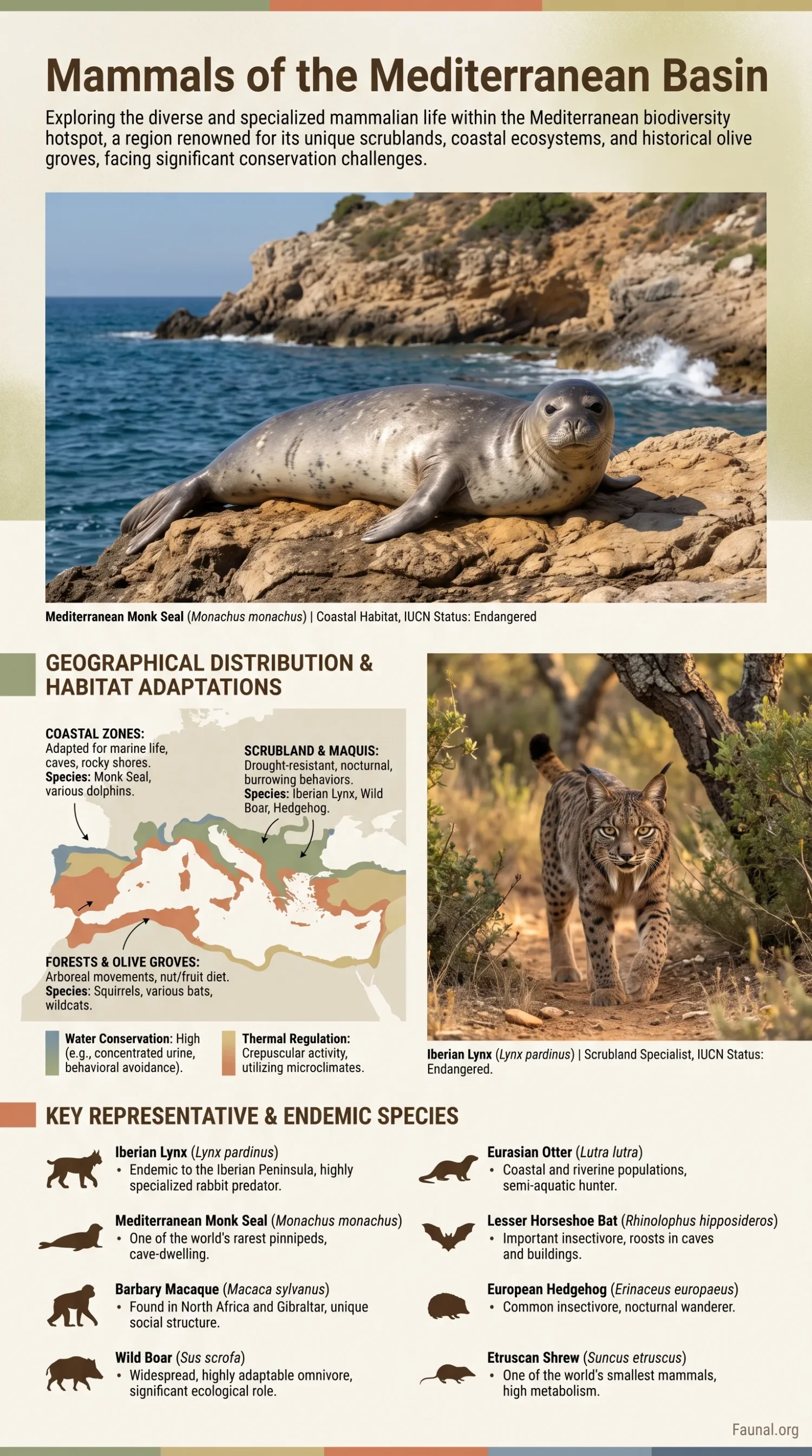
The Iberian lynx, Lynx pardinus, is the clearest large-mammal example. Its current wild range is in Spain and Portugal, and IUCN moved the species from Endangered to Vulnerable in 2024. The recovery programme combined rabbit-prey management, restoration of Mediterranean scrub and forest habitats, mortality reduction and reintroductions. IUCN reported 648 mature individuals in 2022, compared with 62 in 2001, with a total population above 2,000 when young and mature animals were combined. [g]
A species can be strongly associated with Mediterranean landscapes without depending on one vegetation type. For many mammals, the useful unit is a connected mosaic of shelter, feeding ground, prey habitat, water and movement cover.
Mountain Forests and Karst Create Short-Distance Isolation
The Atlas, Pyrenees, Apennines, Dinaric ranges, Hellenic mountains and Taurus Mountains interrupt otherwise Mediterranean-looking landscapes with steep elevation gradients. Cooler forest, exposed rock, talus, caves and high grassland can occur only a short distance from warm coastal scrub. This allows mountain mammals to occupy ecological conditions that differ sharply from nearby lowlands.
Martino’s Dinaric vole, Dinaromys bogdanovi, is a useful example of geographic restriction. Current Mammal Diversity Database records place it in isolated pockets of western Balkan karst mountains, including the Dinaric Alps and Šara–Pindus systems. [h] Its distribution is more informative about the Dinaric landscape than a basin-wide list in which it would appear beside mammals spanning several continents.
Karst also matters to bats, but a cave is usually only one part of a bat’s habitat. Roosting and hibernation sites can occur in caves and rock systems while feeding takes place over water, woodland edges, pasture, orchards or other insect-rich habitats. Protecting a roost without retaining surrounding feeding habitat and movement routes can therefore leave only part of the ecological system intact.
Dry Grassland and Semi-Arid Margins Add North African and West Asian Mammals
The Mediterranean biome grades into drier systems rather than ending at one sharp vegetation line. This transition is especially visible in the Maghreb and eastern Mediterranean, where scrub and open woodland meet dry grassland, rocky uplands, steppe and semi-desert. Mammal communities change with that gradient.
Cuvier’s gazelle, Gazella cuvieri, is a North African example. Current Mammal Diversity Database distribution places the species in Morocco, northern Algeria and Tunisia and notes no reliable record from Libya. [f] Its restricted Maghreb distribution contrasts with species such as caracal, striped hyena and red fox, whose total ranges extend far beyond the Mediterranean Basin.
This distinction prevents two common errors: treating every mammal occurring in Mediterranean habitat as a Mediterranean endemic, and defining Mediterranean mammal fauna only by moist woodland or coastal scrub. Dry open habitats are part of the regional transition system and support species that are poorly represented by a forest-centered species list.
Rivers, Wetlands and Farmland Add Habitat That Summer Drought Cannot Replace
Permanent rivers, springs, marsh edges, riparian woodland and wet meadows occupy a small proportion of many Mediterranean landscapes but provide water, dense vegetation and concentrated insect or aquatic prey. Eurasian otters use aquatic systems, while several bats forage over rivers and wetlands. Small mammals can also depend on moist grassland or dense herbaceous vegetation that disappears from surrounding dry ground during summer.
The long-fingered myotis, Myotis capaccinii, is distributed through Mediterranean parts of Europe, North Africa and western Asia under current Mammal Diversity Database treatment. [j] Its ecology also demonstrates why “cave bat” is an incomplete habitat label: roost availability and productive freshwater feeding areas can be separate landscape requirements.
Traditional agricultural mosaics can add another layer. Open grazing land, orchards, olive groves, hedgerows, stone structures and remnant woodland may retain shelter and feeding habitat when managed at low intensity. The effect reverses where large monocultures, heavy chemical use, removal of field margins or dense infrastructure simplify the landscape. Abandonment can also alter open habitats when shrub and tree succession removes long-maintained grassland or pasture structure.
Small Mammals Carry Much of the Basin’s Local Geographic Signal
Large carnivores and ungulates attract more attention, but rodents and shrews account for much of the terrestrial endemism reported for Mediterranean mammals. CEPF specifically identifies small mammals as the majority of the hotspot’s mammal fauna and notes that rodents and shrews form a large part of its endemic component.
| Small mammal | Current geographic evidence | Biogeographic value |
|---|---|---|
| Cabrera’s vole (Microtus cabrerae) | Current range is fragmented in Spain and Portugal; subfossil evidence documents former occurrence north of its modern range. | Shows how a restricted Iberian mammal can retain a much smaller modern distribution than broader European mammals. [q] |
| Martino’s Dinaric vole (Dinaromys bogdanovi) | Isolated western Balkan mountain and karst populations. | Links mammal distribution to Dinaric relief, rocky substrate and geographic fragmentation. |
| Cretan white-toothed shrew (Crocidura zimmermanni) | Recorded by the current Mammal Diversity Database from Greece, with type locality on Crete. | An island-restricted lineage showing that mammal endemism is not limited to conspicuous large species. [i] |
Small range size also makes taxonomy especially important. Splitting a widespread name into two accepted species can reveal a much narrower geographic unit, while synonymizing names can have the opposite effect. Regional counts should therefore state which taxonomic treatment they follow rather than presenting mammal totals as timeless values.
Bats Connect Caves With Water, Woodland and Open Ground
Mediterranean bat diversity cannot be mapped by cave locations alone. Different species use caves, mines, rock crevices, tree cavities or buildings for roosting, then travel into woodland edges, wetlands, pasture, orchards and open airspace to feed. Seasonal roost needs can also change between maternity, mating and winter periods.
This creates a habitat-connectivity problem different from that of a mammal confined to one patch of scrub. A bat colony may depend on an undisturbed underground roost and on feeding habitat several kilometres away. Roads, lighting, intensive land use, removal of old trees, water degradation and repeated disturbance at roost entrances can affect different parts of the same population’s habitat.
Island bats add another geographic layer because flight permits sea crossings that are impossible for many non-flying small mammals, yet island isolation can still produce restricted lineages. Bat distributions therefore do not follow the same island rules as shrews, voles or terrestrial carnivores.
Large Carnivores Are Native to Parts of the Basin Without Being Mediterranean Endemics
The Iberian lynx is exceptional because its natural range is restricted to Iberia. Most other large or medium-sized carnivores occurring around the basin occupy much broader geographic ranges. Gray wolf, red fox, European wildcat, golden jackal, caracal and striped hyena can all occur within Mediterranean landscapes, but their total distributions extend into other climatic and biogeographic regions.
The direction of those broader connections changes around the sea. Wolves and several mustelids link Mediterranean Europe with temperate Eurasia. Golden jackals connect southeastern Europe and western Asia. Caracals and striped hyenas add African and western Asian components along southern and eastern margins. A basin-wide carnivore list therefore combines mammals with very different evolutionary and geographic relationships to Mediterranean habitat.
Ungulates Follow Woodland, Rocky Mountains and Dry Uplands
Wild boar and several deer populations use woodland and open-ground mosaics in parts of Mediterranean Europe. Wild goats occupy steep rocky terrain in parts of the eastern basin, while Cuvier’s gazelle represents a different North African dry-upland fauna. These mammals should not be grouped under one generic “Mediterranean forest” habitat.
Island ungulates require extra caution. Goats, sheep, deer and related mammals have been repeatedly transported among Mediterranean islands and mainlands. A modern free-ranging population can be ecologically important without being naturally native to the island where it now occurs. Archaeological and genetic evidence is therefore more informative than present-day abundance when origin is disputed.
The Barbary Macaque Belongs to the Maghreb, Not Naturally to Gibraltar
Macaca sylvanus is the only living non-human primate native to the Mediterranean Basin. Current Mammal Diversity Database distribution identifies native populations in Morocco and Algeria and explicitly marks Gibraltar as introduced. [e]
That distinction matters because Gibraltar is one of the species’ most familiar locations in popular culture. Treating the Gibraltar population as evidence of a native European primate range would obscure the species’ natural North African biogeography. Its remaining native distribution instead reflects mountain and forest systems of the Maghreb.
Marine Mammals Need an Oceanographic Definition of Mediterranean Presence
Terrestrial native status cannot simply be transferred to whales and dolphins. Marine mammals move through a connected sea whose depth, shelf width, productivity, water masses and access to the Atlantic vary strongly between subregions. IUCN’s current Mediterranean cetacean account reports 24 cetacean species recorded in the Mediterranean Sea, of which 10 are considered resident. [k]
| Marine occurrence class | Meaning | How it should affect a Mediterranean mammal list |
|---|---|---|
| Resident cetacean | Uses the Mediterranean as a regular part of its annual range, with populations occurring through the year. | Belongs to the core Mediterranean marine mammal assemblage. |
| Regular visitor | Occurs repeatedly but does not have the same regional residency pattern. | Should be separated from resident taxa rather than merged into one undifferentiated species count. |
| Vagrant or exceptional record | Rare occurrence outside the normal regional pattern. | A confirmed record documents occurrence but does not establish a resident Mediterranean population. |
| Mediterranean monk seal | A pinniped rather than a cetacean, using marine waters and suitable coastal resting or breeding habitat. | Belongs to the marine mammal fauna but requires coastal-habitat evidence different from pelagic cetacean data. |
Cetacean Habitat Is Not Uniform Across the Sea
A 2026 basin-scale study modelled habitat suitability for eight Mediterranean cetaceans using survey-based occurrence records collected from 2006 to 2016. The results reinforce an important distinction between a species being recorded in the Mediterranean and the entire sea being equally suitable habitat. Depth, slope, oceanographic zoning and other environmental conditions produce different habitat patterns for coastal dolphins, pelagic dolphins, deep-diving whales and other cetaceans. [l]
The Mediterranean Monk Seal Also Has an Atlantic Population Component
The Mediterranean monk seal, Monachus monachus, is the resident seal species most closely associated with Mediterranean rocky coasts and sheltered resting or pupping sites. Current Mammal Diversity Database treatment lists it as Vulnerable and records a range extending beyond the Mediterranean into Atlantic northwest Africa and nearby Atlantic islands. [m]
IUCN reported in 2026 that roughly 800–1,000 Mediterranean monk seals remain globally and identified Greece, Türkiye and Cyprus among major Mediterranean areas, alongside Atlantic populations around Madeira and Cabo Blanco. [n] The 800–1,000 figure is therefore a global species estimate, not a count of seals inside the Mediterranean Sea alone.
Representative Native Mammals by Subregion and Habitat
The table below is a representative habitat-oriented set, not a claim to be a complete Mediterranean Basin checklist. It includes restricted species alongside widespread mammals whose native ranges enter Mediterranean landscapes. Current scientific names follow the Mammal Diversity Database treatment where applicable.
| Mammal | Scientific name | Mediterranean association | Typical habitat relationship | Range character |
|---|---|---|---|---|
| Iberian lynx | Lynx pardinus | Iberian Peninsula | Scrub, open woodland and prey-rich habitat mosaics | Iberian endemic |
| Cabrera’s vole | Microtus cabrerae | Spain and Portugal | Grassland and moist herbaceous patches | Restricted Iberian range |
| Iberian rabbit | Oryctolagus algirus | Iberia; North African placement currently treated with taxonomic caution | Scrub, grassland and agricultural mosaics | Recognized as a separate species in MDD v2.5 |
| Barbary macaque | Macaca sylvanus | Morocco and Algeria | Mountain forest, woodland and scrub mosaics | Native North African range; Gibraltar introduced |
| Cuvier’s gazelle | Gazella cuvieri | Morocco, northern Algeria and Tunisia | Dry uplands, open wooded country and scrub | North African regional species |
| Barbary sheep | Ammotragus lervia | North African mountains | Dry rocky slopes, cliffs and rugged uplands | Native range extends beyond Mediterranean habitat |
| Martino’s Dinaric vole | Dinaromys bogdanovi | Western Balkans | Rocky karst and mountain terrain | Restricted Balkan distribution |
| Cretan white-toothed shrew | Crocidura zimmermanni | Crete | Terrestrial island habitats including upland landscapes | Island-restricted taxon |
| Long-fingered myotis | Myotis capaccinii | Southern Europe, North Africa and western Asia | Underground roosts linked with freshwater feeding habitat | Mediterranean-associated but not basin-endemic |
| Greater horseshoe bat | Rhinolophus ferrumequinum | Many northern and eastern Mediterranean landscapes | Caves or buildings connected with woodland and open feeding areas | Wider Palearctic range |
| Schreiber’s bent-winged bat | Miniopterus schreibersii | Broad Mediterranean occurrence | Cave roosts with foraging over varied open and wooded habitats | Range extends beyond the basin |
| Egyptian fruit bat | Rousettus aegyptiacus | Eastern Mediterranean and Levant | Caves linked with fruiting woodland and cultivated landscapes | Broader African and western Asian range |
| Eurasian otter | Lutra lutra | Rivers, wetlands and some suitable coasts around the basin | Aquatic feeding habitat with secure banks and resting cover | Widespread Eurasian species |
| Golden jackal | Canis aureus | Balkans and eastern Mediterranean | Wetland margins, scrub, farmland and open woodland mosaics | Range extends well beyond Mediterranean habitats |
| Red fox | Vulpes vulpes | Much of the terrestrial basin | Broad habitat use from scrub and farmland to woodland | Very wide Holarctic range |
| European wildcat | Felis silvestris | Parts of Mediterranean Europe | Woodland, scrub and heterogeneous low-intensity landscapes | Not Mediterranean-endemic |
| Wild boar | Sus scrofa | Many mainland Mediterranean regions | Woodland, scrub, wet areas and farmland mosaics | Broad Eurasian range |
| Wild goat | Capra aegagrus | Eastern Mediterranean and adjacent western Asia | Steep rocky mountains, cliffs and broken terrain | Island populations require separate origin assessment |
| Striped hyena | Hyaena hyaena | Southern and eastern margins | Dry open country, scrub and rocky landscapes | Wider African and Asian range |
| Caracal | Caracal caracal | Parts of North Africa and the eastern Mediterranean | Dry scrub, open woodland and semi-arid terrain | Wider African and Asian range |
| Mediterranean monk seal | Monachus monachus | Mediterranean coasts with additional Atlantic populations | Coastal waters and secluded rocky resting or pupping sites | Mediterranean–Atlantic range |
| Common bottlenose dolphin | Tursiops truncatus | Mediterranean Sea | Especially coastal and shelf waters, with regional variation | Resident Mediterranean cetacean with a global range |
| Striped dolphin | Stenella coeruleoalba | Mediterranean Sea | Primarily pelagic waters | Resident Mediterranean cetacean with a much wider global range |
| Sperm whale | Physeter macrocephalus | Mediterranean Sea | Deep pelagic and slope-associated waters | Resident Mediterranean cetacean within a global species range |
| Fin whale | Balaenoptera physalus | Mediterranean Sea | Offshore waters with regional concentrations linked to productivity | Resident Mediterranean cetacean within a global species range |
Endemism Is Concentrated Unevenly Across Mammal Groups
The CEPF hotspot account reports 38 terrestrial endemic mammals, but those endemics are not evenly distributed by body size or geography. Restricted rodents, shrews and island or mountain lineages contribute strongly to the pattern. Wide-ranging carnivores and ungulates are more likely to cross the geographic boundary used for the Mediterranean Basin.
Peninsulas can preserve restricted mammals because mountains and climatic history separate populations from the rest of Europe. Islands create stronger barriers for non-flying mammals. Karst and isolated mountain blocks can divide small mammals even where larger carnivores move through a wider landscape. The same geographic map therefore produces different levels of isolation for a vole, a bat and a wolf.
Habitat Loss Acts Differently Across Mammal Communities
CEPF identifies agriculture, urban development, infrastructure, changes to natural systems and other land-use pressures across the Mediterranean Basin hotspot. Agricultural intensification and abandonment can both alter mammal habitat, although they act through different processes. Intensification can remove structural diversity, while abandonment can eliminate open habitats maintained by grazing or low-intensity cultivation. [o]
| Habitat system | Mammal groups affected | Main habitat pressures |
|---|---|---|
| Scrub and open woodland | Rabbits, small mammals, wildcats, foxes, Iberian lynx and other predators | Fragmentation, road networks, intensive land conversion, loss of prey habitat and changes in vegetation structure |
| Traditional grassland and farmland mosaics | Voles, hares, insect-feeding bats and mammals using field margins | Agricultural intensification, removal of hedges and margins, chemical use, or abandonment followed by loss of open habitat |
| Mountain forest | Barbary macaques, forest mammals, bats and wide-ranging carnivores | Forest degradation, roads, repeated disturbance, severe fire and loss of connected cover |
| Karst and caves | Cave-roosting bats and rocky-habitat small mammals | Roost disturbance, quarrying, infrastructure and loss of surrounding feeding habitat |
| Rivers and wetlands | Otters, water-associated small mammals and bats | Water abstraction, pollution, channel alteration, wetland drainage and reduced summer flow |
| Rocky coasts | Mediterranean monk seal | Human disturbance, coastal construction, loss of secure resting sites and fisheries interaction |
| Pelagic and deep marine waters | Dolphins and whales | Fisheries interaction, vessel traffic, underwater noise, pollution and prey change |
Iberian Lynx and Monk Seal Recovery Must Be Read at the Correct Scale
The Iberian lynx demonstrates that a regional mammal can improve under sustained habitat, prey and population management while remaining dependent on continued conservation action. Its 2024 IUCN change to Vulnerable reflects a documented recovery in Spain and Portugal, not the disappearance of threats such as road mortality, rabbit decline, disease and habitat change.
The Mediterranean monk seal presents a different geography. Recovery is distributed among separated Mediterranean and Atlantic population areas, so a global population estimate cannot be substituted for a Mediterranean-only count. The regional conservation strategy under the Barcelona Convention was updated at COP24 in 2025 and retains habitat protection, monitoring and reduction of human disturbance as operational priorities. [p]
Climate Pressure Reaches Mammals Through Water, Fire, Prey and Connectivity
Warming does not affect every Mediterranean mammal through the same mechanism. Mountain populations can lose cool or moist habitat as suitable conditions shift upward. Longer drought can reduce wetland extent, summer river flow and productive herbaceous patches. Changes in vegetation and disease can alter rabbit or rodent prey populations, which then affect predators. Larger and more severe fires can remove cover across broad connected areas even where fire is a natural part of Mediterranean vegetation dynamics.
Marine mammals face a different set of climate-linked changes because water temperature, circulation and prey distribution can shift suitable feeding habitat without any visible terrestrial habitat loss. The 2026 cetacean habitat models show why marine distribution should be evaluated through oceanographic conditions rather than distance from the Mediterranean coastline alone.
Across land and sea, Mediterranean mammal diversity is best understood as a set of connected habitat mosaics with different geographic histories. Scrub and oak woodland explain only part of the fauna. Mountain refuges, karst, semi-arid transitions, wetlands, old agricultural mosaics, islands, rocky coasts and deep marine waters each support mammals whose distribution reflects a different combination of habitat, dispersal ability, continental connection and isolation.
Sources and Verification
- [a] CEPF — Mediterranean Basin Species — Used for the hotspot-scale mammal richness estimate, terrestrial endemic count and the importance of small mammals in the regional fauna.
- [b] Mammal Diversity Database — Used for the current MDD version, accepted mammal taxonomy and the need to keep older regional totals separate from later taxonomic revisions.
- [c] MDD v2.5 Taxonomy Changes — Used to verify the 2026 split recognizing Oryctolagus algirus separately from Oryctolagus cuniculus.
- [d] MDD — Oryctolagus algirus — Used for the current Iberian rabbit record and MDD’s caution concerning the placement of North African populations.
- [e] MDD — Macaca sylvanus — Used to distinguish native Barbary macaque distribution in Morocco and Algeria from the introduced Gibraltar population.
- [f] MDD — Gazella cuvieri — Used for the current Cuvier’s gazelle distribution in Morocco, northern Algeria and Tunisia and the lack of a reliable Libyan record.
- [g] IUCN — Iberian Lynx Reassessment and Recovery — Used for the 2024 Vulnerable category change, mature-population figures, habitat restoration, prey management and reintroduction evidence.
- [h] MDD — Dinaromys bogdanovi — Used for the current taxonomic treatment and fragmented western Balkan karst distribution of Martino’s Dinaric vole.
- [i] MDD — Crocidura zimmermanni — Used for the accepted Cretan white-toothed shrew record, Greek distribution and Crete type locality.
- [j] MDD — Myotis capaccinii — Used for current taxonomy and Mediterranean geographic context of the long-fingered myotis.
- [k] IUCN — Conservation Status of Cetaceans in the Mediterranean Sea — Used for the current Mediterranean figure of 24 recorded cetacean species and 10 considered resident.
- [l] Karimi et al. 2026 — Mediterranean Cetacean Habitat Suitability — Used for the 2026 basin-scale habitat modelling of eight cetacean species and the environmental basis of non-uniform marine distribution.
- [m] MDD — Monachus monachus — Used for accepted Mediterranean monk seal taxonomy, current Vulnerable category and Mediterranean–Atlantic range context.
- [n] IUCN — 2026 Mediterranean Monk Seal Population Update — Used for the global estimate of roughly 800–1,000 animals and the distinction between Mediterranean and Atlantic population areas.
- [o] CEPF — Threats to Mediterranean Basin Biodiversity — Used for land-use pressures, agricultural intensification, abandonment, infrastructure and habitat-change patterns relevant to terrestrial mammal habitats.
- [p] SPA/RAC — Strategy and Action Plan on the Mediterranean Monk Seal — Used for the current regional conservation strategy and its 2025 update under the Barcelona Convention system.
- [q] MDD — Microtus cabrerae — Used for the current fragmented Spain–Portugal range and historical subfossil-range context of Cabrera’s vole.
Related Topics
- → Small Mammals of the Mediterranean: Rodents, Hedgehogs, and Shrews
- → Large Carnivores of the Mediterranean: Wolves, Bears, Lynx, and Wild Cats
- → Mediterranean Ungulates: Deer, Goats, Sheep, and Wild Boar
- → Marine Mammals of the Mediterranean Sea
- → Bats of the Mediterranean Basin: Cave, Forest, and Urban Species
- → Island Mammals of the Mediterranean: Native and Introduced Species