Complete guides: •Fauna of the Mediterranean Basin•Regional Fauna Guides•Mammals
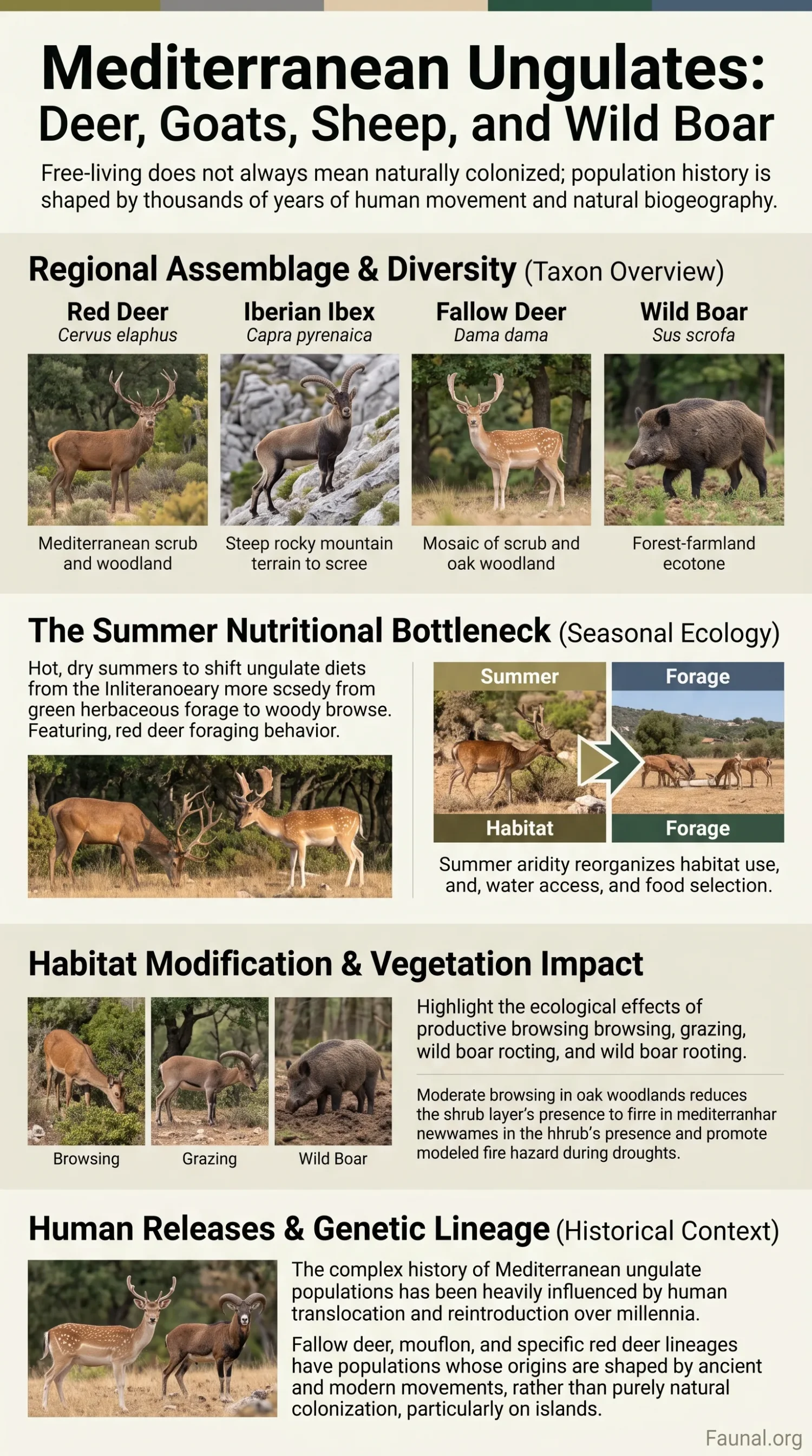
Mediterranean ungulates include widespread deer and wild boar, mountain-adapted goats and ibex, wild sheep lineages, and the North African Barbary sheep. They do not form one uniform fauna around the sea. Iberia, the Italian and Balkan peninsulas, Mediterranean islands, Anatolia, Cyprus, and the Maghreb contain different combinations of species, while several island and mainland populations have histories shaped by human translocation as well as natural biogeography.
This distinction matters especially in the Mediterranean Basin. A free-ranging population can be native to a mainland region, restored after local loss, descended from animals transported thousands of years ago, or established much more recently for hunting. The ecological setting is equally distinctive: hot dry summers, oak woodland, maquis and garrigue, agricultural edges, steep limestone terrain, and isolated islands create very different conditions from the colder forest systems often associated with European ungulates.
The Mediterranean Assemblage Changes by Taxon and Population History
| Group | Taxon | Mediterranean pattern | Population-history issue |
|---|---|---|---|
| Red deer | Cervus elaphus | Occurs across much of continental Europe and Anatolia, with a North African component in the Atlas Mountains of Algeria and Tunisia. | Current populations can contain native, restored, naturally expanding, and human-translocated lineages. [a] |
| Roe deer | Capreolus capreolus | Reaches Mediterranean Europe and extends through Turkey into parts of Southwest Asia, but is absent from Corsica, Sardinia, and Sicily in the current Mammal Diversity Database treatment. | Better regarded as a widespread temperate deer reaching Mediterranean landscapes than as a Mediterranean specialist. [b] |
| Fallow deer | Dama dama | Now widespread in Mediterranean Europe, while current taxonomic data identify naturally wild populations in southern Turkey. | Much of its present range reflects repeated human movement rather than uninterrupted natural distribution. [c] |
| Iberian ibex | Capra pyrenaica | A western Mediterranean mountain caprine associated with the Iberian Peninsula. | Unlike many Mediterranean island caprines, its basic biogeographic identity is tied to the Iberian mainland mountain system. [d] |
| Wild goat | Capra aegagrus | Occurs in Anatolia and adjoining parts of western Asia, placing its natural range along the eastern Mediterranean hinterland rather than across the whole basin. | Island goats resembling wild Capra require separate historical and genetic evaluation. [e] |
| Mouflon | Ovis gmelinii | The current Mammal Diversity Database treatment covers Asian mouflon in Turkey and neighbouring western Asia and also incorporates ancient Mediterranean island introductions. | The same taxonomic treatment includes ancient Mediterranean forms and later European introductions, so locality and population history must accompany the species name. [f] |
| Barbary sheep / aoudad | Ammotragus lervia | Native to North Africa, including Mediterranean-facing countries such as Morocco, Algeria, and Tunisia; introduced populations occur in Spain. | Despite the English name “Barbary sheep,” it belongs to genus Ammotragus, not Ovis. [g] |
| Wild boar | Sus scrofa | Extends across mainland Mediterranean Europe, Anatolia and parts of the Levant, and North Africa in Morocco, Algeria, and Tunisia. | The current taxonomic record identifies Corsican and Sardinian populations as ancient introductions. [h] |
Mediterranean occurrence and Mediterranean origin are not the same thing. A species may be ecologically established in the basin while a particular island or mainland population owes its presence to human transport.
Free-Living Does Not Always Mean Naturally Colonized
Fallow deer provide one of the clearest examples. A 2024 study combining archaeological evidence with ancient and modern biomolecular data found a long history of repeated human movement of Dama around the Mediterranean. The researchers identified Anatolia and the Balkans as the Holocene refugial area for European fallow deer and found no zooarchaeological support for autochthonous Holocene populations in Iberia or Italy. Modern Rhodes deer are associated with a Neolithic introduction, and early farmers also established fallow deer on other Mediterranean islands. The study identifies the Güllük Dağı-Termessos population in Turkey as the remaining native wild population of European fallow deer. [i]
European mouflon has a comparable but taxonomically more difficult history. Archaeological evidence places human transport of mouflon ancestors to Corsica and Sardinia roughly 6,000–7,000 years ago. Much later, mouflon were moved again as game animals across continental Europe and additional islands. Contact with domestic and feral sheep can also produce introgression, making external appearance alone unreliable for identifying hybrid ancestry. [j]
Cyprus combines endemism with prehistoric introduction
The Cyprus Department of Forests uses Ovis gmelini ophion for the Cyprus mouflon, describes the island form as endemic, and also states that it is thought to have been introduced by people around 8000 BC. These descriptions are not contradictory when endemism refers to the present island lineage and distribution rather than to natural colonization of Cyprus. [k]
Cretan goats need the same historical caution
The free-ranging Cretan goat, often called agrimi or kri-kri and historically classified as Capra aegagrus cretica, resembles the wild bezoar goat in phenotype. Genetic and archaeological work does not support treating that resemblance as proof of an autochthonous island population. Mitochondrial evidence shows affinity with domestic goats, while archaeological evidence places caprine arrival on Mediterranean islands within human settlement history. Whether the first Cretan animals were transported in wild form, as early domestic stock, or represent a more complicated sequence of introduction and later introgression remains part of the taxonomic problem. [l]
Deer Occupy Different Parts of the Forest–Scrub Mosaic
Red deer can shift from herbaceous forage to browse as summer dries
Mediterranean red deer commonly encounter a seasonal transition from productive spring herbaceous vegetation to dry summer forage. A three-summer study in southern Portugal found green herbaceous material available in June but not later in summer, even during the wetter study year. Red deer responded by eating much more browse in dry summers: browse represented 0.83–0.89 of the estimated summer diet in dry years, compared with 0.47 in the wet year. The researchers therefore identified summer, rather than winter, as a likely period of nutritional constraint in that Mediterranean system. [m]
This helps explain why Mediterranean red deer cannot be represented simply as grazers of open ground or browsers of woodland. Oak woodland, shrub cover, clearings, pasture, and agricultural edges can contribute different resources at different stages of the dry season.
Roe deer sits closer to the wooded Mediterranean margin
Roe deer belongs in a Mediterranean ungulate account, but not as a basin-wide specialist. Its broad Eurasian distribution reaches Mediterranean countries and continues through Turkey, yet its absence from Corsica, Sardinia, and Sicily and its stronger association with wooded and temperate landscapes produce a different geographic pattern from Iberian ibex or North African aoudad. In Mediterranean fauna, it is often most informative as a species of the northern, montane, or more wooded transition zone.
Fallow deer habitat does not reveal whether a population is native
Fallow deer can use woodland–grassland mosaics very effectively, which helps explain why established populations can appear fully integrated into Mediterranean landscapes. Habitat suitability, however, is not evidence of natural origin. A deer population can function as a wild ecological population for centuries or millennia while still descending from transported founders.
The Main Mountain Caprines Divide the Basin Geographically
Iberian ibex anchors the western mountain fauna
Capra pyrenaica is the clearest western Mediterranean representative of genus Capra. Its range is tied to the Iberian Peninsula, where populations occupy mountain terrain containing combinations of rock, open slopes, shrubland, grassland, and woodland. “Ibex habitat” should therefore not be reduced to bare cliffs. Steep escape terrain is important, but feeding areas can extend into less precipitous vegetation mosaics.
Wild goat marks the Anatolian and western Asian side
Capra aegagrus, the wild goat or bezoar, represents a different geographic axis. Its current natural-range treatment centres on Turkey, the Caucasus, Iran, Iraq, and adjacent parts of Asia. Within a Mediterranean context, the species is therefore most relevant to Anatolia and the basin’s eastern mountain hinterlands rather than to Mediterranean Europe as a whole.
Mouflon is a wild sheep problem as much as a distribution problem
Mouflon combines wild sheep taxonomy with a long record of human transport. Current Mammal Diversity Database treatment places the Anatolian and adjacent Asian form within Ovis gmelinii and includes Mediterranean island forms associated with ancient introduction. Consequently, “mouflon in the Mediterranean” can refer to populations with very different histories: western Asian wild populations, long-established island populations, and much newer game introductions.
Barbary sheep represents the North African caprine branch
The aoudad or Barbary sheep adds a distinctly North African element. Ammotragus lervia belongs to Bovidae and tribe Caprini, but it is neither a species of Ovis nor a Mediterranean mouflon. Its native distribution covers dry and rocky landscapes across North Africa. The population present in Spain has a different biogeographic meaning because it is introduced.
Wild Boar Breaks the Herbivore Pattern
Wild boar belongs to the Mediterranean ungulate fauna but differs fundamentally from the ruminant deer and bovids. It is an omnivorous suid capable of using woodland foods, underground plant material, invertebrates, agricultural resources, and other seasonally available foods. Its broad diet and ability to exploit forest–farmland edges allow it to persist across habitat combinations that would not support the same feeding strategy in an ibex or deer.
Mediterranean summer aridity still matters. A study using 16 years of data from a mixed forested–rural protected area found that wild boar did not show one uniform summer decline in body mass. Female mass rose through summer in rainy, mild years but fell in hot, dry years; lower aridity during the preceding three months was associated with higher body mass. The study also found a positive relationship between female body mass and the availability of ecotones between wooded and cultivated land, showing how agricultural edges can buffer some seasonal food limitation. [n]
Rooting changes the substrate, not only the plants eaten
Wild boar also affects habitat through rooting and trampling. A Mediterranean study in Tuscany found that the outcome depended on boar density and vegetation type. At the lower-density site, several measures of soil organic matter and biological activity were higher in affected soil, while the high-density site showed evidence of soil degradation. Woodland cover also buffered some negative effects better than olive-grove cover. Rooting therefore cannot be assigned one fixed ecological effect without considering intensity and habitat. [o]
The Dry Summer Reorganizes Food and Habitat Use
Mediterranean ungulates experience a seasonal sequence that differs from snow-dominated northern systems. Spring can provide abundant green herbaceous growth. As rainfall declines, annual vegetation dries, surface water becomes less reliable, and the nutritional value of herbaceous forage falls. Woody browse, shaded habitat, permanent water, agricultural crops, and persistent green patches can then become more important, depending on the species and locality.
The response is not identical across taxa. Red deer can shift strongly toward browse. Wild boar can compensate by using woodland–agricultural edges and cultivated foods when available. Mountain caprines can move among elevations, aspects, rocky refuges, shrublands, and feeding areas. Rainfall timing therefore affects more than water availability: it changes where usable forage persists across the landscape.
For Mediterranean ungulates, summer can be the main nutritional bottleneck. The strength of that bottleneck depends on rainfall, vegetation, access to water, population density, land use, and the animal’s feeding strategy.
Browsing, Grazing, and Rooting Can Push Vegetation in Different Directions
Ungulates alter Mediterranean habitats by removing plant biomass, selecting particular shrubs or seedlings, trampling vegetation and soil, transporting seeds, and, in the case of wild boar, physically turning the soil. The result depends on density, plant community, drought, previous land use, and the duration of animal pressure.
An 18-year browsing-exclusion experiment in a Portuguese Mediterranean oak woodland illustrates why the effect should not be reduced to “damage” or “benefit.” Drought increased dead shrub material and modeled fire hazard, while deer browsing reduced shrub density and biomass. Browsed plots consequently had lower total fuel load and lower modeled fire hazard than ungulate-excluded plots, even though browsing also altered shrub mortality and vegetation structure. [p]
| Ungulate process | Direct habitat effect | Why intensity matters |
|---|---|---|
| Browsing | Removes leaves, shoots, and woody plant biomass. | Moderate browsing can suppress dense shrub growth; sustained heavy browsing can restrict shrub and tree regeneration. |
| Grazing | Removes herbaceous biomass and changes competition among ground-layer plants. | Effects depend on forage productivity, season, soil, and the number of animals using the same ground. |
| Trampling | Compresses or disturbs soil and vegetation around paths, feeding sites, and water. | Local effects become stronger where animals repeatedly concentrate in small areas. |
| Wild boar rooting | Turns surface soil and litter while exposing below-ground food. | Low-intensity disturbance and high-density repeated disturbance can produce very different soil outcomes. |
Livestock Can Compete for the Same Mediterranean Feeding Patches
Wild caprines and domestic livestock often meet in the same mountain landscapes because both can depend on seasonal grasslands, shrublands, and water sources. The interaction is not automatically competitive; it depends on spatial overlap, forage quality, animal density, timing, and husbandry. Where high-quality feeding areas are limited, however, livestock can alter where wild ungulates feed.
A two-year study of free-ranging mouflon in central Sardinia found that the animals selected grasslands more strongly when grass was greener, but selection declined when livestock were nearby. The effect became especially clear at distances below roughly 650 m, where mouflon were displaced from preferred feeding sites toward less suitable habitat. The study area combined oak woodland, Mediterranean scrub, grassland and garigue, making the result directly relevant to a Mediterranean mountain mosaic rather than to livestock–wildlife overlap in the abstract. [q]
The Ungulate Pattern Changes from Iberia to the Maghreb and Anatolia
No single species list describes every Mediterranean shore. The basin is better treated as connected but distinct regional assemblages. The table below summarizes the main pattern rather than claiming a complete checklist for every country or island.
| Mediterranean sector | Characteristic ungulate elements | Biogeographic feature |
|---|---|---|
| Iberian Mediterranean | Iberian ibex, red deer, roe deer, established fallow deer, wild boar | The basin’s clearest western Capra centre, combined with drought-prone deer and boar landscapes. |
| Corsica and Sardinia | Mouflon, red-deer lineages, wild boar | Island histories are inseparable from prehistoric or later human movement; current wild status does not establish natural colonization. |
| Italy and the Adriatic–Balkan zone | Red deer, roe deer, fallow deer, wild boar, locally established mouflon | Mainland refugial history, recolonization and human releases can overlap within the same nominal species. |
| Aegean, Anatolia and Cyprus | Wild goat, Asian/Anatolian mouflon, Cyprus mouflon, native-range fallow deer in southern Turkey, wild boar | Eastern Mediterranean refugia and very old island translocations create some of the basin’s most difficult native-versus-introduced classifications. |
| Maghreb | Barbary sheep, North African red-deer populations, wild boar | North African mountains and woodland add a fauna that cannot be represented by European Mediterranean ungulates alone. |
Global Species Status and Local Population Condition Are Different Questions
A global conservation category describes a species at the scale used by the assessment. It does not establish that every Mediterranean population has the same conservation condition. A widespread species can contain small relict populations, restored populations, heavily managed hunting populations, or local areas with densities high enough to affect vegetation and agriculture.
The reverse is also important. An introduced population of a species that is threatened within its native range is not automatically equivalent to a native conservation population. North African Ammotragus lervia and introduced aoudad in Spain illustrate the distinction: they share a species name, but their biogeographic and conservation roles are different. The same principle applies to anciently transported mouflon and fallow deer, where management decisions may depend on genetic lineage and cultural history as well as present abundance.
Human Releases Still Shape Red Deer Lineages on the Italian Mainland
Population history is not only an island issue. A 2026 genetic study analysed mitochondrial DNA from 164 red deer sampled across Italian regions and identified 38 haplotypes belonging to three main European mitochondrial lineages. The authors found that human-mediated translocations have played a large role in the present distribution and mixing of lineages in Italy, layered over older signals produced by glacial refugia. The native lineage still surviving in peninsular Italy was confirmed in the relict Bosco della Mesola population, while much of the wider pattern reflected introductions or expansion from neighbouring regions. [r]
For Mediterranean ungulates, the biologically useful unit is therefore often more precise than a species name on a country list. Species identity, regional occurrence, population origin, habitat use, and genetic history can each answer a different question. Keeping those layers separate is especially important in a basin where people have moved deer, sheep, goats, and pigs for thousands of years.
Sources and Verification
- [a] Mammal Diversity Database — Cervus elaphus — Used for the accepted red-deer taxon, current broad distribution, Atlas Mountain occurrence, and taxonomy notes.
- [b] Mammal Diversity Database — Capreolus capreolus — Used for the current western roe-deer distribution and Mediterranean island exclusions.
- [c] Mammal Diversity Database — Dama dama — Used for accepted taxonomy, southern Turkish naturally wild populations, and the species’ extensive introduced range.
- [d] Mammal Diversity Database — Capra pyrenaica — Used for accepted Iberian ibex taxonomy and Iberian geographic scope.
- [e] Mammal Diversity Database — Capra aegagrus — Used for accepted wild-goat taxonomy and current mainland range in Anatolia and western Asia.
- [f] Mammal Diversity Database — Ovis gmelinii — Used for current mouflon taxonomy and treatment of ancient Mediterranean and later European introductions.
- [g] Mammal Diversity Database — Ammotragus lervia — Used for aoudad taxonomy, native North African distribution, and introduced status in Spain.
- [h] Mammal Diversity Database — Sus scrofa — Used for current wild-boar taxonomy, Mediterranean distribution, and ancient introduction to Corsica and Sardinia.
- [i] Baker et al. — The 10,000-year biocultural history of fallow deer and its implications for conservation policy — Used for fallow-deer refugia, Mediterranean translocations, Rhodes history, and the surviving native Turkish population.
- [j] Current Zoology — European wild mouflon and feral domestic sheep hybrids — Used for prehistoric Corsican and Sardinian mouflon introduction, later game translocations, and hybrid-identification limitations.
- [k] Cyprus Department of Forests — Fauna — Used for the official Cyprus mouflon treatment, island restriction, and stated prehistoric introduction history.
- [l] Horwitz & Kahila Bar-Gal — The Origin and Genetic Status of Insular Caprines in the Eastern Mediterranean — Used for the archaeological and mitochondrial evidence concerning free-ranging Cretan goats.
- [m] Bugalho & Milne — Red deer diet in a Mediterranean environment — Used for measured summer forage change and the dry-year increase in browse consumption by red deer.
- [n] Calosi et al. — Wild boar body-mass variation during Mediterranean summers — Used for the 16-year evidence on aridity, sex-specific summer mass change, population density, and ecotone availability.
- [o] Macci et al. — Effects of wild boar activity on Mediterranean soil properties — Used for density- and vegetation-dependent effects of rooting and trampling in Tuscany.
- [p] Lecomte et al. — Ungulate browsing, drought and fire hazard in Mediterranean oak woodland — Used for the 18-year exclusion experiment linking deer browsing with shrub biomass and modeled fire hazard.
- [q] Brivio et al. — Livestock displace European mouflon from optimal foraging sites — Used for measured livestock–mouflon overlap and displacement from high-quality Sardinian grasslands.
- [r] Pascariello et al. — Red deer mtDNA lineages in peninsular Italy — Used for the 2026 nationwide Italian genetic evidence on glacial history, native lineages, and human-mediated releases.
Related Topics
- → Mammals of the Mediterranean Basin: Native Species and Habitats
- → Small Mammals of the Mediterranean: Rodents, Hedgehogs, and Shrews
- → Large Carnivores of the Mediterranean: Wolves, Bears, Lynx, and Wild Cats
- → Marine Mammals of the Mediterranean Sea
- → Bats of the Mediterranean Basin: Cave, Forest, and Urban Species
- → Island Mammals of the Mediterranean: Native and Introduced Species