Complete guides: •Fauna of the Mediterranean Basin•Regional Fauna Guides•Mammals
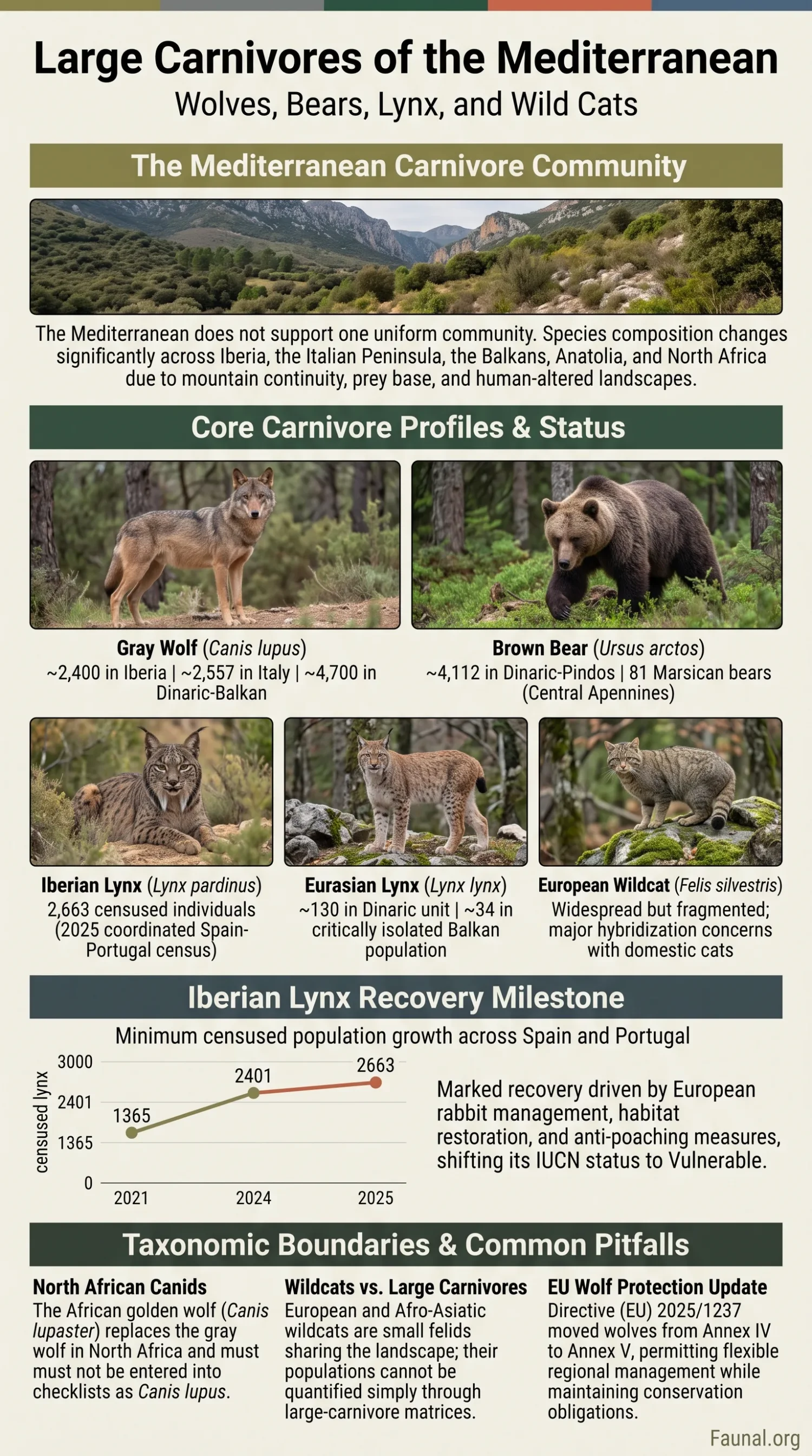
The Mediterranean does not support one uniform community of wolves, bears, lynx and wildcats. Gray wolves occupy several European and Anatolian population systems; brown bears are concentrated in mountain refuges such as the Dinaric–Pindos system and the central Apennines; Iberian lynx have expanded rapidly in Spain and Portugal; the Balkan Eurasian lynx population remains extremely small; and European and Afro-Asiatic wildcats add a separate layer of taxonomic and genetic complexity. The species that coexist in Iberia are therefore not the same assemblage found in Italy, the Balkans, Anatolia or North Africa.
The Mediterranean Carnivore Community Changes Across the Basin
Mediterranean climate alone does not define the range of these carnivores. Mountain continuity, forest and scrub structure, wild prey, livestock systems, roads, persecution history and links with neighbouring biogeographic regions all alter which predators persist. Several of the strongest populations occur in mountains that grade from Mediterranean vegetation into temperate, continental or alpine habitat.
| Carnivore | Scientific name | Mediterranean context |
|---|---|---|
| Gray wolf | Canis lupus | Large regional populations occur in Iberia, the Italian Peninsula and the Dinaric–Balkan system; the species also extends through Anatolia. |
| Brown bear | Ursus arctos | Strongest Mediterranean-linked European population is the Dinaric–Pindos system; a much smaller endemic bear lineage survives in the central Apennines. |
| Iberian lynx | Lynx pardinus | Iberian endemic centred on Spain and Portugal, strongly associated with rabbit-rich Mediterranean habitat mosaics. |
| Eurasian lynx | Lynx lynx | Occurs in Dinaric, Balkan, Alpine and Anatolian mountain systems rather than forming one continuous Mediterranean population. |
| European wildcat | Felis silvestris | Occurs in Iberian, Italian, southeastern European and Anatolian systems, with pronounced regional fragmentation and hybridisation concerns. |
| Afro-Asiatic wildcat | Felis lybica | Extends through North Africa and Southwest Asia; some Mediterranean island and Anatolian assignments remain taxonomically uncertain. |
Wildcats Are Not Large Carnivores in the Strict European Management Sense
European and Afro-Asiatic wildcats are much smaller felids than wolves, bears and lynx. They are included here because they share parts of the same Mediterranean landscapes and because their distribution raises biological questions—especially hybridisation and taxonomic boundaries—that cannot be represented by the large-carnivore population tables alone.
Four Mediterranean-linked systems illustrate the difference
| Regional system | Main carnivore pattern | Important boundary |
|---|---|---|
| Iberian Peninsula | Gray wolf, Iberian lynx and European wildcat occur in separate but partly overlapping regional systems. | The Iberian wolf population is weighted toward northern and northwestern Iberia, while major Iberian lynx nuclei occur farther south and southwest. |
| Italian Peninsula and central Apennines | Italian wolves coexist regionally with the Marsican brown bear and European wildcat. | The tiny Marsican bear population should not be treated as equivalent to the much broader Italian wolf distribution. |
| Dinaric–Pindos and Balkans | Wolf and brown bear populations remain large by European standards, while Dinaric and Balkan Eurasian lynx units are much smaller. | These populations cross national borders and cannot be understood as isolated country totals. |
| Anatolia and the eastern Mediterranean mountains | Gray wolf, brown bear, Eurasian lynx and European wildcat occur across broad mountain and forest systems. | Anatolia also lies near an unresolved contact area between European and Afro-Asiatic wildcat lineages. |
| North African Mediterranean | Afro-Asiatic wildcat is part of the modern carnivore fauna, while the wolf-like North African canid is the African golden wolf. | Canis lupaster should not be entered into a regional checklist as gray wolf Canis lupus. |
Gray Wolves Form Several Population Systems, Not One Mediterranean Population
The Large Carnivore Initiative for Europe assessment separates European gray wolves into population units rather than producing a Mediterranean total. For the 2017–2022/23 reporting window, it reported about 4,700 wolves in the Dinaric–Balkan population, 2,557 in the Italian Peninsula population and about 2,400 in the Iberian population. Those figures describe different monitoring systems and geographic units and should not simply be added together as a census of “Mediterranean wolves.”
The Dinaric–Balkan unit extends through Slovenia, Croatia, Bosnia and Herzegovina, Montenegro, North Macedonia, Albania, Serbia, Kosovo, Greece and Bulgaria. The Italian Peninsula unit follows a very different landscape, while the Iberian population is shared by Spain and Portugal. National borders therefore cut across biological populations rather than defining them.
Mediterranean wolves can use mountain habitat without being confined to wilderness
A 2026 study from Cilento, Vallo di Diano e Alburni National Park in southern Italy found that modeled wolf suitability was concentrated in the central mountainous part of the study area, while wolves also used hilly and agricultural environments. The study recorded a strong spatial relationship between wolves and roe deer and documented connectivity with the southern Apennine population through the Vallo di Diano and Piana del Sele.
That local result should not be expanded into a rule for every Mediterranean wolf population. It does show why a habitat description based only on “forest” or “mountain” is incomplete. Prey distribution, settlement patterns, agricultural land and dispersal corridors can all alter wolf use of the same broad vegetation zone.
EU wolf protection changed in 2025
Protected No Longer Means the Same Legal Category Across the EU
Directive (EU) 2025/1237 moved the wolf from Annex IV to Annex V of the EU Habitats Directive, with the amendment entering into force on 14 July 2025. The European Commission states that wolves remain protected and that management must still achieve and maintain favourable conservation status. Member States may retain stricter national protection.
Brown Bears Range from a Large Dinaric–Pindos Population to a Tiny Apennine Lineage
Brown bears are much less evenly distributed around the Mediterranean than wolves. The LCIE 2017–2022/23 assessment reported about 4,112 bears in the Dinaric–Pindos population, spanning Slovenia, Croatia, Bosnia and Herzegovina, Montenegro, North Macedonia, Kosovo, Albania, Serbia and Greece. That transboundary mountain population is biologically very different from the isolated bear population of the central Apennines.
Brown bears also differ ecologically from the other focal predators because they are omnivores. European bear diets can include berries, nuts, vegetation, ants, carrion, young ungulates, livestock and honey. Their seasonal use of food therefore links bear movement not only to wild prey but also to mast crops, orchards, livestock areas, apiaries, carcasses and human food sources.
The 2025 Marsican bear survey changed the population baseline
The most informative recent estimate for the Marsican brown bear comes from range-wide genetic sampling carried out in summer 2025. ISPRA reported a modeled estimate of 81 bears, with an uncertainty interval of 73–88. The study covered about 6,500 km² of the central Apennines.
The field programme collected 854 biological samples. Genetic analysis produced valid genotypes from 81% of the samples and identified 70 individual bears directly. The population model then estimated 81 animals across the study area. These are therefore two different measurements: 70 genetically identified individuals and 81 estimated animals in the population.
ISPRA estimated 65 bears in the central distribution area and about 16 in peripheral areas. The peripheral detections matter because range expansion depends on functional connections between the core population and suitable habitat farther away. Roads, land use and degradation of narrow ecological corridors can interrupt that process even where apparently suitable mountain habitat remains.
The Older “About 50 Marsican Bears” Figure Is No Longer the Best Population Estimate
Older European summaries used a central Apennine figure near 50 animals. The 2025 genetic programme sampled a much larger area and produced a new model-based estimate of 81. Because survey area and method changed, the difference should not be treated as a simple 50-to-81 population growth calculation.
The Two Mediterranean Lynx Stories Are Moving in Different Directions
Iberian lynx and Eurasian lynx should not be merged into a general “Mediterranean lynx” trend. Lynx pardinus is an Iberian endemic whose monitored population has expanded rapidly. Lynx lynx is distributed much more widely across Eurasia, but its Balkan population remains exceptionally small and isolated.
Iberian lynx reached 2,663 censused animals in 2025
The coordinated Spain–Portugal census published by Spain’s Ministry for the Ecological Transition and the Demographic Challenge recorded 2,663 Iberian lynx in 2025. The total comprised 1,711 adults or subadults and 952 cubs. Spain held 2,269 animals and Portugal 394.
The same census recorded 542 territorial or reproductive females and reproduction in 18 of 26 geographic nuclei. The total was 10.9% above the 2,401 animals recorded in 2024. Monitoring teams also warned that individual identification has become harder as the population has expanded, so the 2025 census figure is best treated as a minimum number of animals detected and identified through the coordinated programme.
Censused Iberian Lynx Population, 2021–2025
Coordinated Spain–Portugal monitoring recorded rapid growth between the three reported census points.
MITECO coordinated Iberian lynx monitoring: 1,365 animals in 2021, 2,401 in 2024 and 2,663 in 2025. The 2025 authority describes its figure as a minimum census count as individual identification becomes harder.
Recovery was not produced by animal releases alone. The IUCN assessment published in 2024 linked the recovery to European rabbit management, Mediterranean scrub and forest restoration, reductions in human-caused mortality, translocations, ex-situ breeding and genetic management. The Red List category changed from Endangered to Vulnerable in 2024.
The Iberian lynx remains unusually dependent on European rabbit Oryctolagus cuniculus. The IUCN/SSC Cat Specialist Group describes rabbit as 80–100% of its prey in many studies and links breeding habitat to areas where rabbit density is high enough to support territorial females. This dependence makes rabbit disease and prey decline direct lynx conservation issues.
Balkan lynx remains a very small, isolated population
The LCIE Eurasian lynx assessment reports about 34 animals in the Balkan population for the 2017–2022/23 reporting period, spanning North Macedonia, Albania, Kosovo, Montenegro and Serbia. LCIE describes this population as very small, completely isolated and associated with a poor prey base.
The neighbouring Dinaric Eurasian lynx population was reported at about 130 animals across Slovenia, Croatia and Bosnia and Herzegovina. Even though both units belong to Lynx lynx, their connectivity, demographic size and management context differ. Neither should be interpreted from the rapid growth of Lynx pardinus in Iberia.
Red List Status and Annual Census Are Different Measurements
The Iberian lynx moved to Vulnerable on the IUCN Red List in 2024 using the assessment evidence available for that process. The later 2025 census provides newer demographic information but does not automatically create a new Red List category. Assessment status, annual census totals and regional population estimates should remain separate fields.
Wildcats Add a Genetic and Taxonomic Problem That Population Counts Cannot Capture
Current IUCN/SSC Cat Specialist Group treatment recognises European wildcat Felis silvestris and Afro-Asiatic wildcat Felis lybica as separate species. The distinction matters around the Mediterranean because Europe, North Africa, Mediterranean islands and Anatolia do not belong to one simple wildcat range.
European wildcat populations do not share one regional trend
The European wildcat account lists the species globally as Least Concern but states that reliable range-wide population information is lacking. It describes the Apennine Peninsula and Sicily metapopulation as expanding, while the Iberian metapopulation is considered declining, highly fragmented and divided into possibly isolated populations. A global category therefore does not describe every Mediterranean wildcat population.
European wildcats are associated strongly with structurally varied forest, but they can also use Mediterranean maquis, oak woodland, riparian habitat, grassland and agricultural mosaics when sufficient cover and prey remain nearby. Their smaller home ranges and dependence on rodents and lagomorphs create a landscape relationship very different from that of wolves or bears.
Domestic cats can alter wildcat genetics
Hybridisation with domestic cats is one of the main conservation problems identified for European wildcats. Hybrids may resemble wildcats closely enough that appearance alone cannot establish genetic identity. Domestic and feral cats can also introduce disease, compete for prey and increase contact in agricultural or fragmented landscapes.
The same issue affects Afro-Asiatic wildcat. Its global population size is not known, and specialist assessments do not provide a verified Mediterranean-wide population estimate. Hybridisation with domestic cats is reported across multiple parts of its range, including northern Africa. A numerical “Mediterranean wildcat population” would therefore imply a level of demographic knowledge that does not exist.
Crete cannot be assigned casually to one wildcat lineage
Mediterranean islands expose the limits of simple range maps. The Cat Specialist Group’s European wildcat account identifies Sicily and Crete as Mediterranean island populations associated with Felis silvestris, while also calling the status of the Cretan population uncertain and suggesting an introduced origin. Its Afro-Asiatic wildcat account lists Sardinia, Corsica and Crete in the range of Felis lybica but explicitly states that the taxonomic classification of these island cats needs further investigation.
Crete Is a Taxonomic Uncertainty, Not a Clean Range-Mapping Point
Current specialist material does not support presenting every Cretan wildcat record as unambiguously European wildcat or Afro-Asiatic wildcat. Island origin, historical introduction and genetic identity need to remain separate from visual identification.
Anatolia is another contact-zone problem
The European wildcat account recognises Felis silvestris caucasica in Anatolia and the Caucasus and notes possible hybridisation with Felis lybica. The Afro-Asiatic account describes the western limit of its Asian distribution as uncertain and treats Turkey as a possible overlap area. A Turkish wildcat record should therefore not be assigned to one species solely because it falls inside a broad national boundary.
North African “Wolves” Require a Species-Level Check
North Africa adds a canid identification problem that can distort Mediterranean fauna lists. The African golden wolf is Canis lupaster, not the gray wolf Canis lupus. The Mammal Diversity Database treats Canis lupaster as a valid species, reflecting genetic work that separated African wolf-like canids from Eurasian golden jackals and gray wolves.
This distinction is especially relevant for Morocco, Algeria, Tunisia, Libya and Egypt. A regional record labelled simply “wolf” can carry an outdated or ambiguous taxonomic meaning. Modern North African records of Canis lupaster should not be used as occurrence evidence for Canis lupus.
The Same Mediterranean Landscape Supports Very Different Feeding Strategies
The focal carnivores do not compete for the landscape in identical ways. Their prey size, feeding behaviour, territorial scale and dependence on cover differ enough that two species may occupy the same mountain system without using its resources in the same manner.
| Carnivore | Feeding pattern | Mediterranean ecological link |
|---|---|---|
| Gray wolf | Primarily carnivorous; wild ungulates are major prey, with livestock, carrion and smaller foods also used. | Prey distribution, pack territories and long-distance dispersal connect mountain, forest, farmland and corridor habitat. |
| Brown bear | Omnivorous; seasonal plant foods, insects, carrion and vertebrate foods are all relevant. | Food availability can shift seasonally between forests, open habitat, orchards, livestock areas and settlements. |
| Iberian lynx | Highly specialised predator of European rabbit. | Rabbit abundance and scrub–open habitat mosaics strongly constrain breeding habitat. |
| Eurasian lynx | Strict carnivore taking medium-sized ungulates and other vertebrate prey. | Forest and mountain connectivity must also support an adequate prey base. |
| European wildcat | Small vertebrates, especially rodents and lagomorphs. | Forest edges, scrub and agricultural mosaics can provide prey but may also increase contact with domestic cats. |
| Afro-Asiatic wildcat | Rodents and lagomorphs dominate, with birds, reptiles, insects and other small prey also taken. | Can occupy dry scrub, open woodland, rocky terrain and cultivated areas, including much drier landscapes than European wildcat. |
Connectivity Problems Are Different for Each Population
A protected area can hold breeding habitat without containing the entire biological population. Wolves disperse over long distances, Marsican bears are beginning to use areas outside their historic core, Iberian lynx expansion creates new road-crossing and settlement interfaces, and isolated Eurasian lynx populations may depend on a small number of links between forest and mountain blocks.
| Population or taxon | Current conservation constraint | Why connectivity matters |
|---|---|---|
| Mediterranean-linked gray wolf populations | Human-caused mortality and livestock conflict remain major management issues. | Dispersers move between packs and across human-used landscapes, making mortality outside protected cores relevant to population exchange. |
| Marsican brown bear | Very small population, restricted core and fragmented expansion routes. | The 2025 genetic programme detected about 16 estimated bears in peripheral areas, making connections beyond the historic core biologically important. |
| Iberian lynx | Rabbit fluctuations, road mortality, disease exposure and genetic management remain active concerns. | Expansion into new nuclei requires movement between habitat patches and safe dispersal across transport networks. |
| Balkan Eurasian lynx | Very small size, isolation and poor prey base. | A population of only a few dozen animals has little margin for further fragmentation. |
| European wildcat | Hybridisation, road mortality, fragmentation and domestic-cat contact. | Agricultural corridors may allow movement while simultaneously increasing genetic contact with domestic cats. |
| Afro-Asiatic wildcat | Hybridisation, road mortality, persecution and major demographic data gaps. | Connectivity cannot be evaluated from occurrence records alone where population size and genetic purity remain poorly known. |
Population Numbers from Different Carnivores Measure Different Things
The strongest available Mediterranean carnivore figures come from different monitoring designs. The 2,663 Iberian lynx figure is a coordinated 2025 census whose managers describe it as a minimum count. The Marsican bear figure of 81 is a statistical population estimate built from non-invasive genetic sampling. LCIE wolf, brown bear and Eurasian lynx figures synthesise national and regional monitoring across a 2017–2022/23 reporting window.
A census count, a model-based estimate and a multi-year population synthesis are not interchangeable. They can all be valid while answering different demographic questions.
The contrast is especially clear between the Iberian lynx and wildcats. Iberian lynx monitoring can identify many individuals and breeding females across defined nuclei. For Afro-Asiatic wildcat, specialist assessments state that national and subpopulation estimates are generally unavailable. For European wildcat, hybridisation means that even deciding which free-ranging cats belong to the wild population may require genetic analysis rather than camera-trap appearance alone.
Sources and Verification
- Large Carnivore Initiative for Europe — Wolf — European wolf population units, 2017–2022/23 estimates, diet, social organisation and threat context.
- Large Carnivore Initiative for Europe — Brown Bear — Dinaric–Pindos population estimate, European bear ecology and fragmentation threats.
- Large Carnivore Initiative for Europe — Eurasian Lynx — Balkan and Dinaric population estimates, isolation, prey and regional threat information.
- MITECO — Iberian Lynx Census 2025 — 2,663-animal census, age composition, reproductive females, geographic nuclei and Spain–Portugal totals.
- IUCN — Iberian Lynx Red List Update — 2024 change to Vulnerable and the conservation actions associated with recovery.
- IUCN/SSC Cat Specialist Group — Iberian Lynx — prey dependence, habitat use and breeding ecology.
- ISPRA — Marsican Brown Bear Population Estimate — 2025 genetic sampling, 81-bear estimate, uncertainty interval, survey extent and core/peripheral distribution.
- IUCN/SSC Cat Specialist Group — European Wildcat — taxonomy, Mediterranean metapopulations, habitat, hybridisation and island uncertainty.
- IUCN/SSC Cat Specialist Group — Afro-Asiatic Wildcat — North African distribution, Mediterranean island uncertainty, hybridisation and demographic data gaps.
- European Commission — Large Carnivores — 2025 wolf protection change under the EU Habitats Directive and continuing conservation obligations.
- Mammal Diversity Database — Canis lupaster — accepted species treatment for the African golden wolf used to separate North African records from Canis lupus.
- Frontiers in Zoology — Wolf Habitat and Prey in Southern Italy — 2026 field-based analysis of wolf occurrence, mountain habitat, prey association and connectivity in a Mediterranean landscape.
Related Topics
- → Mammals of the Mediterranean Basin: Native Species and Habitats
- → Small Mammals of the Mediterranean: Rodents, Hedgehogs, and Shrews
- → Mediterranean Ungulates: Deer, Goats, Sheep, and Wild Boar
- → Marine Mammals of the Mediterranean Sea
- → Bats of the Mediterranean Basin: Cave, Forest, and Urban Species
- → Island Mammals of the Mediterranean: Native and Introduced Species