Complete guides: •Fauna of the Mediterranean Basin•Regional Fauna Guides•Mammals
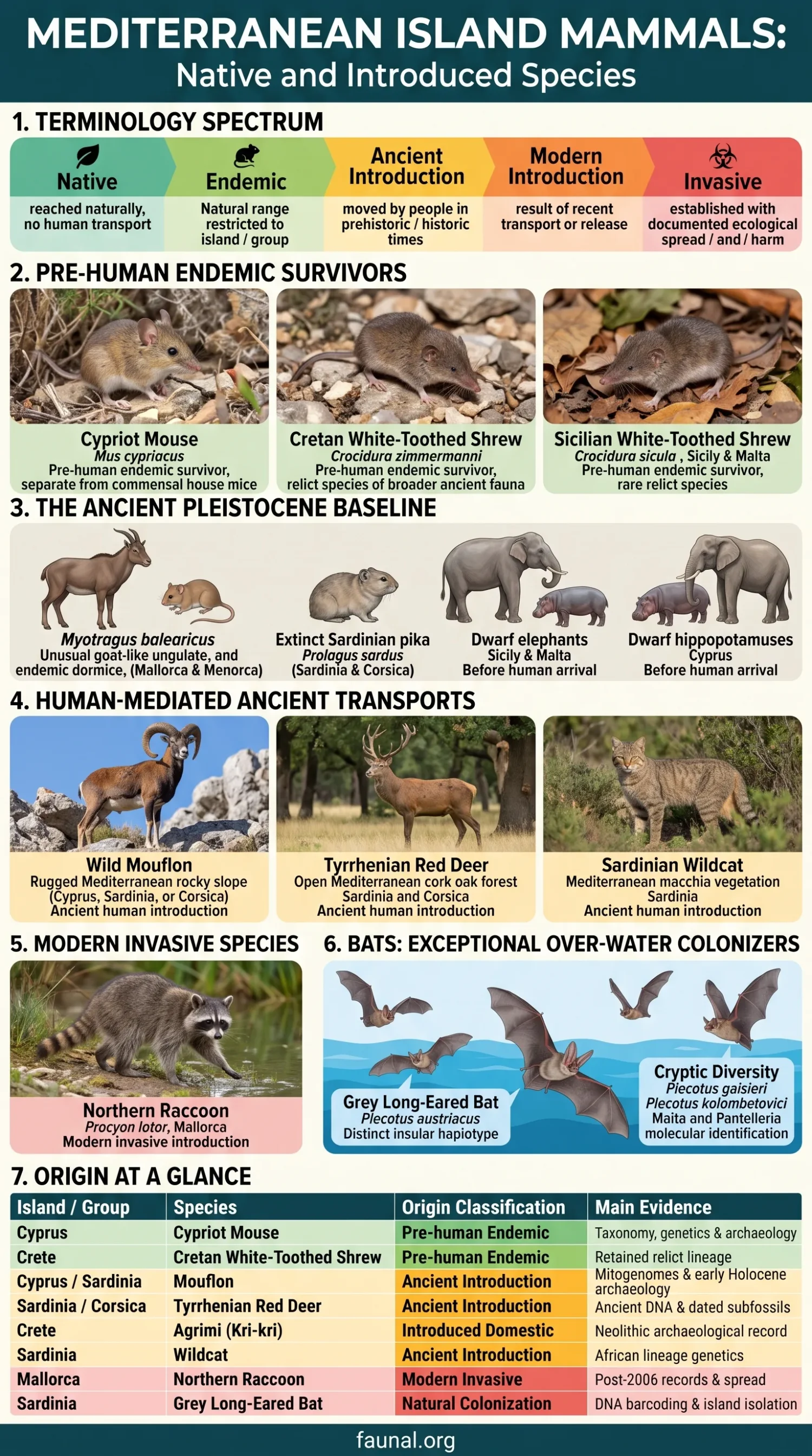
The living mammal fauna of Mediterranean islands is a mixture of very different histories. A few terrestrial lineages survived from the pre-human island fauna, many familiar mammals were carried across the sea by people thousands of years ago, and others arrived through recent releases, escapes or accidental transport. A mammal can therefore be endemic to an island population today without being part of that island’s original pre-human fauna.
This distinction is especially important on the Balearic Islands, Sardinia, Corsica, Crete and Cyprus, where human settlement altered mammal communities that had evolved under long isolation. Sicily and Malta followed a somewhat different history because faunal exchange with nearby mainland areas was easier during parts of the Pleistocene. Bats also require separate treatment because flight allows natural over-water colonization that is impossible for most terrestrial mammals.
Long-established does not necessarily mean native
A population that has lived on an island for several thousand years may still descend from animals transported by people. Mouflons, the Cretan agrimi and the Tyrrhenian red deer illustrate why archaeological and genetic evidence matters more than apparent wildness or historical familiarity.
Native, endemic and introduced describe different parts of an island mammal’s history
The terms used for Mediterranean island mammals answer different biological questions. Native concerns whether a population reached or persisted in the region without human transport. Endemic concerns geographic restriction. Introduced concerns human-mediated movement. Invasive adds evidence of establishment, spread or ecological harm and should not be assigned merely because a mammal is non-native.
| Origin or status | Meaning on a Mediterranean island | Typical evidence |
|---|---|---|
| Pre-human native | The lineage was present before human-mediated animal transport became responsible for its occurrence. | Fossils, ancient deposits, phylogeography and archaeology. |
| Endemic | The natural range of the taxon is restricted to the island or island group under discussion. | Taxonomy and verified geographic range. |
| Ancient human introduction | People moved the ancestral population to the island in prehistoric or early historic times. | Zooarchaeology, radiocarbon chronology, ancient DNA and population genetics. |
| Modern introduction | The population resulted from recent transport, release, escape or accidental arrival linked to people. | Historical records, management records and genetic assignment. |
| Feral | The free-ranging population descends wholly or partly from domestic stock. | Domestic ancestry, historical evidence and genetics. |
| Invasive | An introduced population is established and has documented spread or ecological effects under the cited assessment. | Population studies, impact assessments and official invasive-species records. |
Only a few small terrestrial mammals preserve the old island fauna
A 2024 population-genetic study of the Cypriot mouse describes only three small palaeoendemic mammals known to have survived the long period of human transformation on Mediterranean islands: the Cypriot mouse Mus cypriacus, the Sicilian white-toothed shrew Crocidura sicula and the Cretan white-toothed shrew Crocidura zimmermanni. Hardouin et al., Mammalian Biology
Cypriot mouse: a pre-human rodent that survived human settlement
Mus cypriacus is endemic to Cyprus and was formally described only in 2006. The current Mammal Diversity Database accepts it as a distinct living species and lists Cyprus as its country distribution. Genetic work places it apart from the commensal house mouse and supports its status as a surviving old Cypriot lineage rather than another human-transported Mus population. Mammal Diversity Database: Mus cypriacus
The 2024 population study found no clear population-genetic subdivision across the samples analysed and reported high genetic diversity. Its sampling also placed the species across varied habitats, while the authors cautioned that ecological information remains incomplete. The important biogeographic point is clearer: this mouse belongs to the small remnant of terrestrial mammal diversity that predates the island’s Neolithic livestock and commensal introductions.
Cretan white-toothed shrew: the surviving mammal lineage of Crete
Crocidura zimmermanni is accepted as a distinct species restricted to Greece and is specifically associated with Crete. The Mammal Diversity Database retains the Cretan white-toothed shrew as a living wild species rather than merging it with the widespread white-toothed shrews introduced to many islands. Mammal Diversity Database: Crocidura zimmermanni
Its survival is unusual because Crete formerly held a much broader endemic mammal assemblage, including deer, elephants and other mammals that did not persist into the modern fauna. The shrew therefore represents evolutionary continuity that most of Crete’s larger terrestrial mammals lack.
Sicilian white-toothed shrew: persistence across Sicily and nearby islands
Crocidura sicula remains an accepted species in current mammal taxonomy. The Mammal Diversity Database lists its country distribution in Italy and Malta and retains several names historically applied to populations from Sicily and surrounding islands as synonyms under the species. Mammal Diversity Database: Crocidura sicula
These three mammals should not be treated as evidence that the modern terrestrial fauna of Mediterranean islands is largely unchanged. Their importance comes from being rare survivors within faunas that experienced extensive extinction and replacement.
The pre-human baseline contained mammals that no longer exist
Pleistocene Mediterranean islands supported mammal communities that were often unlike both the nearby mainland and the islands’ current fauna. Long isolation produced dwarf elephants, dwarf hippos, unusual ungulates, endemic rodents, shrews and lagomorphs. Their composition also differed sharply between island systems because the opportunities for natural colonization were not the same.
| Island system | Examples from the pre-human or prehistoric fauna | Why the old fauna matters for present-day origin status |
|---|---|---|
| Mallorca and Menorca | Myotragus balearicus, endemic dormice and endemic shrews. | The modern terrestrial assemblage cannot be treated as a direct continuation of the ancient Gymnesic mammal fauna. |
| Eivissa | Early Pliocene endemic insectivore and rodent lineages documented at Ses Fontanelles. | Eivissa had a separate deep-time history and should not automatically be combined with Mallorca and Menorca. |
| Sardinia and Corsica | Endemic mammals including the Sardinian pika Prolagus sardus and other extinct insular lineages. | Many familiar modern wild mammals arrived only after people began transporting animals. |
| Sicily and Malta | Dwarf elephants, large dormice and other changing Pleistocene mammal assemblages. | Faunal exchange with mainland Italy varied through time, so not every later arrival requires human transport. |
| Crete | Endemic deer, elephants, rodents and shrews. | The surviving Cretan shrew belongs to an older fauna than the island’s human-carried goats and many other modern mammals. |
| Cyprus | Dwarf hippopotamus, dwarf elephant and the lineage represented today by Mus cypriacus. | Large domesticable mammals were absent before human settlement, making later livestock introductions especially clear. |
A synthesis of Pleistocene mammals from the main Mediterranean islands distinguishes the deeply endemic Balearic history, the long isolation of Sardinia and Corsica, the more complex connection history of Sicily and Malta, and the strong isolation of Cyprus. Palombo et al., Pleistocene mammals of Mediterranean islands
Research published in 2026 adds new information from Ses Fontanelles on Eivissa, documenting Early Pliocene insectivores and rodents and refining the history of endemic small-mammal faunas in the western Mediterranean. Agustí et al., Journal of Mammalian Evolution
Balearic mammals show both prehistoric replacement and a modern invasion
Mallorca and Menorca once supported the highly distinctive Myotragus-dominated fauna together with endemic small mammals. Those lineages disappeared, while later island communities accumulated mammals associated with people, including rodents, rabbits, carnivores and domestic-derived populations. The result is a strong separation between the ancient mammal fauna known from fossils and the free-ranging terrestrial mammals encountered today.
Mallorca’s raccoon population belongs to the modern layer of introductions
The northern raccoon Procyon lotor was first recorded on Mallorca in 2006. Research on the invasion documented an established, reproducing population and captures across part of the island rather than isolated escaped animals. That makes the raccoon fundamentally different from ancient introductions whose populations have persisted for millennia.
A 2026 study examined 75 raccoons from Mallorca for selected pathogens. Twenty-four percent were positive for at least one of the pathogens tested; Cryptosporidium DNA occurred in 22.6% of fecal samples. The study illustrates how a recent mammal introduction can create management questions extending beyond competition or predation to parasite and disease ecology. Alves et al., Acta Tropica
Sardinia and Corsica preserve distinctive mammals that arrived with people
Sardinia and Corsica are among the clearest examples of why present-day distinctiveness cannot by itself establish native origin. Zooarchaeological research on Corsica describes a near-total turnover from the late Pleistocene fauna to wild and domestic mammals introduced during the period of human occupation. Vigne, Mammal Review
Tyrrhenian red deer arrived too late for a natural Ice Age crossing
Ancient-DNA analysis of Tyrrhenian red deer linked the Sardinian and Corsican populations to an Italian mitochondrial lineage. The fossil chronology used in that research places red deer on Sardinia from roughly 5,000 years ago and on Corsica from roughly 2,000 years ago, well after the low sea-level period when natural colonization would have been more plausible. The authors therefore identified human introduction as the dispersal explanation. Doan et al., Scientific Reports
The name Cervus elaphus corsicanus remains widely used for the insular form, but current Mammal Diversity Database treatment places corsicanus within the synonymy of the western red deer Cervus elaphus. Taxonomic rank and colonization history are separate questions: a population can be genetically and morphologically distinctive even when its ancestors were transported by people.
Mediterranean mouflons retain an ancient translocation history
Mouflons on Cyprus, Sardinia and Corsica were once widely interpreted as remnants of a naturally occurring European wild sheep fauna. Archaeology instead supports human transport to Cyprus during the Early Neolithic and later movement to the western Mediterranean islands. A 2025 mitogenome analysis found the Cypriot population closer to Anatolian and Iranian mouflons, while Sardinian and Corsican lineages were associated with the early European expansion of domestic sheep. Mereu et al., PLOS ONE
Mouflon names vary among current authorities
The Mammal Diversity Database currently accepts Ovis gmelinii and notes that the ancient Mediterranean populations traditionally called ophion and musimon are included within this taxon. The 2025 mitogenome study uses the spelling Ovis gmelini and argues that the Corsican and Sardinian populations are better treated with their wild relatives rather than as subspecies of domestic sheep. Origin history is clearer than the remaining nomenclatural disagreement.
The current Mammal Diversity Database treatment also records Cyprus among the countries in which Ovis gmelinii occurs and explicitly identifies the Mediterranean populations as ancient introductions. Mammal Diversity Database: Ovis gmelinii
The Sardinian wildcat is old on the island but not native to it
The Sardinian wildcat belongs to the African wildcat lineage Felis silvestris lybica. A 2025 genetic and morphological study describes it as a non-native population introduced in prehistoric times. Some interpretations place its arrival about 6,000–7,000 years ago with Neolithic sailors, although archaeological cat remains allow later introduction scenarios as well, so the exact timing remains unresolved. Lecis et al., BMC Ecology and Evolution
The same study lists red deer, red fox, hare, wild boar, pine marten and wildcat among Sardinian terrestrial mammal populations associated with ancient introductions. Their long isolation can produce regional forms without converting their initial human-mediated arrival into a natural colonization event.
Edible dormouse genetics reveal several separate island movements
A 2024 study of the edible dormouse Glis glis compared samples from Sardinia, Corsica, Sicily, Elba and Salina with mainland populations. The Sardinian sample clustered with central Italian animals, which did not support an endemic Sardinian subspecies and instead suggested an introduction. The Corsican sample grouped differently, while Salina shared the Sicilian lineage. The study used a small island sample and therefore treated several arrival scenarios cautiously. Mori et al., Mammal Research
Crete combines one old native survivor with a human-carried goat lineage
Crete’s living terrestrial mammals do not all share the same biogeographic age. The Cretan white-toothed shrew belongs to the old insular component, while the agrimi or kri-kri represents a very different history.
Large goat bones identified with the agrimi occur in Cretan archaeological deposits from the sixth millennium BCE onward together with domestic sheep and goats. This record supports establishment after a Neolithic introduction rather than survival of a naturally colonizing wild goat population. The animals later became free-ranging and were depicted as game during the Minoan period.
Agrimi taxonomy reflects its domestic ancestry
Older literature frequently uses Capra aegagrus cretica or related combinations for the Cretan agrimi. The current Mammal Diversity Database includes Cretan Goat, Cretan Ibex, Kri-kri and Agrimi under Capra hircus, the domestic goat, and notes that the taxon includes introduced Mediterranean populations. Mammal Diversity Database: Capra hircus
Cyprus separates pre-human endemism from the first livestock introductions
Cyprus provides one of the clearest records of mammal replacement because its long isolation produced a restricted endemic fauna before human settlement. The Cypriot mouse survived, while the island’s dwarf elephant and dwarf hippopotamus disappeared. Large domesticable mammals known from later archaeological sites were not members of that earlier fauna.
A 2026 review of the Neolithic transition states that ancestors of domestic mammals were absent from Cyprus before human settlement and that farming developed through the introduction of plants and animals from the nearby continent. The archaeological record also indicates a more complicated process than simple importation of fully domestic stock: some transported animals were released into the wild and later brought under renewed human management. Vigne and Cucchi, Quaternary Science Reviews
Cypriot mouflon fits this pattern. Archaeological and genetic work supports human-mediated arrival during the early Holocene rather than uninterrupted natural residence from the Pleistocene. Its modern distinctiveness therefore describes what happened after introduction, not how its ancestors first reached Cyprus.
Sicily and Malta had more opportunities for natural faunal exchange
Sicily should not be treated as a simple eastern equivalent of Cyprus or the Balearic Islands. Geological and palaeontological evidence indicates alternating periods of isolation and easier exchange with southern Italy. Mammals therefore reached Sicily under more than one dispersal regime, and a human introduction cannot be inferred solely from the fact that a species occurs on an island.
The old endemic component included dwarf elephants and other insular mammals, while the Sicilian white-toothed shrew survives today. The modern fauna also contains populations whose histories involve human movement. The 2024 edible-dormouse analysis, for example, found both Sicilian genetic structure and evidence that human transport contributed to the species’ present Mediterranean island distribution.
Malta shares parts of this deeper central Mediterranean history. For living mammals, however, presence on Malta or Gozo should still be evaluated species by species because ancient natural colonization, historic transport and recent introductions can produce the same superficial result: a wild mammal population living on an island today.
Bats do not follow the same colonization rules as terrestrial mammals
Rats, deer, goats, cats and dormice need land connections, rafting or human transport to cross major sea barriers. Bats can fly between land masses. A bat found on a Mediterranean island therefore cannot be classified as introduced merely because its closest relatives occur on a mainland coast.
Research on the grey long-eared bat Plecotus austriacus published in the 2026 volume of Mammal Research found distinct mitochondrial lineages in several island and peninsular populations. Sardinia carried its own sampled haplotype, while Sicily shared a haplotype with peninsular Italy. The authors interpreted the Sardinian pattern as the result of older isolation after natural colonization rather than human translocation. Ancillotto et al., Mammal Research
The same research also places different long-eared bat species on Mediterranean islands, including Plecotus gaisleri on Malta, Lampedusa and Pantelleria and Plecotus kolombatovici in parts of the eastern Mediterranean. These closely related bats illustrate another island problem: molecular identification may be needed where morphology alone does not reliably separate cryptic taxa.
Evidence-backed origin examples from major Mediterranean islands
| Island or island group | Mammal | Origin classification | Main evidence |
|---|---|---|---|
| Cyprus | Cypriot mouse (Mus cypriacus) | Pre-human endemic survivor | Taxonomy, archaeology and population genetics support an old Cypriot lineage. |
| Crete | Cretan white-toothed shrew (Crocidura zimmermanni) | Pre-human endemic survivor | Accepted endemic species belonging to the older Cretan mammal fauna. |
| Sicily and nearby islands | Sicilian white-toothed shrew (Crocidura sicula) | Pre-human endemic survivor | Living palaeoendemic lineage retained in current mammal taxonomy. |
| Cyprus | Mouflon (Ovis gmelinii sensu current MDD) | Ancient human introduction | Archaeology and genetics connect the population with early Holocene movement of sheep or mouflon stock. |
| Sardinia and Corsica | Mouflon | Ancient human introduction | Archaeology and mitogenomes associate the western island populations with early European sheep expansion. |
| Sardinia and Corsica | Tyrrhenian red deer (Cervus elaphus, Corsican form) | Ancient human introduction | Ancient DNA and dated subfossils indicate arrival long after natural low-sea-level colonization opportunities. |
| Crete | Agrimi / kri-kri (Capra hircus in current MDD treatment) | Ancient introduced, free-ranging domestic-derived lineage | Neolithic archaeological occurrence and domestic-goat ancestry. |
| Sardinia | Sardinian wildcat (Felis silvestris lybica) | Ancient human introduction | African-lineage genetics and prehistoric or early historic introduction scenarios. |
| Sardinia | Edible dormouse (Glis glis) | Human-mediated introduction supported | 2024 COI data grouped the sampled Sardinian animal with central Italian populations. |
| Corsica | Edible dormouse (Glis glis) | Likely introduced; source differs from Sardinia | The sampled Corsican animal clustered with a northern lineage; wider sampling is still needed. |
| Mallorca | Northern raccoon (Procyon lotor) | Modern invasive introduction | First island record in 2006 followed by documented reproduction, expansion and control captures. |
| Sardinia | Grey long-eared bat (Plecotus austriacus) | Natural island lineage | DNA barcoding supports a distinct Sardinian haplotype interpreted as an old natural colonization followed by isolation. |
The table is deliberately population-specific. The same mammal species can have a different origin history on different islands. Edible dormice provide a direct example: Sardinia, Corsica, Sicily, Salina and Elba do not form one simple human-introduction event, and genetic evidence points to different source populations and timings.
Modern introduced mammals remain an active island-management issue
Prehistoric introductions explain much of the unusual composition of Mediterranean island mammal faunas, but introductions did not stop with antiquity. Rats, house mice, feral goats, rabbits, cats and other mammals have been moved repeatedly among islands, ports and settlements. Their ecological effects depend on the receiving island, the species involved and whether the introduced population becomes established.
A review of mammal eradication projects identified 139 attempted eradications on 107 Mediterranean islands. Thirteen mammal species had been targeted, and the black rat Rattus rattus accounted for more than three quarters of the reported attempts. Feral goats, house mice, European rabbits and domestic cats were also among the recurrent targets. Capizzi, Mammal Review
These mammals do not all affect islands in the same way. Rats and cats can add novel predation pressure to nesting birds, reptiles and small vertebrates. Goats can alter vegetation through browsing and grazing. Rabbits can transform plant recruitment and soils where densities become high. Raccoons add a generalist predator and omnivore that did not occur in the native Mediterranean island fauna.
Introduced and invasive are not interchangeable
Ancient mouflon, Sardinian wildcat and modern Mallorca raccoon populations all have human-mediated origins, but that does not give them the same ecological or management status. Introduction history, current ecological impact, legal protection, evolutionary distinctiveness and conservation value must be evaluated separately.
Ancient introductions create a difficult boundary between biogeography and conservation
Human-mediated origin does not erase thousands of years of subsequent evolution. Mouflons on Cyprus, Sardinia and Corsica, Tyrrhenian red deer and the Sardinian wildcat can retain distinctive genetics or morphology even though their founding populations arrived through people. Conversely, long residence does not turn the original colonization event into a natural one.
This is why island mammal classification works best when four questions remain separate: How did the population first reach the island? How long has it been isolated? How genetically or taxonomically distinct is it now? What ecological effects does it have today? A single label cannot answer all four.
Mediterranean mammal research has repeatedly shown that archaeological age, genetics and modern conservation status can point to different aspects of the same population. Reviews of ancient mammal introductions therefore caution against treating apparent island endemicity as proof of natural origin. Gippoliti and Amori, Mammal Review
Sources and Verification
- Hardouin et al. — Population genetics and demography of the endemic mouse species of Cyprus, Mus cypriacus — Supports the palaeoendemic status, genetic findings and surviving Mediterranean small-mammal comparison.
- Mammal Diversity Database — Mus cypriacus — Current taxonomic treatment and geographic scope of the Cypriot mouse.
- Mammal Diversity Database — Crocidura zimmermanni — Current taxonomic treatment of the Cretan white-toothed shrew.
- Mammal Diversity Database — Crocidura sicula — Current taxonomic treatment and Italy–Malta distribution of the Sicilian white-toothed shrew.
- Palombo et al. — Pleistocene mammals of Mediterranean islands — Supports differences among the prehistoric mammal faunas and colonization histories of major Mediterranean islands.
- Agustí et al. — Insectivores and rodents from Ses Fontanelles, Eivissa — Supports the 2026 Early Pliocene evidence for endemic small-mammal evolution on Eivissa.
- Alves et al. — Zoonotic pathogens in an island invader: the northern raccoon in Mallorca — Supports the 2026 Mallorca raccoon sample and pathogen findings.
- Vigne — Zooarchaeology and the biogeographical history of the mammals of Corsica and Sardinia since the last ice age — Supports post-Pleistocene mammal turnover and human-mediated introductions on Corsica and Sardinia.
- Doan et al. — Phylogeography of the Tyrrhenian red deer resolved using ancient DNA — Supports Italian ancestry, dated island appearance and human introduction of Tyrrhenian red deer.
- Mereu et al. — Revised phylogeny of mouflon based on expanded sampling of mitogenomes — Supports the updated relationships among Cyprus, Sardinian and Corsican mouflons and their ancient introduction history.
- Mammal Diversity Database — Ovis gmelinii — Current taxonomic treatment and notes concerning ancient Mediterranean mouflon introductions.
- Lecis et al. — Unghosting the Sardinian wildcat — Supports African-wildcat ancestry, prehistoric introduction evidence and current genetic characterization in Sardinia.
- Mori et al. — Anthropogenic dispersal explains the phylogeography of insular edible dormouse Glis glis — Supports distinct introduction histories among Sardinia, Corsica, Sicily, Salina and Elba.
- Mammal Diversity Database — Capra hircus — Current treatment of Cretan Goat, Kri-kri and Agrimi within the domestic-goat lineage.
- Vigne and Cucchi — The role of local domestication on the island of Cyprus during the Neolithic transition — Supports the absence of domestic-mammal ancestors before human settlement and the 2026 interpretation of Neolithic animal introductions.
- Ancillotto et al. — Islands as biodiversity arks: insular bat DNA-barcoding diversity — Supports natural island colonization and distinct long-eared bat lineages, including Sardinia.
- Capizzi — A review of mammal eradications on Mediterranean islands — Supports eradication totals and recurrent invasive mammal targets in Mediterranean island restoration.
- Gippoliti and Amori — Ancient introductions of mammals in the Mediterranean Basin and their implications for conservation — Supports the separation of human-mediated origin, island distinctiveness and conservation interpretation.
Related Topics
- → Mammals of the Mediterranean Basin: Native Species and Habitats
- → Marine Mammals of the Mediterranean Sea
- → Bats of the Mediterranean Basin: Cave, Forest, and Urban Species
- → Small Mammals of the Mediterranean: Rodents, Hedgehogs, and Shrews
- → Large Carnivores of the Mediterranean: Wolves, Bears, Lynx, and Wild Cats
- → Mediterranean Ungulates: Deer, Goats, Sheep, and Wild Boar