Complete guides: •Regional Fauna Guides•Birds•Wildlife Habitat Guides•Fauna of Europe
European towns and cities share a recognizable group of urban birds, but there is no single bird community that represents every city on the continent. Standardized surveys repeatedly place the House Sparrow, Common Blackbird, Common Swift, Great Tit, Wood Pigeon and Feral Pigeon among the most frequently recorded urban species, while building density, green cover, latitude, water, migration and local habitat change which birds become common from one neighbourhood or city to another.[a]
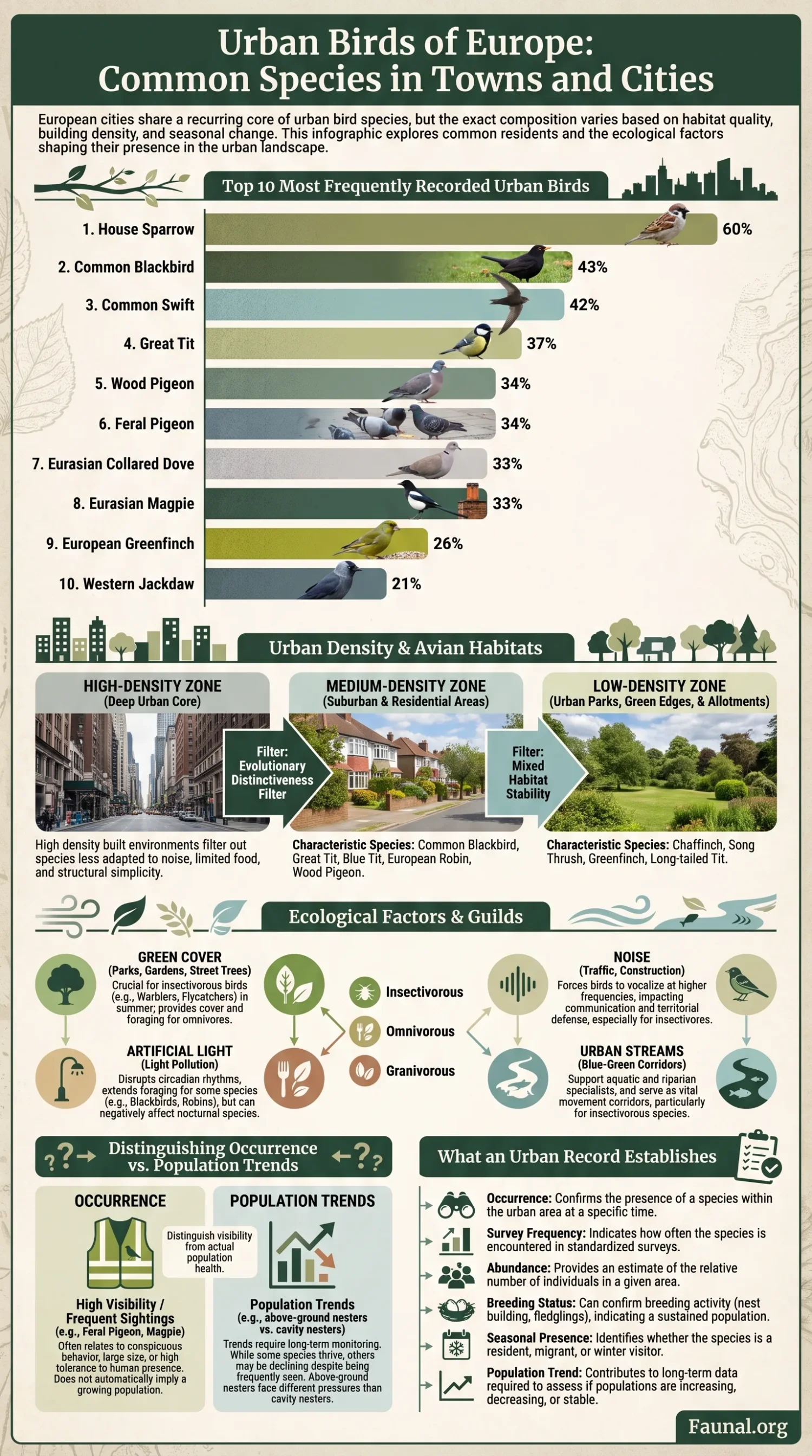
One cross-European study recorded 133 bird species at 1,624 standardized point counts distributed across 17 cities in ten countries. The ten species with the highest frequency of occurrence were House Sparrow Passer domesticus, Common Blackbird Turdus merula, Common Swift Apus apus, Great Tit Parus major, Wood Pigeon Columba palumbus, Feral Pigeon Columba livia, Eurasian Collared Dove Streptopelia decaocto, Eurasian Magpie Pica pica, European Greenfinch Chloris chloris and Western Jackdaw, listed as Corvus monedula in that study.[a]
The Species That Recur Most Often Across European Cities
The frequency pattern is useful because it comes from the same standardized survey design across a broad European gradient. House Sparrow occurred at 60% of the surveyed points, followed by Common Blackbird at 43%, Common Swift at 42% and Great Tit at 37%. Wood Pigeon and Feral Pigeon each occurred at 34% of points. Eurasian Collared Dove and Eurasian Magpie each reached 33%, European Greenfinch 26% and Western Jackdaw 21%.[a]
Most Frequently Recorded Birds in a 17-City European Survey
Frequency of occurrence across 1,624 standardized urban point counts.
Morelli and colleagues, 17 European cities and 1,624 point counts. Values measure the percentage of survey points at which each species was recorded; they are not shares of the total bird population. [a]
Survey Frequency Is Not Population Share
A 60% frequency for House Sparrow means that the species was detected at 60% of the surveyed points. It does not mean that 60% of all individual birds in those cities were House Sparrows, nor does it establish equal abundance in every participating city.
The pattern nevertheless identifies a useful continental urban core. Sparrows, pigeons, doves, corvids, tits, blackbirds and swifts repeatedly appeared across cities separated by climate and latitude. That common core becomes less uniform once individual neighbourhoods and individual cities are compared.
Dense Building Cores and Greener Neighbourhoods Hold Different Birds
A second 17-city analysis separated urban sites into low-, medium- and high-density development. Low-density areas contained fewer isolated buildings and more medium or large green areas. Medium-density areas had more buildings, blocks of flats and smaller gardens or green patches. High-density areas represented tightly built city centres with little greenery beyond features such as roadside trees.[b]
| Urban fabric in the 17-city study | Species characteristic of that density class | What the grouping indicates |
|---|---|---|
| High density | Feral Pigeon, Western Jackdaw, Common Swift, House Sparrow, Black Redstart | Species capable of using dense built structure remained characteristic even where green space was scarce. |
| Medium density | Eurasian Chaffinch, Western House Martin, European Serin, Eurasian Collared Dove, Common Blackbird | Buildings were still prominent, but gardens and smaller green patches added resources absent from the densest cores. |
| Low density | Common Redstart, European Robin, Eurasian Tree Sparrow, Eurasian Blackcap, Fieldfare | More open development and larger green areas supported a bird assemblage different from the tightly built centre. |
These groups are not exclusive ranges. A Blackbird can occur in a dense district and a House Sparrow can occur in a greener suburb. The comparison describes species that were especially characteristic of each urban-density class within the study, rather than rules about where a species can or cannot live.[b]
Birds of the Dense Built Core
The high-density group explains why several familiar urban birds are strongly associated with buildings rather than with park interiors. Feral Pigeons use ledges and built structures; House Sparrows and Common Swifts depend on access to suitable nesting spaces in buildings; Western Jackdaws can use cavities and structures; and Black Redstarts can exploit rocky or built surfaces. The 2024 comparison identified all five among the birds most characteristic of the high-density class.[b]
Feral Pigeon Does Not Mean a Separate Species
Urban feral pigeons are treated within Columba livia. Calling a city bird a Feral Pigeon describes its domestic ancestry and free-living status; the presence of urban C. livia should not automatically be treated as evidence for a wild Rock Dove population.
Parks, Gardens and Lower-Density Streets Add Another Layer
The lower-density classes bring in birds associated with vegetation and mixed built-green habitat. European Robin, Blackcap and Common Redstart appeared among characteristic species of the lowest-density class, while Eurasian Chaffinch, European Serin and Common Blackbird were represented in the medium-density group. In the earlier 17-city analysis, grass, bushes and trees were positively associated with breeding-bird species richness, while building cover showed the opposite relationship. Bush cover also reduced some of the phylogenetic homogenization associated with urbanization.[a]
A city park and a stone-built central square may be only a few streets apart while supporting noticeably different bird assemblages. Urban bird occurrence depends on the habitat inside the city, not merely on whether the location carries a city address.
Europe Does Not Have One Universal City-Bird List
The shared urban core can give the impression that European cities are becoming biologically interchangeable. Cross-city evidence shows a more complicated pattern. A nine-city study covering Granada, Toledo, Madrid, Groningen, Munich, Prague, Poznań, Turku and Rovaniemi recorded 103 breeding bird species. More than 42% of those species were restricted to a single study city, while only 7% occurred in all nine.[c]
That high turnover means that “common in European cities” cannot be translated into “common in every European city.” Regional species pools, climate, latitude, vegetation zone, urban design and habitat availability all influence the local list. The same study found that geographical location helped explain variation in the number of widespread and localized species across the cities.[c]
A separate study of 14 European cities also found geographical differences in feeding guilds. Granivorous species richness was relatively high in Granada, Toledo and Athens; insectivorous richness was highest in Poitiers, Athens and Granada; and omnivorous richness was highest in Poitiers, Granada and Prague. The pattern does not reduce neatly to a simple northern-versus-southern rule.[d]
Season Can Change the Urban Bird Community Without Changing the City
The prominent position of the Common Swift in European urban surveys illustrates why season matters. The species is an Afro-Palearctic migrant and is strongly associated with European summer skies and building nest sites. Its 42% occurrence frequency in the 17-city breeding-season survey therefore cannot be treated as evidence of year-round occupancy at those locations.[i]
Seasonal interpretation has become easier at continental scale. The European Bird Census Council expanded EuroBirdPortal in September 2026 to cover nearly 600 bird species through weekly distribution maps updated close to real time. The system draws on hundreds of millions of bird records contributed through European recording portals and makes the changing seasonal footprint of migratory and resident species visible across the continent.[g]
For urban fauna, this matters because a summer aerial insectivore, a winter visitor and a resident pigeon can all be “common city birds” under different temporal definitions. A city checklist that ignores month or season can merge biologically different patterns into one apparently static list.
Green Cover, Artificial Light and Noise Filter Different Feeding Guilds
Urban vegetation does more than add extra species to a list. Research using 1,349 point counts in 14 European cities recorded 127 breeding bird species and examined how green cover, artificial light at night and noise related to bird communities according to diet. Greater green cover was associated with more insectivorous and omnivorous species. The relationships with artificial light and noise differed among feeding guilds rather than producing one identical response across all urban birds.[d]
The same dataset again placed House Sparrow, Common Blackbird, Common Swift, Great Tit and Eurasian Collared Dove among the most frequently recorded species. Their repeated appearance across separate analyses supports their position as part of the European urban core, while the diet results show why greener or more polluted parts of the same city can support different secondary communities.[d]
Urban Streams Add Habitat That Streets and Squares Cannot Replace
Blue-green corridors create another urban bird setting. A 2026 study examined bird communities along 102 urban streams in five European cities spanning Portugal, France, Italy, Belgium and Norway. The number of insectivorous bird species decreased as urbanization rose, with impervious surface, population density and artificial light at night among the urbanization measures most closely associated with that pattern.[e]
Streams with greater diversity of vegetation types and habitat structure tended to favour insectivores such as the Eurasian Wren Troglodytes troglodytes and Common Chiffchaff Phylloscopus collybita. The cities did not converge on one identical riparian bird community: the study reported differences in the most representative species among cities, with Benevento and Oslo especially distinct from the others.[e]
An urban waterway should therefore not be treated as another version of a city park. Streamside vegetation, impervious cover and night lighting can alter which feeding guilds use the corridor.
A Familiar City Bird Is Not Necessarily a Growing Population
Visibility in streets and parks is a poor substitute for population-trend data. A 2024 analysis modelled long-term population trends for 93 bird species breeding in urban areas across 16 European countries. Species that colonized urban environments earlier tended to have more negative long-term trends than more recent urban colonists. Among highly urbanized species, birds breeding above ground also had more negative trends than ground breeders.[f]
The authors proposed loss of breeding opportunities as one plausible mechanism for above-ground nesters: modern buildings may provide fewer suitable cavities and access points than older structures. This distinction is especially relevant for urban birds associated with roofs, walls and building cavities. A species can remain visually associated with towns while the conditions that once allowed it to breed there are changing.[f]
Urban Familiarity Is Not a Population Trend
Frequent sightings show that a species uses urban habitat. They do not establish whether its population is rising, stable or falling. Trend claims require repeated monitoring through time rather than familiarity alone.
The wider European monitoring context reinforces that distinction. The European Environment Agency reports that the EU index covering 168 common bird species fell by 17% between 1990 and 2024. That figure is not an urban-bird index and should not be used as a decline estimate for city birds. It demonstrates instead why the word “common” cannot by itself be interpreted as evidence of population security.[h]
Dense City Centres Select a Narrower Evolutionary Set of Birds
Urban density affects more than the number of species present. The 2024 analysis of 17 European cities compared the evolutionary distinctiveness of bird communities along low-, medium- and high-density urban gradients. Highly dense areas supported communities with lower evolutionary uniqueness than lower-density areas; the authors estimated a difference of about one million years of evolutionary history between the dense and low-density assemblages.[b]
The result describes an ecological filtering process. Dense built environments repeatedly favour a subset of birds able to persist under similar structural conditions, while greener and less densely built areas retain species that add more evolutionary breadth to the local assemblage. This helps explain why the same few urban-tolerant species can appear repeatedly in central districts without making the entire European urban avifauna uniform.
What an Urban Record Establishes—and What It Does Not
A record of a House Sparrow, Swift, Blackbird or any other species inside a European city establishes occurrence at a place and time. Repeated standardized detections can support statements about frequency. Breeding records can establish reproductive use of urban habitat. Long-term monitoring can identify population trends. These forms of evidence answer different biological questions and should not be substituted for one another.
- Occurrence documents that a species was recorded at a defined place and time.
- Survey frequency describes how often it appeared across standardized sampling units.
- Abundance concerns numbers of individual birds and cannot be derived directly from occurrence percentage.
- Breeding status requires evidence that the species is reproducing in the urban area rather than merely passing through or feeding there.
- Seasonal presence separates residents from migrants and other birds whose urban occurrence changes through the year.
- Population trend requires repeated monitoring across years and cannot be inferred from how familiar a species appears on city streets.
European cities therefore share a measurable group of recurring urban birds without sharing one fixed avifauna. House Sparrows, Blackbirds, Swifts, Great Tits, pigeons, doves and several corvids form much of the repeated continental pattern, but the species actually present in a neighbourhood are filtered by building density, vegetation, water, pollution, geography and season. The most accurate urban bird list is consequently one tied to a defined city, habitat and time period rather than a continent-wide list treated as universally present.
Sources and Verification
- [a] Effects of urbanization on taxonomic, functional and phylogenetic avian diversity in Europe — Used for the 17-city, 1,624-point survey, the 133 recorded species, top-ten occurrence frequencies and relationships between urban greenery, buildings and avian diversity.
- [b] Dense city centers support less evolutionary unique bird communities than sparser urban areas — Used for the low-, medium- and high-density urban classes, characteristic bird groups and the comparison of evolutionary distinctiveness across building-density levels.
- [c] Occupancy-frequency distribution of birds in land-sharing and -sparing urban landscapes in Europe — Used for the nine-city comparison of 103 breeding species, including the proportions restricted to one city or shared by all study cities.
- [d] Effects of light and noise pollution on avian communities of European cities are correlated with the species’ diet — Used for the 14-city, 1,349-point analysis of green cover, artificial light, noise, feeding guilds and the study’s most frequently recorded urban birds.
- [e] Urbanisation impacts avian biodiversity on stream ecosystems – insights from a large geographical scale — Used for the 2026 assessment of 102 urban streams, insectivorous-bird responses to urbanization and the association of Wren and Chiffchaff with more varied riparian habitat.
- [f] Ecological traits predict population trends of urban birds in Europe — Used for long-term trend modelling of 93 urban-breeding species in 16 European countries and the reported relationships with urbanization history and nesting position.
- [g] European Bird Census Council: EuroBirdPortal near-real-time European bird occurrence — Used for the 2026 expansion of weekly European distribution mapping to nearly 600 bird species.
- [h] European Environment Agency: Common bird index in Europe — Used only for the wider EU common-bird population context from 1990 to 2024; the indicator is not treated as an urban-bird index.
- [i] BirdLife International: Migratory bird of the month — the Common Swift — Used for the Common Swift’s migratory status, Afro-Palearctic movement and close association with urban nesting habitat.
Related Topics
- → Birds of Europe: Species Diversity, Habitats, and Biogeographic Regions
- → Farmland Birds of Europe: Species Decline and Habitat Change
- → Forest Birds of Europe: Woodland Species and Breeding Habitats
- → Wildlife of Western Europe: Landscapes, Species, and Conservation
- → Wildlife of Eastern Europe: Forests, Wetlands, and Steppe Species
- → Wildlife of Northern Europe: Boreal Forests, Tundra, and Coasts