Complete guides: •Regional Fauna Guides•Birds•Wildlife Habitat Guides•Fauna of Europe
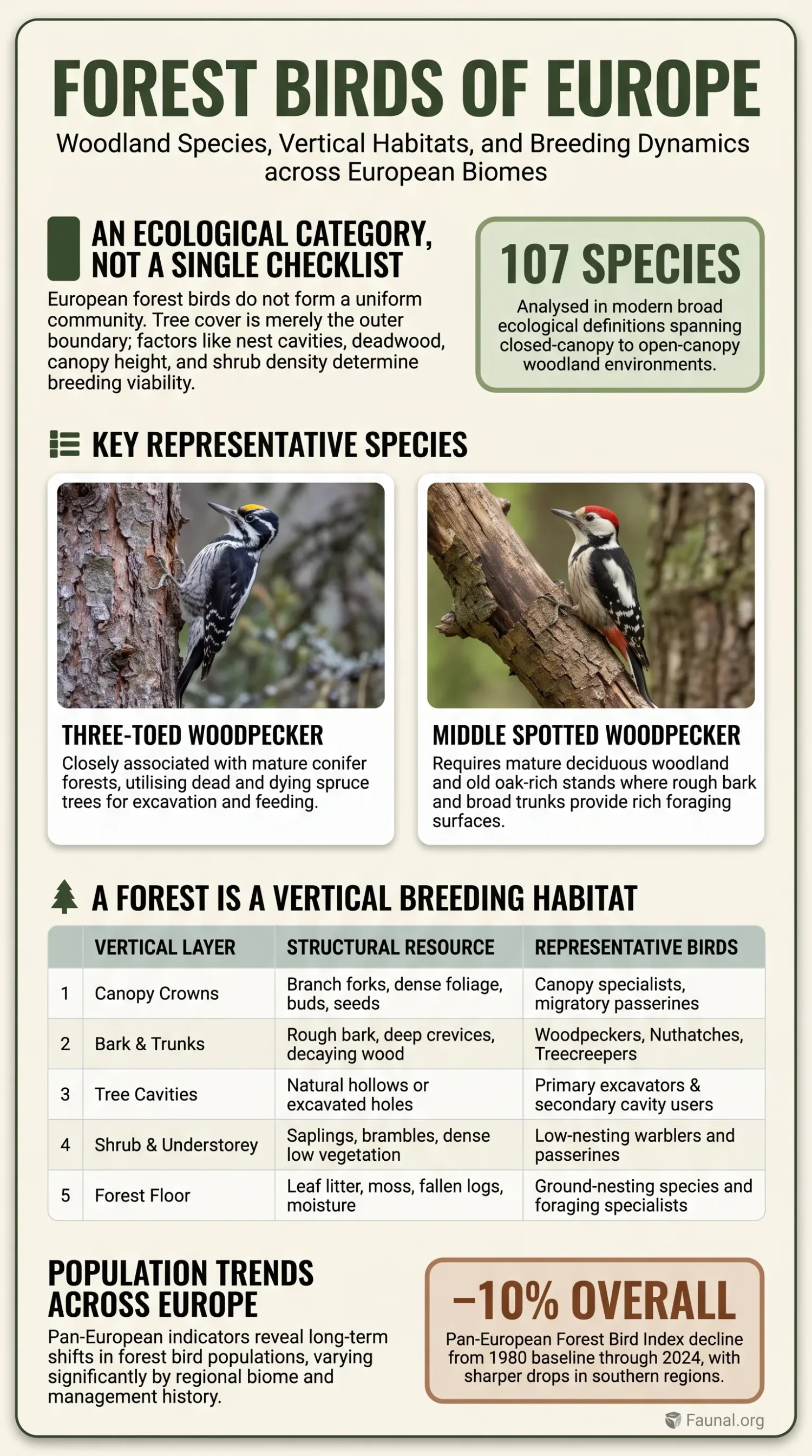
Europe’s forest birds do not form one uniform woodland community. A spruce-dominated boreal forest, an old oak-beech stand, a Mediterranean pine-oak mosaic, a wet alder forest and a Corsican mountain pine forest can all be mapped as woodland while providing very different breeding conditions. For birds, tree cover is only the outer boundary of habitat. Nest cavities, dead and dying trunks, bark structure, canopy height, shrub density, ground vegetation, small openings, wet patches and the age mixture of trees determine which species can actually breed there.
“Forest Bird” Is an Ecological Category, Not One European Checklist
There is no single species total that can be labelled the definitive number of forest birds in Europe. The result changes with the biological definition. A species may depend on closed forest, use woodland only for nesting, favour forest edges and glades, breed in wooded wetlands, or occupy both woodland and non-forest habitats.
The Pan-European Common Bird Monitoring Scheme assigns 34 species to its Forest Bird Index. That set was designed for a multi-species population indicator; it is not an inventory of every European bird that breeds in forest or woodland. A 2025 study in Ecography, using a broader ecological definition that included environments from closed-canopy forest to open-canopy woodland, analysed 107 European forest bird species. The two totals answer different questions.
Thirty-four indicator species do not define the whole forest avifauna
PECBMS classifies monitored species into farmland, forest and other groups for population indicators. Birds outside its 34-species Forest Bird Index can still breed regularly in European woodland. Conversely, indicator membership should not be interpreted as proof that a species requires closed forest throughout its European range.
This distinction matters even within familiar species. Tree Pipit Anthus trivialis and Common Redstart Phoenicurus phoenicurus belong to the PECBMS forest group, yet both can depend strongly on open woodland structure rather than dense continuous canopy. Black Woodpecker Dryocopus martius, Eurasian Nuthatch Sitta europaea, Collared Flycatcher Ficedula albicollis, Wood Warbler Phylloscopus sibilatrix, Crested Tit Lophophanes cristatus and Hawfinch Coccothraustes coccothraustes represent other ways of using wooded breeding landscapes.
Europe’s Main Woodland Breeding Systems Produce Different Bird Communities
Latitude alone does not sort Europe’s woodland birds. Tree species, moisture, elevation, disturbance regime and forest structure alter nesting and feeding resources within the same climatic zone. The habitat systems below are therefore ecological groupings rather than rigid geographic borders.
| Woodland breeding system | Structure relevant to birds | Representative breeding associations |
|---|---|---|
| Boreal conifer and mixed forest | Spruce, pine, birch and aspen; standing dead trees; peatland edges; natural disturbance patches; variable quantities of old trees and deadwood. | Three-toed Woodpecker, Crested Tit, Coal Tit, Goldcrest, Spotted Nutcracker and Hazel Grouse-type boreal communities. |
| Temperate deciduous woodland | Oak, beech, hornbeam and other broadleaves; large trunks; rough bark; natural hollows; layered canopy; leaf litter. | Middle Spotted Woodpecker, Eurasian Nuthatch, Hawfinch, Wood Warbler and cavity-nesting flycatchers where suitable structures occur. |
| Montane mixed forest | Beech, fir, spruce or pine mixtures shaped by elevation, slope, snow, streams and canopy gaps. | Black Woodpecker, treecreepers, Coal Tit and locally specialised grouse, owl and woodpecker assemblages. |
| Mediterranean woodland | Evergreen or deciduous oaks, pines, dry scrub, open canopy, rocky ground, sunlit gaps and strong summer moisture limitation. | Short-toed Treecreeper, Western Bonelli’s Warbler and woodland-edge species whose breeding ranges extend through southern Europe. |
| Floodplain and riparian woodland | Alder, willow, poplar and other moisture-tolerant trees associated with river channels, wet soils, pools and seasonal inundation. | Woodland birds occur beside species tied to wet ground and water margins; local assemblages depend strongly on flooding and tree age. |
| Wood pasture and open woodland | Old or veteran trees mixed with grassland, short vegetation, grazing areas, gaps and exposed feeding ground. | Common Redstart, Tree Pipit and other birds requiring combinations of trees, cavities and open foraging space. |
| Island and restricted mountain forest | Geographically isolated forest types with narrow climatic and tree-species associations. | Corsican Nuthatch is closely associated with mature Corsican pine forest and illustrates how restricted woodland systems can hold highly localised birds. |
The European Breeding Bird Atlas 2 provides continent-scale breeding evidence rather than a forest-only inventory. Its field programme covered Europe mainly during 2013–2017 and produced breeding-likelihood, abundance and distribution products across 48 countries. Such atlas evidence establishes where species breed at broad scale; it does not by itself describe the cavities, deadwood, shrub cover or canopy conditions that make a particular forest stand suitable.
A Forest Is a Vertical Breeding Habitat
Two woodland plots can contain similar tree cover and still support different birds because forest habitat is divided vertically. The upper crown, small branches, main trunks, cavities, shrub layer, litter and fallen wood each contain different nesting sites and feeding resources. Birds separate among these layers even when their territories overlap on a conventional land-cover map.
Canopy crowns provide nesting cover and seasonal food
Upper crowns offer branch forks, dense foliage, buds, seeds, fruits and canopy arthropods. Canopy structure changes through the breeding season as deciduous leaves expand and insect availability shifts. Tree height and crown continuity can therefore matter independently of the total area classified as forest.
Bark and trunks create a separate feeding surface
Treecreepers, nuthatches and woodpeckers use trunks in different ways. Bark roughness, trunk diameter, cracks, decaying wood and arthropods beneath bark all alter the value of a tree. A young stand of smooth, uniform stems therefore cannot be assumed to provide the same resources as an older stand simply because both have a closed canopy.
Tree cavities form a nesting system shared across species
Some birds excavate their own nest holes; others depend on hollows, old woodpecker holes or similar enclosed spaces. The distinction separates primary cavity excavators from secondary cavity users. Once an excavated hole survives beyond one breeding attempt, it can become part of the nesting resource available to other animals.
Shrub and mid-storey density changes nest concealment
A forest with intact trees but almost no shrub layer is not structurally equivalent to one containing hazel, saplings, bramble, rhododendron or other low vegetation. Species that feed or nest close to the ground respond to that difference. Understorey removal can therefore alter the breeding community without changing the mapped forest boundary.
The forest floor is nesting habitat, feeding habitat and cover
Leaf litter, moss, bilberry, grasses, fallen branches and decaying logs support invertebrates and create concealed nest sites. Ground-nesting woodland birds experience a different set of conditions from cavity nesters above them: vegetation height, trampling, grazing, soil moisture and disturbance near nests can matter even when mature trees remain untouched.
Small openings can belong to functioning forest habitat
Continuous closed canopy is not optimal for every woodland bird. Natural tree-fall gaps, rides, glades, bog edges and open patches can provide sunlit feeding areas, low vegetation and aerial insects. Tree Pipit and Common Redstart illustrate why the ecological value of woodland cannot be reduced to maximum canopy closure.
More tree cover does not automatically mean more breeding habitat. The relevant question is whether the forest contains the structures required by the birds expected to reproduce there.
Old, Damaged and Dead Trees Supply Resources That Young Stands Often Lack
Tree ageing changes habitat before a tree dies. Trunks widen, bark changes, branches break, fungal decay develops, wounds open and hollows can form. A standing dead tree can then retain value as feeding substrate, excavation material or a perch even after living foliage disappears.
A 2025 review in Forest Ecology and Management examined 22 studies from boreal Europe covering research published between 1939 and 2024. Aspen emerged as an especially frequent cavity tree, while many cavities occurred in low-vitality or dead trees. The review reported cavity or cavity-nesting bird densities 1.7–4 times higher in unmanaged forest than in managed forest. The authors linked the difference mainly to the lower frequency of trees suitable for excavation in managed stands.
The 1.7–4× result belongs to boreal Europe
The cavity comparison should not be applied as a universal multiplier to every European woodland type. It summarises boreal studies, especially relevant to Fennoscandian-style forest conditions and their management histories.
Deadwood also has functions beyond nest holes. Standing dead trees can contain bark- and wood-associated invertebrates used by foraging birds. Fallen wood changes moisture and decomposition on the forest floor and supports another set of organisms. Removing all dead material therefore modifies several habitat layers at once.
Woodpecker Cavities Connect One Breeding Generation to the Next
Woodpeckers are especially relevant because nest excavation changes the physical forest environment. A suitable trunk can first support feeding, then excavation and breeding, and later provide an enclosed nest space after the original excavator has left. The same cavity may change through decay or enlargement, so its usefulness is not fixed in time.
Three-toed Woodpecker Picoides tridactylus demonstrates the link between mature conifer forest, disturbance and dead trees. A Central European breeding-season study found its habitat use associated with attributes of mature boreal-like forest, including potential cavity trees and heterogeneous tree dimensions. The 2025 boreal cavity review likewise identified the species as favouring dead spruce for excavation.
White-backed Woodpecker Dendrocopos leucotos represents a different deadwood relationship. European species accounts associate it with old mature forest containing mouldering and rotting trees. Middle Spotted Woodpecker Leiopicus medius, by contrast, is strongly associated with mature deciduous woodland and can use old parks and oak-rich stands where broad trunks and bark structure provide feeding surfaces.
These species should not be treated as interchangeable symbols for “good forest.” Their tree preferences, geographic ranges and stand requirements differ. What they demonstrate collectively is that structural resources can be more informative than the binary presence or absence of forest cover.
Nest Site Divides Woodland Birds Into Different Resource Guilds
| Breeding strategy | Forest resource required | European examples | What can become limiting |
|---|---|---|---|
| Excavated cavity | Trunks that can be excavated, often including decaying, low-vitality or dead wood. | Black Woodpecker, Three-toed Woodpecker, White-backed Woodpecker, Middle Spotted Woodpecker. | Suitable trunk diameter, tree condition, deadwood continuity and replacement trees. |
| Existing cavity | Natural hollows or cavities produced by earlier decay or excavation. | Eurasian Nuthatch, Collared Flycatcher, European Pied Flycatcher, Stock Dove and several tits. | Number, entrance size, cavity depth, predator access and competition for holes. |
| Canopy or branch nest | Stable branches, crown cover and suitable tree architecture. | Woodland raptors, thrushes, jays and other open-nest tree breeders. | Loss of large trees, nest exposure and disturbance around established nesting sites. |
| Shrub or low-tree nest | Dense saplings, shrubs, bramble or other low woody cover. | Several woodland warblers and other low-nesting passerines. | Understorey clearance, heavy browsing and simplification of vegetation layers. |
| Ground or low-vegetation nest | Litter, moss, grasses, bilberry, low plants or concealed ground beneath woodland cover. | Wood Warbler, Tree Pipit and grouse species under their respective habitat conditions. | Ground disturbance, vegetation loss, altered moisture and unsuitable canopy density. |
| Large-tree nest platform | Mature trees capable of supporting large open nests within a sufficiently secure territory. | Goshawks and other large tree-nesting woodland birds. | Loss of nest trees and repeated disturbance near occupied territories. |
Nest-site categories overlap with feeding ecology but do not replace it. A cavity-nesting flycatcher still requires enough flying insects within reach of the nest. A ground-nesting bird may need mature trees above it but dense low vegetation below. Retaining only the nest structure can therefore leave other breeding resources missing.
Six Species Show How Different “Forest Habitat” Can Be
Three-toed Woodpecker — dead conifers within mature boreal-like structure
Picoides tridactylus is closely associated with conifer-dominated forest where dead and dying trees provide feeding and excavation resources. Central European research during the breeding period linked smaller home ranges with greater densities of potential cavity trees and a wider range of tree diameters, showing that stand structure can change how much area an individual needs.
White-backed Woodpecker — old deciduous forest with decaying wood
Dendrocopos leucotos is associated with old mature forest containing rotting trees. Its ecology illustrates why retention of broadleaved deadwood can matter even where total forest area remains unchanged.
Middle Spotted Woodpecker — mature broadleaves rather than generic tree cover
Leiopicus medius is a characteristic bird of mature deciduous woodland in much of its European range. Old broadleaved stands and parks provide the bark surfaces and mature-tree structure that distinguish its habitat from young uniform plantations.
Collared Flycatcher — mature woodland plus usable cavities
Ficedula albicollis belongs to the PECBMS Forest Bird Index and represents migratory cavity-nesting passerines. Suitable breeding woodland must provide both nest holes and feeding conditions during the relatively short period between spring arrival and fledging. Its presence cannot be inferred from winter woodland use because the species is a seasonal breeder in Europe.
Western Capercaillie — forest structure at a much larger spatial scale
Tetrao urogallus uses extensive coniferous or mixed forest landscapes rather than a single nesting tree. Old forest, ground vegetation, patches of openness, wet areas and cover can all contribute to habitat quality. This scale separates its breeding requirements from small cavity users even when both occur within conifer forest.
Corsican Nuthatch — one island forest system can define most of a species’ habitat
Corsican Nuthatch Sitta whiteheadi is almost entirely associated with Corsican pine forest. EUNIS identifies the bird directly with Corsican Pinus laricio woodland, while field research has found the species concentrated in mature pine stands and especially favourable where large old trees remain. Its ecology demonstrates the opposite end of the spectrum from widespread forest generalists: a European woodland bird can be tied to one restricted island forest system.
Closed Canopy and Open Woodland Support Different Breeders
Dense mature forest is not the endpoint required by every woodland bird. Some species depend on interior structure, old trees or humid shaded conditions. Others require open feeding space, forest edges or a mixture of trees and low vegetation. Treating canopy closure as a simple measure of habitat quality therefore produces contradictory results when species with different ecological requirements are combined.
Wood pasture illustrates the distinction clearly. A landscape of old trees, cavities, grazed ground and open space may contain less canopy than closed forest while providing combinations of nest sites and feeding ground absent from a dense even-aged stand. Natural gaps can perform similar functions at smaller scales.
Recent clear-cuts are different again. A 2025 systematic review of 99 boreal European studies found higher bird species richness in older forest and high species turnover between recently clear-cut sites and closed forest. Open sites can acquire their own birds, but the arrival of a different assemblage does not mean the original mature-forest community has been retained.
Species richness and species identity are different measurements
A disturbed or young site can contain many bird species while supporting a different set from old forest. Counting species alone can therefore hide replacement of mature-forest specialists by birds adapted to young vegetation or open ground.
Residents and Migrants Use Woodland on Different Annual Schedules
Breeding habitat should be separated from seasonal occurrence. Eurasian Nuthatch, several woodpeckers and many tits can remain within or near European woodland through much of the year. Collared Flycatcher, European Pied Flycatcher Ficedula hypoleuca, Wood Warbler and Tree Pipit are migratory examples whose European woodland relationship is concentrated around breeding and migration periods.
A spring record of a migrant inside forest does not automatically establish nesting. Territorial song, repeated presence, nest-building, food-carrying, occupied cavities or atlas breeding codes provide stronger breeding evidence. Likewise, a species recorded in woodland during migration may use a different habitat during reproduction.
This distinction is particularly important in continent-scale datasets. EBBA2 maps breeding evidence, whereas general occurrence databases can combine breeding birds, migrants, winter visitors and incidental observations unless the data are filtered by date and breeding status.
Europe Does Not Have One Forest-Bird Population Trend
The latest published PECBMS Forest Bird Index covers 34 monitored forest species and extends through 2024. At the pan-European scale the index is reported as 10% below its 1980 level. Regional trajectories differ: West Europe is slightly above its starting level, while the South European series shows a much larger reduction.
Regional Change in the European Forest Bird Index
PECBMS multi-species indicator change across each region's published monitoring period through 2024.
Data: PECBMS European Indicators, 2025 update. Europe 1980–2024; West 1980–2024; North 1980–2024; Central & East 1982–2024; South 1989–2024. Values are changes in multi-species indices, not percentages of species lost.
The regional values should not be compared as though every series began in the same year. Central and East Europe begins in 1982 and South Europe in 1989, while the Europe, North and West series begin in 1980. The number of species entering each regional indicator also differs because monitored forest species are not distributed evenly across the continent.
The European Environment Agency reports a separate EU common forest bird indicator. Its 1990–2024 series for 26 EU countries is 8% below the 1990 baseline. That figure should not be substituted for the pan-European −10% result: the geographic coverage, reference year and time span differ.
An index decline is not a percentage of species lost
A Forest Bird Index combines population trajectories of selected species. A value reported as −10% does not mean that Europe has lost 10% of its forest bird species, nor does it mean that every included species declined by 10%.
The latest released European series still ends in 2024. PECBMS reported in July 2026 that participating countries had submitted 2025 monitoring data and that checks were underway ahead of the next planned European update. Until that release is published, the 1980–2024 series remains the current pan-European indicator for direct use.
Boreal, Temperate and Mediterranean Forest Birds Are Changing Differently
A continent-wide average can hide opposing movements among biomes. A 2025 Ecography analysis selected 107 European forest and woodland bird species and examined changes in abundance and distribution alongside ecological traits. Boreal forest species declined in abundance and range area in the study, while temperate and Mediterranean groups showed increases in abundance and range on average.
Within the boreal group, mixed-forest specialists showed particularly negative changes in abundance and range and shifted northward. The authors linked the wider pattern to a combination of forest structure and composition, land use and warming rather than to one continent-wide process.
This is why “European forest birds are stable” and “European forest birds are declining” can both conceal useful information. The outcome depends on the species included, geographic boundary, biome, measurement used and period examined. Abundance, occupied range and latitude can change in different directions.
Forest Management Can Alter Breeding Habitat Before Tree Cover Disappears
Forest change relevant to birds is not limited to complete clearing. A stand can remain visibly wooded while losing cavities, old trunks, broadleaved components, shrub cover or structural variation. Management effects are therefore better described by the habitat resource altered than by the single label “forest loss.”
| Structural change | Breeding resource affected | Birds most directly exposed to the change |
|---|---|---|
| Shorter rotations and fewer old trees | Large trunks, mature crowns, decay features, natural hollows and long-lived nest trees. | Cavity users, mature-tree specialists and large tree-nesting birds. |
| Removal of standing deadwood | Excavation substrate, bark insects, feeding surfaces and future cavities. | Woodpeckers and other bark- or cavity-associated birds. |
| Removal of fallen deadwood | Moist decomposing substrate, forest-floor invertebrates and structural cover. | Ground-foraging and low-layer woodland species. |
| Even-aged stand structure | Variation in trunk size, canopy height, decay stage and regeneration patches. | Bird communities requiring several forest layers or old-tree resources. |
| Dense uniform canopy | Small glades, low vegetation, sunlit feeding areas and open flight space. | Open-woodland, ride and gap users such as Tree Pipit-type breeders. |
| Understorey clearance | Shrub nests, concealment and low-level feeding substrate. | Shrub- and low-nesting woodland passerines. |
| Drainage of wet woodland | Wet soils, pools, riparian vegetation and moisture-dependent prey. | Birds associated with wooded streams, floodplain forest and wet forest floor. |
| Fragmentation | Large territories, interior habitat and movement between forest patches. | Species requiring broad continuous woodland or several habitat patches within one home range. |
The same intervention can also produce opposite responses among species. Opening a dense stand may create feeding habitat for an open-woodland bird while reducing interior conditions for another species. Retaining old broadleaves inside a conifer-dominated forest can add cavity and feeding structures without converting the entire stand to broadleaf woodland. Forest-bird management therefore depends on the ecological community being considered.
Tree Cover Can Remain While Climate Changes the Breeding Environment
Climate effects on woodland birds do not require forest to disappear. Changes in temperature and drought can alter tree growth, conifer survival, fire regimes, insect timing, moisture and the geographic position of suitable forest types. Birds may respond through changes in abundance, range size or the latitude and elevation of breeding populations.
The biome differences reported in the 2025 European forest-bird study fit this more detailed view. Boreal species showed contraction and lower abundance on average, while warmer-region groups often moved differently. A forest map that remains green from one decade to the next can therefore conceal ecological changes relevant to nesting and food supply.
Range expansion also should not be treated as proof that a population is increasing everywhere. A species can occupy new northern areas while declining in another part of its range, and abundance can change without a matching change in mapped range. Population indices and breeding-distribution atlases measure different biological responses.
Forest Birds Now Form Part of EU Forest-Restoration Monitoring
The EU Nature Restoration Regulation gives the common forest bird index a formal monitoring role. Article 12 requires EU Member States to put forest-restoration measures in place and achieve an increasing national trend in the common forest bird index, measured from 18 August 2024 to 31 December 2030 and in subsequent six-year periods until nationally defined satisfactory levels are reached.
The same forest-ecosystem provisions also refer to structural indicators such as standing deadwood, lying deadwood, uneven-aged structure, forest connectivity, organic carbon, native-tree dominance and tree-species diversity. The regulation applies to EU Member States; it is not a monitoring rule for every country in geographic Europe.
For European woodland birds, the biologically useful unit is rarely “forest present or absent.” Breeding habitat is assembled from tree species, age classes, cavities, deadwood, vegetation layers, moisture, openings and landscape continuity, and different birds depend on different combinations of those features.
Sources and Verification
- PECBMS — European Wild Bird Indices, 2025 update — Used for the 34-species Forest Bird Index scope, habitat-classification purpose and current indicator methodology.
- PECBMS — European Indicators — Used for the published Europe and regional Forest Bird Index changes through 2024 and their different starting years.
- PECBMS — Report on the Pan-European Common Bird Monitoring Scheme, June 2026 — Used to verify that 2025 national monitoring data were under quality checks ahead of the planned next European update.
- European Environment Agency — Common bird index in Europe — Used for the EU 1990–2024 forest-bird indicator, its 34-species scope and the 8% change from the 1990 baseline.
- European Bird Census Council — European Breeding Bird Atlas 2 — Used for the atlas field period, geographic coverage and distinction between breeding-distribution evidence and local habitat structure.
- Cours et al. — Changes in abundance and distribution of European forest bird populations depend on biome, ecological specialisation and traits — Used for the 107-species ecological definition and the contrasting boreal, temperate and Mediterranean abundance and range patterns.
- Nirhamo & Kouki — Tree cavity patterns and implications for forest management in boreal Europe — Used for cavity-tree characteristics, the 22-study review scope and the 1.7–4× unmanaged-versus-managed forest comparison.
- Forest biodiversity in boreal Europe: species richness and turnover among old-growth forests, managed forests and clearcut sites — Used for the 99-study synthesis of bird richness in older forests and species turnover between clear-cut and closed-forest assemblages.
- Habitat use of the Three-toed Woodpecker in central Europe during the breeding period — Used for breeding-season relationships between Three-toed Woodpeckers, potential cavity trees, tree-size variation and mature boreal-like forest structure.
- Naturalis Biodiversity Center — White-backed Woodpecker — Used for the species’ association with old mature forest containing decaying and rotting trees.
- Naturalis Biodiversity Center — Middle Spotted Woodpecker — Used for the species’ association with mature deciduous woodland and old wooded parks.
- EUNIS — Corsican Pinus laricio forests — Used for the formal habitat description linking Corsican Nuthatch with Corsican laricio pine forest.
- Thibault et al. — Habitat requirements and foraging behaviour of the Corsican Nuthatch — Used for the species’ close relationship with Corsican pine forest and mature-stand habitat.
- EUR-Lex — Regulation (EU) 2024/1991 on nature restoration — Used for Article 12 requirements concerning the national common forest bird index and forest-ecosystem restoration monitoring.
Related Topics
- → Birds of Europe: Species Diversity, Habitats, and Biogeographic Regions
- → Urban Birds of Europe: Common Species in Towns and Cities
- → Farmland Birds of Europe: Species Decline and Habitat Change
- → Wildlife of Western Europe: Landscapes, Species, and Conservation
- → Wildlife of Eastern Europe: Forests, Wetlands, and Steppe Species
- → Wildlife of Northern Europe: Boreal Forests, Tundra, and Coasts