Complete guides: •Regional Fauna Guides•Birds•Fauna of Europe
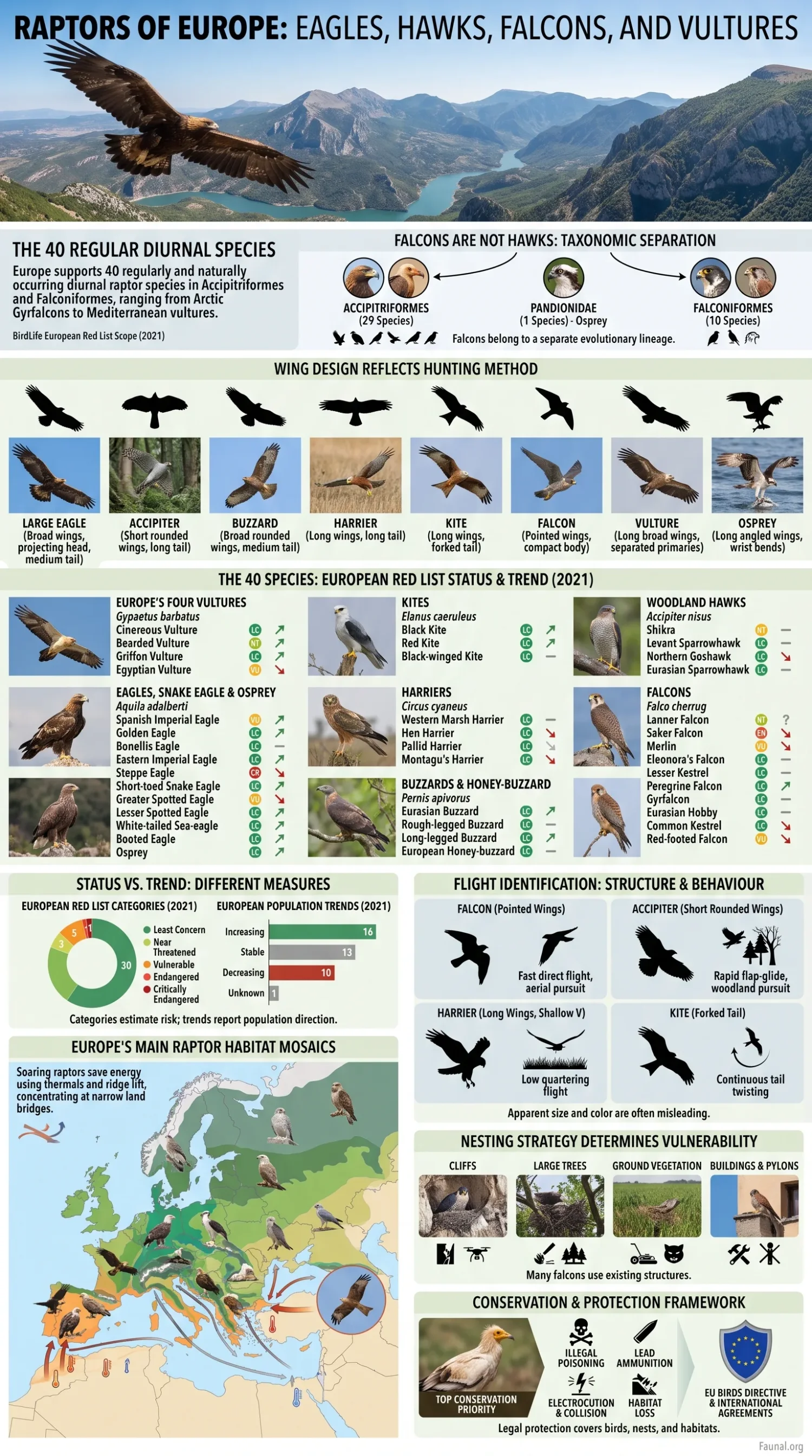
Europe supports 40 regularly and naturally occurring diurnal raptor species when the continent-wide scope of the European Red List of Birds is filtered to Accipitriformes and Falconiformes. The assemblage contains 29 species in Accipitridae, the Osprey in Pandionidae, and 10 falcons in Falconidae. It ranges from Arctic Gyrfalcons and wetland eagles to Mediterranean vultures, farmland harriers and woodland ambush hunters.
The 40-species total is tied to a defined boundary. BirdLife’s European assessment covers 54 countries and territories from Greenland, Iceland and Svalbard south to the Canary Islands, Malta and Cyprus, and from the Azores east to the Caucasus and Ural Mountains. It includes species native to Europe or occurring there naturally and regularly. A narrower peer-reviewed analysis based on regular breeding raptors counted 38 species, showing why totals from different European lists do not always match. BirdLife European Red List PeerJ raptor diversity study
Why European Raptor Totals Differ
A list may count only breeding species, include regular winter visitors, add rare vagrants, extend Europe to the Caucasus and Atlantic islands, or treat owls as raptors. The checklist on this page includes regular diurnal species within BirdLife’s European Red List boundary. Owls and accidental visitors are excluded.
Falcons Are Not Hawks in a Taxonomic Sense
The English word raptor describes birds that share predatory adaptations, not one close evolutionary branch. Eagles, buzzards, kites, harriers, accipiters and Old World vultures belong to Accipitriformes. Falcons belong to Falconiformes, a separate lineage placed nearer parrots and passerines than to Accipitridae in modern avian classifications. The Osprey is also distinct enough to occupy its own family, Pandionidae. IOC classification
| Order | Family | European Species | Forms Included |
|---|---|---|---|
| Accipitriformes | Accipitridae | 29 | Eagles, vultures, kites, harriers, buzzards, honey-buzzard and accipiters |
| Accipitriformes | Pandionidae | 1 | Osprey |
| Falconiformes | Falconidae | 10 | Falcons, hobbies, kestrels and Merlin |
“Hawk” is especially imprecise. In a narrow European use it often refers to Accipiter species such as the Northern Goshawk and Eurasian Sparrowhawk. In broader English usage it may also be applied to buzzards, harriers or other medium-sized Accipitridae. Scientific names prevent that linguistic overlap from becoming a taxonomic error.
Taxonomy Is Moving Toward AviList
Scientific and English names were checked against IOC World Bird List v15.2. BirdLife maintains the taxonomy used for its conservation assessments and has begun aligning its work with AviList, first released in 2025. Species order and English names may therefore differ slightly between current checklists even where the underlying taxon is unchanged.
Wing Design Reflects Hunting Method
European raptors do not share one flight pattern or feeding system. Wing loading, tail length, body mass and feather shape reflect the airspace and prey used by each group. A Goshawk built for acceleration between trees has a different outline from a Griffon Vulture designed to remain aloft on rising air.
| Raptor Form | Typical Outline | Characteristic Flight | Main Feeding Method |
|---|---|---|---|
| Large eagles | Broad wings, projecting head, medium to long tail | Soaring mixed with strong, deliberate wingbeats | Capture of mammals, birds, reptiles, fish or carrion use |
| Accipiters | Short rounded wings and a long tail | Rapid wingbeats followed by short glides | Ambush pursuit through woodland and enclosed habitats |
| Buzzards | Broad rounded wings and a medium tail | Circling, slope soaring and perch-based hunting | Small mammals, reptiles, birds, invertebrates and carrion |
| Harriers | Long wings and long tail | Low quartering flight with wings often held in a shallow V | Detection of prey in marshes, grassland and crops |
| Kites | Long wings and a forked or notched tail | Buoyant circling with constant tail adjustments | Small prey, refuse, fish remains and carrion |
| Falcons | Pointed wings and compact body | Fast pursuit, aerial interception, hovering or stooping | Birds, mammals and flying insects |
| Vultures | Long broad wings with separated primary feathers | Extended thermal and slope soaring | Carcass detection and scavenging |
| Osprey | Long angled wings with strong wrist bends | Hovering, gliding and feet-first plunge-diving | Fish capture |
The 40 Regular Diurnal Raptors in the European Red List Scope
The tables below include every diurnal raptor assessed as regularly and naturally occurring within BirdLife’s European boundary. “Europe category” and “trend” refer to the 2021 regional assessment, not the current global category. LC means Least Concern, NT Near Threatened, VU Vulnerable, EN Endangered and CR Critically Endangered. Habitat and movement descriptions identify the species’ main European pattern rather than every habitat or seasonal exception. European Red List report
European and Global Categories Can Differ
A regional assessment measures extinction risk inside Europe. A species may be secure within the assessed European boundary but threatened across its full global range, or it may face high regional risk despite being more widespread elsewhere. Category and population direction are also separate measures.
Europe’s Four Vultures
| Common Name | Scientific Name | Core European Ecology | Movement and Field Profile | Europe Category | Trend |
|---|---|---|---|---|---|
| Cinereous Vulture | Aegypius monachus | Open woodland, wooded dehesa and mountain landscapes | Resident or dispersive; broad, dark wings and a longer tail than Griffon Vulture | LC | Increasing |
| Bearded Vulture | Gypaetus barbatus | High mountains, cliffs and open alpine terrain | Mostly resident; long diamond-shaped tail and narrow, pointed-looking wings | NT | Increasing |
| Griffon Vulture | Gyps fulvus | Cliffs, open grazing country and mountain systems | Resident or dispersive; very broad wings, short tail and small projecting head | LC | Increasing |
| Egyptian Vulture | Neophron percnopterus | Dry open country, cliffs and pastoral landscapes | Mainly migratory in Europe; white adult with black flight feathers and wedge-shaped tail | VU | Decreasing |
These species form a scavenger guild rather than four interchangeable carrion feeders. Griffon Vultures often open and consume soft tissue in groups. Cinereous Vultures can handle tougher material. Egyptian Vultures take smaller remains and a wider range of food, while Bearded Vultures are adapted to swallowing and digesting bones. Europe’s four-vulture restoration work therefore seeks to rebuild a set of complementary feeding roles. Vulture Conservation Foundation
Eagles, Snake Eagle and Osprey
| Common Name | Scientific Name | Core European Ecology | Movement and Field Profile | Europe Category | Trend |
|---|---|---|---|---|---|
| Spanish Imperial Eagle | Aquila adalberti | Iberian woodland and open hunting mosaics | Resident or locally dispersive; large eagle with pale shoulder patches in adults | VU | Increasing |
| Golden Eagle | Aquila chrysaetos | Mountains, uplands, steppe and open rocky country | Mostly resident; long wings, projecting head and long tail | LC | Increasing |
| Bonelli’s Eagle | Aquila fasciata | Mediterranean cliffs, scrub and dry woodland mosaics | Mostly resident; long-tailed, powerful flight with relatively narrow wings | LC | Stable |
| Eastern Imperial Eagle | Aquila heliaca | Eastern lowlands, steppe edges and open woodland | Partial migrant; long, parallel-edged wings and pale nape in adults | LC | Increasing |
| Steppe Eagle | Aquila nipalensis | Steppe and semi-arid open country at Europe’s eastern edge | Long-distance migrant; broad-winged eagle with a long gape line | CR | Decreasing |
| Short-toed Snake Eagle | Circaetus gallicus | Dry open habitats with scrub, woodland edges and reptile prey | Long-distance migrant; pale underparts, dark hood and frequent wind-hovering | LC | Increasing |
| Greater Spotted Eagle | Clanga clanga | Wet forests, floodplains, marshes and lake districts | Migratory or dispersive; compact dark eagle with broad wings | VU | Decreasing |
| Lesser Spotted Eagle | Clanga pomarina | Eastern and central European forest–meadow mosaics | Long-distance migrant; smaller and more lightly built than Greater Spotted Eagle | LC | Increasing |
| White-tailed Sea-eagle | Haliaeetus albicilla | Coasts, estuaries, large rivers, lakes and wetlands | Resident or partial migrant; huge rectangular wings and short white tail in adults | LC | Increasing |
| Booted Eagle | Hieraaetus pennatus | Warm woodland, forest edges and open hunting country | Mainly migratory; small eagle occurring in pale and dark morphs | LC | Increasing |
| Osprey | Pandion haliaetus | Lakes, reservoirs, rivers, estuaries and coasts | Migratory or partial migrant; angled wings, dark wrist patches and fish-catching dives | LC | Increasing |
“Eagle” does not identify one ecological type. Golden Eagles hunt across open uplands; spotted eagles depend more heavily on forest–wetland mosaics; White-tailed Sea-eagles use aquatic systems; Short-toed Snake Eagles specialise in reptile-rich landscapes. The Osprey is grouped here for ecological comparison but belongs to Pandionidae rather than Accipitridae.
Kites
| Common Name | Scientific Name | Core European Ecology | Movement and Field Profile | Europe Category | Trend |
|---|---|---|---|---|---|
| Black Kite | Milvus migrans | Wetlands, rivers, farmland, settlements and open woodland | Mainly migratory in Europe; shallow forked tail and elastic circling flight | LC | Increasing |
| Red Kite | Milvus milvus | Farmland, pasture, woodland edge and uplands | Resident or partial migrant; deeply forked tail and long angled wings | LC | Increasing |
| Black-winged Kite | Elanus caeruleus | Open farmland, grassland and lightly wooded plains | Resident or dispersive; pale plumage, black shoulder patches and hovering hunts | LC | Stable |
Red and Black Kites use their tails as active steering surfaces while circling and searching. The Black-winged Kite is structurally and behaviourally different: it frequently hovers over open ground and takes small mammals from short aerial searches or perches.
Harriers
| Common Name | Scientific Name | Core European Ecology | Movement and Field Profile | Europe Category | Trend |
|---|---|---|---|---|---|
| Western Marsh Harrier | Circus aeruginosus | Reedbeds, marshes, wetlands and farmland | Partial migrant; large harrier with low quartering flight | LC | Stable |
| Hen Harrier | Circus cyaneus | Moorland, heath, bog, steppe and winter farmland | Migratory or partial migrant; buoyant flight with wings held in a shallow V | LC | Decreasing |
| Pallid Harrier | Circus macrourus | Eastern steppe, dry grassland and open farmland | Long-distance migrant; slim wings and narrow hand, especially in adult males | LC | Stable |
| Montagu’s Harrier | Circus pygargus | Grassland, cereal fields, heath and open marsh | Long-distance migrant; slender build and flexible, tern-like flight | LC | Decreasing |
Harriers search close to the ground rather than remaining high in thermals. Their long wings, long tails and shallow dihedral improve control during low-speed turns over vegetation. Ground nesting exposes several populations to mowing, harvesting, trampling, fire and disturbance that would not affect cliff- or tree-nesting raptors in the same way.
Buzzards and the European Honey-buzzard
| Common Name | Scientific Name | Core European Ecology | Movement and Field Profile | Europe Category | Trend |
|---|---|---|---|---|---|
| Eurasian Buzzard | Buteo buteo | Woodland edge, farmland, pasture and mixed landscapes | Resident or partial migrant; broad wings and highly variable plumage | LC | Increasing |
| Rough-legged Buzzard | Buteo lagopus | Arctic tundra in the breeding season and open lowlands in winter | Migratory; long wings, pale tail base and dark carpal patches | LC | Stable |
| Long-legged Buzzard | Buteo rufinus | Dry steppe, semi-desert, rocky slopes and open farmland | Resident or partial migrant; long wings and tail, often with warm rufous tones | LC | Increasing |
| European Honey-buzzard | Pernis apivorus | Woodland mosaics with clearings and insect-rich ground | Long-distance migrant; long tail, small pigeon-like head and flexible wings | LC | Stable |
The European Honey-buzzard is not a typical Buteo buzzard. It feeds heavily on social wasps and their larvae, has scale-like facial feathering that offers protection around nests, and migrates to sub-Saharan Africa. Its long tail, small head and elastic wing action help separate it from the highly variable Eurasian Buzzard.
Woodland Hawks
| Common Name | Scientific Name | Core European Ecology | Movement and Field Profile | Europe Category | Trend |
|---|---|---|---|---|---|
| Shikra | Accipiter badius | Dry woodland, groves and cultivated landscapes at Europe’s southeastern edge | Resident or short-distance migrant; small accipiter with rapid wingbeats | NT | Stable |
| Levant Sparrowhawk | Accipiter brevipes | Open woodland, groves and wooded river valleys in southeast Europe | Long-distance migrant; compact accipiter often seen in passage flocks | LC | Stable |
| Northern Goshawk | Accipiter gentilis | Mature forest and wooded mosaics | Resident or dispersive; powerful body, broad short wings and long tail | LC | Decreasing |
| Eurasian Sparrowhawk | Accipiter nisus | Woodland, scrub, farmland and urban areas | Resident or partial migrant; small, short-winged and long-tailed bird hunter | LC | Stable |
Accipiters trade soaring efficiency for acceleration and manoeuvrability. Their short wings clear branches during tight turns, while the long tail acts as a brake and rudder. Females are larger than males, sometimes enough to alter the apparent proportions and prey range of the same species.
Falcons
| Common Name | Scientific Name | Core European Ecology | Movement and Field Profile | Europe Category | Trend |
|---|---|---|---|---|---|
| Lanner Falcon | Falco biarmicus | Mediterranean and southeastern cliffs, dry open country and semi-desert | Mostly resident; large falcon with long wings and a pale head pattern | NT | Unknown |
| Saker Falcon | Falco cherrug | Eastern steppe, open farmland and lowland plains | Partial or long-distance migrant; broad-winged falcon adapted to open-country pursuit | EN | Decreasing |
| Merlin | Falco columbarius | Northern moor, tundra and open country; lowlands in winter | Migratory or partial migrant; small, fast falcon with direct flight | VU | Decreasing |
| Eleonora’s Falcon | Falco eleonorae | Mediterranean islands and sea cliffs | Long-distance migrant; late breeder timed to autumn passerine migration | LC | Stable |
| Lesser Kestrel | Falco naumanni | Dry farmland, steppe, villages and colony sites | Mainly migratory; colonial falcon with frequent hovering | LC | Stable |
| Peregrine Falcon | Falco peregrinus | Cliffs, coasts, mountains and cities | Resident or partial migrant; heavy-bodied falcon with pointed wings and a powerful stoop | LC | Increasing |
| Gyrfalcon | Falco rusticolus | Arctic tundra, sea cliffs and northern open country | Resident or dispersive; very large falcon with broad-based wings | LC | Stable |
| Eurasian Hobby | Falco subbuteo | Woodland edge, wetlands and open country | Long-distance migrant; slim, scythe-winged aerial hunter | LC | Stable |
| Common Kestrel | Falco tinnunculus | Farmland, grassland, cliffs and urban areas | Resident or partial migrant; frequent hovering and a long tail | LC | Decreasing |
| Red-footed Falcon | Falco vespertinus | Eastern grassland, steppe and open farmland with colony trees | Long-distance migrant; social falcon that often hunts insects in the air | VU | Decreasing |
Falcons are not defined by one high-speed dive. Peregrines frequently intercept birds in open air, but kestrels use hovering searches, Merlins chase small birds close to the ground, hobbies take birds and insects in flight, and Sakers pursue prey across open steppe. Pointed wings unite the group, while wing breadth, tail length and hunting height separate its members.
Threat Category and Population Direction Measure Different Things
Thirty of the 40 species were assessed as Least Concern in Europe, but that does not mean every one was stable or rising. Ten species had decreasing European trends, including several classified as LC. A Red List category estimates regional extinction risk using population size, range and rate of change; the trend field reports whether numbers were moving upward, downward or remaining broadly stable during the assessment period.
European Red List Categories Among 40 Diurnal Raptors
Regional categories reported in the European Red List of Birds 2021.
Data: BirdLife International, European Red List of Birds 2021. Counts were calculated from the 40-species diurnal checklist used on this page.
Reported European Population Directions
The direction attached to each species in the same regional assessment.
Data: BirdLife International, European Red List of Birds 2021. Trend totals are 16 increasing, 13 stable, 10 decreasing and one unknown.
Europe’s Main Raptor Regions Are Habitat Mosaics
Iberian and Western Mediterranean Landscapes
The Iberian Peninsula holds the entire breeding range of the Spanish Imperial Eagle and major European populations of Griffon, Cinereous and Egyptian Vultures. Dry woodland, dehesa, grazing land, cliffs and extensive open habitats occur close enough to support nesting, hunting and scavenging within the same regional system. Bonelli’s Eagle, Black-winged Kite, Red Kite, Lesser Kestrel and several migratory raptors add further ecological breadth.
Alps, Pyrenees, Carpathians and Balkan Mountains
Mountain chains provide cliff nesting, slope lift, open hunting ground and extensive livestock landscapes. Golden Eagles occupy many upland systems, while Bearded and Griffon Vultures depend on a smaller set of mountain strongholds and restored populations. The Balkans also connect European breeding grounds with migration routes toward Anatolia and the eastern Mediterranean.
Forest, Lake and Floodplain Belt
Central, eastern and northern European forest–wetland mosaics support White-tailed Sea-eagles, Ospreys, Greater and Lesser Spotted Eagles, Northern Goshawks and Eurasian Sparrowhawks. Large nest trees may lie within forest, while feeding takes place over lakes, rivers, marshes, meadows or agricultural clearings. Protecting a nest stand alone cannot retain this ecological arrangement if nearby feeding habitat is drained or simplified.
Eastern Steppe and Farmland
Open lowlands from central Europe eastward contain the European cores of Saker Falcon, Red-footed Falcon, Eastern Imperial Eagle, Long-legged Buzzard and several harriers. Scattered trees, old corvid nests, ground-squirrel colonies, field margins and low-intensity grassland can all affect breeding opportunities. Conversion to uniform crops may remove prey and nesting structure even when the landscape still appears open.
Arctic and Boreal Europe
Gyrfalcons, Merlins and Rough-legged Buzzards occupy Europe’s northern tundra and open boreal margins. Golden Eagles, White-tailed Sea-eagles, Ospreys and Northern Goshawks extend through parts of the same broad region but use different prey and nesting settings. Winter movement can carry northern raptors far into temperate farmland, coasts and wetlands.
Migration Concentrates Soaring Raptors at Narrow Crossings
Large eagles, vultures, buzzards and harriers save energy by using thermals and ridge lift. Rising air is weaker or absent over long stretches of open sea, so many soaring migrants concentrate where land narrows the crossing. The Strait of Gibraltar and Bosporus are major examples. Routes also pass through the central Mediterranean, the Black Sea margins and eastern Mediterranean land bridge.
Falcons and accipiters can sustain more powered flight than the heaviest soaring birds, yet many still follow productive coasts, valleys and peninsulas where prey and favourable winds concentrate. Migration routes are therefore species-specific networks rather than one shared European flyway.
| Movement Pattern | European Examples | Ecological Consequence |
|---|---|---|
| Long-distance soaring migration | European Honey-buzzard, Lesser Spotted Eagle, Short-toed Snake Eagle | Strong concentration at land bridges and narrow sea crossings |
| Long-distance powered or mixed flight | Eleonora’s Falcon, Eurasian Hobby, Red-footed Falcon, Lesser Kestrel | Greater sea-crossing ability, although routes still follow prey and wind conditions |
| Partial migration | Red Kite, Common Kestrel, Western Marsh Harrier, White-tailed Sea-eagle | Some populations remain while others shift south or west |
| Juvenile dispersal | Griffon Vulture, Cinereous Vulture, Golden Eagle | Young birds may appear far beyond breeding cores without establishing a breeding range |
| Northern winter movement | Rough-legged Buzzard, Merlin, Gyrfalcon | Winter distribution changes with weather and prey availability |
A record made during passage does not prove local breeding. Likewise, a dispersing juvenile beyond the usual range does not establish a resident population. Season, age and repeated breeding evidence are needed before a regional status is changed.
Flight Identification Begins with Structure and Behaviour
Colour is often the least reliable first feature at distance. Backlighting removes plumage detail, while age, sex, colour morph and moult can make members of the same species look unrelated. Wing proportions, tail form, flight rhythm, habitat and season usually narrow the possibilities before plumage markings are considered.
| Observed Form | Most Likely Group | Supporting Behaviour | Common Source of Error |
|---|---|---|---|
| Pointed wings and compact body | Falcon | Fast direct flight, aerial pursuit, hovering or stooping | Hobbies, kestrels and large falcons still differ greatly in proportions |
| Short rounded wings with a long tail | Accipiter | Rapid flap–glide flight and sudden woodland pursuit | Female Sparrowhawks may be mistaken for male Goshawks without a scale reference |
| Long wings held in a shallow V near the ground | Harrier | Quartering over reeds, crops, heath or grassland | Sex and age produce sharply different plumages |
| Deeply forked tail | Red Kite | Continuous tail twisting during buoyant circling | Black Kite has a shallower fork that may disappear when the tail is spread |
| Broad wings and very short tail | Griffon Vulture or White-tailed Sea-eagle | Slow soaring with limited flapping | Head projection, wing shape and habitat must be checked together |
| Long angled wings with dark wrist marks | Osprey | Hovering above water and feet-first plunge-diving | Gulls can produce a similar bent-wing impression at poor angles |
| Broad rounded wings with variable underwing pattern | Buzzard | Circling, hovering in wind or watching from a perch | Eurasian Buzzard plumage is too variable for colour alone to be dependable |
| Very broad fingered wings and small head | Large vulture | Extended thermal soaring, often with other scavengers | Distance can conceal the longer tail and larger head of Cinereous Vulture |
Apparent Size Is Easily Misjudged
A lone bird against an empty sky has no dependable scale. Distance, wing position and altitude can make a buzzard appear eagle-sized or make a large eagle seem compact. Comparative size becomes useful only when another bird, tree, structure or known landscape feature is close enough to provide scale.
Predators, Scavengers and Specialists Share the Same Food Web
Bird Hunters
Eurasian Sparrowhawks and Northern Goshawks use surprise and acceleration. Peregrines, Merlins and hobbies intercept birds in more open airspace. Eleonora’s Falcon delays breeding until late summer, allowing adults to exploit migrating passerines crossing Mediterranean islands while chicks are growing.
Mammal and Ground-Prey Hunters
Golden and imperial eagles can take medium-sized terrestrial prey, while buzzards and kestrels rely more heavily on small mammals. Harriers locate mammals and ground-nesting birds while flying slowly over vegetation. Prey composition changes by region, season, age and local availability, so no species should be reduced to one food item.
Fish, Reptiles and Invertebrates
Ospreys are dedicated fish hunters with reversible outer toes and spiny foot pads that improve grip. White-tailed Sea-eagles take fish but also birds, mammals and carrion. Short-toed Snake Eagles search reptile-rich open ground, while European Honey-buzzards excavate nests of social wasps. Lesser Kestrels and Red-footed Falcons may take large numbers of insects where seasonal swarms occur.
Carrion Use Extends Beyond Vultures
Vultures depend most heavily on carcasses, but kites, sea-eagles, buzzards and large eagles also scavenge. This overlap links raptor health to livestock carcass management, hunting ammunition, veterinary drugs, road mortality and deliberate poisoning. A contaminated carcass can expose several species during one feeding event.
Nesting Strategy Determines the Form of Disturbance
| Nest Setting | Representative Raptors | Main Vulnerability |
|---|---|---|
| Cliffs and rock ledges | Griffon Vulture, Egyptian Vulture, Golden Eagle, Peregrine Falcon, Eleonora’s Falcon | Climbing, quarrying, aircraft, drones, repeated close observation and poorly placed energy infrastructure |
| Large forest trees | White-tailed Sea-eagle, Northern Goshawk, Black Kite, Cinereous Vulture, spotted eagles | Felling, forestry during breeding, loss of old nest trees and road access near nest stands |
| Ground vegetation | Hen Harrier, Montagu’s Harrier, Pallid Harrier | Harvesting, mowing, fire, trampling, predators and direct disturbance |
| Reedbeds and wetland vegetation | Western Marsh Harrier | Drainage, reed cutting, burning, fluctuating water levels and disturbance |
| Buildings, towers and bridges | Peregrine Falcon, Common Kestrel, Lesser Kestrel | Renovation during breeding, sealed cavities, unsafe ledges and collision hazards |
| Power pylons and artificial platforms | Saker Falcon, Osprey, Red-footed Falcon and other secondary nest users | Electrocution, maintenance disturbance and unstable nest structures, balanced against the value of artificial nest sites |
Many falcons do not construct a substantial nest and instead use cliff scrapes, buildings or old nests made by other birds. Red-footed Falcons often depend on colonial corvid nests. Sakers may use pylons or artificial platforms in treeless lowlands. Nest-site conservation therefore includes retaining structures created by other species as well as protecting vegetation and cliffs.
Conservation Priorities Are Narrower Than the Full Species List
The 2025 European chapter of State of the World’s Raptors ranked the Egyptian Vulture and Spanish Imperial Eagle as the highest diurnal raptor priorities for the region after combining extinction risk, evolutionary distinctiveness and the share of each range within Europe. Red-footed Falcon, Greater Spotted Eagle, Pallid Harrier, Bearded Vulture, Cinereous Vulture and Saker Falcon also appeared among the leading priorities. The analysis used a broader raptor definition that included owls; only its diurnal results are applied here. Raptor conservation in Europe, 2025
Recovery and risk can occur at the same time. Spanish Imperial Eagles, Bearded Vultures, Cinereous Vultures, Griffon Vultures, White-tailed Sea-eagles, Red Kites and Peregrine Falcons have expanded in parts of Europe following legal protection, reintroduction, safer infrastructure, nest management or reduced exposure to former pollutants. Some remain restricted, fragmented or exposed to poisoning, collision and habitat change despite an upward regional trend.
Threats Act Through Different Biological Pathways
| Pressure | Mechanism | Exposed Examples |
|---|---|---|
| Illegal poisoning | One poisoned bait or carcass can kill several scavengers and predators | Egyptian, Griffon and Cinereous Vultures; Red Kite; imperial eagles |
| Lead ammunition | Fragments remain in carcasses or discarded viscera and are ingested during scavenging | Vultures, sea-eagles, kites, Golden Eagles and other carrion users |
| Electrocution | A perched bird bridges energised conductors or a conductor and grounded structure | Saker Falcon, imperial eagles, vultures, kites and large perching raptors |
| Wire and turbine collision | A flying bird strikes a cable, rotor or associated structure | Large soaring raptors, vultures, eagles and migrants moving through constrained airspace |
| Agricultural intensification | Loss of prey, insects, fallow ground, nesting cover and structural variety | Red-footed Falcon, Lesser Kestrel, Saker Falcon, harriers and buzzards |
| Wetland alteration | Drainage and water-level change remove feeding and nesting habitat | Western Marsh Harrier, Greater Spotted Eagle, Osprey and White-tailed Sea-eagle |
| Forest management | Loss of old nest trees or breeding disturbance within occupied stands | Northern Goshawk, spotted eagles, Cinereous Vulture and White-tailed Sea-eagle |
| Illegal shooting and trapping | Direct mortality on breeding grounds and migration routes | Harriers, kites, falcons, eagles and vultures |
| Recreation near nests | Repeated close approach can interrupt incubation, feeding or fledging | Cliff-nesting eagles, falcons and vultures |
Collision and Electrocution Are Separate Problems
Electrocution occurs when a bird completes an electrical circuit while perching, taking off or landing. Risk depends heavily on pole design, conductor spacing and insulation. Collision occurs when a bird physically strikes a wire, turbine or other structure during flight. Making a pole safe from electrocution does not automatically make nearby wires visible, and marking wires does not correct an unsafe energized crossarm.
Energy risk cannot be inferred from the technology alone. Location, topography, migration flow, roosts, nest sites, carcass availability, prey density and local flight height determine exposure. Surveying before construction and monitoring mortality after operation are necessary to detect risks that broad distribution maps may miss.
Protection Covers Birds, Nests, Habitats and Migration Routes
Within the European Union, the Birds Directive applies to naturally occurring wild bird species and requires Member States to prohibit deliberate killing or capture, destruction or damage of nests and eggs, egg collection and deliberate disturbance during breeding where the disturbance affects the Directive’s aims. It also requires habitat preservation and Special Protection Areas for listed and migratory species. These rules apply to all EU wild birds, not only species placed in a threatened Red List category. European Commission Birds Directive
The European Commission issued updated guidance on Articles 5 and 9 on 31 March 2026. The document explains the general protection system and the limited conditions under which Member States may use derogations. It does not replace national law, court decisions or site-specific restrictions. 2026 Articles 5 and 9 guidance
Conservation beyond the EU also depends on national wildlife laws, the Bern Convention, the Convention on Migratory Species and the CMS Memorandum of Understanding on African-Eurasian migratory birds of prey. Migrants may breed under one legal system, pass through several others and winter outside Europe. Mortality at any stage can reduce the breeding population observed thousands of kilometres away. CMS Raptors species database
Sources and Verification
- BirdLife International — European Red List of Birds 2021 — Geographic and taxonomic scope of the European assessment and access to species-level regional assessments.
- BirdLife International — European Red List of Birds 2021 full report — Scientific names, European categories, population directions and the source table used to construct the 40-species checklist and charts.
- IOC World Bird List v15.2 — Accipitriformes — Current order, family, scientific-name and English-name checks for eagles, hawks, kites, harriers, Osprey and Old World vultures.
- IOC World Bird List v15.2 — Falconiformes — Current taxonomy and nomenclature for European falcons, hobbies, kestrels and Merlin.
- BirdLife International — Taxonomy — Relationship between BirdLife conservation taxonomy, IUCN bird assessments and the transition toward AviList.
- Negro et al. — Generation of Raptor Diversity in Europe — Peer-reviewed breeding-species scope, European raptor diversity and migration-related ecological context.
- Buij et al. — Raptor Conservation in Europe, 2025 — Current regional conservation priorities, habitats, threats, recovery evidence and recommended conservation actions.
- Convention on Migratory Species — Raptors Database — Orders, families, scientific names and CMS instruments for African-Eurasian migratory birds of prey.
- Vulture Conservation Foundation — Europe’s four vulture species, feeding ecology, monitoring and active reintroduction or restocking work.
- European Commission — Birds Directive — EU-wide wild-bird protection duties, habitat measures and Special Protection Area provisions.
- European Commission — Guidance on Articles 5 and 9, 31 March 2026 — Current Commission guidance on the general protection system and derogations under the Birds Directive.
Related Topics
- → Birds of Europe: Species Diversity, Habitats, and Biogeographic Regions
- → Farmland Birds of Europe: Species Decline and Habitat Change
- → Migratory Birds of Europe: Flyways, Seasons, and Stopover Habitats
- → Wildlife of Western Europe: Landscapes, Species, and Conservation
- → Wildlife of Eastern Europe: Forests, Wetlands, and Steppe Species
- → Wildlife of Northern Europe: Boreal Forests, Tundra, and Coasts