Complete guides: •Regional Fauna Guides•Birds•Wildlife Habitat Guides•Fauna of Europe
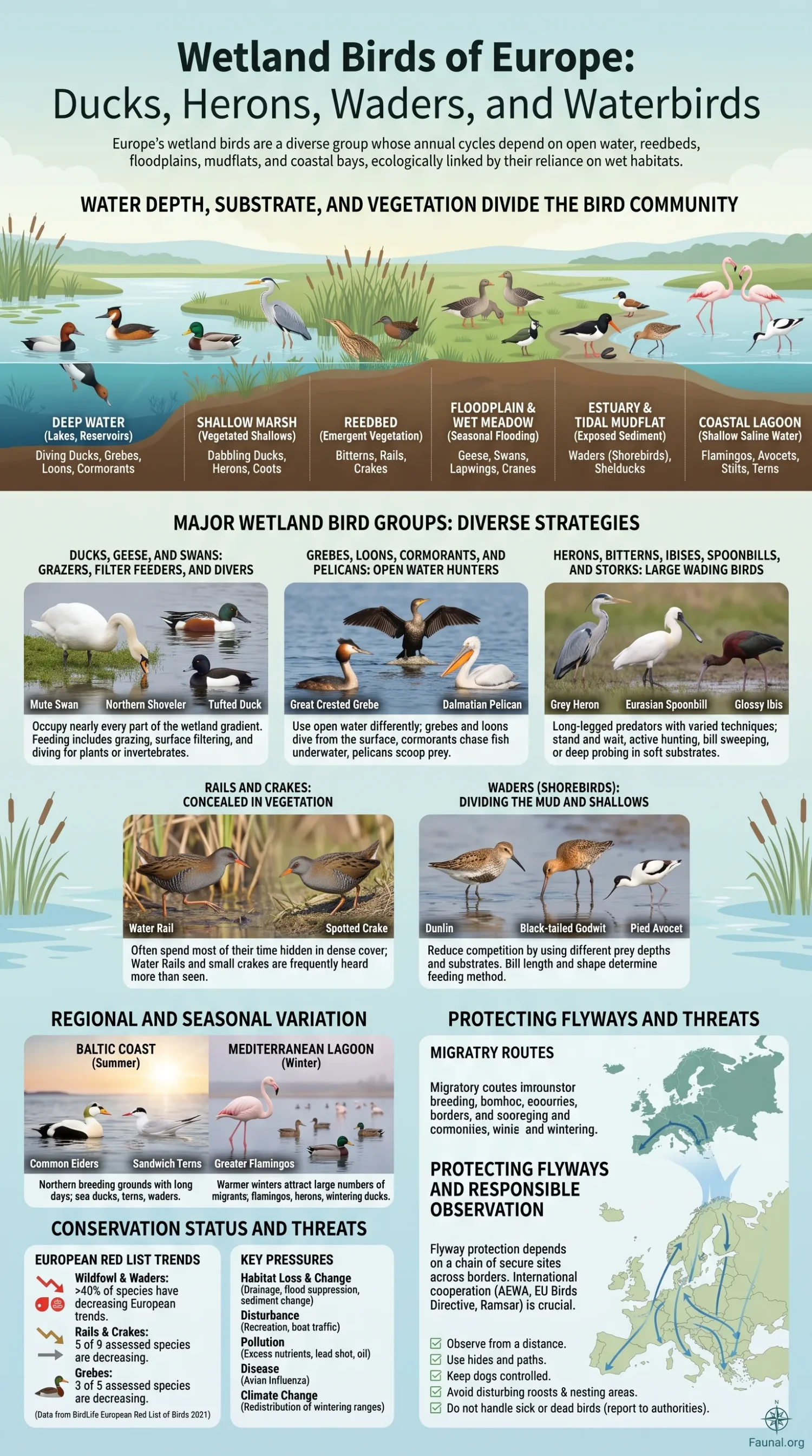
Europe’s wetland birds include far more than ducks on lakes and herons at the water’s edge. The group extends across swans, geese, grebes, loons, cormorants, pelicans, rails, flamingos, shorebirds, gulls and terns whose annual cycles depend on open water, reedbeds, floodplains, wet grassland, mudflats, lagoons or shallow coastal bays. They do not form one branch of bird taxonomy. Their shared feature is ecological dependence on water and wet ground.
A European wetland may hold breeding birds, locally resident birds, Arctic migrants stopping to refuel and wintering populations that originated well outside Europe. The species present can therefore change sharply with water depth, salinity, vegetation, freezing conditions, rainfall, tidal stage and season. A drained meadow, a flooded river margin and an exposed estuarine mudflat may be separated by only a few kilometres yet support very different bird communities.
Scope of the European Working Checklist
The checklist on this page contains 143 wetland-dependent species that occur regularly, locally, seasonally or as conservation-relevant historical species within the broad European assessment area. It excludes most purely oceanic seabirds, wetland-associated songbirds and exceptional transatlantic or trans-Asian vagrants. It is a bounded reference list, not a claim that every listed species occurs in every European country.
Wetland Bird, Waterbird, Wader and Wading Bird
Wetland bird is an ecological expression. It can apply to any bird that depends on wetlands for feeding, breeding, moulting, resting or migration. A species may qualify even when it spends part of the year on farmland, tundra, coastal cliffs or open sea.
Waterbird is also broad. The African-Eurasian Migratory Waterbird Agreement covers hundreds of wetland-dependent species from divers and grebes to ducks, rails, herons, storks, flamingos, shorebirds, gulls and terns. This range shows why “waterbird” cannot be treated as a synonym for duck. AEWA species coverage
In European ornithological usage, wader usually refers to shorebird families such as plovers, sandpipers, godwits, curlews, snipes, stilts and avocets. The everyday phrase wading bird may also describe long-legged herons, storks, ibises and spoonbills. A Grey Heron is a bird that wades, but it is not a wader in the narrower shorebird sense.
Taxonomy and English Names Used on This Page
Scientific and primary English names follow AviList v2025b. This matters because field guides, monitoring programmes and global checklists do not always use the same English name. Anas crecca, for example, appears as Green-winged Teal in AviList but remains widely called Common Teal in European monitoring. Mergus merganser is Common Merganser in the global list and Goosander in much European usage. Ardea alba is Great Egret in AviList and Great White Egret in several European reports.
A name difference does not necessarily indicate a different species. The scientific name should be checked before records from field guides, monitoring portals and conservation assessments are combined.
Water Depth, Substrate and Vegetation Divide the Bird Community
The distribution of birds within one wetland is often structured more strongly by a few centimetres of water than by the total size of the site. Dabbling ducks need water shallow enough to reach submerged food. Diving ducks need sufficient depth and open surface for repeated dives. Small sandpipers use exposed or barely flooded sediment, while godwits and curlews can probe farther below the surface. Bitterns require dense emergent vegetation, whereas pelicans and cormorants need open areas where fish can be pursued or concentrated.
| Wetland setting | Physical features | Bird groups commonly associated with it | Change that can remove feeding or breeding value |
|---|---|---|---|
| Deep lakes and reservoirs | Open water, fish and benthic prey below the surface | Diving ducks, grebes, loons, cormorants and pelicans | Loss of fish, poor water clarity, shoreline disturbance or prolonged freezing |
| Shallow freshwater marsh | Submerged plants, aquatic invertebrates and patchy open water | Dabbling ducks, coots, moorhens, spoonbills and small herons | Rapid drainage, uniformly deep water or dense vegetation covering all open pools |
| Reedbed | Emergent reeds, narrow channels and concealed margins | Bitterns, Purple Herons, rails, crakes and nesting grebes | Cutting during the breeding season, drying, burning or loss of shallow feeding edges |
| Floodplain and wet meadow | Temporary flooding, soft soil, short vegetation and shallow pools | Geese, swans, lapwings, godwits, snipes, cranes and grazing ducks | River confinement, early mowing, permanent drainage or conversion to intensive crops |
| Estuary and tidal mudflat | Alternating exposed sediment and tidal water rich in invertebrates | Oystercatchers, plovers, knots, dunlins, godwits, curlews and shelducks | Coastal construction, sediment change, shellfish depletion or loss of high-tide roosts |
| Saltpan and coastal lagoon | Shallow saline water, islands, brine invertebrates and exposed banks | Flamingos, avocets, stilts, Kentish Plovers, gulls and terns | Abandonment of water management, excessive flooding, drying or disturbance of nesting islands |
| Sheltered coast and marine bay | Shallow coastal water, eelgrass, shellfish beds and fish | Sea ducks, mergansers, loons, grebes and cormorants | Oil contamination, fishing bycatch, shellfish loss or repeated boat disturbance |
| Fishpond, rice field and managed basin | Artificial water levels with seasonally exposed feeding surfaces | Herons, ibises, spoonbills, ducks and passage waders | Sudden water-level changes, netting, poisoning, disturbance or complete removal of shallow margins |
Ducks, Geese and Swans: Grazers, Filter Feeders and Divers
Anatidae occupy nearly every part of the wetland gradient. Swans reach submerged plants with long necks. Geese often feed away from open water on saltmarshes, floodplains or agricultural grassland but return to water for safety and roosting. Dabbling ducks feed at the surface or tip forward in shallow water. Pochards, scaup, eiders, scoters, goldeneyes and mergansers dive for plants, molluscs, crustaceans or fish.
Dabbling and Diving Are Feeding Strategies, Not Simple Habitat Labels
Dabbling ducks are often associated with shallow marshes, but they may rest on deep reservoirs and move into flooded fields at night. Diving ducks can occur on small ponds when depth and prey are suitable. Sea ducks regularly enter estuaries and sheltered lagoons. The same species may therefore use several wetland types in one day.
| Common name | Scientific name | Main feeding or wetland association | Broad European pattern |
|---|---|---|---|
| Mute Swan | Cygnus olor | Submerged vegetation in lakes, rivers and sheltered coasts | Widespread resident and partial migrant |
| Tundra Swan | Cygnus columbianus | Shallow water, flooded grassland and arable feeding areas | Arctic breeder; Bewick’s Swan populations winter in western, central and south-eastern Europe |
| Whooper Swan | Cygnus cygnus | Lakes, floodplains, marshes and wet farmland | Northern breeder and widespread winter visitor |
| Taiga Bean Goose | Anser fabalis | Wet grassland, bog margins and farmland near secure roosts | Localized northern and central European wintering populations |
| Tundra Bean Goose | Anser serrirostris | Floodplains, fields and shallow lakes | Regular migrant and winter visitor, especially in northern, central and eastern Europe |
| Pink-footed Goose | Anser brachyrhynchus | Coastal marshes, wet grassland and farmland | Concentrated in north-western Europe during migration and winter |
| Greater White-fronted Goose | Anser albifrons | Floodplains, grassland and shallow-water roosts | Widespread winter visitor from Arctic breeding grounds |
| Lesser White-fronted Goose | Anser erythropus | Natural grassland, steppe wetlands and shallow lakes | Scarce migrant with fragmented European routes and wintering areas |
| Greylag Goose | Anser anser | Reed-fringed lakes, marshes, floodplains and grassland | Resident, breeding and migratory populations across much of Europe |
| Red-breasted Goose | Branta ruficollis | Coastal lakes, steppe wetlands and nearby feeding fields | Concentrated around the Black Sea and south-eastern Europe in winter |
| Barnacle Goose | Branta leucopsis | Saltmarshes, coastal grassland and shallow roosts | Arctic and Baltic breeder with large north-western wintering flocks |
| Brant Goose | Branta bernicla | Eelgrass beds, intertidal vegetation and saltmarsh | Atlantic and North Sea coastal winter visitor |
| Egyptian Goose | Alopochen aegyptiaca | Urban lakes, rivers, reservoirs and grazed banks | Introduced and established in parts of western and central Europe |
| Ruddy Shelduck | Tadorna ferruginea | Saline lakes, river basins and open wetland margins | Localized natural populations in the east and south-east; feral populations elsewhere |
| Common Shelduck | Tadorna tadorna | Estuaries, mudflats, saltmarshes and saline inland waters | Common around many western and southern coasts, with inland populations in the east |
| Mandarin Duck | Aix galericulata | Wooded ponds, slow rivers and lakes with tree cavities | Introduced and established in several western and central European regions |
| Garganey | Spatula querquedula | Shallow vegetated marshes and flooded meadows | Summer breeder and long-distance migrant; largely absent in winter |
| Northern Shoveler | Spatula clypeata | Surface filtering in shallow, plankton-rich water | Breeder, passage migrant and winter visitor |
| Gadwall | Mareca strepera | Shallow lakes and marshes rich in aquatic plants | Widespread but uneven breeder and wintering species |
| Eurasian Wigeon | Mareca penelope | Grazing on wet grassland, saltmarsh and aquatic vegetation | Northern breeder with large western and southern wintering populations |
| Mallard | Anas platyrhynchos | Highly flexible surface feeder in natural and artificial wetlands | Widespread resident, breeder and migrant |
| Northern Pintail | Anas acuta | Shallow marshes, floodplains, lagoons and estuaries | Passage migrant and winter visitor, with localized breeding |
| Green-winged Teal | Anas crecca | Very shallow water, wet mud and small seeds | Widespread migrant and winter visitor; commonly called Common Teal in Europe |
| Marbled Duck | Marmaronetta angustirostris | Shallow Mediterranean marshes with emergent vegetation | Localized in southern Europe and the Mediterranean basin |
| Red-crested Pochard | Netta rufina | Plant-rich lakes, lagoons and reservoirs | Localized breeder and winter visitor, strongest in southern and central regions |
| Common Pochard | Aythya ferina | Diving for plant material and benthic invertebrates | Broad breeding and wintering range, with marked regional changes |
| Ferruginous Duck | Aythya nyroca | Shallow, densely vegetated freshwater wetlands | Localized breeder and migrant in central, eastern and southern Europe |
| Tufted Duck | Aythya fuligula | Diving in lakes, reservoirs, gravel pits and sheltered coasts | Widespread breeder, migrant and winter visitor |
| Greater Scaup | Aythya marila | Diving for molluscs and other benthic prey | Northern breeder and winter visitor to coasts and large inland waters |
| Common Eider | Somateria mollissima | Marine molluscs in shallow coastal water | Resident and migratory around northern and north-western coasts |
| King Eider | Somateria spectabilis | Marine benthic prey | Arctic species occurring regularly only in the far north and sparingly farther south |
| Harlequin Duck | Histrionicus histrionicus | Fast rivers when breeding and rocky coasts in winter | Regular in Iceland; scarce elsewhere in Europe |
| Long-tailed Duck | Clangula hyemalis | Deep diving for molluscs and crustaceans | Arctic breeder with major Baltic and northern coastal wintering areas |
| Common Scoter | Melanitta nigra | Shellfish and other benthic prey in coastal water | Northern breeder; large marine wintering flocks |
| Velvet Scoter | Melanitta fusca | Diving over shellfish beds and shallow marine substrate | Northern and eastern breeder; Baltic and coastal winter visitor |
| Common Goldeneye | Bucephala clangula | Diving for aquatic invertebrates and small fish | Northern breeder and widespread winter visitor |
| Barrow’s Goldeneye | Bucephala islandica | Freshwater and coastal diving | Regular but localized in Iceland; rare elsewhere |
| Smew | Mergellus albellus | Small fish and aquatic invertebrates in open freshwater | Boreal breeder and winter visitor to central, western and south-eastern Europe |
| Common Merganser | Mergus merganser | Fish in rivers, lakes and reservoirs | Northern and central breeder with wider winter distribution; also called Goosander |
| Red-breasted Merganser | Mergus serrator | Fish in sheltered marine water, estuaries and large lakes | Northern breeder and widespread coastal winter visitor |
| White-headed Duck | Oxyura leucocephala | Shallow to medium-depth lakes with rich submerged vegetation | Localized in Spain and parts of south-eastern and eastern Europe |
| Ruddy Duck | Oxyura jamaicensis | Vegetated lakes and reservoirs | Introduced; subject to control because of hybridization risk to White-headed Duck |
Grebes, Loons, Cormorants and Pelicans Use Open Water Differently
These birds may appear together on open water, but their feeding systems differ. Grebes pursue fish and aquatic invertebrates underwater and often build floating nests among vegetation. Loons are powerful foot-propelled divers that breed mainly on northern lakes and move to coasts in winter. Cormorants chase fish and often rest with partly spread wings. Pelicans capture fish with the bill pouch and may feed cooperatively where fish are concentrated.
| Common name | Scientific name | Wetland use | European pattern |
|---|---|---|---|
| Little Grebe | Tachybaptus ruficollis | Small lakes, ponds, slow rivers and reed-fringed channels | Widespread resident or partial migrant |
| Great Crested Grebe | Podiceps cristatus | Large lakes, reservoirs and sheltered coastal water | Widespread breeder and winter visitor |
| Red-necked Grebe | Podiceps grisegena | Vegetated breeding lakes and open coastal wintering water | Northern and eastern breeder; dispersed winter visitor |
| Horned Grebe | Podiceps auritus | Small northern lakes in summer and sheltered coasts in winter | Localized northern breeder and winter visitor; called Slavonian Grebe in much of Europe |
| Black-necked Grebe | Podiceps nigricollis | Shallow productive lakes, saline lagoons and reservoirs | Localized colonial breeder and migrant |
| Red-throated Loon | Gavia stellata | Small northern breeding pools and coastal wintering water | Northern breeder and widespread coastal migrant |
| Black-throated Loon | Gavia arctica | Clear northern lakes and marine wintering areas | Northern breeder and coastal winter visitor |
| Common Loon | Gavia immer | Large lakes and coastal bays | Breeds in Iceland and occurs as a scarce winter visitor elsewhere; often called Great Northern Diver |
| Yellow-billed Loon | Gavia adamsii | Arctic lakes and northern marine coasts | Regular only in the far north; scarce farther south |
| Pygmy Cormorant | Microcarbo pygmaeus | Fish-rich rivers, deltas, lakes and flooded woodland | Concentrated in south-eastern and eastern Europe, with expansion into central regions |
| Great Cormorant | Phalacrocorax carbo | Rivers, lakes, reservoirs, estuaries and coasts | Widespread resident, breeder, migrant and winter visitor |
| European Shag | Gulosus aristotelis | Rocky marine coasts and offshore feeding water | Mainly resident around Atlantic and Mediterranean coasts |
| Great White Pelican | Pelecanus onocrotalus | Shallow fish-rich lakes, deltas and lagoons | Localized breeder and migrant in south-eastern Europe |
| Dalmatian Pelican | Pelecanus crispus | Large lakes, deltas, reedbeds and coastal lagoons | Localized south-eastern European populations |
Herons, Bitterns, Ibises, Spoonbills, Storks and Flamingos
Long legs do not mean that all large wading birds feed in the same way. Grey and Purple Herons often wait before striking. Little Egrets move actively through shallow water and may stir prey with their feet. Bitterns remain concealed in reeds and are often detected first by voice. Spoonbills sweep the partly open bill from side to side. Ibises probe soft substrate. Flamingos filter small organisms and suspended material with a highly specialized bill.
| Common name | Scientific name | Feeding or nesting association | Broad European pattern |
|---|---|---|---|
| Eurasian Bittern | Botaurus stellaris | Large reedbeds with shallow feeding channels | Localized breeder, resident and migrant |
| Little Bittern | Botaurus minutus | Dense reeds, willow margins and small open pools | Summer breeder, strongest in central, eastern and southern Europe |
| Black-crowned Night Heron | Nycticorax nycticorax | Wooded wetland colonies and shallow nocturnal feeding sites | Localized summer breeder and migrant |
| Squacco Heron | Ardeola ralloides | Vegetated shallows, rice fields and marsh edges | Southern and south-eastern summer breeder |
| Western Cattle Egret | Ardea ibis | Grazed floodplains, rice fields and wetland margins | Southern stronghold with spread into western and central Europe |
| Grey Heron | Ardea cinerea | Shallow water, river margins, fields and fishponds | Widespread resident and migrant |
| Purple Heron | Ardea purpurea | Extensive reedbeds and densely vegetated marshes | Localized summer breeder, mainly central and southern |
| Great Egret | Ardea alba | Open shallows, floodplains and wet grassland | Formerly concentrated in the east and south-east; now much more widespread |
| Little Egret | Egretta garzetta | Active hunting in lagoons, estuaries, rivers and rice fields | Southern and western breeder with northward expansion |
| Glossy Ibis | Plegadis falcinellus | Soft mud, flooded grassland, marshes and rice fields | Localized colonial breeder and migrant, strongest in the south |
| Eurasian Spoonbill | Platalea leucorodia | Shallow sweeping in lagoons, estuaries and flooded basins | Localized breeder, passage migrant and winter visitor |
| Black Stork | Ciconia nigra | Forest streams, river shallows, pools and wet meadows | Summer breeder and long-distance migrant |
| White Stork | Ciconia ciconia | Wet grassland, floodplain, marsh edges and farmland | Widespread but uneven summer breeder; some populations now winter in Europe |
| Greater Flamingo | Phoenicopterus roseus | Shallow saline lagoons, saltpans and soda lakes | Mediterranean and south-eastern colonies with wide dispersal |
Rails and Crakes Occupy the Boundary Between Water and Vegetation
Rails are often under-recorded because many spend most of their time inside reeds, sedges, flooded grass or dense bankside cover. Water Rail and small crakes may be heard more often than seen. Moorhens and coots use open water more freely. Corn Crake differs from the others by favouring tall, damp grassland rather than permanent open water.
| Common name | Scientific name | Primary European habitat | Visibility and seasonal pattern |
|---|---|---|---|
| Water Rail | Rallus aquaticus | Reedbeds, sedge beds and muddy vegetated margins | Resident and migrant; frequently concealed |
| Corn Crake | Crex crex | Damp meadows, floodplain grassland and tall herb vegetation | Summer breeder; usually detected by its call |
| Spotted Crake | Porzana porzana | Shallow sedge marsh and seasonally flooded vegetation | Scarce summer breeder and passage migrant |
| Little Crake | Zapornia parva | Reedbeds with shallow open edges | Localized eastern and south-eastern breeder and migrant |
| Baillon’s Crake | Zapornia pusilla | Very shallow marsh with dense low vegetation | Localized and easily overlooked breeder or migrant |
| Purple Swamphen | Porphyrio porphyrio | Large reedbeds, marshes and vegetated lagoons | Localized in southern Europe |
| Common Moorhen | Gallinula chloropus | Ponds, canals, marsh margins and slow rivers | Widespread resident and migrant |
| Eurasian Coot | Fulica atra | Open lakes, reservoirs and vegetated freshwater | Widespread breeder with large winter gatherings |
| Red-knobbed Coot | Fulica cristata | Shallow lakes and marshes with abundant vegetation | Very localized in south-western Europe |
| Common Crane | Grus grus | Bogs, marshes, shallow roosts and wet agricultural landscapes | Northern and eastern breeder with major continental migration routes |
Waders Divide Mud and Shallow Water Into Feeding Layers
Waders reduce direct competition by using different prey depths, substrates and movements. Plovers usually detect prey visually and stop before picking it from the surface. Sandpipers probe or peck while walking. Snipes push long bills into soft wet ground. Godwits and curlews reach deeper prey. Avocets sweep curved bills through shallow water, while phalaropes swim and pick prey from the surface.
A Long Bill Does Not Always Mean Deep Probing
Bill shape matters alongside length. The upturned bill of a Pied Avocet is used in a lateral sweeping action. The downcurved bill of a curlew reaches into sediment and around vegetation. A Ruff may peck, probe or take prey from the surface. Tidal conditions can also change behaviour: a species that probes wet mud at low tide may roost without feeding when the same surface is submerged.
| Common name | Scientific name | Feeding zone or method | Broad European pattern |
|---|---|---|---|
| Eurasian Oystercatcher | Haematopus ostralegus | Shellfish, worms and other exposed intertidal prey | Coastal resident, breeder and migrant; inland breeding also occurs |
| Black-winged Stilt | Himantopus himantopus | Small prey in relatively deep shallow water | Southern stronghold with expansion into central and western Europe |
| Pied Avocet | Recurvirostra avosetta | Side-to-side sweeping in lagoons, saltpans and estuaries | Localized breeder and widespread coastal migrant |
| European Golden Plover | Pluvialis apricaria | Surface prey on tundra, moorland, wet grassland and fields | Northern breeder with large western wintering flocks |
| Grey Plover | Pluvialis squatarola | Visual surface feeding on tidal flats | Arctic breeder and widespread coastal migrant or winter visitor |
| Northern Lapwing | Vanellus vanellus | Surface and shallow-soil prey in wet grassland and farmland | Widespread breeder, migrant and winter visitor |
| Sociable Lapwing | Vanellus gregarius | Short grassland and steppe wetland margins | Rare eastern migrant with a very restricted European occurrence |
| White-tailed Lapwing | Vanellus leucurus | Shallow marsh edges and wet open ground | Localized in the far south-east and rare elsewhere |
| Common Ringed Plover | Charadrius hiaticula | Visual picking on sand, shingle and mud | Northern and coastal breeder with wide passage distribution |
| Little Ringed Plover | Thinornis dubius | Bare gravel, reservoir edges and river sediment | Summer breeder and migrant across much of Europe |
| Kentish Plover | Anarhynchus alexandrinus | Dry and damp surfaces around beaches, lagoons and saltpans | Localized southern and coastal breeder |
| Caspian Plover | Anarhynchus asiaticus | Open steppe and shallow wetland margins during migration | Rare passage species at Europe’s eastern edge |
| Eurasian Whimbrel | Numenius phaeopus | Probing on mudflats, saltmarshes and coastal grassland | Northern breeder and long-distance migrant |
| Eurasian Curlew | Numenius arquata | Deep probing in wet grassland, saltmarsh and tidal mud | Breeder, migrant and winter visitor across broad regions |
| Slender-billed Curlew | Numenius tenuirostris | Historically associated with steppe wetlands, lagoons and coastal marshes | Possibly extinct; modern regional presence has not been confirmed as a regular population |
| Black-tailed Godwit | Limosa limosa | Probing in wet meadows, marshes, rice fields and estuaries | Localized breeder with large migratory concentrations |
| Bar-tailed Godwit | Limosa lapponica | Deep probing on estuarine and coastal mudflats | Arctic breeder and coastal migrant or winter visitor |
| Ruddy Turnstone | Arenaria interpres | Turns stones, shells and debris to expose prey | Arctic breeder and widespread rocky-coast migrant |
| Red Knot | Calidris canutus | Molluscs and invertebrates on large tidal flats | Arctic breeder with major migration and wintering concentrations |
| Ruff | Calidris pugnax | Flexible pecking and probing in wet grassland and shallow marsh | Northern breeder and widespread migrant |
| Broad-billed Sandpiper | Calidris falcinellus | Fine probing in soft mud and shallow brackish margins | Scarce northern breeder and passage migrant |
| Curlew Sandpiper | Calidris ferruginea | Probing and picking on mudflats and shallow pools | Arctic breeder and long-distance passage migrant |
| Temminck’s Stint | Calidris temminckii | Slow surface picking around muddy freshwater margins | Northern breeder and passage migrant |
| Little Stint | Calidris minuta | Fine surface prey on exposed mud and very shallow water | Arctic breeder and regular passage migrant, strongest in the east and south |
| Sanderling | Calidris alba | Runs along wave-washed sand and picks exposed prey | Arctic breeder and widespread coastal migrant or winter visitor |
| Dunlin | Calidris alpina | Pecking and shallow probing on mudflats and marsh edges | Northern breeder with very large migratory and wintering populations |
| Purple Sandpiper | Calidris maritima | Rocky coasts, harbour walls and wave-washed shorelines | Northern breeder and winter visitor to exposed coasts |
| Jack Snipe | Lymnocryptes minimus | Soft mud and saturated vegetation | Northern breeder and secretive migrant or winter visitor |
| Great Snipe | Gallinago media | Wet meadows, sedge marsh and soft soil | Localized eastern and northern breeder and long-distance migrant |
| Common Snipe | Gallinago gallinago | Deep probing in wet mud, marsh and flooded grassland | Widespread breeder, migrant and winter visitor |
| Terek Sandpiper | Xenus cinereus | Rapid surface feeding with an upturned bill on tidal mud | Eastern breeder and scarce but regular passage migrant |
| Red-necked Phalarope | Phalaropus lobatus | Swimming and surface picking on pools and shallow open water | Northern breeder and pelagic migrant |
| Red Phalarope | Phalaropus fulicarius | Surface feeding at sea and on Arctic pools | Arctic breeder; mainly offshore during migration, with storm-driven coastal records |
| Common Sandpiper | Actitis hypoleucos | Walking and bobbing along river, lake and reservoir edges | Widespread summer breeder and migrant |
| Green Sandpiper | Tringa ochropus | Shaded pools, muddy ditches and wooded wetland edges | Northern breeder and widespread migrant or winter visitor |
| Spotted Redshank | Tringa erythropus | Active feeding in shallow water and soft mud | Northern breeder and widespread migrant |
| Common Greenshank | Tringa nebularia | Fish and invertebrates in estuaries, pools and shallow lakes | Northern breeder and widespread migrant |
| Marsh Sandpiper | Tringa stagnatilis | Delicate picking in shallow freshwater and saline pools | Eastern breeder and passage migrant, strongest in south-eastern Europe |
| Wood Sandpiper | Tringa glareola | Shallow freshwater pools, flooded meadows and marsh edges | Northern breeder and abundant passage migrant in suitable regions |
| Common Redshank | Tringa totanus | Wet grassland, saltmarsh, estuary and shallow coastal pools | Breeder, migrant and winter visitor |
| Collared Pratincole | Glareola pratincola | Aerial insect feeding over open marshes and dry wetland margins | Localized southern and south-eastern summer breeder |
| Black-winged Pratincole | Glareola nordmanni | Steppe wetlands, grazed floodplains and open shallow basins | Rare eastern passage species with limited breeding at Europe’s edge |
Gulls and Terns Link Lagoons, Rivers, Estuaries and Coasts
Not every gull or tern is primarily a wetland bird, yet many European species depend on lagoons, river islands, saltpans, estuaries, reservoirs and shallow coastal waters for feeding or nesting. Terns often require open, predator-limited nesting surfaces. Small changes in island height or water level can determine whether a breeding colony remains isolated from terrestrial predators.
| Common name | Scientific name | Main wetland association | Broad European pattern |
|---|---|---|---|
| Little Gull | Hydrocoloeus minutus | Shallow lakes, marshes, estuaries and coastal migration routes | Localized eastern and northern breeder; widespread migrant |
| Ross’s Gull | Rhodostethia rosea | Arctic wetlands, pack-ice margins and northern coasts | Regular mainly in Arctic Europe and rare farther south |
| Black-headed Gull | Chroicocephalus ridibundus | Marsh colonies, lakes, reservoirs, estuaries and farmland | Widespread breeder, migrant and winter visitor |
| Mediterranean Gull | Ichthyaetus melanocephalus | Lagoon islands, marsh colonies, estuaries and coasts | Expanded from south-eastern origins into western and central Europe |
| Slender-billed Gull | Chroicocephalus genei | Saline lagoons, saltpans and shallow Mediterranean coasts | Localized southern breeder and migrant |
| Common Gull | Larus canus | Lakes, rivers, estuaries, wet fields and coasts | Northern and central breeder with broad winter distribution |
| Audouin’s Gull | Ichthyaetus audouinii | Mediterranean islands, lagoons and fishing waters | Localized Mediterranean breeder |
| Yellow-legged Gull | Larus michahellis | Mediterranean coasts, reservoirs, rivers and urban wetlands | Widespread in southern Europe with expansion beyond the Mediterranean |
| Caspian Gull | Larus cachinnans | Large rivers, reservoirs, fishponds, landfills and coasts | Eastern and central breeder with westward dispersal |
| European Herring Gull | Larus argentatus | Coasts, estuaries, islands, reservoirs and urban waters | Widespread in northern and western Europe |
| Lesser Black-backed Gull | Larus fuscus | Coasts, estuaries, islands, reservoirs and river systems | Widespread breeder and long-distance migrant |
| Great Black-backed Gull | Larus marinus | Northern coasts, estuaries, islands and large inland waters | Resident and migrant in northern and western Europe |
| Gull-billed Tern | Gelochelidon nilotica | Saltpans, lagoons, deltas and nearby dry feeding ground | Localized southern summer breeder |
| Caspian Tern | Hydroprogne caspia | Large lakes, deltas, lagoons and sheltered coasts | Localized breeder and wide-ranging migrant |
| Sandwich Tern | Thalasseus sandvicensis | Coastal islands, lagoons, estuaries and shallow sea | Colonial breeder around Atlantic, North Sea, Baltic and Mediterranean coasts |
| Common Tern | Sterna hirundo | River islands, lakes, reservoirs, lagoons and coasts | Widespread summer breeder and migrant |
| Arctic Tern | Sterna paradisaea | Northern coasts, islands, lakes and estuaries | Northern breeder and very long-distance migrant |
| Little Tern | Sternula albifrons | Bare sand, shingle, saltpan banks and lagoon islands | Localized coastal and riverine summer breeder |
| Whiskered Tern | Chlidonias hybrida | Floating vegetation, shallow marshes and fishponds | Localized central, eastern and southern breeder |
| White-winged Tern | Chlidonias leucopterus | Flooded grassland, shallow marshes and temporary wetlands | Eastern breeder and widespread passage migrant |
| Black Tern | Chlidonias niger | Freshwater marshes with floating vegetation | Localized breeder and broad passage migrant |
European Wetland Regions Support Different Assemblages
Atlantic Estuaries and the Wadden Sea
Large tidal systems support dense concentrations of Dunlin, Red Knot, Bar-tailed Godwit, Eurasian Curlew, Grey Plover, Eurasian Oystercatcher, Common Shelduck and Brant Goose. Feeding mudflat and high-tide roost are separate resources. A mudflat may remain productive while the site loses much of its value because safe roosting ground has been developed or repeatedly disturbed.
Baltic Bays, Archipelagos and Coastal Meadows
The Baltic combines low-salinity marine water, islands, reedbeds, coastal grassland and major migration corridors. Long-tailed Ducks, scoters, Common Goldeneyes, mergansers, swans and geese may gather in open bays, while meadow-breeding lapwings, redshanks and other waders use the land–water boundary.
Danube Floodplains and Black Sea Wetlands
River branches, flooded forest, reedbeds, shallow lakes, steppe lagoons and coastal deltas support pelicans, Pygmy Cormorants, herons, ibises, spoonbills, geese, ducks and passage waders. The region also forms a bridge between northern breeding grounds, eastern migration routes and Mediterranean or African wintering areas.
Mediterranean Lagoons, Rice Fields and Saltpans
Seasonal drying and managed water levels create alternating nesting islands, shallow feeding basins and exposed mud. Greater Flamingos, Pied Avocets, Black-winged Stilts, Kentish Plovers, Glossy Ibises, spoonbills, egrets and terns may depend on these changing surfaces. Rice fields can replace part of the shallow-water feeding habitat lost elsewhere, but their value varies with flooding schedule and chemical use.
Northern Lakes, Bogs and Tundra Pools
Northern wetlands hold breeding loons, grebes, phalaropes, scoters, goldeneyes, mergansers, geese and many shorebirds. Some use very small fishless pools for nesting but move to larger lakes or marine coasts after breeding. Conditions on the breeding grounds can affect bird numbers observed thousands of kilometres away during migration or winter.
The Wetland Bird Calendar Is Not the Same Across Europe
In northern Europe, lakes may remain frozen while Mediterranean wetlands already hold nesting herons, stilts or flamingos. Spring passage brings Arctic-bound waders through Atlantic estuaries, inland floodplains and Mediterranean lagoons. Many remain only long enough to replace body reserves before continuing north.
During summer, water levels affect nest access, food depth and exposure to predators. Grebes and terns may lose nests after rapid rises. Crakes, snipes and meadow-breeding waders may fail when temporary wetlands dry too early or vegetation is cut before chicks can move.
After breeding, several duck species enter a period when the flight feathers are replaced together and flight is temporarily lost. Secure moulting water can therefore be as important as the nesting site. Autumn then brings adults and young birds into the same migration system, often in duller plumage than shown in identification images centred on breeding males.
Winter distribution depends on ice, temperature, water depth, food and disturbance. A decline in one country’s count may reflect movement toward newly ice-free areas rather than an equal decline in the whole flyway population. The opposite can also occur: a local increase can be produced by redistribution while the wider population remains depleted.
Similar Species Require Structure and Behaviour, Not Colour Alone
Plumage changes with age, sex, season, feather wear and light. Shape, feeding movement, leg position in flight, wing pattern, voice and habitat often remain more useful than one apparent colour. Female ducks and non-breeding waders are especially likely to be misidentified when only bright adult breeding plumage is considered.
| Species pair | Most useful distinction | Supporting feature | Common complication |
|---|---|---|---|
| Great Egret and Little Egret | Great Egret is much larger, with a long neck and heavier proportions | Adult Little Egret normally has a dark bill and conspicuous yellow feet | Bill and leg colours change with season and age |
| Grey Heron and Purple Heron | Purple Heron is slimmer, longer-necked and strongly associated with reeds | In flight, Purple Heron often appears narrower with darker wing contrast | Young birds lack the clean adult head pattern |
| Common Pochard and Tufted Duck | Common Pochard has a longer, more sloping head profile | Tufted Duck usually appears shorter-bodied and more compact | Females and eclipse males can show weak colour contrast |
| Greater Scaup and Tufted Duck | Greater Scaup has a broader, rounder head and lacks a true rear crest | Wing pattern and bill-tip pattern help when visible | Head shape changes with posture, wind and wet feathers |
| Eurasian Coot and Common Moorhen | Coot has a white bill and frontal shield; moorhen has red and yellow on the bill | Coot is more likely to remain on open water | Young birds do not show full adult bill colour |
| Black-tailed and Bar-tailed Godwit | Black-tailed Godwit shows a bold white wing bar in flight | Bar-tailed Godwit has shorter legs and a more upturned bill | Body colour varies greatly between breeding and non-breeding plumage |
| Dunlin and Curlew Sandpiper | Curlew Sandpiper is longer-legged with a longer, more evenly curved bill | A white rump is visible on Curlew Sandpiper in flight | Juveniles and non-breeding adults lack the familiar red breeding colour |
| Common Redshank and Spotted Redshank | Spotted Redshank is longer-legged, longer-billed and more elegant | Flight call and feeding depth are useful | Non-breeding Spotted Redshank is not black |
| Common Sandpiper and Green Sandpiper | Common Sandpiper has a low horizontal shape and a clear white shoulder notch | Green Sandpiper has a darker upper body and contrasting white rump | Both bob their rear body and use freshwater margins |
| Common Ringed and Little Ringed Plover | Little Ringed Plover has a fine bill and, in adults, a clear yellow eye-ring | Wing bar is stronger in Common Ringed Plover | Juvenile Little Ringed Plovers may not show a bright eye-ring |
European Red List Results Differ Among Waterbird Groups
The 2021 European Red List assessed 544 bird species across the European region. Thirteen percent were placed in threatened categories at the European level, and 30% had decreasing population trends. Wildfowl and waders were among the groups with the highest shares of threatened or Near Threatened species. More than 40% of species in each of those two groups had decreasing European trends. Five of nine assessed rails and crakes and three of five grebes were also reported as decreasing. European Red List of Birds 2021
European and Global Categories Can Differ
A regional assessment asks about extinction risk within Europe. The global IUCN category asks about the entire species. A species can be secure globally but threatened in Europe, or have a stable European wintering count while its European breeding population declines. The assessment scale and year should remain attached to every status statement.
What the 2025 Wintering Waterbird Analysis Shows
The International Waterbird Census is a coordinated site-based monitoring programme that began in Europe in 1967. Its core January counts are designed to track wintering waterbirds through national schemes. The 2025 European Union analysis examined 33 selected species whose wintering populations can be monitored reasonably well through this system. Geese feeding mainly on farmland, gulls and waterbirds wintering mainly at sea were excluded from that analysis, so the results must not be treated as a trend for every European waterbird. EU wintering waterbird trends, 2025 update
| Species or policy group | Long-term annual trend | Recent annual trend | Meaning within the report |
|---|---|---|---|
| Seven Annex I species combined | Increasing since 1980 | About +2% per year during the latest decade | Six of seven had higher indexed wintering numbers than around the start of the Birds Directive period |
| Greater Flamingo | +7.6% per year | +3.3% per year | Strong rise in counted EU wintering numbers across the included populations |
| Great Egret | +8.8% per year | +1.1% per year | Large long-term increase accompanied by expansion into north-western Europe |
| White-headed Duck | +1.9% per year | +8.1% per year | EU total increased, although Spain and south-eastern wintering areas did not follow one uniform pattern |
| Tundra Swan, Bewick’s populations | -0.4% per year | -1.1% per year, statistically classified as stable | Decline at the western edge occurred alongside growth in parts of central and south-eastern Europe |
| Eighteen Annex II species combined | Below the 1980 baseline after a long decline | +0.8% per year during the latest decade | Recent improvement had not restored the combined index to earlier levels |
| Common Pochard | -1.4% per year | +2.2% per year | A partial recovery followed the decline that continued into the mid-2010s |
| Common Goldeneye | Approximately 0% per year | +1.3% per year | Stable combined long-term total masked redistribution among European regions |
| Tufted Duck | -0.3% per year | -0.4% per year, classified as stable | Counted wintering numbers remained below earlier levels despite the weak recent rate |
Winter counts measure wintering distribution and abundance, not the breeding success of every population represented in the flock. A bird counted in an EU wetland may have bred in the Arctic, western Siberia or another area outside the European Union.
Why Wintering Ranges Move North and East
Warmer winters allow some ducks, swans, geese and other waterbirds to remain closer to breeding areas instead of moving to traditional western or southern wintering grounds. The 2025 IWC analysis found regional redistribution in several species, including Common Goldeneye, Red-breasted Merganser, Smew, Whooper Swan and Bewick’s Swan. National declines can therefore occur while numbers rise elsewhere.
Redistribution does not make site loss harmless. Birds still need a connected sequence of secure feeding, moulting, resting and wintering wetlands. A newly occupied northern site may lack legal protection, suitable roosts or management designed for the numbers now using it. Traditional southern wetlands may also remain necessary during severe cold periods.
Water Management Can Improve One Guild While Harming Another
Maintaining a wetland does not mean holding one water level throughout the year. Deep permanent water may favour diving birds while removing exposed sediment needed by small waders. Extensive reed growth may help bitterns yet cover feeding pools used by dabbling ducks. Complete summer drying can expose mud for migrants but eliminate fish, aquatic plants or nesting cover if it occurs too early or too often.
| Pressure or management change | Wetland response | Bird groups most directly exposed | Possible field consequence |
|---|---|---|---|
| Permanent drainage | Loss of shallow water, wet soil and temporary pools | Crakes, snipes, dabbling ducks, godwits and wet-meadow breeders | Shorter feeding season, nest loss and fewer migration stopovers |
| River embankment and flood suppression | Reduced floodplain renewal and fewer seasonal wetlands | Geese, ducks, lapwings, cranes, herons and passage waders | Birds concentrate in fewer managed sites or move to farmland |
| Uniformly deep water | Loss of mudflat and shallow feeding margins | Small waders, stilts, avocets and dabbling ducks | Open water remains visible, but accessible food declines |
| Rapid water-level rise | Flooded islands and floating nests | Terns, gulls, grebes and ground-nesting waders | Nest failure during a short breeding window |
| Excess nutrients | Algal growth, oxygen change and altered plant or fish communities | Grebes, diving ducks, coots, fish-eating birds and herbivorous waterfowl | Initial food increases may be followed by loss of water clarity or prey |
| Sediment and coastal engineering | Changed tidal channels, erosion and mudflat extent | Oystercatchers, knots, dunlins, godwits, curlews and shelducks | Feeding areas or high-tide roosts shift beyond safe access |
| Repeated recreation disturbance | Birds leave feeding, nesting or roosting areas | Large flocks, colonial nesters and birds with limited alternative sites | Lost feeding time and greater energy expenditure |
| Early mowing | Removal of tall grass and nest cover | Corn Crake, Northern Lapwing, Black-tailed Godwit and Common Redshank | Destruction of nests or death of flightless chicks |
| Loss of nesting islands | Greater access for foxes and other terrestrial predators | Terns, gulls, avocets, stilts and colonial waterbirds | Colony abandonment or repeated breeding failure |
Hunting Pressure and Lead Exposure Affect Several Waterbird Groups
The EU Birds Directive protects naturally occurring wild birds while allowing regulated hunting of listed species under defined conditions. Legal harvest, illegal killing and accidental poisoning are separate pressures and should not be combined into one category. Harvest effects depend on the species, population, timing, location and ability of monitoring systems to detect change.
Lead shot deposited in wetlands can be swallowed by ducks, geese and swans while they take grit or food from sediment. Predators and scavengers may then be exposed through contaminated prey. EU restrictions on lead shot in and around wetlands are intended to reduce this pathway. European Commission guidance on hunting and wetland lead
Avian Influenza Is a Current Wild-Waterbird Health Pressure
Highly pathogenic avian influenza A(H5) continued to circulate among European wild birds during 2026. Between 28 February and 4 June 2026, authorities reported 763 detections in wild birds across 30 European countries. Detections fell during spring, but the figure records reported infected birds or events; it is not an estimate of the total number of wild birds exposed or killed. ECDC and EFSA avian influenza overview
Sick or Dead Waterbirds Should Not Be Handled
Unusual mortality, birds showing neurological signs or groups of dead waterbirds should be reported through the relevant national wildlife or veterinary authority. People and dogs should be kept away from carcasses unless local officials give different instructions.
Flyway Protection Depends on a Chain of Sites
A bird may depend on separate breeding, moulting, staging and wintering sites located in different countries. AEWA addresses this geographic problem across the African-Eurasian migration system. The International Waterbird Census supplies long-term count evidence, while the Waterbird Population Estimates process defines biogeographic populations rather than treating every individual of a species as one interchangeable unit.
Under the Convention on Wetlands, a site may qualify under the waterbird population criterion when it regularly supports at least 1% of a defined population of one waterbird species or subspecies. The threshold identifies international concentration sites; it does not imply that wetlands below 1% lack ecological value. Smaller wetlands may form essential stepping stones, drought refuges or parts of a larger functional complex. Global Waterbird Estimates Partnership
Within the European Union, the Birds Directive requires habitat protection for listed species and other migratory birds, with particular attention to wetlands of international importance. Special Protection Areas form part of Natura 2000. The Nature Restoration Regulation adds restoration duties for habitats and protected-species habitat, including wetlands, rivers and lakes. EU Birds Directive EU Nature Restoration Regulation
Observing Wetland Birds Without Displacing Them
Wetland birds often reveal disturbance before they fly. Feeding stops, heads rise, tightly resting flocks begin walking away and adults move between an observer and their chicks. Continued approach after these responses reduces feeding or resting time even when no bird leaves the wetland.
- Remain outside closed breeding areas, colony islands and marked high-tide roosts.
- Use existing paths, hides and observation points rather than approaching across open mud or marsh.
- Keep dogs controlled near nesting beaches, saltmarshes, wet meadows and resting flocks.
- Avoid playback around bitterns, rails, crakes and other concealed territorial birds.
- Do not launch drones over reedbeds, colonies, roosts or concentrations of moulting waterfowl.
- Use binoculars or a telescope instead of reducing the distance until birds react.
- Leave feeding and roosting routes open when birds move between water, mudflat and grassland.
Sources and Verification
- AviList: The Global Avian Checklist, v2025b — Taxonomic baseline for accepted scientific names, family placement and primary English names.
- BirdLife International, European Red List of Birds 2021 — European assessment scope, threatened-category totals and trend findings for wildfowl, waders, rails, crakes and grebes.
- BirdLife International, Birds in Europe 4 — Wider European population-status context and conservation-concern assessment.
- Agreement on the Conservation of African-Eurasian Migratory Waterbirds — Waterbird group coverage and flyway-scale conservation context.
- Wetlands International Europe, Trends of Wintering Waterbirds in the European Union: 2025 Update — Species selection, annual trend estimates, population redistribution and limits of the EU wintering analysis.
- International Waterbird Census — Coordinated January monitoring, national count schemes and multispecies trend data.
- Convention on Wetlands, Global Waterbird Estimates Partnership — Biogeographic population estimates and their use in identifying internationally important wetlands.
- European Commission, Birds Directive — Protection of naturally occurring wild birds, migratory species and Special Protection Areas.
- European Commission, Nature Restoration Regulation — Restoration requirements applying to wetlands, rivers, lakes and protected-species habitat.
- ECDC and EFSA, Avian Influenza Overview: March–May 2026 — Reported HPAI detections in European wild birds and the spring 2026 epidemiological pattern.
Related Topics
- → Birds of Europe: Species Diversity, Habitats, and Biogeographic Regions
- → Seabirds of Europe: Coastal Colonies and Marine Habitats
- → Migratory Birds of Europe: Flyways, Seasons, and Stopover Habitats
- → Wildlife of Western Europe: Landscapes, Species, and Conservation
- → Wildlife of Eastern Europe: Forests, Wetlands, and Steppe Species
- → Wildlife of Northern Europe: Boreal Forests, Tundra, and Coasts