Kenneth J. Almonte

Turkish raptors including eagles, hawks, falcons, and vultures perched on trees and flying in their natural habitat.

Raptors of Turkey: Eagles, Hawks, Falcons, and Vultures

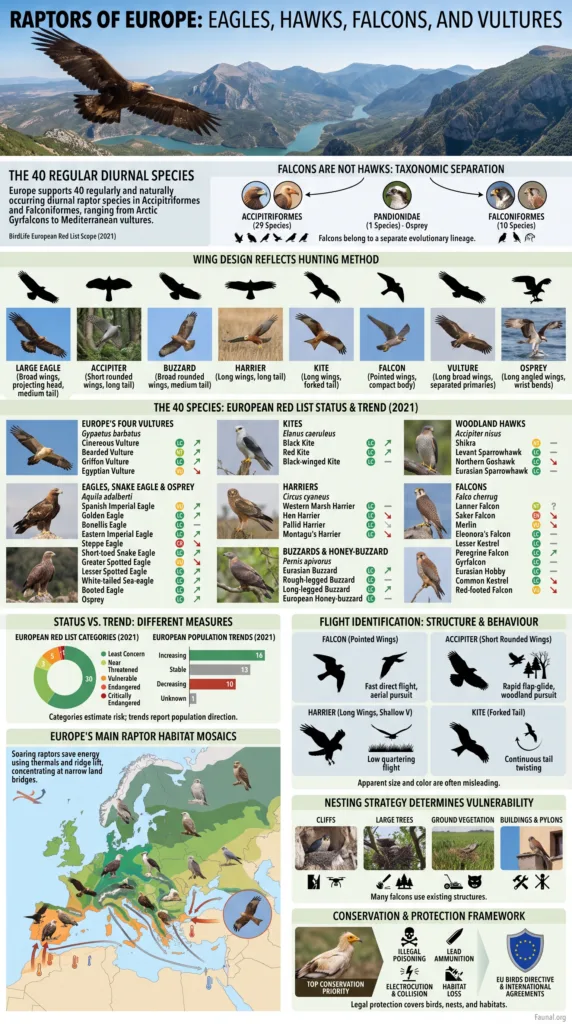
The Clements 2025-based Turkey checklist contains 42 diurnal raptor species: one member of Pandionidae, 30 members of Accipitridae and 11 falcons. The total includes resident birds, breeding visitors, passage migrants, winter visitors and five rare or accidental records. It is not a count of 42 regularly breeding raptors.[a] The 42-Species Boundary Includes Exceptional Records A […]

Raptors of Turkey: Eagles, Hawks, Falcons, and Vultures Read More »

Turkish wetland birds, including lakes, deltas, and marshes, showcase diverse bird species thriving in Turkey’s unique habitats.

Birds of Turkish Wetlands: Lakes, Deltas, and Marshes

Turkish wetlands support different bird communities in open lakes, river deltas, coastal lagoons, saline basins, reed marshes, wet meadows, reservoirs, and shallow sea margins. The 2024 national Midwinter Waterbird Census recorded 1,684,756 waterbirds from 106 named species at 165 active sites; all 106 species are included below. This is a winter census, not a complete

Birds of Turkish Wetlands: Lakes, Deltas, and Marshes Read More »

Migratory birds in Turkey follow major flyways during seasonal migrations across the country.

Migratory Birds in Turkey: Major Flyways and Seasonal Patterns

Turkey sits between the Balkans, Black Sea, Caucasus, Anatolia and eastern Mediterranean, placing it across several connected bird-migration routes. The country does not have one narrow flyway. White Storks, pelicans and many raptors gather at sea crossings and mountain passes; ducks, shorebirds and other waterbirds move through chains of deltas, lakes and coastal wetlands; many

Migratory Birds in Turkey: Major Flyways and Seasonal Patterns Read More »

A detailed guide showcasing various native, migratory, and rare bird species found in Turkey for bird enthusiasts and nature lovers.

Birds of Turkey: Native, Migratory, and Rare Species

Turkey’s published national checklist contains 505 bird species. The list includes year-round residents, breeding visitors, winter visitors, passage migrants, introduced populations, historical records, and birds known from very few accepted observations; these are overlapping forms of status rather than three separate groups.[a] Why Published Totals for Turkey Differ A species total is meaningful only when

Birds of Turkey: Native, Migratory, and Rare Species Read More »

Wildlife of the Black Sea region in Turkey showcasing diverse aquatic and terrestrial species in their natural habitat.

Wildlife of the Black Sea Region of Turkey

The wildlife of Turkey’s Black Sea Region belongs to a connected sequence of marine waters, coastal lagoons, river deltas, humid forests, deep valleys and high mountains. Brown bears, Eurasian lynx, roe deer and forest bats occur inland; large wetlands support breeding, migrating and wintering birds; separate river basins contain distinct fish communities; and the southern

Wildlife of the Black Sea Region of Turkey Read More »

Turkey's Mediterranean wildlife features diverse species across coastlines, forests, and marine environments of this unique regional ecosystem.

Wildlife of the Mediterranean Coast of Turkey

The Mediterranean coast of Turkey supports marine mammals, nesting sea turtles, lagoon fish, migratory waterbirds, wetland carnivores, maquis reptiles and mountain mammals within a narrow land-to-sea transition. Its fauna changes sharply between rocky bays, sandy nesting beaches, river deltas, salt marshes, coastal forests and the lower slopes of the Taurus and Amanos mountains. The biological

Wildlife of the Mediterranean Coast of Turkey Read More »

Eastern Anatolia wildlife includes diverse species thriving in mountains, steppes, and wetlands of the region.

Wildlife of Eastern Anatolia: Mountains, Steppes, and Wetlands

Eastern Anatolia supports mountain carnivores and ungulates, open-country mammals and birds, migratory waterbirds, rock-dwelling reptiles, stream-dependent amphibians and the Lake Van basin’s endemic pearl mullet. This fauna is shaped by the close contact between alpine ridges, rocky valleys, forest patches, high steppes, reservoirs, marshes and headwater streams. No checked source provides one complete official wildlife

Wildlife of Eastern Anatolia: Mountains, Steppes, and Wetlands Read More »

Endemic and range-restricted animals of Turkey, including freshwater fish, amphibians, reptiles and small mammals

Endemic Animals of Turkey: Species Found Nowhere Else

Turkey supports many animal species whose accepted natural ranges lie wholly within its borders. Most belong to freshwater-fish, rodent, shrew, mole, salamander, frog, lizard and snake lineages. There is no single enduring total for all endemic animals, because published counts change with taxonomic revisions, checklist dates, geographic rules and the treatment of subspecies. A Turkey

Endemic Animals of Turkey: Species Found Nowhere Else Read More »

Turkey fauna overview showcases diverse wildlife and habitats across different regions of Turkey.

Fauna of Turkey: Wildlife, Habitats, and Regional Diversity

The fauna of Turkey reflects the meeting of European, Mediterranean, Caucasian, Middle Eastern and Central Asian biological communities. Forested mountains, interior steppe, high plateaus, river basins, saline lakes, coastal lagoons and four contrasting seas support more than 1,700 vertebrate species in one published national synthesis, together with a much larger and less completely inventoried invertebrate

Fauna of Turkey: Wildlife, Habitats, and Regional Diversity Read More »

A map illustrating biogeographic regions explained for wildlife guides, showing diverse ecosystems and natural boundaries.

Biogeographic Regions Explained for Wildlife Guides

Biogeographic regions are geographic units defined by recurring patterns in the distribution, evolutionary history, and turnover of living organisms. They do not simply divide Earth by continents, climate zones, or political borders. A region used for terrestrial mammals may differ from one designed for freshwater fish, coastal species, plants, or entire ecosystems. Biogeographic Regions Describe

Biogeographic Regions Explained for Wildlife Guides Read More »